
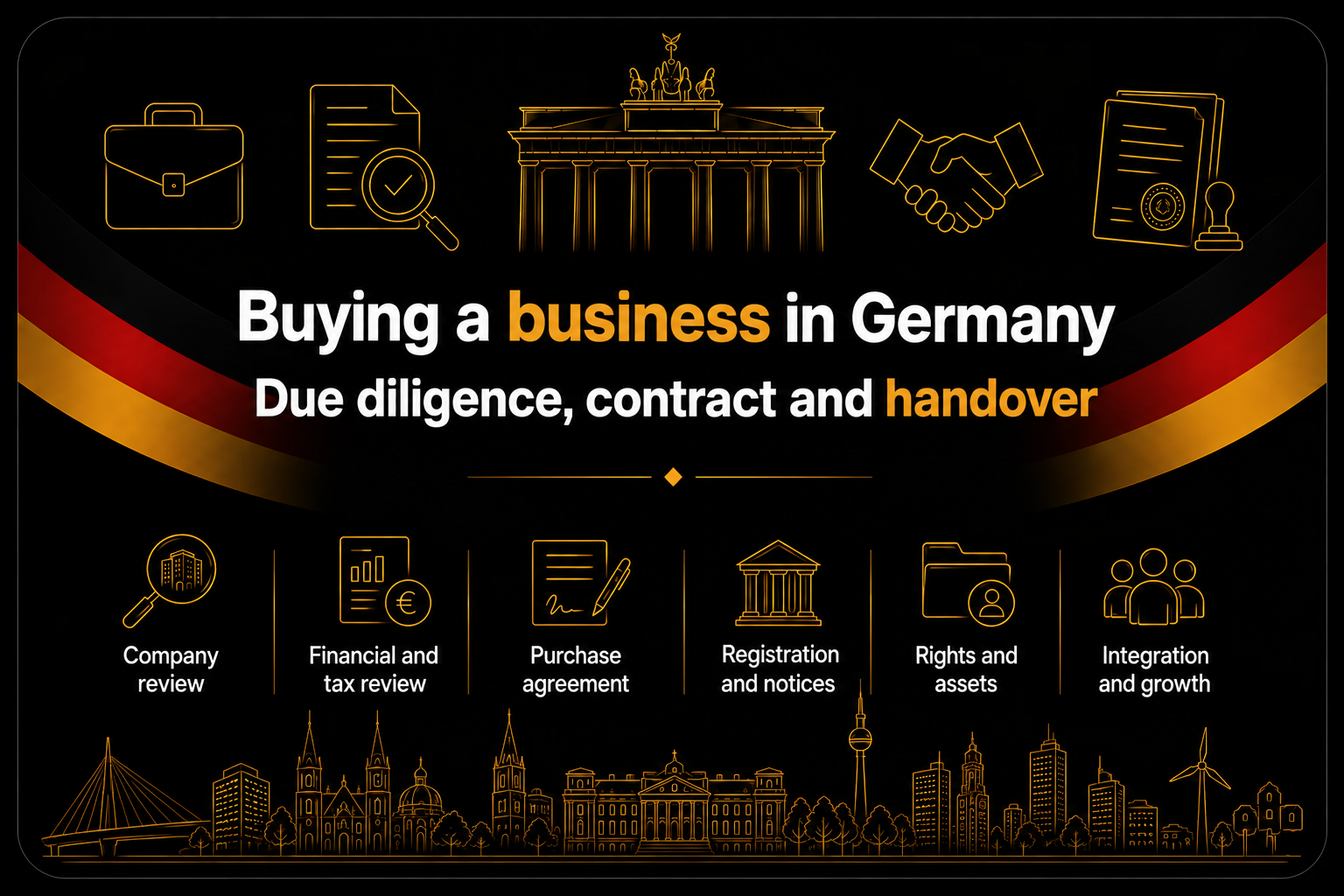
When buying a business in Germany, distinguish early between a share deal and an asset deal. The structure affects taxation, liability, contracts, permits and employment relationships.
In a share deal, the buyer acquires shares, for example in a GmbH or UG. The company remains the legal holder of its assets, contracts and obligations. The buyer’s control depends on the acquired stake and the company’s articles.
An asset deal transfers specified assets and, where agreed and legally possible, contracts, such as equipment, brands or business assets. The seller’s legal entity is not acquired. Review contract assignments, customer-data protection, statutory liability and any business transfer as well as the list of assets.
Acquiring and transferring GmbH or UG shares requires compliance with statutory notarial formalities (§15 GmbHG).
Required register applications and shareholder lists are filed with theHandelsregister as required. Processing time depends on the filing and the register court.
- Share deal or asset deal: the differences
- Where to find businesses for sale in Germany
- Due diligence before buying a business in Germany
- Checking a company through the commercial register
- Negotiations and letter of intent (LOI)
- The notary’s role in a German business acquisition
- Completion, shareholder list and register filings
- Business acquisition costs: the main items
- Company name and sector-specific permits
- Employees in a business acquisition: section 613a BGB
- Business acquisitions and residence permits in Germany
- Common mistakes when buying a business in Germany
- FAQ
Share deal or asset deal: the differences
Agree the transaction structure early with legal and tax advisers. It shapes the review scope, contracts and tax consequences for both parties; negotiations may require adjustments.
| Feature | Share deal | Asset deal |
| What is acquired | Shares in the company; rights and obligations generally remain with the company | Specified assets; also check statutory transfer rules |
| Debts and tax risks | Remain with the company and affect the value of the acquired shares | Contractual selection is possible; statutory liability, particularly under sections 25 HGB and 75 AO, still needs checking |
| Permits and contracts | Legal entity stays the same; check change-of-control and licensing requirements | Check transferability, consent and licensing individually |
| Notary | Required for GmbH/UG shares under section 15 GmbHG | Depends on the assets; required, for example, for a real-estate purchase |
| Taxation | Taxation of gains depends on the seller, stake and transaction structure | Individual tax assessment; a transfer of a business as a whole may fall under section 1(1a) UStG |
| Potential advantages | Continuity of the legal entity and its relationships | Selection of specific assets; no complete exclusion of historical liabilities |
A share deal can make contractual continuity easier because the legal entity stays the same. Change-of-control clauses, licensing rules and seller warranties may still matter; it does not guarantee an exit free of liability.
An asset deal allows buyers to select specific assets. It does not automatically exclude historical risks: sections 25 HGB, 75 AO and 613a BGB can, in particular, create statutory liability or transfer obligations.
For residence based on entrepreneurial self-employment (§21 AufenthG), a share deal has no automatic priority. The viable business project, funding and the applicant’s actual entrepreneurial role are among the decisive factors. Buying shares alone does not confer residence rights.
Where to find businesses for sale in Germany
Business opportunities can be found through succession platforms, chambers, advisers and direct contacts. Any brokerage commission depends on the agreement. There is no universal commission percentage or automatic reduction in the purchase price.
| Platform | Focus | Costs for advertisers |
| Nexxt-Change (nexxt-change.org) | SME succession; platform involving KfW and the federal economic affairs ministry | Free of charge |
| DUB.de | A broad range of businesses, potentially including franchises | Check the provider’s current listing and service fees |
| Unternehmensborse.de | Business listings covering different legal structures | Check the provider’s terms |
| DIHK / IHK | Chamber succession listings and advice | Ask the relevant chamber about services and fees |
| M&A advisers | Medium-sized and larger businesses, including confidential transactions | Commission as individually agreed |
Nexxt-Change is a business succession platform involving KfW and the federal economic affairs ministry. The platform connects succession opportunities through regional partners. A transfer of operations to KfW is announced for autumn 2026; check the current migration and availability notices.
The local chamber of commerce or crafts chamber can also help with succession opportunities and advice. Services, access and confidentiality vary by region; not every offering is an exclusively private database. Ask the relevant chamber what is available.
Due diligence before buying a business in Germany
Due diligence is the structured review before committing to an acquisition. In a share deal, historical obligations and risks remain with the acquired company and affect the value of the shares. An asset deal also requires checks of encumbrances, statutory liability, contract transfers and permits. The scope and specialists should fit the transaction.
Due diligence typically covers four areas:
- Legal due diligence. Articles, corporate history, shareholder structure, powers of attorney, disputes, encumbrances and termination or change-of-control clauses.
- Financial due diligence. Accounts for several years, receivables and liabilities, liquidity, tax returns and reconciliations with the tax office.
- Tax due diligence. VAT, transfer pricing, previous tax audits, outstanding assessments and potential additional liabilities.
- Operational due diligence. Key customers and suppliers, dependence on specific people, IT infrastructure, operating permits and licences.
Due diligence identifies material risks and informs the price, completion conditions, warranties and indemnities. The seller’s acceptance and scope must be negotiated; a price reduction is not automatic (warranties & Indemnities).
Review costs depend on the business’s size, sector, available information and engagement. A €2,000–13,000 planning range is neither a general fee rule nor a quotation. Obtain a specific proposal and agree the material risks and review scope.
Checking a company through the commercial register
An initial check can be made through the public register portal (Handelsregister). Register extracts and filed documents provide information such as representation powers, changes to the articles and a GmbH’s shareholder list. Insolvency notices and the actual business position need additional checks.
Check these four areas in particular in the commercial register:
- the GmbH’s shareholder list and stakes; identify beneficial owners separately;
- management and representation powers; the managing director need not be the seller or a shareholder;
- indications of insolvency proceedings and the separate official insolvency notices;
- whether entries are current and plausible; an entry unchanged for a long time does not itself prove inactivity.
Also review the Transparenzregister , which records beneficial ownership. Reporting duties apply in particular to private-law legal entities and registered partnerships (§20 GwG).
Differences between the commercial and transparency registers need explanation. Legal shareholders and beneficial owners are not necessarily the same people, so a difference alone does not prove wrongdoing.
Negotiations and letter of intent (LOI)
A letter of intent (LOI) records the main negotiating points before detailed due diligence. The intention to purchase is often non-binding, while confidentiality, exclusivity, costs or other clauses may be binding. Obtain legal review of the wording and any formal requirements before signing.
An LOI may address:
- an indicative price or range and any conditions;
- the due diligence timetable and scope, suited to the available information and complexity;
- any exclusivity: clearly define its scope, duration and consequences of parallel negotiations;
- confidentiality: agree the scope, duration and exceptions to an NDA, preferably before disclosing sensitive information.
Detailed due diligence and negotiation of the purchase agreement commonly follow the initial terms. Agree the language, translations and notarial arrangements early. A German-language contract is common, but every party’s adequate understanding and compliance with formal requirements are essential.
The notary’s role in a German business acquisition
Observe the notarial form requirements when acquiring and transferring GmbH or UG shares (§15 GmbHG). The statutory form and any required consents must be observed; defects can make the transaction invalid.
The notary’s role may include:
- prepares or notarises the share purchase and assignment agreement;
- checks identity, representation powers and the corporate requirements relevant to notarisation;
- arranges required register applications and submission of the updated shareholder list;
- holds funds in a notarial escrow account only where the statutory conditions are met.
Notarial fees follow statutory fee rules and the relevant transaction value; share capital alone is insufficient to calculate them. The table below gives rough planning figures, not a binding tariff. Ask for a calculation for the actual transaction in advance.
| Cost estimate | Context |
| €150–500 solely as a rough planning figure | A straightforward matter; this range is not an entitlement |
| €500–1,500 as a non-binding planning range | A moderately complex notarial scope; a specific fee calculation is required |
| €1,500 or more as a non-binding planning estimate | Larger or more complex transactions |
| Additional register fees depend on the filing | Depends on the type and number of register filings |
The notary acts independently and impartially for the parties and explains the deed’s legal implications. This does not replace the buyer’s own legal representation or a comprehensive commercial and tax review.
Completion, shareholder list and register filings
For GmbH shares, transfer depends on a valid assignment and agreed conditions, such as payment; a constitutive commercial-register entry is not universally required. The shareholder list has a separate role: the listed person is generally recognised as shareholder in relation to the company under section 16 GmbHG. Submit the updated list after the change takes effect under section 40 GmbHG. Other changes, such as amendments to the articles, can have their own registration requirements.
Coordinate these steps in particular for completion:
- Required applications and documents are submitted to the competent register court; the shareholder list must also be addressed.
- The register court processes the required filings and receives the documents to be filed. This is distinct from the contractual transfer of shares.
- Registration time depends on the filing and court; two to four weeks is not a guaranteed deadline.
- Coordinate required notifications to the bank, tax office and chamber according to the actual change and applicable deadlines; not every duty waits for a register entry.
- The provision on business transfers (§613a BGB) can trigger the statutory transfer of the affected employment relationships. Notification duties, objection rights and potential liability need separate assessment.
Changes in beneficial ownership must be reported in the Transparenzregister without undue delay where a duty arises under the Money Laundering Act; there is no general two-week deadline (§20 GwG). Breaches can attract fines; the applicable range depends on the infringement and statutory conditions.
Business acquisition costs: the main items
Add due diligence, advice, financing and completion costs to the price. These can be substantial, particularly in smaller transactions. The figures below are non-binding planning examples; assess statutory fees, actual quotations and sufficient working capital separately.
| Cost item | Amount | Note |
| Business purchase price | Individually assessed from the business’s value and risks | Depends on sector, earnings, assets and risks |
| Notary | Obtain a calculation based on transaction value and statutory fees | Based on the relevant transaction value, not share capital alone |
| Court and registration fees | Depends on the specific register filing | For the required register filing |
| Legal advice: contract and due diligence | €1,500–10,000 as a non-binding planning range | Depends on scope and complexity |
| Tax adviser | €500–3,000 as a non-binding planning range | Budget for qualified advice appropriate to the scope and risks |
| Document translation | €200–800 as a non-binding planning range | If the buyer’s German is insufficient |
| Broker, if engaged | According to the agreed commission | Only where agreed with a broker |
A blanket €15,000–20,000 threshold is not a reliable benchmark. Assess the full budget, including liquidity, risks and transaction costs; additional costs can be substantial in smaller acquisitions.
Financing requires an individual credit and project assessment; a universal 20–30 per cent equity requirement does not apply to every product. KfW lists options including StartGeld (067), ERP-Förderkredit Gründung und Nachfolge (077) and ERP-Förderkredit KMU (365/366). Check current eligibility and apply through the financing partner in good time before starting the project. Approval depends on the applicable conditions.
Company name and sector-specific permits
Buying GmbH shares generally leaves the registered company name in place. Nevertheless, check business-name, trademark and other naming rights, as well as contractual requirements. The Commercial Code defines a firm’s name (§17 HGB). Changing a GmbH’s registered name generally requires a notarised amendment to its articles and registration of that amendment.
Whether a permit remains valid depends on the legal entity, transaction structure and sector-specific rules. A share deal often leaves the permit holder unchanged, but notification, consent or personal suitability requirements can still apply. An asset deal requires separate assessment of new permits or transfers.
For a restaurant, licensing or notification requirements depend particularly on state law and the operating model. A medical practice requires separate checks of professional rules and, where relevant, statutory health-insurance accreditation. Commercial security services have specific licensing requirements (§34a GewO). Establish before committing which permits remain valid, need amendment or require a new application.
Employees in a business acquisition: section 613a BGB
A pure share deal generally leaves the employer unchanged; the company continues employing its staff. In an asset deal, assess whether a business or part of one transfers. The provision on business transfers (§613a BGB) can transfer existing employment relationships to the acquirer where a business transfer occurs. Dismissal solely because of the transfer is invalid; other lawful grounds remain possible. Employees can generally object in writing within one month of proper notification. The consequences, including possible risks with the former employer, require individual assessment.
For a business transfer, the former employer or new operator must notify affected employees before the transfer in text form of its timing, reason, legal, economic and social consequences, and planned measures. Observe the statutory objection right and the importance of proper notification. Separately assess and fulfil any works council or economic committee participation rights in good time.
Business acquisitions and residence permits in Germany
Acquiring an operating business may form part of a project for a self-employment residence permit. The statutory conditions must be met independently of the purchase (§21 AufenthG).
The immigration authority (Ausländerbehörde) assesses the actual business activity, viability, development plan, financing and secure livelihood, among other factors. A company existing only on paper is insufficient. Read more about business immigration to Germany.
Common mistakes when buying a business in Germany
Unresolved formalities can undermine an otherwise commercially sound acquisition. The following five mistakes highlight issues to address before making a binding commitment.
- Buying without appropriate due diligence. Undiscovered debts or tax risks may become apparent only after completion.
- An unsuitable transaction structure. A share deal may involve underestimated historical liabilities within the company. An asset deal does not automatically protect against statutory liability or problems with non-transferable permits and contracts.
- An excessive purchase price. Valuing a business solely from exceptionally successful past years can overstate sustainable earnings. An independent valuation should also consider investment needs, risks, customer retention and prospects.
- Dependence on the previous owner. In smaller businesses, customer relationships often depend on the former owner personally. Assess their continuity and arrange an orderly handover where appropriate.
- Overlooking transparency-register duties. The entities subject to reporting duties must report changes in beneficial ownership without undue delay. A change of managing director is not necessarily a change of beneficial owner. Incorrect, incomplete or late reports can attract fines.
Timing depends on documents, financing, approvals, negotiations and completion conditions. Several months may be needed; there is no general two-to-four-month deadline. Review change-of-control clauses, permits and insurance before completion, and arrange the required notifications to authorities, registers, banks and chambers within the applicable deadlines.
RelocationDE: how we can help
A business acquisition needs coordinated legal, financial and, where relevant, immigration assessment. Omissions can create unexpected obligations or undermine the residence project. Have qualified legal and tax advisers assess the specific decision.
RelocationDE coordinates the practical preparation across these areas, involving qualified legal and tax advisers as needed. Read more on our page about business immigration to Germany.
- Finding and initially assessing opportunities: checking relevant register documents and the ownership structure before detailed negotiations.
- Coordinating due diligence with suitably qualified German legal, tax and business specialists.
- Practical support for the notarial process: coordinating documents, liaising with the notary and tracking required follow-up steps.
- Coordinating required translations by appropriately authorised or sworn translators.
- Residence planning: we help prepare the documents for the immigration authority under §21 AufenthG, including the business plan and funding evidence.
Send us an enquiry and we will discuss your project and the next steps.
FAQ
Not speaking German does not generally prevent an acquisition. The notary must ensure adequate understanding, involving a suitable interpreter where required. Agree translation and language arrangements in advance. You also need a reliable way to communicate when managing the business, dealing with staff, contracts and authorities.
There is no universal minimum price for a viable business acquisition. Budget for the purchase price, financing, working capital, due diligence, notarial services, advice and registration together. A low advertised price says little about debts, investment needs or viability.
Buying a business does not itself confer residence rights. A genuinely operating business may form part of a section 21 application. A viable project, funding, an entrepreneurial role and a secure livelihood are particularly relevant. A company existing only on paper is insufficient; the authority decides each case.
Searching, negotiating and parts of due diligence can often be done remotely. Appropriate representation may be possible for the notarial transaction. Agree in advance with the German notary on the form and scope of the authority, identity evidence and any apostille or legalisation for foreign documents. Fully online share acquisitions cannot be promised universally.