
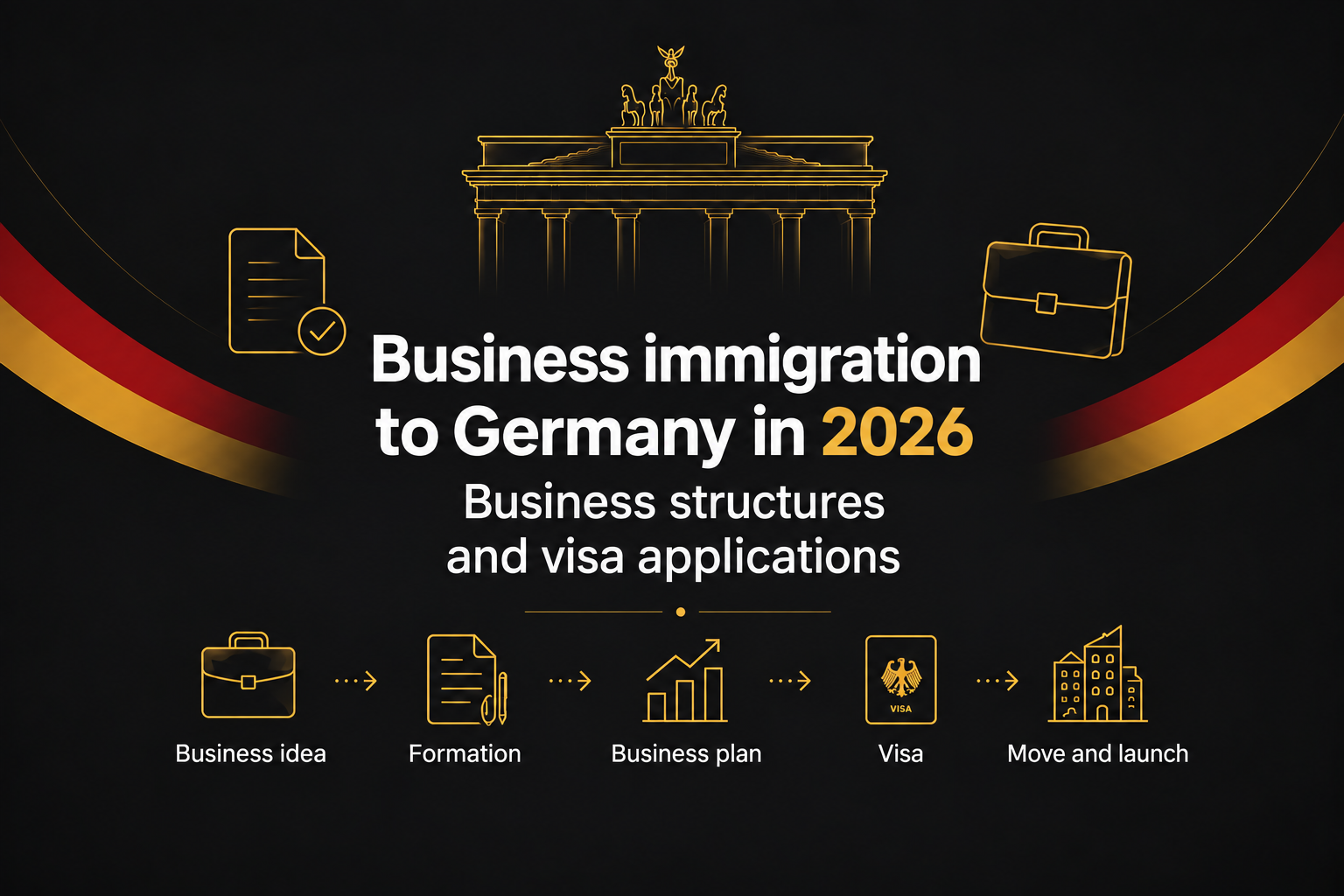
Forming or acquiring a business can form part of a section 21 application, but does not itself grant residence rights. Foreign nationals can generally form or acquire shares in German corporations without holding a German residence permit. Actually working and residing in Germany requires the relevant permissions separately. Available corporate structures include:
- GmbH: €25,000 share capital; liability generally rests with the company’s assets;
- UG (haftungsbeschränkt): share capital from €1, with special payment and reserve requirements;
- AG: at least €50,000 share capital; liability generally rests with the company’s assets.
The immigration authority assesses the statutory conditions and the project’s viability; registration alone is insufficient. Preparation, funding, approvals and appointments affect timing. A general six-to-twelve-month estimate is not a reliable promise.
An avoidable formation mistake when planning residence: incurring costs before checking immigration eligibility and viability. A commercial-register entry does not replace a convincing section 21 application. Assess funding and entry planning before making binding commitments. Official information: Make it in Germany: self-employment, BAMF: self-employment. We explain the business structures available and how company formation fits with immigration requirements, using typical preparation steps.
Contents
- Business structures and residence planning
- Visa for self-employment: requirements and assessment
- Business plan: structure and requirements
- Self-employment residence permit and national visa
- Planning formation and immigration costs
- Business taxes: an overview
- When another residence route may fit better
- FIRMDER: how we help
- FAQ
Business structures for formation planning
The legal structure affects liability, taxes, capital needs and organisation. A GmbH, UG or AG generally answers with all its assets, not merely up to the amount of share capital. Personal liability can arise, for example, from breaches of duty, guarantees or actions during formation.
| Legal structure | Minimum capital | Liability | Taxes | Suitable for |
| GmbH | €25,000 share capital; a cash formation generally requires at least €12,500 paid before filing, subject to the other payment rules | Generally company assets; personal liability is possible in specific circumstances | In 2026: 15 per cent corporate income tax plus solidarity surcharge and municipal trade tax | Projects with shareholders and a need for a corporate structure |
| UG | From €1; sufficient liquidity for formation and operation is still required | Generally company assets, as with a GmbH | Taxation generally as for a GmbH; a statutory reserve of 25 per cent of annual surplus after deducting loss carryforwards until the statutory transition conditions are met | Smaller start-ups with adequate funding |
| AG | €50,000 share capital; observe section 36a AktG payment rules, including full payment of any share premium | Generally liable with all company assets | In 2026, generally 15 per cent corporate income tax plus solidarity surcharge and municipal trade tax | Larger projects and equity financing; a management board and supervisory board are required, but not every AG is listed |
Commercial or freelance sole trading requires the appropriate immigration permission. Freelance professional status depends on the statutory activity criteria and, where applicable, professional licensing. This structure may suit someone working independently, but generally involves personal liability.
FIRMDER supports the practical preparation of your project. Depending on the agreed scope, this can include:
- practical support for a suitable business formation;
- searching for suitable business premises;
- preparing to relocate an existing business to Germany;
- recruitment support;
- organisational and administrative services within the legally permitted scope;
- help finding an actively involved managing director where agreed and legally permissible;
- support preparing a business-account application.
Read more about our support on the page about business immigration to Germany.
Visa for self-employment: requirements and assessment
Where a visa is required, planned long-term self-employment needs the appropriate national D visa. The German mission decides on the visa and involves the immigration authority under the applicable rules. After arrival, apply for the residence permit in good time. The procedures are connected, although a visa and residence permit are different titles.
Among the points the immigration authority assesses:
- Economic interest or regional demand: expected positive economic effects, such as employment or innovation, within the overall assessment.
- Business-plan viability: an identifiable market, specific customer groups and substantiated financial assumptions.
- Applicant’s experience: documented skills, experience and qualifications to implement the actual project.
- Financing: traceable origin and availability of funds for investment and living costs.
- Genuine business activity: the business must actually operate; a company existing only on paper does not demonstrate viable self-employment.
Appointments, visa assessment and residence-permit processing follow different procedures. Completeness, official workloads and the business model affect timing. Build in time reserves; generic week or month estimates do not replace checking the actual procedure.
Important: A visa does not remove the need to meet the conditions for the subsequent residence permit. FIRMDER coordinates preparation across both stages; approval cannot be promised.
Business plan for the immigration authority: structure and evidence
The business plan should demonstrate viability, demand, funding and the applicant’s capability with evidence. General promotional statements do not replace that evidence.
| Section | Required information | Common mistake |
| Business activity | Product or service, target customers and a reasoned choice of location | A vague activity description without a concrete offering |
| Market analysis | Market size, competition, specific demand and traceable data sources | Claims without reliable supporting evidence |
| Financial forecast | Monthly revenue, expenses and liquidity in the first year, with a substantiated break-even calculation. | Optimistic figures without a substantiated basis |
| Customer acquisition | Specific channels, expressions of interest, partnerships and marketing measures | A single social-media channel without an acquisition plan |
| Financing | Own funds or a loan commitment, potentially equity investment; substantiated liquidity until the business is viable | A funding gap before the business becomes profitable |
| Applicant’s experience | CV and a clear connection to the proposed business | An unexplained change of industry |
| Risks | Key risks and preparation | No assessment of risks |
Existing clients, credible contracts and documented expressions of interest can support demand. Assess them alongside market analysis, financing and implementation plans; no single document guarantees approval.
There is no universal statutory ten-to-twenty-page requirement. Length and attachments should clearly demonstrate viability and meet the responsible authority’s requirements. FIRMDER helps organise and prepare the material; the official outcome remains undecided.
Self-employment residence permit versus business-visit visa
Visa-required applicants planning longer-term self-employment generally need the appropriate national visa followed by a residence permit. A Schengen business-visit visa is different and does not automatically authorise operating a business locally.
A section 21 permit is initially limited to no more than three years. Renewal involves reassessing the applicable conditions, such as actual business activity, funding and livelihood. Duration and the decision depend on the case.
For entrepreneurial activity, section 21(4) can allow settlement after three years if the business has been successfully implemented and livelihood is secure. Subsection 5 excludes freelancers from this special rule; the general section 9 route, normally requiring five years and further conditions, may instead apply. Neither timeframe automatically grants permanent residence.
Business immigration costs: items to budget for
The table lists first-year cost items for a GmbH formation. Figures are non-binding planning examples, not quotations. Scope, location and fees can differ; personal living costs are additional.
| Expense | Amount in euros | Note |
| GmbH formation: notary and register fees | 1 500-3 000 | Excluding share capital |
| GmbH share capital | 12,500 before register filing in a standard cash formation | Part of the share capital, not a fee; available for legitimate company purposes subject to capital-maintenance rules |
| National visa through the German mission | ~75 | Standard adult national-visa fee; check exemptions |
| Residence-permit issuance by the immigration authority | 100 | Check the cost of the required digital photograph separately |
| Annual business-address costs | 500-1 500 | If a dedicated office is unnecessary |
| Annual tax-advice costs | 1 500-5 000 | Budget for tax advice early |
| Annual accounting-software costs | 200-600 | Lexoffice, Fastbill, Datev Online |
| Annual business liability insurance | from 200, depending on the tariff | Depends on activity and risks |
| Annual business-account costs | 0-600 | Compare current providers, eligibility and fees; do not assume a free account |
Clarify tax obligations before trading: accounting, returns, advance payments and VAT. Professional support can reduce errors; scope and fees depend on the business. Read more about business insurance under insurance in Germany.
Business taxes in Germany
Applicable taxes depend on legal structure, activity and income. This overview does not replace an individual calculation by a qualified tax adviser.
- Einkommensteuer (personal income tax): applies, for example, to profits from commercial or freelance sole trading. Rates are progressive, with marginal rates up to 45 per cent above the tax-free allowance. The highest marginal rate is not applied uniformly to the entire profit.
- Körperschaftsteuer (corporate income tax): generally 15 per cent in 2026, plus a solidarity surcharge of 5.5 per cent of that tax, giving 15.825 per cent before trade tax.
- Gewerbesteuer (trade tax): generally applies to commercial businesses. The assessed tax base is multiplied by the municipal rate. Individuals and partnerships generally have a €24,500 allowance; corporations do not. Pure freelance professional activity by individuals is generally outside trade tax.
- Umsatzsteuer (VAT): generally 19 per cent, with 7 per cent or an exemption for specified transactions. Since 2025, the small-business exemption under section 19 UStG generally requires previous-year turnover of no more than €25,000 and current-year turnover of no more than €100,000; the applicable start-up-year limit is €25,000. Check the other conditions and the consequences of exceeding a limit.
The small-business exemption can simplify VAT administration. Input VAT on purchases used for exempt small-business transactions is generally not deductible. Opting out may make sense where investment is substantial; assess the binding period and other consequences with a tax adviser.
When another residence route may fit better
Where an eligible German employment offer exists, an employment residence permit or an EU Blue Card may be an option. Compare the actual conditions and risks rather than assuming one route is always faster or more reliable.
Explain why the business is to operate from Germany and what economic effects are expected. International or digital client relationships are not automatically excluded; they need to fit the business model and applicable residence basis.
Demonstrate the ability to implement the project through experience, training, previous results or a qualified team. Changing industries is not automatically excluded, but requires a credible explanation and realistic preparation.
An employment route may be an alternative depending on the applicant’s profile. Subsequent self-employment must be permitted by the residence title; a settlement permit is not always necessary. A change of status or additional permission may need to be obtained first.
How FIRMDER supports your business formation and move
Formation, financing and immigration procedures need to be coordinated. Uncoordinated commitments can create unnecessary costs. FIRMDER supports preparation as one connected project:
- Choose the legal structure by considering liability, tax, financing, the business model and the applicant’s immigration role together.
- Business plan: organise the structure, credible assumptions and evidence for the official assessment.
- Coordinate the required qualified translations in the appropriate format.
- Visa and residence permit: organise documents, track deadlines and coordinate responses to enquiries.
- After arrival: practical support with address registration, banking, insurance and tax arrangements.
Starting a business in Germany requires coordination of company law, tax and immigration requirements. FIRMDER supports practical preparation from choosing a suitable structure to the steps after arrival.
Legal framework: residence for self-employment under §21 AufenthG (self-employment). An intra-corporate transfer has a separate potential residence route: §19 AufenthG. An EU Blue Card may be available for qualifying employment: §18g AufenthG. Employing staff in Germany involves separate rules: §18a AufenthG. Family reunification is governed by the relevant provisions: §29 AufenthG.
First steps after the residence title is issued:
- Choose a business account suitable for the legal structure, residence situation and activity. Clarify identification, capital evidence, fees and eligibility in advance. Keep personal and business payments clearly separated. Do not rely on outdated provider lists, particularly Penta as a standalone option for new accounts.
- Starting the activity generally needs to be reported for tax purposes within one month; the tax-registration questionnaire is normally submitted electronically. The Finanzamt issues the tax number after processing, not necessarily within that deadline.
- Establish VAT status: domestic small businesses generally face limits of €25,000 previous-year turnover and €100,000 current-year turnover; the start-up-year limit is €25,000. Check eligibility, the effect of exceeding a limit and any opt-out before invoicing.
- Arrange tax support early. Deadlines, accounting and advance payments must fit the business. Errors can lead to additional tax, surcharges or other consequences; suitable advice helps with preparation.
FIRMDER coordinates the business model, documents and immigration route early, helping identify avoidable inconsistencies before binding costs arise. Discuss your project with us: send us an enquiry and we will discuss the next steps.
FAQ
Formation from abroad may be possible through an appropriate power of attorney or an eligible online notarial procedure. Identity checks, document formalities, registration and account opening need separate assessment. No provider guarantees every overseas founder an account without personal participation. Penta is no longer a current standalone account recommendation.
There is no general obligation to appoint a tax adviser on day one. Tax and accounting duties still apply. Early qualified advice is particularly useful for corporations and cross-border situations; agree the fees and scope.
Family reunification may be possible where the conditions are met. Spouses and children need their own applications and evidence. Spouses joining section 21 permit holders generally benefit from the statutory A1 exemption; the other conditions still need checking.
Check the reasons and legal-remedy instructions immediately. Whether an administrative objection or court action is available, and the deadline, depends on the decision. Visa remonstration was abolished worldwide on 1 July 2025. A new application does not replace a timely legal challenge. Obtain a lawyer’s assessment of the next steps.
A business acquisition may qualify for consideration under section 21. Viability, funding, the applicant’s role and statutory conditions matter. Buying the business alone does not create residence rights.
There is no single turnover or profit figure for every case. The permit conditions, viability and secure livelihood including necessary insurance are decisive. Household size and actual costs affect the assessment.
Freelance professional status is a tax classification of certain self-employed activities, not a separate legal form. Eligibility depends on the actual activity and its tax assessment. A sole trader can carry on freelance or commercial activity. Pure freelance professional activity generally requires no trade registration and incurs no trade tax; commercial activities follow different rules.