Current as of 4 October 2026
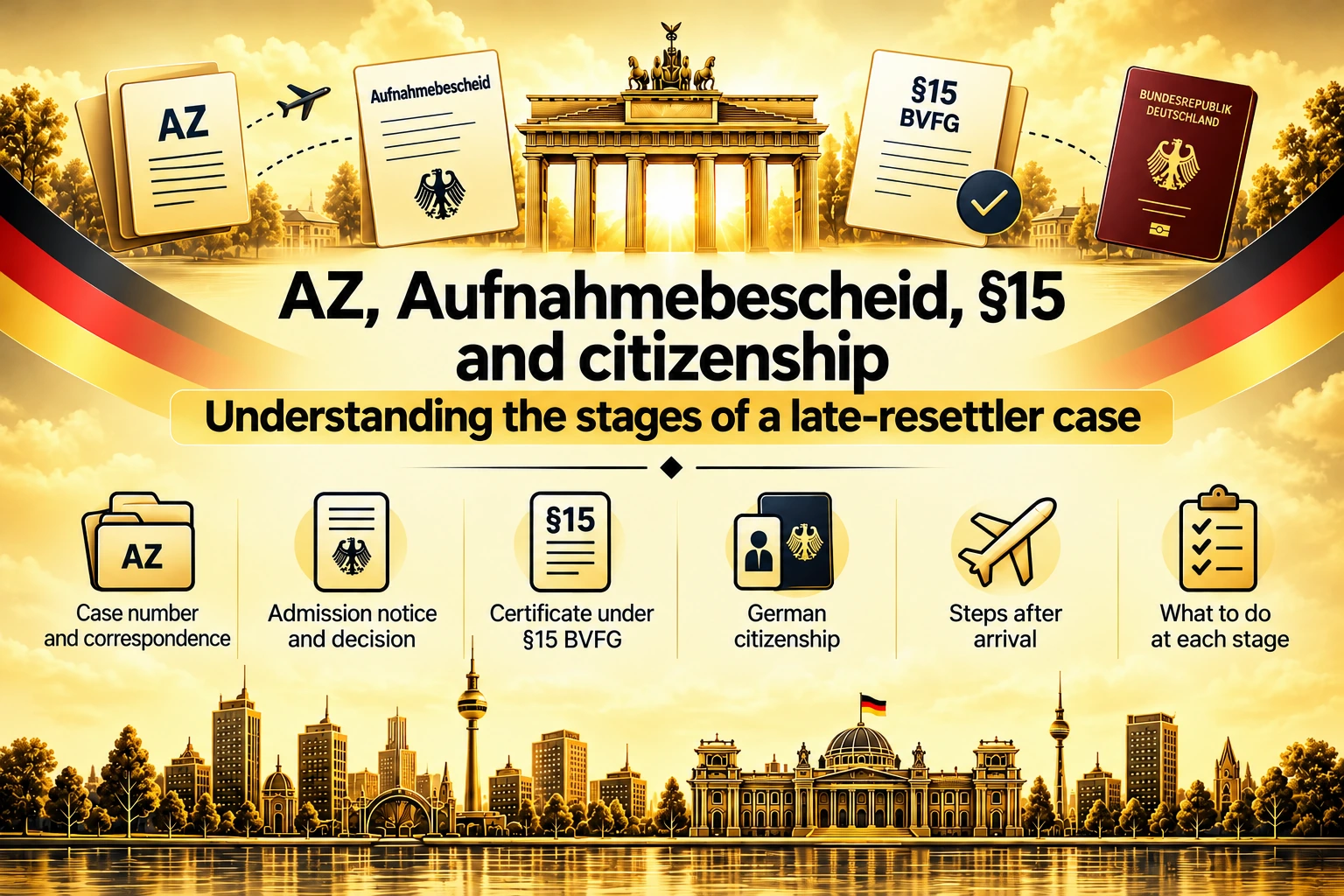
Short answer. AZ (Aktenzeichen) is the case reference. The Aufnahmebescheid records the admission decision in the ethnic German resettlement procedure. A certificate under section 15 BVFG confirms the relevant status after admission in Germany. Citizenship under this route is acquired when that certificate is issued—the law uses the term Ausstellung. Neither a case reference, address registration nor completing registration at Friedland replaces this legal event. A passport is issued separately. Legal bases: §26 BVFG, §27 BVFG, §15 BVFG, §7 StAG.
If you receive a letter from the Federal Office of Administration (BVA), first establish what it confirms and what action is required. The same AZ may appear on an acknowledgement, a document request and a decision. The stage is determined by the letter’s content, not by the presence of a number.
This guide concerns documents in a case that has already started. Eligibility, ancestry and preparing an application are covered in our general guide to ethnic German resettlement.
- Table of stages and documents
- AZ: the case reference for correspondence
- Aufnahmebescheid: the admission decision
- Why family members may have different documents
- Friedland and address registration: what they establish
- The section 15 BVFG certificate and when citizenship is acquired
- Typical situations
- Preparing for a review of a BVA letter
- Frequently asked questions
- Help with a specific letter
Table of stages and documents
| What you have | What it means | Next step |
| Proof of delivery of the application | The shipment was delivered to the specified address | Keep the proof and separately check whether the authority has replied |
| Acknowledgement of receipt with an AZ | The application has been assigned a correspondence reference; read the entire response | Check personal details, address and instructions in the letter |
| BVA request for documents or explanations | The specified information is needed to continue the assessment | Record each requested item, the deadline and required form of response |
| Admission decision | An admission decision under the BVFG has been made | Check the addressee, conditions and documents for each family member moving |
| Decision including a relative (Einbeziehungsbescheid) | The named person has been included in the principal applicant’s admission notice | Before planning a joint departure, verify who was included and on what basis |
| Registration certificate and allocation documents | The relevant registration steps in Germany have been completed | Follow the instructions on residence and further processing |
| Address registration certificate after Anmeldung | Registration at the place of residence has been confirmed | Send proof to the BVA if required by the procedure and check further instructions |
| Certificate under section 15(1) or 15(2) BVFG | The BVA has issued a certificate confirming the relevant status | Check the details and issue date; clarify the documents needed for an identity card or passport |
| German identity card or passport | A German identity document has been issued | Check the details and validity period |
This sequence reflects the usual route, not a mandatory set of separate letters in every case. Admission and post-entry steps are described by the federal services portal. The distinction between the certificate and citizenship is set out in §15 BVFG and §7 StAG.
AZ: the case reference for correspondence
Aktenzeichen is usually abbreviated to AZ or Az. It is the identifier the authority uses to assign correspondence and documents to your case. For example, the German Embassy in Ukraine’s official information on subsequent inclusion of relatives explains that the BVA sends an acknowledgement with an AZ after receiving the application, and that the number must be quoted in further correspondence. This describes a specific procedure, not a uniform deadline for assigning references to all applicants. Source: Federal Foreign Office.
Receiving an AZ does not itself confirm:
- compliance with all programme conditions;
- sufficient evidence of ancestry and language skills;
- inclusion of a spouse or children;
- a positive outcome or a specific decision date.
If the letter only acknowledges receipt of the application, treat it as just that. If it asks for documents alongside the AZ, the current task is to answer that request. If it communicates a refusal, the same case reference does not change the substance of the decision.
What to check: the correct name and address, who is named as applicant, who receives correspondence, which attachments are listed and whether a reply is required. Keep the complete letter, including its reverse and attachments. Do not try to calculate queue position or an approval date from the digits of the reference.
Aufnahmebescheid: the admission decision
An Aufnahmebescheid is often called an AB. Its legal basis is sections 26–27 BVFG: it is issued in the admission procedure for people intending to resettle and live permanently in Germany. Normally, the application is assessed while the applicant lives in the area of origin; the law separately provides an exception for special hardship. §26 BVFG, §27 Abs.1 BVFG.
In practical terms, an AB means the admission application has resulted in a positive decision for the named person. The move must then be arranged under the applicable procedure. The federal portal describes the visa application, entry, processing at Friedland and allocation. The admission notice itself is neither a visa nor a German passport. Federal services portal.
Before buying tickets, check:
- Who is named in the admission notice, and do the details match current documents?
- Which relatives have actually been included in the decision, and for whom has only an application been submitted?
- Are there separate conditions, attachments or subsequent BVA letters?
- Have marital status, family composition, address or documents changed since the application?
- What visa and entry steps are required for each person moving?
For the standard route under section 4(1) BVFG, permanent residence in Germany must also be established within six months of leaving the area of origin. These six months are not the Aufnahmebescheid’s ‘expiry period’ and do not run from assignment of the case reference. §4 Abs.1 BVFG.
Read an older positive decision together with subsequent correspondence. If family circumstances have changed, do not assume the previous conditions automatically remain valid: section 27 BVFG expressly identifies circumstances in which a relative’s inclusion becomes ineffective. §27 Abs.2 BVFG.
Why family members may have different documents
People commonly refer to a ‘principal applicant under section 4’ and a ‘family member under section 7’. When reading a letter, clarify which law the section belongs to and what decision has been made for the particular person.
- §4 BVFG defines who qualifies as a Spätaussiedler. It is the basis for the resettler’s own status. Statutory text.
- section 7 BVFG governs integration and the application of certain provisions to spouses and descendants. The conditions for inclusion in an admission notice are in §27 BVFG. section 7 BVFG, §27 BVFG.
- §7 StAG belongs to the Nationality Act and sets the moment citizenship is acquired through issuance of the section 15 BVFG certificate. Statutory text.
A shared surname, joint application form or plans to travel together do not replace an inclusion decision. Check the list of people and each person’s documents. The law sets conditions for spouses and descendants, including marriage duration and language requirements, as well as special cases. Individual assessment matters, not merely calling it a ‘family case’. §27 Abs.2 BVFG.
Not every relative arriving with an ethnic German resettler automatically acquires citizenship under section 7 StAG. This route depends on inclusion in the admission notice and issuance of the statutory certificate. If a family member enters on another basis, their legal position must be assessed separately. §7 StAG.
Friedland and address registration: what they establish
The procedure includes registration and allocation after entry. Friedland is the initial processing location, not the name of a citizenship document. The Registrierschein records participation in the relevant registration procedure. The family then moves to the allocated location; Anmeldung means registering the residential address. Federal portal on admission, BAMF: information for ethnic German resettlers.
The address registration certificate matters for subsequent processing: the federal services portal states that the BVA issues the status certificate after receiving proof of registration at the new residence. The address registration date itself, however, is not the date citizenship is acquired under section 7 of the Nationality Act. Procedure, time of citizenship acquisition.
If you have completed registration at Friedland and registered your address but do not yet have the certificate, check whether proof of registration was sent, whether the postal address is correct and whether any BVA requests remain outstanding. Do not infer citizenship solely from being in Germany or the absence of a letter in your mailbox: establish whether the certificate has been issued and when.
The section 15 BVFG certificate and when citizenship is acquired
Section 15 provides for two main types of certificate:
- Abs.1: The BVA issues a certificate confirming the person’s status as a Spätaussiedler.
- Abs.2: An included spouse or descendant receives a certificate confirming status under Article 116(1) of the Basic Law and entitlement to the relevant measures under section 7(2) BVFG.
These are different legal bases for certificates issued to different family members. §15 Abs.1–2 BVFG.
Under §7 StAG ethnic German resettlers and included family members acquire German citizenship upon issuance of the certificate under section 15(1) or 15(2) BVFG. Do not confuse the certificate’s issue date with its postal delivery, address registration, entry into Germany or passport issuance. §7 StAG.
The law also distinguishes between being German within the meaning of Article 116(1) of the Basic Law and acquiring citizenship under the Nationality Act. The phrase ‘admitted as an ethnic German resettler’ therefore cannot be converted into an exact citizenship date without examining the document. §4 Abs.3 BVFG, §7 StAG.
When the certificate arrives, check the name, date of birth, legal basis and issue date. Then ask the local identity card and passport authority which documents are needed for a Personalausweis or Reisepass. Keep the certificate separately from the passport: it proves the basis of your status, while the passport is issued through a separate administrative procedure.
Typical situations
All examples below are fictional and are intended solely to explain the documents.
Receiving an AZ and assuming the case is approved
A family receives an acknowledgement with a reference and starts planning departure. The letter contains no admission decision. The next step is to keep the reference and check for requests or further instructions. Approval cannot be inferred from assignment of the AZ alone.
Only the principal applicant has an Aufnahmebescheid
The applicant has received an AB, but the spouse appears only in an earlier application form. The next step is to establish the outcome of the spouse’s inclusion request and locate the document confirming it. Until then, do not treat the family composition as approved. Inclusion conditions are governed by §27 BVFG.
The family is waiting for certificates after Friedland
Address registration is complete, but the certificates have not yet arrived. Check that the registration certificate was sent and review correspondence, then ask the BVA about issuance if necessary, quoting the AZ. Not having the paper letter in hand does not itself establish whether issuance has already taken place. Issuance procedure, §7 StAG.
The certificate has been issued, but there is no passport yet
A person has a certificate under section 15(2) BVFG, but the passport appointment is later. If citizenship was acquired under section 7 StAG, its date does not move to the later date of passport production. Check the certificate and prepare the documents for the passport appointment. §7 StAG.
Family circumstances changed after the decision
For example, the spouses divorced before both left the area of origin. The previous decision cannot then be treated as unconditional proof of continuing inclusion: the law expressly provides for inclusion to become ineffective in the specified circumstances. Report the change and check its consequences before arranging the move. §27 Abs.2 BVFG.
Preparing for a review of a BVA letter
To understand the case stage, one complete letter with attachments is usually more useful than a verbal summary that ‘we were given a section’. For an initial review, prepare:
- the latest complete BVA letter, including its date and attachments;
- the admission notice and inclusion decisions, if already available;
- a list of participants identifying the principal applicant;
- a short chronology: application, requests, replies, decisions, entry and registration;
- details of changes to the address and family composition;
- after moving: registration, address registration and status certificates, if issued;
- your specific question: whether a reply is needed, inclusion is confirmed, something is missing or what comes next.
This list helps identify the stage; it is not a universal BVA document checklist. Check requirements for copies, translations and individual documents against the actual request and the current BVA instructions.
If the letter contains a response deadline, record it first. Do not delay individual legal assessment where there is a refusal, warning of an adverse decision or dispute over status. Do not calculate an appeal deadline from a general article: the document type, notification procedure and instructions on legal remedies in the specific decision matter.
Do not publish letters in open chats without anonymising them. Redact names, birth dates, addresses, case references, signatures, barcodes and QR codes; check attachments and file names too. For a complete individual review, send necessary information only through an agreed secure channel.
Frequently asked questions
No. The AZ identifies the case. The decision is determined by the document’s content. An acknowledgement of receipt and an admission notice have different meanings.
The number cannot reliably tell you the decision date. The federal portal states that processing time depends, among other things, on the applicant’s cooperation and language skills. This does not allow a timeframe to be promised for an individual case. Source.
Applicants usually use AB to mean Aufnahmebescheid. Check the full title and contents: an informal abbreviation does not replace the legal wording of the decision.
Not by itself. For this route, section 7 StAG links acquisition of citizenship to issuance of a certificate under section 15(1) or 15(2) BVFG. §7 StAG.
Check the name of the law. Section 7 BVFG and section 7 StAG govern different matters. Ask to see the complete legal reference and the document containing it.
Arrival or registration at Friedland is not the event specified in section 7 StAG for acquiring citizenship. For this route, issuance of the section 15 BVFG certificate is what matters. §7 StAG.
Anmeldung confirms registration of your address. Check separately whether the section 15 certificate has been issued and its date of issue. §7 StAG.
For acquisition under section 7 StAG, the decisive event is issuance of the relevant certificate, not production of the passport. If the date is uncertain, clarify it with the BVA using the document. §7 StAG.
Section 27(2) BVFG permits subsequent inclusion of a spouse or descendant who remained in the area of origin, provided the conditions are met. This needs separate assessment: the relationship or the principal applicant’s citizenship does not itself mean that the relative is already included and has acquired citizenship. §27 BVFG.
Help with a specific letter
If the BVA’s wording is unclear, you can request a review of your ethnic German resettlement documents. Start with the date and title of the letter, the people involved and your question. Agree on a secure way to transfer documents before sending complete copies.
The purpose of the review is to understand what the authority has decided, which questions remain open and what action is needed next. The competent authority determines the decision and processing time; the outcome cannot be guaranteed in advance.
This article is informational and does not replace an assessment of individual circumstances. If you already held German citizenship on another basis, this outline does not establish when you first acquired it.