
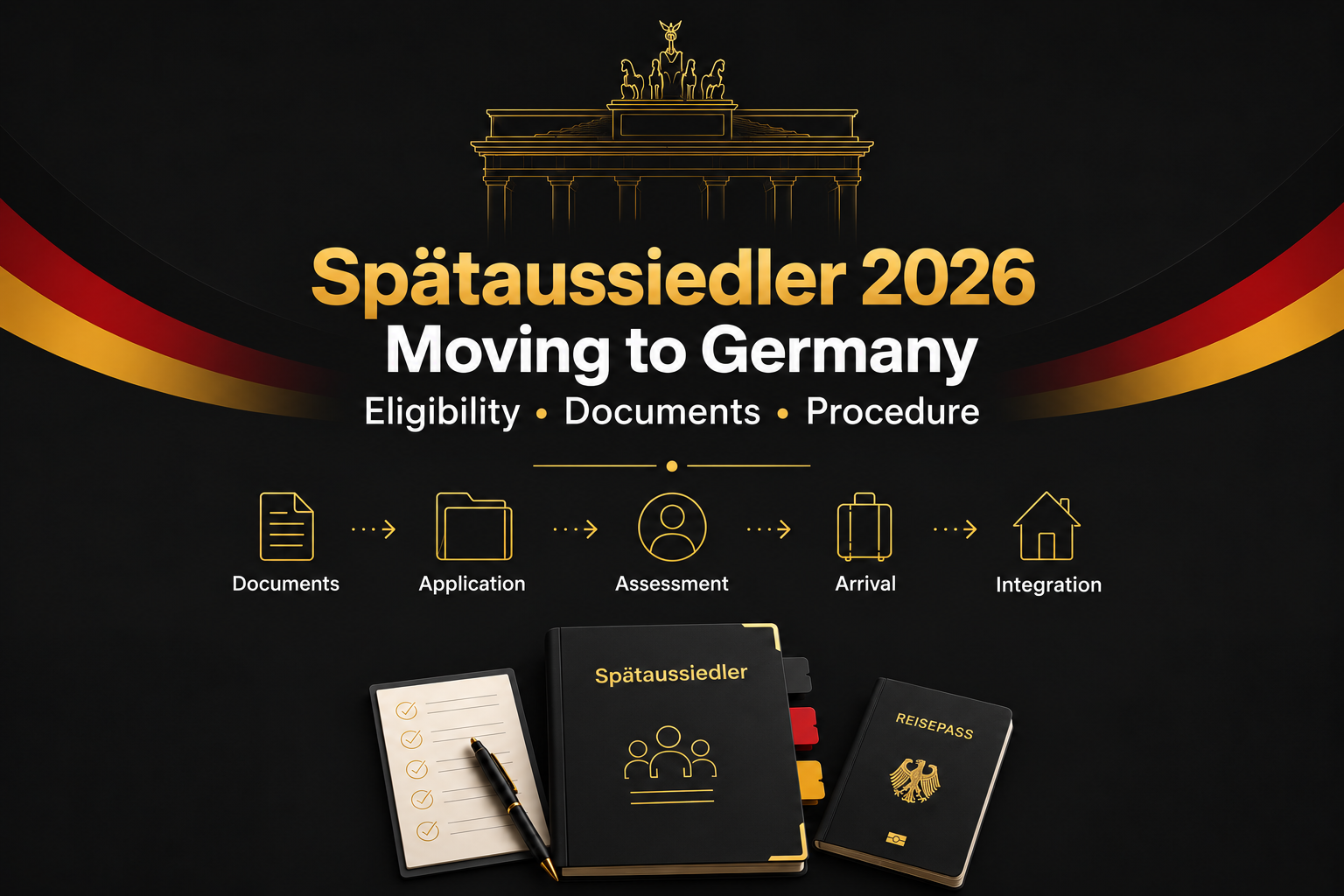
The Spätaussiedler procedure is a statutory admission route for people of German ethnic affiliation from designated areas of origin and certain family members. Section 4(1) covers the republics of the former Soviet Union; it does not categorically exclude the Baltic states. The legal framework is the Bundesvertriebenengesetz (BVFG, Federal Expellees Act): §4 BVFG sets out the requirements for Spätaussiedler status, supplemented in particular by sections 5 and 6 BVFG; section 27 BVFG governs inclusion of spouses and descendants subject to the conditions stated there.
Where all admission requirements are met, the BVFG route leads through admission and certification under section 15 BVFG to German citizenship, without the ordinary multi-year naturalisation process. German ancestry alone is insufficient. Ethnic affiliation, residence and reference-date rules, language and the absence of exclusion grounds are particularly relevant. Independent eligibility generally uses the birth cut-off of before 1 January 1993; family members require separate assessment.
This guide explains the main steps in 2026: eligibility, evidence of descent, archive research, language requirements, the BVA application, registration in Friedland and budgeting. It provides general information and does not replace individual legal advice.
FIRMDER describes experience with admission cases since 2007. Private case-volume and timing estimates are not official BVA statistics and do not guarantee success or a decision date. Current authoritative procedural guidance is available from the BVA – Bundesverwaltungsamt; information on integration courses after arrival is available from the BAMF.
Contents
- Who may qualify for Spätaussiedler admission in 2026
- Documenting German descent
- Archive sources and response times
- Correcting ethnic-affiliation entries: when it may be relevant
- Language evidence: requirements, examinations and exceptions
- Exceptions to language requirements: what the law actually allows
- Family members: spouses, descendants and the limits for parents
- Citizenship by descent and subsequent inclusion: different legal routes
- Document translations: sworn translators
- Applying to the BVA: eight preparation steps
- How long the BVA admission procedure takes
- After admission: visa, Friedland and citizenship
- Pensions, housing and health insurance after relocation
- Budgeting for documents, examinations and relocation
- FIRMDER: support with Spätaussiedler admission
- Frequently asked questions about Spätaussiedler admission
Who may qualify for Spätaussiedler admission in 2026
Independent admission may be available, in particular, to people of German ethnic affiliation from the statutory areas of origin who were born before 1 January 1993 and meet, in particular, the following conditions:
- A documented chain of descent from a German national or a person of German ethnic affiliation
- The statutory residence and reference-date requirements for an area of origin under section 4 BVFG must be met. The Baltic states are not categorically excluded from this provision.
- The principal applicant must meet section 6 BVFG, including simple conversational ability, subject to statutory exceptions. B1 may evidence German ethnic affiliation. Included spouses and adult descendants generally require A1 under section 27(2) BVFG.
Check the birth-date cut-off. For independent Spätaussiedler status under section 4(1), point 3 BVFG, the relevant birth cut-off is generally before 1 January 1993. People born later may be included as descendants under section 27 BVFG, either jointly or, where eligible, subsequently. The principal applicant must independently qualify. Proposals to change the law do not alter the current requirements.
Possible obstacles to admission: Residence outside the statutory areas of origin, past nationality changes and possible exclusion grounds under section 5 BVFG may be relevant. A second passport, previous travel or study abroad does not establish a blanket exclusion without further assessment. Have the complete residence and nationality history reviewed individually.
Assess eligibility before committing to major expenses. The requirements must be assessed and evidenced together. Statutory exclusion grounds may also apply. FIRMDER offers an initial assessment based on your documents before you commit to substantial archive and translation costs. Only the BVA decides on admission.
Documenting German descent
Official and historical records are particularly important for proving descent. The BVA assesses supplementary evidence individually. Family stories or a surname’s German origin alone are generally insufficient.
Example of a documented chain of descent:
- The applicant’s birth certificate identifying the parents.
- The relevant parent’s birth certificate identifying their parents.
- Evidence of the relevant ancestor’s German ethnic affiliation, such as historical civil-status records, internal passports recording ethnic affiliation or archive certificates.
Ethnic-affiliation entry in a Soviet internal passport recorded ethnic affiliation rather than simply citizenship. A German entry may be important evidence. If the old passport is missing or a newer document has no such field, assess other suitable evidence and the complete chain of descent.
If the passport is missingother sources may help: parish registers, household registers, military records, employment record books and archive certificates. Entries recording ethnic affiliation must be assessed together with the complete chain of descent.
Explain name changes in the chain of descent. Name changes and spelling differences must be explained clearly. Registry extracts, name-change or marriage certificates and other reliable links can help. A linguistic expert opinion may supplement the evidence but does not replace proof of relationship or German ethnic affiliation.
A traceable chain of descent is essential. Evidence must establish a traceable chain from the applicant to the relevant German ancestor. Birth, marriage, name-change and, where necessary, adoption records connect the generations. Missing links require further clarification. FIRMDER helps structure the evidence and conduct archive research within the agreed service scope.
Archive sources and response times
Archive research can take a substantial part of the preparation period. Timing depends on the records, access and search scope. Submit requests early; meanwhile, you can learn German and gather personal documents.
Archive sources and individual waiting times (indicative planning estimates; dependent on region, individual circumstances and workload):
| Document | Where to obtain it | Response time | Possible issue |
|---|---|---|---|
| Birth certificate or official replacement copy | The responsible civil registry office or public service centre in the country of origin | About 1–4 weeks; check locally | If registry records are missing, check the responsible archive |
| Soviet internal passport recording ethnic affiliation | Family records | First check whether the family already has it | If lost, seek alternative archive and registry evidence |
| Archive certificate recording ethnic affiliation | The responsible national or regional archive in the country of origin | Several months, depending on the archive | Keep proof of receipt and follow up after the stated processing period |
| Parish register | Church archives and the responsible historical archives | Several months, depending on the archive | Relevant, among others, to German settlements in the Volga region, Black Sea region and Kazakhstan |
| Household or house register | Local administrations and district archives | Several weeks to months | May record residents’ ethnic affiliation |
| An ancestor’s military identity document or service records | The responsible military authority or archive in the country of origin | Several months, depending on the archive | May contain ethnic-affiliation entries from military registration |
| An ancestor’s employment record book | Family records, former employer or responsible archive | About 1–2 weeks; check locally | May contain supplementary identity or ethnic-affiliation entries |
| Evidence of a name change | The registry responsible for the name change | About 1–2 weeks; check locally | Document every relevant name change clearly |
Preparing an archive request. Use the archive’s designated request channel. Include the name, historical spellings, approximate dates, location, document sought, purpose and reply address. Provide evidence of relationship or entitlement where required. Keep proof of dispatch and receipt.
If an archive confirms a record is missing or destroyedrequest written confirmation that the record is missing or was destroyed. This explains the gap but does not automatically replace evidence of descent. Discuss alternative evidence and the next steps with the BVA.
Do not leave archive requests until the last minute. Identify the responsible archives and accessible records early. FIRMDER provides agreed support with requests in the relevant countries of origin and Germany. Access, response times and obtaining records cannot be guaranteed, particularly in war-affected areas.
Correcting ethnic-affiliation entries: when it may be relevant
An incorrect or inconsistent ethnic-affiliation entry may require correction or supplementary evidence. Court proceedings are not mandatory for every application. Descent, personal declaration of affiliation and earlier declarations are separate issues; section 6 BVFG provides different forms of evidence. Obtain legal review before deciding how to proceed.
Possible reasons for a registry correction:
- historical records contain conflicting entries on ethnic affiliation;
- entries in civil-status records are incorrect or inconsistent;
- The registry office refuses the requested correction.
How the assessment works. Whether a registry correction or court procedure is possible and useful depends on the law of the country of origin and the evidence available. A judgment does not replace the BVA’s independent assessment. FIRMDER can arrange agreed support and necessary legal representation; neither success nor the absence of personal attendance can be guaranteed universally.
If a correction is not possible: Refusal to correct a registry entry does not automatically rule out admission. Section 6 BVFG recognises, among other matters, changed declarations of ethnic affiliation and genuine efforts to amend them; descent and the remaining conditions still require separate evidence. Have the refusal and alternative evidence legally assessed rather than assuming automatic recognition.
Language evidence: requirements, examinations and exceptions
For the principal applicant, section 6 BVFG distinguishes evidence of German ethnic affiliation from the ability to hold a simple conversation. B1 is one possible form of affiliation evidence; the law also provides other evidence and limited exceptions. Included spouses and adult descendants generally need A1 under section 27(2) BVFG. Minor descendants are not subject to that requirement. Preparation can run alongside the procedure, but all necessary evidence must be available at the relevant stage.
Language evidence for the principal applicant (section 6 BVFG). The language interview generally assesses whether you can hold a simple conversation in German, for example about family, everyday life, education and work. It is not automatically a full B1 examination. B1 proficiency may be relevant, particularly as evidence of German ethnic affiliation. Confirm with the BVA whether a certificate can replace an interview in your case.
Language evidence for family members (section 27 BVFG, generally A1). Included spouses and adult descendants generally need basic German, usually A1. Confirm the appropriate certificate with the BVA beforehand. FIRMDER’s published offer includes individual online preparation from EUR 16 per lesson; clarify lesson length, price and examination target before contracting.
Distinguish the different language assessments. The following forms of evidence should not be treated as equivalent:
- an accepted examination certificate (for example, Goethe-Institut, telc or ÖSD): the required examination and level depend on the applicant’s role. Check with the BVA that the particular certificate is accepted before booking; a certificate does not necessarily have to be ready when the application is filed.
- Language assessment in the BVA admission procedure (an oral interview during the admission procedure): the BVA checks the ability to hold a simple conversation in German. This must be distinguished from using B1 proficiency as evidence of a declaration of German ethnic affiliation. Confirm the venue, appointment and accepted certificates with the BVA.
Before booking an examination, check with the BVA that the particular certificate will be accepted ; check the current guidance and responsible authorities.
Possible language examination providers:
| Examination provider | Examination levels | Cost | Appointment availability | How to register for an examination |
|---|---|---|---|---|
| Goethe-Institut | A1, A2, B1 (Start Deutsch 1 / Goethe-Zertifikat) | Request the examination centre’s current fee | Several weeks to months | goethe.de – current examination venues and dates |
| telc GmbH | A1, A2, B1 (telc Deutsch) | Request the examination centre’s current fee | About 1–2 months; check locally | telc.net – current examination centres |
| ÖSD | A1, A2, B1 (ÖSD Zertifikat) | Request the examination centre’s current fee | About 1–2 months; check locally | osd.at – accredited examination centres |
| Language assessment in the BVA admission procedure | Language and ethnic-affiliation evidence for the principal applicant | Part of the official procedure | As requested or scheduled by the BVA | Follow the BVA’s instructions |
Statutory exceptions to language requirements is possible only under the relevant statutory conditions. Distinguish qualifying health-related grounds from circumstances that are insufficient by themselves:
- Age alone is insufficient; separately establish any relevant illness or disability
- Illness or disability preventing the required language ability; appropriate medical evidence is required
- History of persecution: assess any separate nationality-law claims; this is not a blanket language exemption under the BVFG
Statutory exceptions to language requirements
The BVFG provides limited exceptions to language requirements where illness or disability prevents the required ability. This does not exempt the entire family. The principal applicant must independently qualify for admission; language requirements and any exception must be assessed separately for each adult family member.
Conditions for an exception. An older or ill relative may be the principal applicant if they independently meet the statutory admission requirements. Section 6(2) BVFG provides an exception to conversational ability where physical or mental illness or disability prevents that ability. Age alone is insufficient. The other requirements still apply. Included spouses and adult descendants generally need A1; any exception for them must be established separately under section 27(2) BVFG. Minor descendants do not have this language-evidence requirement.
What matters in the individual assessment. These are limited statutory exceptions under section 6 or section 27 BVFG. Medical evidence must explain why illness or disability prevents the particular language ability required. Advanced age or a diagnosis alone is insufficient. All other admission conditions still have to be met.
FIRMDER helps compile medical and other evidence and respond to BVA requests. The exact service scope is agreed individually. The BVA decides whether a statutory exception applies; disputed legal issues should be reviewed by a qualified lawyer.
Beware of forged language certificates. Use only genuine evidence obtained through the proper procedure. Forged certificates can have criminal consequences and jeopardise the application. A statutory exception must be established for the particular person; a relative’s illness does not replace your own required language evidence.
Preparing language evidence. Practise spontaneous speaking and listening regularly. Preparation time depends on your starting level; memorised passages cannot replace a conversation. If your proficiency is insufficient, the BVA may require further evidence or a repeat assessment. The timing and consequences depend on your case.
Family members: spouses, descendants and the limits for parents
Admission may include spouses and descendants such as children, grandchildren and great-grandchildren where section 27 BVFG is satisfied. Parents and siblings cannot be included merely because of that relationship. Each family member is assessed separately; clarify language, marriage duration, residence and any exclusion grounds early.
Provide full family details and report changes. Notify the BVA of changes in family circumstances and requests for inclusion. Clarify the requirements and any effect on processing at an early stage.
Inclusion of family members: requirements and limits
| Category | Basis for inclusion | Language evidence | Documents | Possible issue |
|---|---|---|---|---|
| Spouse | Generally a marriage of at least three years, plus the other requirements of section 27 BVFG | Generally A1; assess statutory exceptions separately | Marriage certificate, identification and required language evidence | Inclusion generally requires a marriage of at least three years; check alternative entry routes if the marriage is more recent |
| Minor descendants | Descent from the principal applicant | No | Birth certificate and identification | For adoption: adoption records and, where applicable, the court order |
| Adult descendants | Descent and the other individual requirements | Generally A1; assess statutory exceptions separately | Complete documents for an independent claim | A complete individual evidence set for the separate claim |
| Parents with care needs or dependency | Assess a separate admission or residence claim | Individual assessment | Evidence of care needs or dependency for a separate procedure | A separate legal route, not inclusion as a parent |
Check the spouse’s language readiness early. Plan language preparation for every family member concerned from the outset. An included spouse has their own requirements; the principal applicant’s proficiency alone is insufficient. Missing evidence can delay joint relocation.
Parents: assess an independent legal route. Parents cannot be included in their child’s admission decision as ascendant relatives. They may have an independent admission claim or another residence route requiring separate assessment. Dependency or care needs alone do not create an automatic right to join the family.
Citizenship by descent and subsequent inclusion: different legal routes
Two different matters must be distinguished: subsequent inclusion in an admission decision and confirmation of existing German citizenship by descent. Inclusion under section 27 BVFG is intended for admission in Germany. There is no general BVFG inheritance scheme automatically granting citizenship to descendants who remain abroad without entering Germany.
Assess an independent claim under nationality law. Citizenship by descent depends, in particular, on whether a parent was already German at the child’s birth and the acquisition conditions were met. A relative’s later Spätaussiedler status is insufficient by itself. Subsequent inclusion instead follows section 27 BVFG and the conditions for later admission in Germany.
What may be possible with an independent citizenship-by-descent claim:
- where applicable, confirmation of existing German citizenship; no automatic citizenship for family members remaining abroad;
- language requirements depend on the legal basis; there is no automatic exemption simply because of age or relationship;
- representation under authorisation where the particular procedural step permits it; personal appointments may still be required;
- assessment from abroad of an independent citizenship claim, where its legal requirements are met.
When a separate assessment may be useful. If a parent acquired German citizenship after a child was born, that earlier-born child does not automatically become German. Subsequent inclusion followed by admission in Germany, or another independent nationality-law claim, may be possible. These routes have different conditions and must not be treated as equivalent.
Assessment depends on dates of birth, descent, when citizenship was acquired and any subsequent changes. FIRMDER can help organise the evidence; complex legal classification should be undertaken by a qualified lawyer.
Document translations: sworn translators
The BVA requires foreign-language documents to be accompanied by a sworn translator’s translation. A certified copy and a translation serve different purposes: merely certifying a translator’s signature does not replace proper certification of the document copy. Check the requirements for the country of origin and the particular document in advance.
Distinguish copy certification from translation. Certification of a copy or signature is not the same as a qualified translation. Both the certified copy and the translation must satisfy the BVA’s applicable requirements. Clarify these before placing an order.
Translations for the admission procedure:
| Feature | Details | Common mistake |
|---|---|---|
| Finding a sworn translator | The official interpreter and translator database maintained by the German state justice administrations; also check qualifications and BVA requirements | Hiring a translator without checking the required qualification |
| Cost | Individual quotation based on language, volume and urgency | Failing to obtain a quotation for the entire document set |
| Processing time | Depends on the quotation and volume; agree any urgent-service surcharge in advance | Ordering translations just before a deadline |
| Required format | The translation must be clearly linked to the source document; check certification wording and any required authentication against the BVA’s instructions. | A translation that cannot be clearly matched to the original document |
| Source language | Foreign-language records generally require a German translation meeting BVA requirements; German originals do not need to be translated again. | Unnecessarily commissioning translations of documents already in German |
Translation budget The budget depends on the number and length of documents, language and certification. FIRMDER gives a planning example of EUR 1,200–1,600 for 15–20 documents; this is neither an official tariff nor a binding quotation. Family applications and additional requests may cost more.
Practical tip: arrange translations of related documents together. Coordinated translation of related documents helps maintain consistent names and terminology and can improve cost planning. On request, FIRMDER arranges qualified translations and checks the agreed format; prices and scope are clarified before commissioning.
Applying to the BVA: eight preparation steps
The Federal Office of Administration (BVA) is responsible for admission. Submit the current forms and supporting evidence according to its mailing instructions. A visit to Cologne is generally unnecessary simply to file the application, although personal language or visa appointments may still be required.
Aim for the most complete application possible from the outset. Complete, consistent documents can prevent follow-up requests. Missing evidence may prolong processing, but there is no fixed additional delay per request. Do not postpone submission without individual assessment where deadlines may matter.
Steps for submitting an application to the BVA:
- Download the current application forms from the BVA. Use the current Spätaussiedler admission form and complete it in German according to the BVA’s instructions. Names and dates must correspond clearly with the records.
- Compile the documents: personal records, descent and family evidence, required language documents, and translations and certifications meeting BVA requirements.
- Prepare a covering letter. Use it to explain name changes, spelling differences and gaps in the chain of descent. Attach supporting evidence rather than leaving discrepancies unexplained; further questions may still arise.
- Prepare a document inventory — a numbered inventory makes documents easier to identify. Keep a copy of the file and proof of dispatch.
- Send using a method providing dispatch and delivery records. Postal address: Bundesverwaltungsamt, 50728 Köln, Germany. Check the current mailing instructions and keep proof of dispatch.
- Wait for the file number (Aktenzeichen). Assigned after registration. The time until notification varies; quote it in subsequent correspondence.
- Respond to BVA requests within the specified deadline. The deadline stated in the particular BVA letter is decisive. If you cannot meet it, request an extension in good time, explain why and attach the evidence already available.
- Await and review the decision. A positive decision results in an Aufnahmebescheid. If refused, check the remedy and deadline stated in the decision and obtain legal advice.
Missing documents can delay the decision. List any missing documents in the covering letter and explain when they are expected to become available. This does not replace the evidence itself. FIRMDER helps prepare a comprehensive file; whether earlier submission is advisable depends on the individual case.
How long the BVA admission procedure takes
The overall duration depends on ancestry research, language evidence, individual complications and official workload. The federal service portal gives a range of several months to several years. Complete documents may reduce avoidable questions, but they do not imply a fixed reduction or a guaranteed completion date.
Planning time for each stage (estimates, not guarantees):
| Stage | Indicative timeline | Possible delays | What you can prepare |
|---|---|---|---|
| Archive searches and evidence of descent | Case-specific; longer proceedings are possible | Long archive processing, missing records or several responsible archives | Start early and contact relevant archives in parallel |
| Language preparation | Depends on records and research | Insufficient language proficiency and requests for further evidence | Start learning early and check suitable examination dates |
| Prepare documents and translations | Several weeks to months | Translator workload and missing documents | Have related documents translated consistently |
| Processing by the BVA | Several months to several years | Missing evidence, follow-up questions and official workload | Consistent documents and prompt responses |
| Visa after the admission decision | Depends on the mission and individual circumstances | Appointment availability at the German mission | Check appointment availability early |
| Overall procedure | Several months to several years | Avoidable errors can accumulate throughout the process | Careful preparation and clear supporting evidence |
What you can influence when planning the timeline. Early archive requests and complete documents are the main factors you can influence. They can reduce avoidable follow-up requests but cannot guarantee a decision date or faster official processing.
If processing takes longer than expected. A concise written status enquiry should include the file number and the specific question. Repeated enquiries do not automatically speed up processing. FIRMDER can handle agreed correspondence under a valid authorisation.
After admission: visa, Friedland and citizenship
The Aufnahmebescheid is the BVA’s admission decision, not a visa. It is followed by the necessary entry, registration and certification steps under section 15 BVFG. The overview below helps with planning; deadlines depend on the particular procedure and when you actually move into accommodation.
Step 1: apply for the required entry visa at the responsible German mission if a visa is required. Follow the current checklist for the admission decision, passports, civil-status records and insurance. Spätaussiedler visas are generally free of charge; appointment availability and processing time vary. FIRMDER can help arrange suitable incoming-insurance options; price, age limits and coverage depend on the policy.
Step 2: arrival and registration in Friedland. Initial registration generally takes place through the responsible reception centre in Friedland, Lower Saxony. Follow the current arrival and appointment instructions. The admission process may include:
- Initial registration in the admission procedure.
- Medical examination where required.
- Allocation to a federal state.
Allocation to a federal state. Allocation follows the statutory rules. You can submit preferences with evidence, but this does not create an unrestricted right to choose a particular location. Relevant circumstances may include:
- close relatives in the preferred federal state;
- a specific job offer;
- available suitable accommodation, subject to allocation and benefit rules.
Benefits and funds brought into Germany. Personal funds and benefit eligibility must be considered separately from customs obligations. Cash of EUR 10,000 or more, including exactly EUR 10,000, must be declared when entering or leaving across an EU external border. Declaration is not a general ban on larger amounts; additional rules may apply. Disclose income and assets truthfully in benefit applications.
By agreement, FIRMDER provides support in Friedland with appointments, interpreting, registration and onward travel to the assigned place of residence. The contract defines the scope, including any legal representation.
Step 3: register your residential address generally within two weeks of actually moving into a dwelling, rather than automatically from the date of crossing the border. The registration authority requires identification and the landlord’s confirmation in particular. Different rules may apply to reception facilities and special circumstances.
Accommodation after Friedland. Coordinate accommodation plans with admission and allocation requirements. Registering a residential address requires actually moving in and obtaining the landlord’s confirmation.
FIRMDER offers accommodation in Germany subject to availability. Address registration requires actually moving in and obtaining a landlord’s confirmation; a mailbox address alone is insufficient.
Step 4: certificate under section 15 BVFG is the BVA certificate confirming the relevant status. Eligible persons acquire German citizenship under section 7 StAG when it is issued under section 15(1) or (2) BVFG.
Step 5: citizenship and identity documents. German citizenship is acquired under section 7 StAG when the certificate under section 15(1) or (2) BVFG is issued. No additional naturalisation application to the foreigners authority is required. Apply afterwards for an identity card and passport at the responsible identity-document or passport authority.
Step 6: arrange everyday essentials as outlined below:
- Check your tax identification number; it is normally issued automatically after your first address registration.
- Arrange a German SIM card.
- Open a suitable bank account; check identification requirements, documents and fees with the provider.
Step 7: find a suitable integration course. Eligible Spätaussiedler are entitled to one free integration course under the statutory conditions. The general course normally comprises 600 language and 100 orientation units of 45 minutes each. Certification requires the relevant examination results, not merely attendance. German citizens do not need a residence permit, but language skills help with everyday life and employment. Look for available courses early.
Pensions, housing and health insurance after relocation
Alongside documents and language preparation, plan the first months after arrival. Four areas deserve particular attention: pensions, accommodation, health insurance and finances.
Pension entitlements for Spätaussiedler. Employment and insurance periods abroad may be recognised under the conditions of Germany’s foreign-pensions legislation; recognition and valuation are individual. Germany has no social-security agreement with Russia. For a reliable assessment, contact the Deutsche Rentenversicherung. Advice is free; appointment length and scope vary. Clarify insurance periods and potential pension entitlements before moving so that financial planning is based on an individual assessment.
Subsidised housing with a WBS. A housing entitlement certificate (WBS) may provide access to subsidised housing if local income and household requirements are met. It does not guarantee accommodation. Start searching early in competitive markets and take account of allocation or residence conditions. Possible search portals include ImmoScout24, Immowelt and WG-Gesucht.
Health insurance after arrival. Clarify health coverage for entry and subsequent residence early. The responsible insurer and contributions depend on factors including employment, pension status, family coverage and possible benefits. Obtain individual confirmation from the relevant insurer rather than relying on a flat monthly estimate. Necessary medical treatment is not unlawful merely because insurance is missing, but it can result in costs.
A bank account in Germany. Required documents depend on the bank, account type and identification procedure. Proof of address is often requested, but address registration is not an absolute statutory requirement for every account. Check fees, eligibility and any right to a basic payment account. Opening within a few days is not guaranteed.
Budgeting for documents, examinations and relocation
The official admission procedure is free of administrative charges. Private expenses for documents, translations, examinations and travel still arise. FIRMDER gives a rough preparation budget of EUR 1,000–3,000 per applicant; individual quotations determine actual prices. Possible expense items include:
- Translations: according to an individual quotation; FIRMDER gives a planning range of EUR 800–2,000;
- A1 examination: the accepted examination centre’s current fee;
- Spätaussiedler visa: generally free of charge; check incidental costs separately;
- Archive fees and postage: according to actual costs;
- optional legal support for complex cases: according to an individual quotation.
Allow for additional costs. This excludes travel, shipping belongings, initial rent and deposit, required insurance and living costs until the first income or approved benefit payment. FIRMDER recommends an additional planning reserve of EUR 3,000–5,000 for two people; expensive cities may require substantially more.
FIRMDER: support with Spätaussiedler admission
You can generally handle the admission procedure yourself; private assistance is not a statutory requirement. Particular care is needed with chains of descent, translations, names and timely replies. FIRMDER offers organisational support within the agreed scope; official processing times and decisions remain independent of that support.
FIRMDER states that it has supported Spätaussiedler admission cases since 2007. With appropriate authorisation, FIRMDER’s Berlin office can receive the agreed BVA correspondence. Confirm the authorisation, current address and service scope beforehand. The Telegram chat provides exchange with other applicants; it does not replace individual official guidance or legal advice.
Support FIRMDER can provide by agreement:
- request a free initial document review — initial review of descent, cut-off dates, residence and language, plus inclusion under section 27 BVFG. An assessment or service offer does not replace an official decision;
- Archive research in the relevant countries of origin — agreed requests to responsible archives in the countries of origin and Germany; access and record availability may be restricted, especially in war-affected areas;
- support with necessary registry or court proceedings — arranging necessary steps under the law of the country of origin and legal representation where appropriate. Whether personal attendance is required depends on the procedure;
- translations by qualified sworn translators — arranging qualified translations, consistent spelling of names, and the certifications and apostilles required by the applicable document checklist;
- final document review using a checklist — checking documents against the relevant BVFG requirements before dispatch;
- tracked delivery to the correct BVA address — with tracking and, where applicable, a valid authorisation to receive the agreed correspondence;
- language preparation with FIRMDER — individual online preparation for the agreed learning objective; clarify lesson length, price and suitable examination beforehand;
- the required insurance for entry — assistance finding suitable incoming insurance; the policy, acceptance conditions and coverage are decisive;
- support in Friedland and afterwards — agreed transport, interpreting, registration and onward-travel support, plus help with address registration, a bank account, possible family benefits and an integration course;
- accommodation subject to availability and registration after actually moving in — ready-to-use accommodation subject to availability; address registration only after actually moving in and with a landlord’s confirmation.
- Private assistance does not guarantee faster BVA processing. FIRMDER describes its approach as a structured document review using a 42-point checklist and tracked delivery. Case-volume and past-processing figures are the company’s own statements and cannot guarantee the outcome or timing of a new application.
- Support packages — from completing application documents to more comprehensive support. Published offers list LIGHT from EUR 460 and MAX at EUR 35,000 for a family; check the scope, current prices, any instalment option and contractual refund conditions before signing. A private refund arrangement does not guarantee official approval. Consult the current details on the page Spätaussiedler admission.
Have your eligibility for Spätaussiedler admission assessed — request our free initial document review and clarify the appropriate next steps!
Frequently asked questions about Spätaussiedler admission
A completed language certificate does not necessarily have to be available when applying. However, the required evidence must be provided by the relevant assessment stage. Start preparing early and follow the BVA’s instructions.
Identify missing documents openly and submit them when available. Comprehensive preparation is useful, but does not justify postponing every application automatically. Consider deadlines and personal circumstances.
Request written confirmation that the record is missing or destroyed and seek alternative sources. An expert opinion on a surname’s origin can only supplement the evidence; it cannot replace the chain of descent or proof of German ethnic affiliation.
Not simply as the principal applicant’s siblings or parents. Eligible spouses and descendants, including grandchildren and great-grandchildren, may be included. Other relatives need an independent claim or a separate residence route.
A refusal gives reasons and normally includes instructions on legal remedies. These identify the available remedy, responsible body and deadline, often one month. Seek prompt legal review; a new application does not replace a timely challenge. FIRMDER can arrange agreed support and, where appropriate, legal representation.
Special residence and hardship rules may be relevant to people who left Ukraine because of the war. Check the individual admission requirements with the BVA; further information on residence is available from the BAMF.
Children validly included in admission acquire German citizenship when the certificate under section 15(2) BVFG is issued. A child born in Germany with at least one parent who is German at the time of birth generally acquires citizenship by descent.
FIRMDER gives a rough planning range of EUR 1,000–3,000 per applicant for translations, language examinations, archive searches and postage. This is not an official tariff. The admission procedure is free of administrative charges, and Spätaussiedler visas are generally issued free of charge. Budget separately for travel, accommodation and private support.
An exception may apply where illness or disability prevents the required language ability. Section 6(2) BVFG governs the principal applicant; age alone does not exempt them. Family members need separate evidence for any exception applying to them.
Spouses and adult descendants have their own language requirements under section 27(2) BVFG. Minor descendants do not need this evidence. Any exception due to illness or disability must be established individually; forged certificates are not a lawful alternative.
Spätaussiedler admission generally requires relocation and admission in Germany. Subsequent inclusion does not confer citizenship without entering Germany. Anyone who may already be German by descent should have a separate claim under nationality law assessed; a parent’s later acquisition of citizenship does not automatically extend retrospectively to children born earlier.