


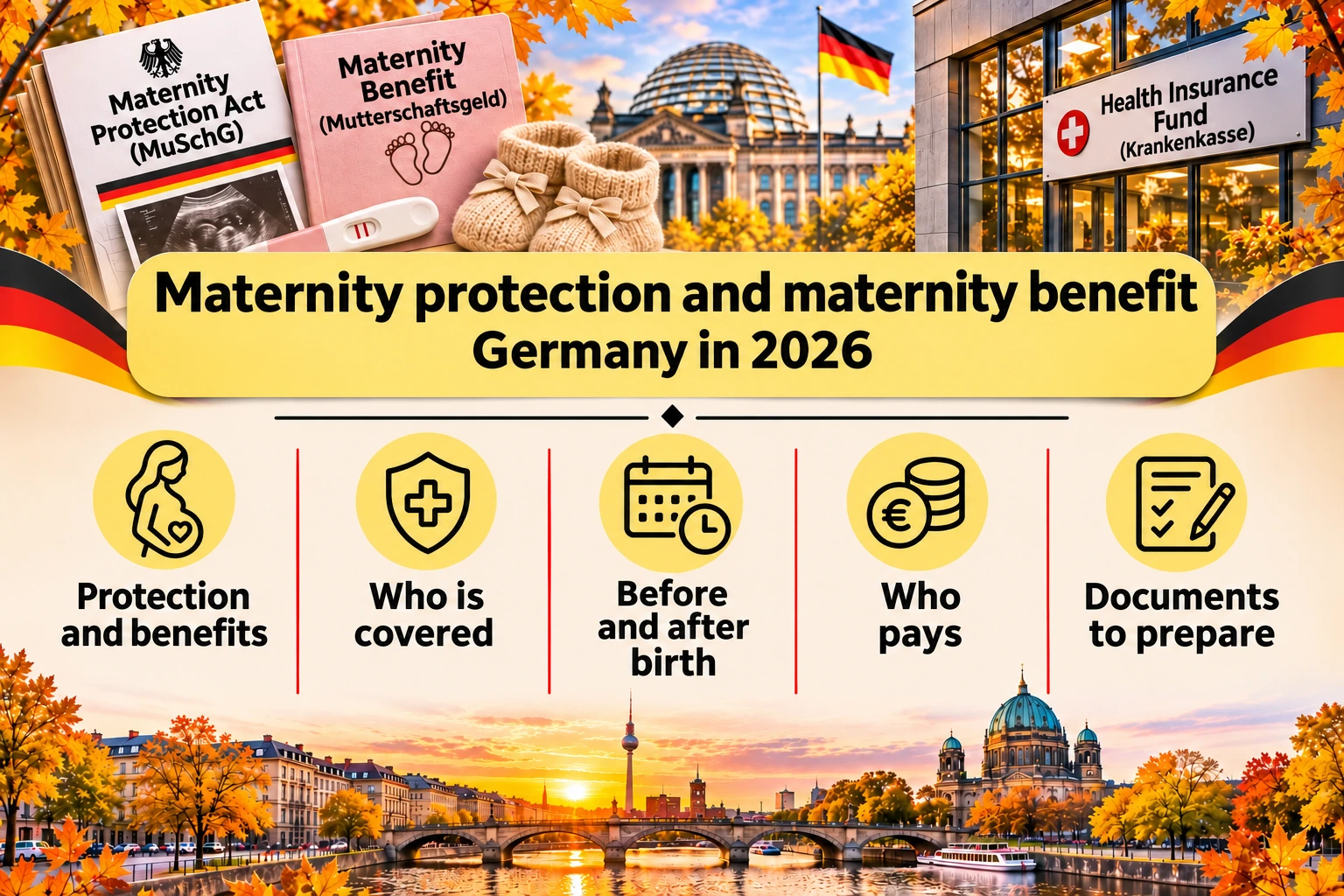
Russian source dated 10 November 2026. Source checks for this translation are documented separately.
Pregnancy after moving to Germany requires separate consideration of working conditions and income before and after birth. Mutterschutz protects pregnant employees and mothers at work. Mutterschaftsgeld replaces part of their earnings during statutory protection periods. Protection and entitlement to a particular payment have different conditions: employment, the type of health insurance and dates matter.
For an employee with her own membership of a statutory health insurance fund, the usual arrangement combines a fund payment with an employer supplement. Family or private insurance involves a different route. A self-employed woman may have an insurance payment but no employer obliged to top it up to her previous salary. Below we explain whom to contact, which documents to prepare and what matters after a recent move.
Terms to distinguish
- Mutterschutz includes workplace health protection during pregnancy and breastfeeding, employment restrictions, protection periods around birth and special dismissal protection.
- Mutterschaftsgeld, or maternity benefit, is paid by a statutory health insurance fund or, under different conditions, the Bundesamt für Soziale Sicherung (BAS).
- Arbeitgeberzuschuss zum Mutterschaftsgeld is the employer's supplement to maternity benefit. It is calculated separately.
- Mutterschutzlohn, or maternity protection pay, is paid by the employer when work is fully or partly prohibited outside the usual protection periods, for example when safe work cannot be arranged.
These rules are in the Maternity Protection Act, particularly sections 18–20. Elternzeit and Elterngeld are arranged separately: the former is leave to care for a child, the latter is parental allowance. A maternity benefit application does not automatically arrange either.
Who is covered after moving?
This article mainly concerns employment in Germany. Protection also applies to part-time work, Minijobs, probation and fixed-term contracts while employment continues. German citizenship and marriage are not prerequisites. The Familienportal refers to working in Germany or an employment relationship governed by German law. With a foreign employer, posting or work in several countries, applicable law and social insurance must be clarified separately. See the official explanation of the protected groups.
Protection also covers certain students, trainees and other groups, but rights vary. A university student may be protected in her studies when the institution determines the place, time and course of attendance as mandatory. This does not create the same payment entitlement as employment. Special rules apply to civil servants, judges and service personnel. The standard employer-based model does not apply to exclusively self-employed women. Economically dependent arbeitnehmerähnliche Personen may have a special position, with limited financial guarantees. Legal basis: section 1 MuSchG.
Moving, address registration or holding a residence permit does not itself create maternity benefit entitlement. The relevant employment and insurance relationship must exist. Do not assume an acquaintance's conditions apply merely because you hold the same residence card. The relevant provisions are section 24i SGB V and, for BAS payments, that authority's criteria.
Before moving or starting work, clarify in writing:
- When the employment contract starts and ends.
- Where you are insured and whether you hold your own fund membership.
- For self-employment, whether sickness benefit or a Krankentagegeld policy is included.
- Who will pay and what information is required about foreign earnings or insurance.
If pregnancy coincides with relocation, FIRMDER can provide organisational support in Germany, including documents, translations and enquiries. The scope is agreed beforehand; the relevant fund or authority confirms benefit entitlement.
Protection periods before and after birth
The following periods apply to ordinary employment:
- Six weeks before the expected delivery date. Work is permitted only if the employee expressly agrees. She may withdraw that agreement for the future.
- Eight weeks after birth. As a general rule, the employer may not let the employee work even if she agrees.
- Twelve weeks after medically premature births and multiple births. If a doctor establishes a disability within the statutory definition during the child's first eight weeks, extension to twelve weeks is granted at the mother's request.
If the child arrives before the expected date, the unused portion of the six prenatal weeks is added to the postnatal period. Birth a few days early does not itself establish a medical Frühgeburt or automatically produce twelve weeks. If delivery is later, the prenatal period grows and the ordinary postnatal period is not shortened. Rules and exceptions are in section 3 MuSchG.
In practice, two dates are needed: the expected date on the medical certificate and the actual birth date. Submit birth evidence to the fund and employer so they can recalculate the end of the period. Premature birth or the child's disability requires additional medical evidence; the documents are listed on the Federal Portal.
Rules after pregnancy loss
Since 1 June 2025, separate protection periods apply following miscarriage:
- from the 13th week of pregnancy: two weeks;
- from the 17th week: six weeks;
- from the 20th week: eight weeks.
The period is determined by medical evidence. The employee may expressly state that she is willing to work and later withdraw her agreement. The employer must know about the situation for protection to be implemented. Since 1 January 2026, the updated “Bescheinigung einer Fehlgeburt, Frühgeburt oder Behinderung des Kindes”, form 9, can be used. It also serves as evidence for the health insurance fund. See the Familienportal on miscarriage and stillbirth.
If the employment and insurance conditions are met, maternity benefit and the employer supplement may be paid for the relevant protection period. For earlier pregnancy loss, section 3(5) provides no special period; incapacity for work and evidence of it are matters for the doctor. Stillbirth is regulated separately: the miscarriage schedule and twelve-week premature-birth extension cannot automatically be applied. The law provides the normal eight-week postnatal period, taking account of applicable rules on unused prenatal time, and a separate exception for returning to work. Legal basis: section 3 MuSchG. Do not determine the medical classification yourself from an article.
Informing the employer and arranging safe work
Under section 15 MuSchG, an employee should tell the employer about pregnancy and the expected delivery date when she learns she is pregnant. This is not a leave request the employer can approve or reject. Earlier knowledge allows earlier protective arrangements.
A practical approach is to notify HR or your manager, state the expected date and ask for acknowledgement. If the employer requests medical evidence of pregnancy, it should include the expected delivery date. The employer pays for a certificate it requests: section 9(6) MuSchG.
Once informed, the employer must promptly determine the protective measures needed and offer a discussion about adjusting working conditions. The employee may only perform activities for which those measures are already in place. The law requires risk assessment, not automatic suspension of every pregnant employee: section 10 MuSchG.
If an unacceptable risk is identified, the statutory sequence is:
- Adjust working conditions to remove the risk.
- If that is insufficient or impossible under the statutory conditions, provide another suitable and reasonable workplace.
- If safe work is still impossible, impose an employer-based employment prohibition.
This sequence is established by section 13 MuSchG. A separate medical prohibition exists when continuing work endangers the employee's or child's health: section 16 MuSchG. Sick leave and a Beschäftigungsverbot have different grounds; the document cannot be chosen simply for the more favourable payment.
Working hours and examinations
For adult pregnant and breastfeeding employees, the usual limits are 8.5 hours daily and 90 hours in a fortnight. Contractual weekly hours must not be exceeded on a monthly average. Hours with several employers are added together, and uninterrupted rest must be at least eleven hours. Lower limits apply to employees under 18. See section 4 MuSchG.
Night, Sunday and public-holiday work is restricted. Exceptions require statutory conditions and, where applicable, a supervisory-authority procedure. Consent alone does not remove all restrictions. Agree shift patterns with HR taking account of sections 5–6 MuSchG and special permissions under sections 28–29.
Time off is provided for necessary pregnancy and maternity examinations. Pay is not reduced for the statutory time, and it need not be worked back. After returning, a breastfeeding mother may request breastfeeding time during the first twelve months after birth. Details: section 7 MuSchG and section 23 MuSchG.
Dismissal protection and fixed-term contracts
Special protection applies during pregnancy, for four months after miscarriage following the twelfth week, and after birth until the postnatal protection period ends, but for at least four months. The employer must know of the relevant circumstance or be informed within two weeks after the employee receives dismissal notice. The law allows an exception if the deadline was missed for a reason beyond her control and notification is made promptly once the obstacle is removed. See section 17 MuSchG.
This is not an absolute prohibition in every circumstance: in special cases unrelated to pregnancy or birth, the competent state authority may permit dismissal. Do not sign an Aufhebungsvertrag without understanding the consequences; an agreed termination is not equivalent to dismissal by the employer.
If notice has already arrived, seek employment-law assistance immediately. A claim challenging dismissal normally has a three-week deadline, with special starting rules where authority approval is required. The two-week pregnancy notification does not replace a court claim. Legal basis: section 4 KSchG.
A fixed-term contract normally ends on its agreed date. Pregnancy does not itself extend it. If it ends during the protection period, the former employer's supplement stops and subsequent support depends on insurance. Under GKV, the fund pays at the sickness-benefit level, so the previous total income cannot be assumed to continue. An established BAS entitlement does not disappear merely because the contract subsequently ends. Check dates using the fixed-term contract guidance and maternity benefits section.
Who pays maternity benefit?
Employees with their own GKV membership
If you have your own compulsory or voluntary membership of a statutory health insurance fund and meet the legal conditions, apply to your fund. Benefit is paid for statutory protection periods and the delivery day. For an ordinary employee, it equals average calendar-day earnings after statutory deductions, capped at EUR 13 a day. The basis is the last three settled calendar months before the prenatal protection period starts. Where average daily net pay exceeds EUR 13, the employer pays the difference. See section 24i SGB V and section 20 MuSchG.
Illustrative example. An employee has stable monthly net pay of EUR 2,400, three full assessment months, no special adjustments and a continuing contract. Three months total EUR 7,200; dividing by 90 gives EUR 80 per calendar day. The fund pays EUR 13 and the employer EUR 67. The example illustrates the principle and does not replace an individual calculation.
Do not divide salary by working days: the calculation uses calendar days. If you recently started work, lacking three complete months does not automatically mean refusal. For employment shorter than three months, the actual period is used. Other adjustments cover one-off payments, certain earnings reductions and permanent salary changes. Rules: section 21 MuSchG.
With several employers, the relevant average daily earnings are combined and employers share the supplement proportionately. Tell the fund about every job, including a Minijob: section 20(2) MuSchG.
Employees with private or family insurance
If you are not an individual GKV member at the start of the prenatal period — or on the miscarriage date — but have private insurance or Familienversicherung, a BAS payment of up to EUR 210 for the entire period may be available. This is not EUR 210 per month or a payment for every pregnant woman. In particular, employment earnings must be lost because of the protection period; the BAS also covers certain dismissals approved by an authority. Family insurance without employment is insufficient. Conditions: BAS maternity benefit eligibility.
Where entitlement exists, the employer still calculates its supplement as average daily net pay minus EUR 13, not salary minus the actual small BAS payment. The combination therefore does not always replace previous net earnings fully. For private insurance, separately check the Krankentagegeld policy, possible offsetting of other benefits and waiting periods. Legal basis: section 20 MuSchG and section 192(5) VVG.
Do not confuse medical-cost coverage with earnings replacement. Family membership conditions are discussed in our separate Familienversicherung article.
If you have a Minijob
A Minijob does not remove employment protection. The application destination depends on insurance:
- Own GKV membership, including student or voluntary membership: apply to your fund.
- Family or private insurance, if eligible: apply to the BAS.
- Average daily net earnings above EUR 13: also check the employer supplement.
Sending all Minijob employees to the BAS is incorrect. The authority specifically addresses this mistake in its official maternity benefit FAQ.
If you are self-employed
For a voluntarily GKV-insured self-employed woman, maternity benefit depends on entitlement to sickness benefit. That is not automatically part of every voluntary insurance arrangement. If eligible, payment is at the sickness-benefit level, not “EUR 13 plus an employer supplement”. A privately insured self-employed woman must check a separate daily sickness allowance policy, contract terms and waiting periods. Ordinary private health insurance covering treatment does not itself replace earnings. See the Familienportal on benefits for self-employed women.
Do not assume extra insurance taken out during pregnancy will pay immediately. Obtain written confirmation of the actual coverage and payment start date. For private daily sickness allowance following miscarriage, contract terms matter: the statutory guarantee for ordinary prenatal and postnatal periods does not automatically cover this situation.
If you continue receiving contributory wages or self-employment income during the benefit period, maternity benefit may be suspended to that extent. Do not plan full work alongside full benefit without agreement with the fund: section 24i(4) SGB V.
If you are not currently working
Pregnancy alone does not give an unemployed woman entitlement to BAS payment. A separate route exists, for example, for a GKV-insured ALG I recipient: the fund pays the applicable sickness-benefit amount, which in this situation is linked to unemployment benefit. Conditions are listed on the Federal Portal. If your employment ended immediately before the protection period, also contact the fund: section 24i(1) SGB V contains a special rule, not a blanket exclusion of everyone no longer working.
When maternity protection pay applies
Mutterschutzlohn applies when an employment prohibition prevents all or part of the work outside the protection periods around birth. The employer pays it. Its usual basis differs from maternity benefit: average wages in the last three settled calendar months before pregnancy began, rather than before the prenatal protection period. Special rules apply where work starts during pregnancy or employment is short: section 18 MuSchG and section 21 MuSchG.
Ask HR to confirm in writing the basis for stopping or limiting work, the date, whether the restriction is full or partial and which payment applies. Do not replace a statutory employment prohibition with unpaid leave merely because it is easier to enter in the HR system.
Applying for benefit and the supplement
Application to a statutory health insurance fund
Ask your fund about submission methods and documents. Do not assume all funds use the same form or app.
- Obtain a doctor's or midwife's certificate of the expected delivery date: Zeugnis über den mutmaßlichen Tag der Entbindung.
- Apply when the certificate is ready. Declare every employment relationship and check whether the employer has transmitted the necessary earnings data.
- Separately agree the employer-supplement process and documents with HR.
- After birth, submit a birth certificate or confirmation. For an extension, add the relevant medical evidence and, where the child has a disability, the application.
This follows the Familienportal application guidance and Federal Portal document list.
Keep a copy of the application and submission confirmation. After processing, check not only payment arrival but the calculation period, daily amount and jobs included. If information is incomplete, ask the fund to identify the exact missing document.
Application to the BAS
The official BAS page offers online and paper applications. Prepare the expected delivery date, insurance and employment details, tax identification number, bank details and:
- the expected delivery date certificate;
- the employer-completed Bescheinigung über eine Beschäftigung with the attachments specified on the form.
The BAS recommends applying around the start of the protection period where possible. The employer's certificate should not be completed earlier; an early certificate may require clarification. Application after birth is also possible. The BAS asks for a due-date certificate issued before the expected delivery date. If none exists, it uses the actual birth date. Details: BAS application timing guidance.
You can apply online without BundID. There is no need to resend a paper version solely for a signature. Save a copy after submission and monitor your chosen communication channel. The decision is delivered through the prescribed process, including post or BundID. Do not submit documents twice unnecessarily; first ask what is missing from the existing application. See the BAS instructions.
If this falls within your first weeks in Germany, FIRMDER can help organise documents and translations. Support with particular enquiries can be agreed, while the fund, BAS and employer retain responsibility for assessment and calculation.
What to check in the family budget
Insurance contributions. Maternity benefit does not mean identical contribution-free insurance for everyone. A previously compulsorily insured employee's GKV membership continues under the statutory conditions. Voluntary insurance depends on which previous earnings stopped and whether other income exists. Private insurance requires checking contractual contributions. General GKV rules are explained by the Familienportal. Ask your insurer to confirm your own contribution amount.
Taxes. Maternity benefit and the employer supplement are exempt from income tax but subject to Progressionsvorbehalt and may increase the rate on other taxable income. Check whether a tax return is required and keep payment certificates: Familienportal on taxes and section 32b EStG.
Mutterschutzlohn remains ordinary employment pay with applicable taxes and social insurance contributions. The exemption for benefit and the supplement does not automatically extend to it: BMBFSFJ employer guide, section 3.1.2.
Elterngeld. GKV maternity benefit and the employer supplement for the period after birth are offset against parental allowance for this child. BAS benefit up to EUR 210 is excepted. Do not automatically add the full amounts of both benefits for the same days: section 3 BEEG. Parental allowance planning and parental-leave notification need separate preparation.
Where to turn in a dispute
The Maternity Protection Act is federal legislation, but state authorities supervise workplace protection and special dismissal protection. Their names vary, including Gewerbeaufsichtsamt, Arbeitsschutzbehörde or another competent office. Find the relevant one in the official BMBFSFJ state directory.
Contact your fund or BAS about maternity benefit amounts and documents. For the supplement or maternity protection pay, first request the employer's calculation. If refused, ask for a written decision or explanation, check appeal deadlines and obtain individual legal assistance if needed. The workplace supervisory authority does not replace the fund in calculating benefits or the court in a dismissal dispute.
FAQ
Three months is the ordinary calculation basis, not a universal minimum employment period for workplace protection. For short employment, the law uses the actual period. Insurance entitlement is still assessed separately: section 21 MuSchG and section 24i SGB V.
For an ordinary employee, the prohibition also covers contractual work from home. Agreeing to remote work does not remove the postnatal protection period. Section 3 MuSchG has specific exceptions, including certain study situations; they cannot be transferred to ordinary office work.
Family insurance alone is insufficient. The normal BAS route requires employment earnings to be lost specifically because of the protection period. Non-working homemakers are outside the recipient group it identifies: BAS conditions.
If you hold your own GKV membership, your fund is normally responsible. Tell it about the Minijob and request a written decision if refused. The BAS explicitly discusses this in its FAQ.
No. Absence due to an employment prohibition counts as employment when determining paid annual leave. A separate carry-over rule covers unused leave: section 24 MuSchG.
A new pregnancy needs separate assessment. Benefits under sections 18 and 20 MuSchG are not paid from an employment relationship suspended for parental leave; part-time work during leave is considered separately. Clarify in advance whether the previous parental leave can end for a new maternity protection period and what steps are required, rather than assuming all payments are automatic. See section 22 MuSchG and the BAS explanation.
What to prepare before the protection period
- Confirmation of insurance status and the correct application destination.
- A medical certificate giving the expected delivery date.
- The start and end dates of every employment contract.
- Payslips and details of all employers.
- Evidence that the employer was informed and protective measures agreed.
- The fund or BAS application and a separate enquiry about the employer supplement.
- A plan for submitting birth documents and checking the final calculation.
For a recently relocated family, obtaining coordinated answers from employer and insurer in advance is particularly useful. It establishes the period off work, who pays and which costs must be covered personally. If you need help organising these steps, discuss support with FIRMDER. Work and fees are agreed for your circumstances; the competent organisation decides entitlement and amount.