


Updated: 12 November 2026. All amounts below apply to 2026.
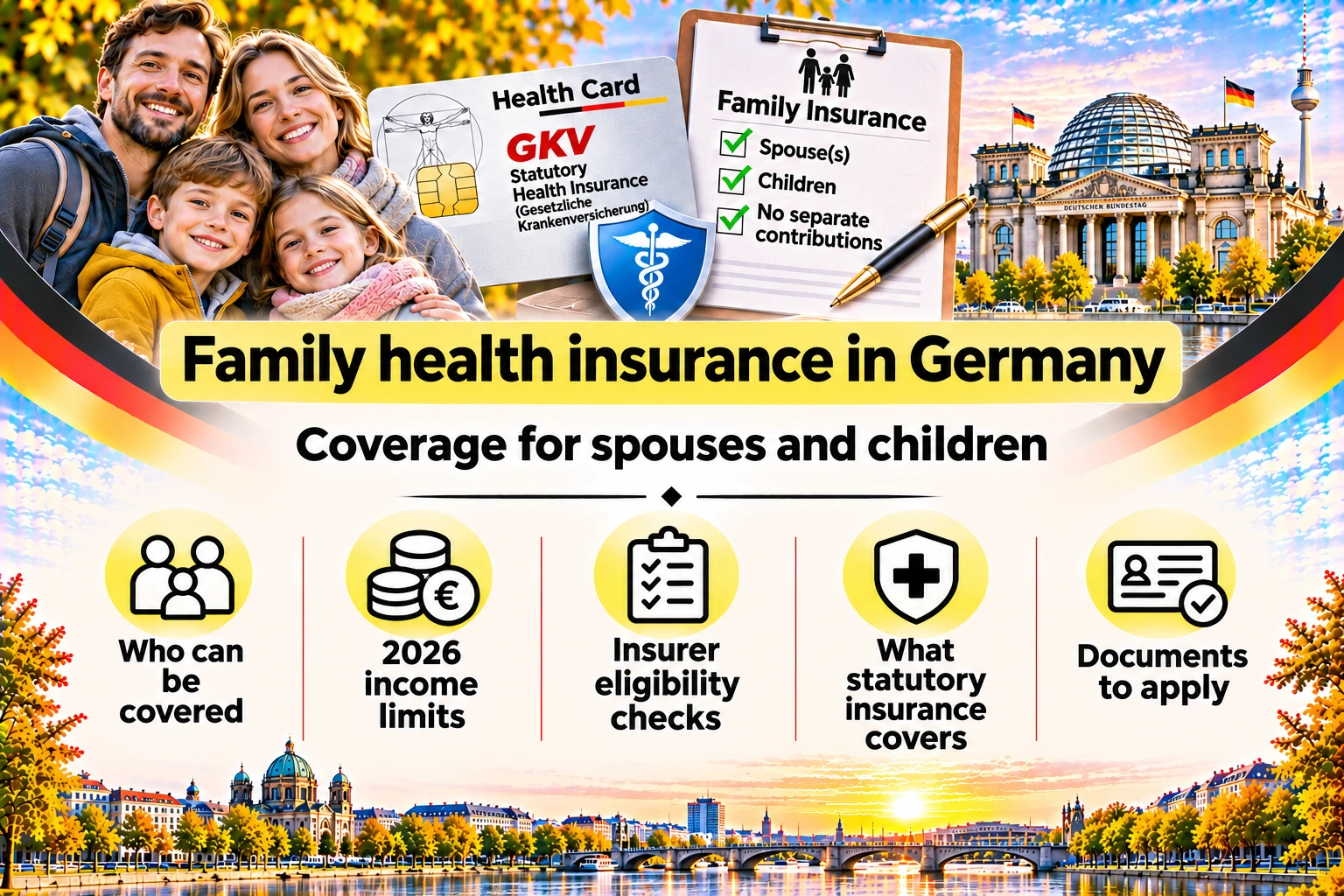
Family health insurance in Germany, known as Familienversicherung, allows a spouse and children to be covered by statutory health insurance (GKV) without a separate contribution for each relative. However, marriage, the birth of a child or moving in with an insured spouse does not, by itself, establish entitlement to this coverage. The health insurance fund checks each person's family relationship, place of residence, insurance in their own right, employment and income.
In 2026, the general limit for regular total income is EUR 565 per month, while a limit of EUR 603 applies to someone with a minijob. For children, age, education and, in some cases, the other parent's income also matter. These figures are confirmed by vdek, the Association of Substitute Health Insurance Funds.
If you are planning to move with your whole family, FIRMDER can help you choose health insurance suited to your circumstances. The Krankenkasse, or statutory health insurance fund, confirms whether relatives can be included without additional contributions after checking the documents.
- What contribution-free family insurance means
- Who can be included in Familienversicherung
- Which conditions the health insurance fund checks
- How much income is allowed in 2026
- Minijobs and family insurance
- Freelancing and small-scale self-employment
- How long children can remain in family insurance
- One parent in GKV and the other in PKV
- Pregnancy, parental leave and retirement
- What to check after moving to Germany
- How to apply for family insurance
- Which changes you must report
- What to do when family insurance ends
- FAQ
- Check your family's coverage before changing jobs or moving
What contribution-free family insurance means
Familienversicherung is not a shared policy that spouses take turns using. Each included relative has their own entitlement to medical care under GKV. “Contribution-free” means that no separate insurance contribution is charged for that relative; it does not remove every statutory co-payment for medical services.
The person through whom family insurance is arranged must be a member of a statutory health insurance fund. Membership may be compulsory or voluntary. For example, a self-employed person with voluntary GKV membership can include family members who meet the conditions. The restriction on self-employment as a main occupation applies to the relative being included, not automatically to the member through whom coverage is arranged.
Family coverage is also available under statutory long-term care insurance, known as Pflegeversicherung. Its conditions are set out separately in section 25 of Book XI of the Social Code (SGB XI). When applying, ask for confirmation of both types of insurance.
The general legal basis for family health insurance is section 10 SGB V in its current version.
Who can be included in Familienversicherung
The eligible relatives are defined by law. They include:
- a spouse in a legally recognised marriage;
- a partner in a registered civil partnership, or Lebenspartnerschaft, as defined by German law;
- children, including adopted children, subject to the age limits;
- children born to a child who is themselves covered by family insurance;
- foster children, stepchildren and grandchildren where the statutory conditions are met.
Living together without being married does not entitle you to insure your partner as a spouse. In this context, the German word Lebenspartner refers to a legally defined status, not any long-term relationship.
You cannot include your parents or siblings in your own family insurance simply because they live with you and depend on you financially.
For stepchildren and grandchildren, the law provides alternative grounds: they either live in the member's household or receive most of their maintenance from that member. For a foster child, the legally relevant nature of the family relationship is checked. Ordinary help provided to a family you know does not create this entitlement. The grounds are listed in section 10(1) and (4) SGB V.
Which conditions the health insurance fund checks
In a standard case wholly within Germany, the relative must have their residence or habitual residence here. The fund also checks that they:
- do not have insurance status in their own right that excludes family insurance;
- are neither exempt by law from compulsory insurance nor individually exempted from it, subject to the statutory exceptions;
- are not self-employed as their main occupation;
- do not exceed the permitted regular total income.
Having no income does not replace the other conditions. For example, an exemption from compulsory GKV coverage or continuing to run a business as your main occupation may matter even in months without receipts.
If your spouse is currently insured in their own right, first establish the legal grounds and the possible date for switching. Do not end existing coverage merely because your income appears to fall within the limit. The conditions for spouses are explained by Techniker Krankenkasse.
How much income is allowed in 2026
One of two limits applies to a family member:
- EUR 565 per month under the general rule;
- EUR 603 per month when working in a minijob with an earnings limit.
The relevant figure is regular total income, or Gesamteinkommen. The limit is checked for the individual relative. The main member's salary is not added to the spouse's income for comparison with EUR 565. Children in a family with both GKV and private health insurance (PKV) are subject to a separate assessment of their parents, discussed below.
Exactly EUR 565 or exactly EUR 603 does not exceed the respective limit. However, it is essential to calculate the assessable income correctly and identify any other income.
This is not a tax-free allowance or an amount that the family may earn on top of its existing income without consequences. Tax rules, minijob rules and family insurance conditions serve different purposes.
Which income is taken into account
Under section 16 SGB IV, Gesamteinkommen is determined by reference to income within the meaning of income tax law. You therefore cannot look only at the salary paid into your bank account.
The assessment may take into account:
- gross employment earnings, including expected bonuses and Christmas bonuses, or Weihnachtsgeld;
- profit from self-employment or a business;
- income from letting property;
- interest, dividends and other assessable investment income;
- pensions, including foreign and survivor's pensions;
- taxable maintenance payments.
Different calculation rules apply to different types of income. Business turnover is not the same as profit. Rent received does not always equal the full amount of assessable income. Permitted expenses and deductions must be supported by documents, not deducted arbitrarily.
Kindergeld, Elterngeld, Wohngeld, BAföG and tax-exempt scholarships are normally excluded from this calculation. Special rules apply to pensions, including the exclusion of the portion attributable to pension points for child-raising periods. TK lists the types of income and exceptions.
If you receive money from another country, tell your fund. Having no German employer or receiving payments into a foreign account does not remove the need for an income assessment.
How irregular earnings are assessed
The fund assesses expected regular income, rather than just one particularly good or bad month. Where receipts fluctuate, it may use a forecast of annual income converted into a monthly amount. A lasting change in circumstances leads to a reassessment.
Do not assume on your own that every one-off payment is harmless. For severance pay, or Abfindung, section 10(1) SGB V provides for a special allocation to subsequent periods.
For seasonal work, short-term employment and temporarily exceeding the limit, the exact type of employment and the regularity of the income must be established. The assessment principles are set out in the GKV-Spitzenverband guidance, section 2.8; section 3 addresses proof and attribution of income.
Minijobs and family insurance
In 2026, the minijob earnings limit is EUR 603 per month. Minijob-Zentrale confirms this amount.
A minijob does not itself provide separate health insurance. Even if the employer pays the required flat-rate contribution, the worker needs insurance coverage on another basis, such as family insurance. Minijob-Zentrale explicitly explains this in its insurance section.
You cannot add a further EUR 565 to the EUR 603 limit. The higher limit applies to all assessable regular income of a person with a minijob.
Illustrative examples, with income already calculated after the applicable deductions:
- A EUR 500 minijob plus EUR 80 of assessable rental income gives EUR 580. This is within the EUR 603 income limit; the other conditions must be checked separately.
- A EUR 603 minijob plus EUR 40 of assessable investment income gives EUR 643. Regularly exceeding the limit excludes contribution-free family coverage.
- Profit of EUR 590 from small-scale self-employment without a minijob exceeds the general EUR 565 limit. The higher limit does not apply to this activity merely because it is small-scale.
The basis for checking the combined amount is contained in section 10(1) SGB V.
Freelancing and small-scale self-employment
Self-employed people must pass two separate assessments: the nature and scale of the activity, and the amount of income.
Self-employment as a main occupation, or hauptberufliche Selbstständigkeit, excludes family insurance. Low income in the first months of a business does not, by itself, change this. For a secondary activity, family insurance may continue if the other conditions are met. BARMER emphasises this distinction.
Do not determine your status solely from labels such as Kleingewerbe, Freiberufler or Kleinunternehmer. To answer the fund's questions, prepare a description of your work, working hours, information about employees and an estimate of expected profit. Ask for written confirmation of whether the activity is considered your main occupation and which income has been included in the calculation.
If you have both a minijob and secondary self-employment, report both sources. Two individually small amounts can together exceed the limit.
How long children can remain in family insurance
The general age limits are:
- up to the 18th birthday;
- up to the 23rd birthday if the child is not working; a minijob within the permitted limits does not, by itself, prevent continued coverage;
- up to the 25th birthday during qualifying school or vocational education, including university studies, and in certain statutory cases of voluntary service.
AOK explains the possibility of coverage for children under 23 with a low income. Age does not remove the need to check income and insurance status in the child's own right. For example, paid vocational training, or Ausbildung, usually creates compulsory insurance in its own right. A student's income from a part-time job is assessed even if they retain student status.
If education was delayed or interrupted by a particular form of service, coverage may be extended beyond 25. The conditions depend on the type of service; for the voluntary schemes listed in the law, the extension is limited to twelve months. This period cannot automatically be added for everyone who previously took part in a volunteering programme. TK explains the age rules.
For a child with a disability, coverage without an age limit may be possible if they cannot support themselves and the condition concerning when the disability arose is met. In particular, the law takes account of cases in which family coverage was excluded at that time only because insurance in the child's own right took priority. A disability identification document alone is not enough to determine eligibility. The precise grounds are set out in section 10(2) SGB V.
After education ends, a course changes or a job starts, it is best to ask the fund in advance about the next review date. Receiving Kindergeld is not independent proof of entitlement to Familienversicherung.
One parent in GKV and the other in PKV
The other parent's private insurance does not always prevent a child from receiving GKV family coverage. Under section 10(3) SGB V, the exclusion applies when all the following conditions are met:
- The other parent is married to, or in a registered civil partnership with, the GKV member and is related to the child.
- They are not a member of a statutory health insurance fund, for example because they have PKV coverage.
- Their regular total income exceeds the monthly equivalent of the applicable annual earnings threshold, or Jahresarbeitsentgeltgrenze.
- This income is regularly higher than the total income of the parent in GKV.
In 2026, the general Jahresarbeitsentgeltgrenze is EUR 77,400 a year, or EUR 6,450 a month. TK provides the general rule for families with different insurance arrangements and this figure.
This is an assessment of Gesamteinkommen, not just the salary stated in an employment contract. The amounts to compare must be calculated under the applicable rules.
Examples using the general threshold, where the parents are married, the child is theirs jointly, and assessable income has already been calculated:
- The parent in PKV has EUR 7,000 per month and the parent in GKV EUR 5,000. Both income conditions for the exclusion are met.
- The parent in PKV has EUR 6,000 and the parent in GKV EUR 4,000. EUR 6,450 is not exceeded, so this exclusion does not apply.
- The parent in PKV has EUR 7,000 and the parent in GKV EUR 7,500. The privately insured parent earns less, so this exclusion does not apply either.
In the second and third examples, all the other requirements for the child's family insurance still apply. Equal parental incomes, or an income exactly at the applicable threshold, do not in themselves meet the statutory requirement of being “higher” or “exceeding” the threshold.
A special case applies to certain employees who were already exempt from compulsory GKV insurance because they exceeded the earnings threshold and had comprehensive private health insurance on 31 December 2002. Their special annual earnings threshold in 2026 is EUR 69,750 a year, or EUR 5,812.50 a month. The applicable threshold must be checked separately with the fund. vdek confirms the amount, while section 1 of the GKV-Spitzenverband guidance explains how the general or special threshold applies to the family insurance assessment.
If the parents are not married
The exclusion described in section 10(3) does not apply to parents who are neither married nor in a registered civil partnership. A child may therefore qualify for contribution-free coverage through the GKV parent even if the other parent has private insurance and a higher income.
Marriage may change the position. Tell the fund about the marriage and ask it to assess the child's coverage from the relevant date.
If both parents belong to different statutory funds, they can choose through whom the child will be insured. If both have PKV coverage, their private contracts do not create entitlement to Familienversicherung. The child's own GKV membership requires a separate legal basis.
Families with mixed insurance arrangements should compare costs before changing funds or switching to PKV. FIRMDER provides advice on choosing insurance in Germany. The statutory fund makes the final determination on contribution-free coverage for children.
Pregnancy, parental leave and retirement
Elterngeld is not included in Gesamteinkommen, but parental leave does not itself guarantee a switch to family insurance. If the spouse was not covered by GKV immediately before maternity protection leave, or Mutterschutz, or parental leave, or Elternzeit, section 10(1) SGB V contains a specific exclusion for those periods.
For someone previously insured in GKV, it is necessary to establish whether their own membership continues and on what conditions. Switching to family coverage should not be presented as a mandatory step for every parent on parental leave.
The age limit of 25 applicable to children does not apply to spouses. However, pensioners' own insurance and assessable pension income are checked. The 2026 version of the law also contains a specific restriction on switching from previous non-statutory insurance by taking a partial old-age pension, or Teilrente: the reduced payment alone is not decisive if a full pension would exceed the income limit and the other conditions of this exclusion are met.
What to check after moving to Germany
For a standard application, actual residence and the date when all conditions arise matter. A residence permit, address registration and marriage certificate help establish particular circumstances, but do not replace the assessment of insurance status and income.
If your spouse works remotely for a foreign company, runs a business abroad or receives a foreign pension, report this in the application. The applicable social security system matters as well as the amount received.
Where family members live in different EU or EEA countries or in Switzerland, international coordination rules may apply. For example, frontier workers use an S1 document, and the relatives entitled to healthcare in the country of residence are determined with regard to that country's legislation. This is a separate procedure, not automatic inclusion of any relative abroad. It is explained by DVKA, a department of the GKV-Spitzenverband.
For other countries, check whether a relevant agreement exists and what it covers. Before moving, request an answer addressing the specific countries, place of work and family members involved.
Do not cancel existing insurance until the dates of the next coverage are confirmed. General insurance requirements for entry and residence are discussed separately in our article on residence permits and health insurance in Germany.
How to apply for family insurance
Apply to the statutory fund of the person through whom family insurance is to be arranged. The employer registers its employee, but does not replace the family's application or the assessment of its circumstances.
First establish the required start date
State when coverage is needed: after a child's birth, a spouse's entry into Germany, marriage or the end of insurance in your own right. Ask the fund to compare that date with the supporting documents.
For a newborn, TK accepts the application after birth and asks for the birth certificate. Where the conditions are met, family coverage starts on the date of birth. This procedure is described on TK's application page.
Prepare your information and supporting documents
Check the form used by your own fund. To prepare, it helps to collect:
- the main member's insurance number;
- the relatives' details, addresses and required coverage start date;
- information about the marriage or civil partnership and the relationship to the children;
- details of each person's previous and current insurance;
- details of employment, minijobs, self-employment and other income;
- proof of an adult child's education where required;
- details of the other parent's insurance and income where that assessment is necessary.
The fund may request income documents: payslips, an Einkommensteuerbescheid, or income tax assessment notice, pension decisions and evidence of investment income. For children aged 23 and over who are studying, a school or university certificate is usually required. The federal administrative services portal lists these examples of supporting documents.
For foreign documents, check in advance whether translations or additional evidence are required. If a tax assessment notice is not yet available, explain why and ask which evidence of current income will be accepted at this stage. Do not leave the income section blank instead of stating “no income”.
Submit the application and obtain the result
Funds use their own submission channels: an online account, app, post and sometimes a branch office. For example, TK offers its app and Meine TK, while a paper application can be sent by post. TK does not recommend ordinary email for this application.
Keep the application, attachments and evidence of submission. Then check the fund's response for:
- Who has been confirmed as covered by Familienversicherung.
- The date from which coverage applies.
- Whether further information or documents are needed.
- How to obtain proof of insurance before the health card is issued.
Submitting the form does not mean disputed conditions have already been accepted as satisfied. The fund establishes whether family insurance exists when it starts and may request evidence that the conditions continue to be met. This is provided for in section 289 SGB V.
Which changes you must report
Do not wait for the fund's next questionnaire if your circumstances change. In particular, report:
- a new job, changed earnings or additional income;
- starting or expanding self-employment;
- starting or ending education or vocational training;
- marriage or divorce;
- a change in a parent's insurance, including a switch to PKV;
- moving to another country;
- a new basis for a relative's insurance in their own right.
The obligation to provide the necessary information and report changes is set out in section 10(6) SGB V. In your notification, include not only the new circumstance but also its effective date.
Possessing a health card does not mean that the income assessment is closed forever. If changes are discovered late, the insurance status for an earlier period may need to be reassessed and contributions calculated on the applicable basis.
What to do when family insurance ends
First establish the exact reason and date. Starting a job may mean compulsory membership in your own right; reaching the age limit for a student's family coverage may require student insurance; in other cases, voluntary continuation of GKV may be considered.
After Familienversicherung ends, in the cases provided for by law, insurance continues as voluntary membership from the following day. Under section 188(4) SGB V, opting out of this continuation is subject to a two-week period after the fund informs you of the option to leave, and requires proof of alternative coverage. Ignoring the fund's letters is therefore risky: the absence of a new application does not always mean no contributions are due.
If the fund refuses to include you, request a written decision giving its reasons and check the income, dates and family relationships used. Consult the decision's Rechtsbehelfsbelehrung, or instructions on legal remedies, for the objection procedure and deadline. The federal portal lists the possibility of an objection (Widerspruch) and subsequent proceedings before the social court.
FAQ
This is possible if all the conditions are met. First tell the fund about the marriage, your spouse's income, employment and previous insurance. Not receiving a salary does not, by itself, establish entitlement.
Simply living together does not provide this entitlement. The law separately provides for registered civil partnerships. However, a shared child may qualify for family coverage through the GKV parent regardless of whether the other adult can be insured.
In 2026, this is possible if the other conditions are met and there is no other assessable income that would cause the overall limit to be exceeded. The minijob itself does not provide health insurance.
You must report income from renting it out. Owning an apartment and receiving rental income are different circumstances. The fund will determine the assessable amount and the evidence required.
No. The assessment considers the parents' marriage or registered civil partnership, their insurance status and their relative incomes. If contribution-free Familienversicherung is excluded, ask the fund about the possibility of the child's own paid GKV membership and compare the available options.
No. Continued coverage beyond the basic age limits requires qualifying grounds, such as education. Insurance status in the child's own right and income also matter.
It is safer to obtain confirmation of the new coverage and its start date first, then arrange termination of the previous contract under its terms. If the fund requests additional information, ending the old policy prematurely may cause problems with continuity of coverage.
This article gives the figures for 2026. For an insurance period in 2027, the annual limits and the applicable version of the rules must be checked again.
Check your family's coverage before changing jobs or moving
For an initial assessment, list your family members, each person's insurance, the children's ages and all sources of income. Then compare your circumstances with the fund's conditions and obtain confirmation of the dates. This is especially useful before entering a new employment contract, starting a business, getting married or moving from another country.
FIRMDER can help you choose insurance and prepare the application documents. If family coverage is unavailable, you can discuss other options suited to your status. The Krankenkasse decides on Familienversicherung and the periods for which it applies.
This article provides general information. An individual decision requires the health insurance fund to check the documents and the applicable conditions.