


Updated on 12 November 2026.
Short answer: Before travelling to Friedland, check the documents of everyone moving with you, contact the receiving office as instructed in the BVA decision and clarify the arrival procedure. Registration and allocation take place there; not every family member receives a German passport on arrival day. Before travelling onwards, you need to understand where you have been allocated, which documents you have received and which steps remain.
This article is for ethnic German resettlers (Spätaussiedler) and relatives preparing to enter Germany under the relevant procedure. It helps organise the Friedland stage: contact before travelling, the first day, paperwork, everyday arrangements and departure for the allocated destination. Initial application requirements and proof of ancestry are covered in our general guide to the resettler programme.
The obligation for resettlers and included spouses or descendants to register after entry is set out in section 8(1) BVFG. Check the practical route against your individual correspondence rather than relying only on another family's experience.
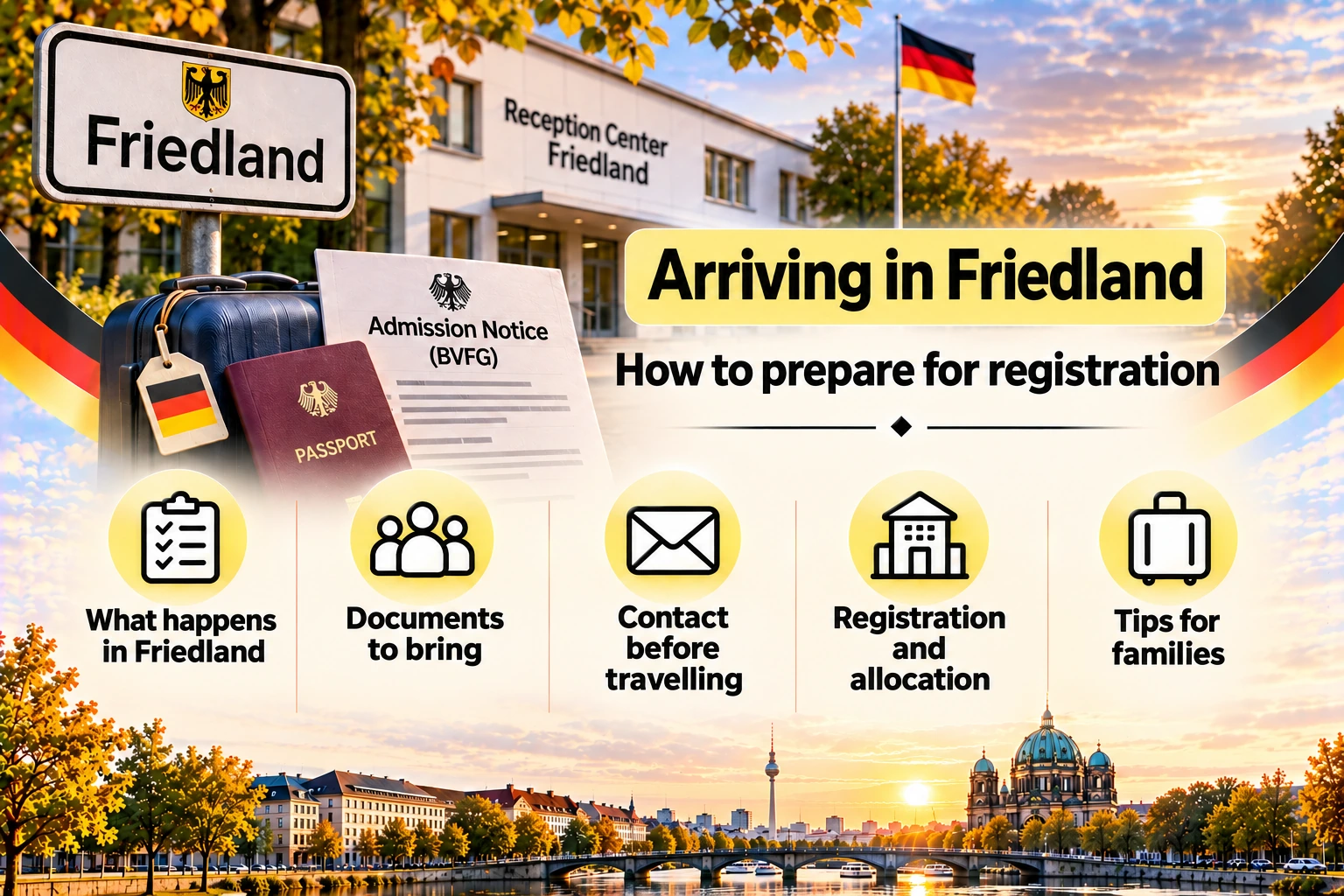
- What happens in Friedland
- First check each person's basis for entry
- Contact the receiving office before travelling
- Check the address and save contacts offline
- Prepare a document folder for the procedure
- Pack for temporary accommodation
- Organising your first day
- Preparing an allocation preference
- Checking documents before departure
- What to arrange after allocation
- FAQ
- Final checklist before travelling
What happens in Friedland
Two organisations with different responsibilities operate alongside each other in Friedland. Grenzdurchgangslager Friedland, or GDL, belongs to the Lower Saxony reception authority, Landesaufnahmebehörde Niedersachsen, and provides initial accommodation. The Federal Office of Administration, Bundesverwaltungsamt or BVA, conducts registration and allocation. Lower Saxony expressly distinguishes these functions in its description of the facility.
For a family, this means that a question about a room and one about the content of a decision may need to go to different offices. Record the authority's name and case reference when you receive instructions. If a staff member directs you to another building, ask what you need to do there and what to bring.
Do not apply instructions for all other residents at the facility to resettlers. People arriving through different programmes may be accommodated in the same place. Admission under the BVFG has its own legal basis and does not become an asylum procedure because the accommodation address is shared.
First check each person's basis for entry
A family travelling together may include people with different legal positions. Your working checklist before departure should contain not only names but also the documents on which each person is travelling.
| Person moving | What to clarify before arrival |
|---|---|
| Main applicant | Aufnahmebescheid, subsequent BVA letters and up-to-date personal details |
| Included spouse or descendant | Proof of inclusion, whether inclusion remains valid and the arrangements for travelling together or later |
| Other relative | Independent basis for entry and residence and possible participation in allocation |
| Child | Who is accompanying the child and which documents establish the relationship and representative's authority |
Section 8(2) BVFG allows other family members arriving together with the resettler to be included in allocation even if they do not meet the conditions of section 7(2). Participation in allocation alone does not mean that all relatives acquire the same status. Admission and inclusion requirements should be read together with sections 4, 7 and 27 BVFG.
If a relative is arriving later, a child has been born, a marriage has been entered into or dissolved, or a passport has changed, report this in your case and obtain instructions before travelling. Do not assume that the decision automatically covers a new person or a changed itinerary. Our article on family members under sections 4, 7 and 8 helps explain the differences.
If the family composition or order of departure raises questions, you can contact FIRMDER for advice on the resettler programme. Start by preparing a list of those travelling, the decisions and a list of changes since you received them. This enables a specific discussion of which questions should be put to the competent authority.
Contact the receiving office before travelling
The German Embassy in Moscow states that people arriving with an Aufnahmebescheid or Einbeziehungsbescheid should proceed to Friedland after making contact, and refers them to the instructions in the decision. This is reason enough not to plan your arrival solely on advice that “they always admit people there”.
Start with the contacts in your most recent letter. Clarify:
- whether the arrival date and time must be agreed;
- where to report first and which documents to show;
- what to do if a flight is delayed or you arrive outside normal hours;
- whether you should report the family composition and any special needs in advance;
- which instructions apply if some family members are already in Germany;
- whom to notify of changes to your plans.
This is a practical list of questions, not a claim that everyone uses a single appointment system. If you receive a reply, save it with the case reference and contact details. A lack of response to a message does not itself confirm an agreed arrival time.
Someone already in Germany without a completed admission procedure needs an individual assessment. The law provides for special consideration in cases of particular hardship, but simply arriving at GDL does not replace the programme's conditions. The exception is based on section 27 BVFG. Do not treat instructions for particular humanitarian cases as a universal way to bypass the normal procedure.
Check the address and save contacts offline
When planning the route, distinguish between the accommodation facility's address and the BVA address.
| Organisation | Checked contact details |
|---|---|
| GDL Friedland | Heimkehrerstraße 18, 37133 Friedland; telephone +49 5504 803 0; poststelle-fr@lab.niedersachsen.de |
| BVA Friedland office | Heimkehrerstraße 16, 37133 Friedland; telephone +49 228 99358 91919; spaetaussiedler@bva.bund.de |
GDL contacts are published on the LAB Niedersachsen website; BVA details appear on the official Hesse administrative portal. Checked on 12 November 2026. Check the address and contact procedure again before departure: a contact number does not confirm admission at a particular time.
Enter the full address and postcode in your navigation system, rather than just “Friedland”. Save the route, instruction letter and telephone numbers so they remain accessible without mobile internet. Allow extra time for connections and ensure you can contact the receiving office if delayed. These contact details do not imply a promise of a free transfer, collection at the station or reimbursement for any ticket you choose.
Prepare a document folder for the procedure
Documents for a visa, status determination and everyday life serve different purposes. At the first stage, being able to find what is needed quickly matters more than presenting an unsorted stack of papers.
It is practical to divide the folder into several sections:
- Passports and documents used by each person to enter Germany.
- Aufnahmebescheid, inclusion decisions and current BVA correspondence with attachments.
- Family civil-status documents: birth, marriage, surname changes and documents on a child's representation where relevant to the case.
- Evidence of circumstances you want considered during allocation.
- A separate list of questions and missing documents.
This is an organisational inventory, not a universal mandatory list. The authority determines the required form of documents, translations, certifications and additional evidence for your situation. Do not order an apostille or new translation for every paper just because an acquaintance did so.
Keep originals in your hand luggage and copies separately. Do not put the only copy in a suitcase that might be delayed. If you hand over an original for checking, clarify how it will be returned and retain any acknowledgement of receipt that is issued. A folder containing passports and family civil-status records should not be placed in a publicly accessible cloud folder or shared group chat.
Pack for temporary accommodation
The GDL page describes shared rooms, meals in a communal dining hall and a medical station. It also gives an indicative stay of one to two weeks for resettlers. This describes operational arrangements; it is not a statutory deadline for completing every case or a guarantee of a particular room. Source: LAB Niedersachsen.
What to pack depends on your family: essentials for the first few days, chargers, toiletries, seasonal clothing, children's supplies and accessible contact details for relatives. Do not assume you will immediately be able to retrieve items from your main luggage or buy everything you need on arrival.
If ongoing treatment is necessary, discuss continuity of care with your doctor in advance and prepare a clear medication list. Rules for carrying medicines, particularly controlled medicines, must be checked separately for your route. Having a medical station does not mean every medicine will be available or that arranging necessary care can be postponed.
Ask before arrival about accessibility, mobility assistance, special diets or support from an accompanying person. Send medical details only through a suitable channel to the appropriate recipient. Keep any reply confirming whether a need can be accommodated; your own expectation is not a substitute for an arrangement.
Organising your first day
Follow the instructions you receive on site. Internal reception procedures and the sequence of offices may vary, so a task list is more useful than memorising someone else's hourly schedule.
First establish where your arrival is recorded, whom to approach about accommodation and where to obtain the next instructions for your case. Give your case reference and show the documents requested. Ask whether all family members must attend a particular step and who is entitled to represent a child.
Record appointments, location, time and required paperwork. If an oral explanation is unclear, ask for it to be repeated or for the action to be described in writing. For legally significant declarations, separately clarify the requirements for language assistance and interpreters. Having a Russian-speaking acquaintance present does not always replace the interpretation required by the procedure.
Before signing, check names, dates of birth, family composition and what the document means. If you find an error, show the source document and ask how to have it corrected. Do not alter an official form yourself or sign a declaration you have not understood merely to move on to the next office more quickly.
Preparing an allocation preference
The BVA determines the receiving federal state. Section 8 BVFG sets quotas and allows allocation to a state different from the resettler's preference. An arrangement with relatives, acquaintances in the area or a wish to live in a particular city is not an allocation decision.
If a particular location matters to you, prepare a short explanation and relevant supporting evidence. This might include information on close relatives, a job offer or care responsibilities. Such a set of documents helps present your request clearly; it does not guarantee approval.
Separate three questions: which state you are allocated to, exactly where you must report after Friedland, and how your subsequent accommodation will be arranged. An answer to one does not answer the others. Until you have clear instructions, do not enter irreversible housing commitments based on an assumed destination city.
If the decision differs from your expectations, first ask for an explanation and details of how to pursue the matter. Keep the written document and any stated deadlines. Travelling to another state without authorisation may complicate reception: section 8(5) provides that a state need not admit someone who settles there contrary to an allocation or without one.
With FIRMDER, you can discuss preparing questions about family relocation and allocation. Bring evidence of family ties and instructions already received to the consultation. The company does not determine the receiving state or promise accommodation in a chosen city.
Checking documents before departure
Do not stop at asking “Have we finished everything?”. Sort the documents issued by purpose and check that the next steps are clear for each person.
| Question | What the family should understand |
|---|---|
| Registration | Which steps have been completed and what proves this |
| Allocation | Where to travel, the address and the deadlines specified in the instructions issued |
| Personal details | Whether names, dates, family composition and the contact address are recorded correctly |
| Outstanding matters | Which documents must still be submitted, to whom and by which method |
| Further correspondence | How to report your current address and where to send questions about the case |
Do not mistake a Registrierschein or allocation documents for a German passport or automatically for a certificate under section 15. Section 15 BVFG governs proof of the relevant status, while section 7 StAG links acquisition of citizenship by the specified categories to issuance of that certificate. The differences are explained in the article on AZ, Aufnahmebescheid and section 15.
If your first name or surname was discussed, clarify whether a record was simply corrected or a legally significant declaration was made. Keep the document confirming the outcome. Section 94 BVFG provides for certain declarations during allocation, but applicability depends on the person's status and the nature of the change.
What to arrange after allocation
The next steps depend on the instructions received and your family's circumstances. Before travelling to the next location, establish the receiving contact and accommodation procedure. Once you actually move in, residential registration must be addressed separately; a Friedland document does not replace Anmeldung at the new address. The general obligation to register upon moving into a home is set out in section 17 BMG, although the law also contains special rules and exceptions for particular situations.
At the same time, clarify each person's insurance coverage, further document formalities and, if needed, how to apply for support. For a relative with foreign nationality, lawful residence remains a separate issue. An entry in the family folder is not a substitute for a decision by the foreigners authority, Ausländerbehörde.
Do not transfer local rules on schools, social assistance or accommodation from one city to another. The receiving state and municipality explain their own organisational procedures. Keep copies of submissions and acknowledgements of receipt so that you can show exactly what has already been sent if asked.
FAQ
The safer approach is to follow the instructions in your decision and contact the receiving office first. Official consular information expressly calls for contact before proceeding to Friedland. This does not mean there is one online booking system for every category. If you are already travelling and circumstances change, report this instead of relying on an old chat message.
The GDL description gives an indicative temporary stay of up to two weeks, but this is not a deadline for issuing the section 15 certificate or a guarantee of completing checks in a particular case. Do not tie non-refundable tickets, starting work or handing over a home to an assumption that all procedures will finish on a specific day.
Section 8(1) BVFG requires resettlers and included family members to register at a federal initial reception facility. The possibility of living with relatives and the specific route must be agreed with the competent authority. Having a relative's address does not itself remove the registration requirement.
No. Distinguish between the main applicant, included spouses and descendants, and other relatives. Participation in allocation under section 8(2) does not automatically give the same status or citizenship on the same basis as the main applicant.
Section 94 BVFG permits certain declarations; it does not impose a general obligation to adopt a new name. The law allows a declaration to the BVA during allocation or to the civil registry office, Standesamt. First establish whether you need an error corrected, a spelling confirmed or an actual legal name change.
Show what you have and ask the responsible staff member exactly what is required: an original, a translation, proof of a particular fact or another document. Record the deadline and submission method. Do not replace a missing document with a homemade certificate or treat an oral “bring it later” as resolving the issue without clear further instructions.
Final checklist before travelling
- The travel basis and documents have been checked individually for each person.
- The latest BVA letters have been read together with their attachments.
- The arrival procedure has been clarified, and the address and contacts saved offline.
- Originals and necessary papers are accessible in hand luggage.
- The family's special needs have been discussed in advance.
- Allocation preferences are distinguished from decisions already made.
- The plan allows extra time, and further commitments do not depend on promises based on someone else's experience.
If the move is approaching and questions remain, contact FIRMDER to discuss arrival preparation and your family's action list. FIRMDER UG is a private consultancy, does not represent the BVA and does not guarantee processing times, status or allocation. Decisions are made by the relevant German authorities.
This material provides general information. Personal instructions from the authority and the circumstances of the individual case require separate checking.