Checked on 19 October 2026.
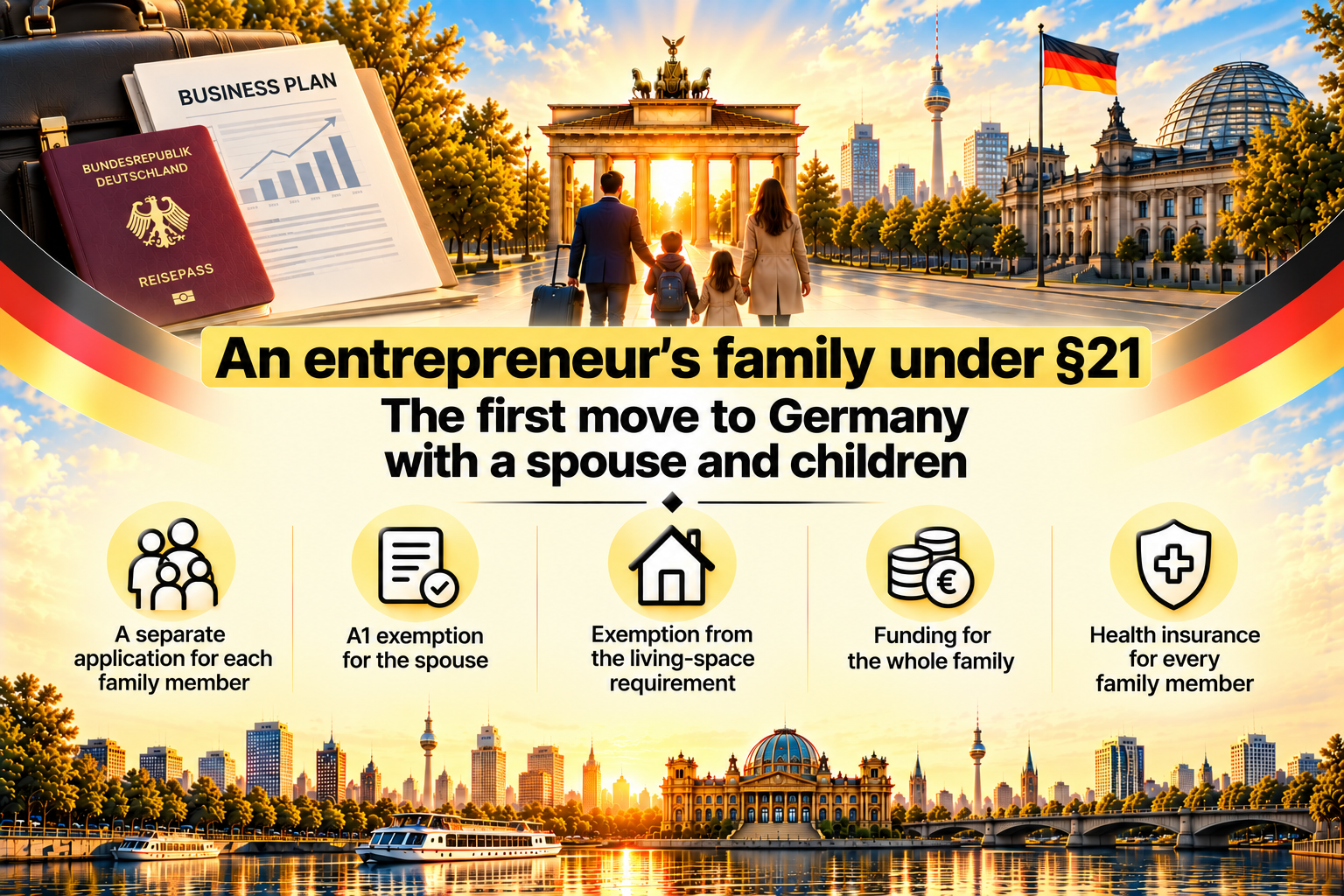
An entrepreneur applying to move to Germany under section 21 of the Residence Act (AufenthG) can plan to enter with a spouse and minor children. Each family member needs a separate application. The spouse benefits from an exemption from the pre-entry A1 German requirement, while the spouse and children are exempt from the sufficient-living-space requirement. Family relationships, the conditions of each residence route and funding for the household, including health insurance, still have to be checked. Preparing applications together does not guarantee that all visas will be issued together. See section 29, section 30 and section 32 AufenthG.
This guide is for a family still living in a CIS country or another country outside the EU and preparing its first move. The main scenario is commercial self-employment under section 21(1): establishing or developing a real business in Germany. It is particularly important to align the entrepreneur's case with the family applications before allocating money between the business launch and relocation.
Which residence route applies to each family member?
The entrepreneur and their relatives rely on different provisions. The main applicant must meet the requirements for self-employment under section 21. The spouse applies for family reunification under section 30, and a child under section 32, alongside the general rules in sections 27–29 and section 5 AufenthG. Marriage and birth certificates connect the cases, but do not replace the other supporting evidence.
For section 21(1), the assessment considers an economic interest or regional need, expected positive economic effects and funding for the venture. Merely registering a GmbH or UG does not qualify someone for a residence permit. Our guide to business immigration to Germany explains the general conditions. The legal basis is section 21 AufenthG.
Family reunification is intended for genuine family life together. This route normally concerns a spouse and minor children who meet the condition of being ledig: unmarried and never previously married. The entrepreneur's parents and adult children require a separate assessment of possible residence grounds; they are not automatically included in this group of applications. Unmarried cohabitation alone is not equivalent to marriage for section 30. See the general principle in section 27 AufenthG.
Members of the liberal professions applying as Freiberufler under section 21(5) face different requirements for their principal activity. A business plan designed for a commercial company cannot simply be reused unchanged for freelance professional work. Family residence rules still need to be considered when choosing that route. Read more about the principal activity in our guide to moving to Germany as a freelancer.
Can the applications be submitted together?
A joint move can be part of the plan from the outset. The entrepreneur does not have to move alone first merely so that the family can begin preparing its documents. However, “applying together” means several linked cases, not one visa covering the entire family.
Where the applicant's nationality requires a visa, the regular route for long-term relocation is a national D visa obtained before entry. The entrepreneur and relatives have different purposes of stay. Visa-free access for short visits, where available, does not by itself permit someone to settle in Germany under the chosen residence route. See section 6(3) AufenthG.
A shared cover sheet can help organise the applications. Include:
- every applicant's name exactly as shown in their passport;
- family relationships, dates of birth and the marriage date;
- the main applicant's residence ground, business outline and intended city;
- the preferred sequence of entry;
- reference numbers for linked applications once available;
- consistent information on family funding and accommodation.
This is a practical recommendation, not an additional statutory form. Check appointment arrangements, how online applications can be linked and the required attachments with the competent German mission. If the family legally lives in a third country, establish in advance whether the mission there accepts its applications and which residence evidence it requires. The federal government's family-reunification guidance describes the procedure.
The family decisions depend on the entrepreneur's residence route, but each applicant may receive an individual request for further evidence. Allow for costs if visas are issued on different dates or a document needs updating. It is sensible not to base non-refundable tickets or the final termination of your current accommodation on an assumed decision date.
Spouses: why do the marriage date and residence status matter?
Section 30(1), first sentence, no.3(e) is important for a family's first move to join an entrepreneur. In this scenario, the assessment considers whether the marriage already existed when the relevant residence permit was granted and whether the main applicant's stay in Germany is expected to exceed one year. Both spouses must also normally be at least 18. See section 30 AufenthG.
Preparation therefore requires exact dates, not simply a statement that the couple is married. Particular care is needed where one person received a national visa before the wedding, or previously held another German residence status. The legally relevant sequence of the visa, residence permit and marriage must be established from the documents.
A later marriage is not an absolute bar to reunification. Section 30(2) allows the authority to waive the additional conditions in paragraph (1), no.3(e), at its discretion; the provision also refers to holders of national visas. This calls for an individual assessment, not a promise of immediate approval or a categorical instruction to wait two years. See the Federal Foreign Office's guidance on spousal reunification.
Does the spouse need an A1 German certificate?
For reunification with someone holding a residence title under section 21, the pre-entry basic-German requirement does not apply. The exemption is expressly listed in section 30(1), third sentence, no.5. This specific concession does not remove checks on the marriage, age or other conditions. The linked applications should clearly identify the residence ground on which the main applicant is applying.
Learning German remains useful for daily life, children's schooling and employment. However, a generic checklist for all spouses is not enough to establish that a certificate is mandatory before this application. Nor should all the rules for an EU Blue Card holder's family be transferred to an entrepreneur's case: the marriage and residence-status timeline described above requires its own assessment.
Planning to apply as a family? Discuss preparation with FIRMDER / RelocationDE. We support business immigration and preparation of family members' documents. A useful starting point is to review the dates, family composition and sequence of applications.

How can you prove family funding before the business is operating?
Secure means of subsistence generally remain necessary. Section 5(1), no.1 requires a secure livelihood, and section 2(3) includes adequate health insurance within that concept. Contributions from family members to the household's income are also considered in family-reunification cases. See section 5 and section 2(3) AufenthG.
For a new business, the practical question is which evidenced resources will support the family until reliable revenue starts. Rather than searching for one supposedly correct “visa amount”, prepare a coherent calculation of expenses and available funds.
Separate business funding from household spending
Your working budget should have three parts:
- Business launch and operations: registration, equipment, stock, premises, staff, mandatory payments and a buffer for delayed customer payments.
- Regular family living costs: rent, utilities, insurance for each person, food, transport, communications and necessary spending on children.
- The relocation itself: translations, obtaining documents, application fees, travel, a rental deposit and temporary accommodation.
Show a contingency reserve separately. Its size depends on the venture and family circumstances; it is not a universal extra amount prescribed by law.
Share capital shows only part of the financial picture. Turnover does not show what remains after costs and taxes. If the company plans to pay its shareholder or managing director, explain the legal basis for those payments and how the new business can afford them. Moving money between accounts does not create additional income.
Illustrative calculation: a family has EUR 80,000, of which EUR 55,000 is allocated to equipment, stock and initial business costs. Listing EUR 80,000 as business funding and the same EUR 80,000 as money for the family's living costs counts the funds twice. The allocation leaves EUR 25,000. Whether that is sufficient must be assessed against household spending and the period before business receipts begin. This is an arithmetic example, not a recommended budget or an approval threshold.
Which financial evidence should you prepare?
- A business plan and monthly cash-flow forecast with explainable assumptions;
- proof of your own funds and their source;
- confirmed project financing if borrowing is involved;
- existing customer contracts, orders and payment terms;
- evidence of family income that will genuinely continue after the move;
- a calculation of personal payments from the business, taxes and insurance costs.
This is a preparation list; the final evidence required depends on the individual case. A letter from a prospective customer is not a paid contract. Money in a foreign account must be assessed for actual availability and the ability to use it lawfully in Germany. A spouse's intention to “find work quickly” is not yet proven income.
Test a second, more cautious scenario: sales start later, but rent and health insurance are payable from month one. If this would leave the family without funds, revise the financial plan before applying. Our article on business immigration with a limited budget and a UG discusses constrained start-up capital.
If household expenses have not yet been reconciled with the business plan, contact FIRMDER / RelocationDE. As part of business-immigration preparation, we help assemble the venture's financial justification and documents for the family move. The scope of support depends on your circumstances.
Housing and insurance: what still matters despite the exemptions?
For a spouse or minor unmarried child joining someone with section 21 status, section 29(5) waives the sufficient-living-space requirement in section 29(1), no.2. A general floor-area standard therefore cannot automatically be imposed on this family as a mandatory criterion for its residence permits. See section 29(5) AufenthG.
The family still needs somewhere to live, and accommodation costs remain part of the budget. Plan the initial address, permitted occupancy and the possibility of registering residence. A company's registered business address does not prove that a spouse and children may live there. If using temporary accommodation, ask the mission what information is needed at the visa stage and ask the landlord whether residence registration is possible.
Each family member needs health cover. Do not assume that the entrepreneur's policy will automatically cover a spouse and children free of charge. Conditions depend on the type of insurance and the family's circumstances. Obtain written confirmation of the insured people, cover start date and premiums, and include those costs in the financial plan.
Section 29 contains a particular exemption from proving subsistence for some EU Blue Card families moving from another EU member state. It does not automatically extend to an entrepreneur's family making its first move from a CIS country. Sharing some housing or language concessions does not make the financial rules identical.
Children: age, custody and a separate application
Section 32 requires the child to be a minor and ledig, meaning neither currently nor previously married. Parentage, custody and the parents' residence status must be documented. Prepare a separate application for each child in accordance with the mission's instructions. See the official child-reunification guidance.
If both parents are moving together, the documents should show the full chain: one parent's business residence ground, the other parent's family ground and their relationship to the child. If the child is joining a parent with sole custody, that specific legal status must be demonstrated.
Where custody is shared and the child will join only one parent, section 32(3) provides for the other parent's consent to the child living in Germany or an appropriate binding decision by a competent body. Consent to a short foreign holiday may not resolve permission for permanent residence. A divorce certificate alone does not prove sole custody. See section 32 AufenthG.
What if the child is 16 or 17?
“Every child over 16 must have C1 German” is incorrect. The law distinguishes a child moving their centre of life together with the parents from a later move. Section 32(2), second sentence, no.2 also expressly provides an exemption from the additional language or integration condition, including where the parent, or their spouse living with them as a family, holds qualifying section 21 status. See section 32(2) AufenthG.
For the age criterion, the first application to the mission is relevant. Turning 18 during processing does not by itself invalidate an application submitted in time; the other conditions still have to be met. The Visa Handbook provides for acceptance of an incomplete application to preserve the age deadline, followed by submission of missing documents within a specified period. Booking an appointment should not automatically be treated as having lodged an application. See the Federal Foreign Office's guidance on the age limit.
If the 18th birthday is approaching, clarify the submission process early and retain proof of the application. Do not wait for the business plan to be finished. When the first application is made after the child has become an adult, an independent residence ground is generally needed.
Practical checklist before applying
Organise documents by person, keeping shared information consistent across every application.
Family history
- Each person's nationality, country of lawful residence and valid passport;
- the date and place of marriage, and relevant documents about previous marriages;
- children's birth certificates and evidence of name changes;
- custody documents, consent statements or court decisions as applicable;
- dates of birth, highlighting any approaching 18th birthday.
Business and household funding
- The entrepreneur's exact residence route and the venture's preparation stage;
- business plan, financing and intended personal payments;
- household spending shown separately from the company budget;
- evidence of funds and continuing income;
- accommodation and insurance plans for every family member.
Procedure and document quality
- Current checklists from the mission competent for your applications;
- separate forms, photographs and supporting documents for every applicant;
- required translations and authentication under the rules applicable to the issuing country;
- consistent names, dates and addresses, with explanations for discrepancies;
- copies of the submitted files, case numbers and deadlines for further evidence.
Apostilles, legalisation, document verification and translation requirements depend on the document and country. Ordering the same set of certifications everywhere “just in case” can be costly and unhelpful. First compare the mission's checklist with the documents you already have.
For an initial consultation, a short account of the family, nationalities, residence country, marriage and birth dates, business type, intended city and available budget is sufficient. Do not send full passports or children's documents to public chats. Arrange a protected way to transfer them.
What should you check before departure and after arrival?
Check every family member's visa separately: the spelling of the name, validity period, earliest permitted entry date and any stated conditions. If the dates differ, plan travel around the documents actually issued.
After arrival, register your residence and apply for residence permits in time, before the visas expire. A spousal residence permit allows gainful employment. Before starting work, check the authorisation recorded on the document issued. Access to a regulated profession is a separate matter. See the official guidance on steps after family entry.
Keep the financial plan and underlying business records: they will be needed to assess actual performance. Our article on renewing an entrepreneur's section 21 residence permit addresses the next stage. For now, the priority is correct preparation for the whole family's first move.
Frequently asked questions
Do not treat receipt of the physical card as a mandatory first step before beginning family preparation. Linked visa cases can be planned in advance. The mission can explain joint submission, technical linking of applications and the evidence required for the main residence route. Simultaneous decisions are not guaranteed.
No. The exemption concerns the pre-entry language condition. Marriage, age, the connection to the section 21 holder, family funding and insurance are checked separately. The documents must show why the exemption applies.
The same amount cannot automatically be allocated both to company costs and to a private reserve. Show which funds the family can actually use, the basis for payments and whether enough remains for the business. Share capital alone does not establish this.
There is no universal threshold for every entrepreneur's family. The calculation depends on the children's ages, housing, insurance, obligations and evidenced resources. A complete household budget aligned with the business forecast is the practical starting point. The authority makes the final assessment of sufficiency.
A later marriage does not make reunification categorically impossible, but changes the legal assessment. Section 30(1) and possible use of paragraph (2) must be considered. Planning on the basis of an already-existing marriage without reviewing the dates is risky.
There is no general requirement of this kind for a section 21 family. Age, a joint move, custody and the exemption in section 32(2), second sentence, no.2 matter. Plan German preparation for school independently of any visa exemption.
Yes, if the conditions are met, but evidence of parentage and custody is required. If custody is shared and the other parent stays behind, their consent to the child living in Germany or a corresponding decision by a competent body must be examined.
No. The family residence permit does not tie the spouse to the family business. Check the conditions on the issued document and, where relevant, professional authorisation before starting work. Future earnings cannot be treated as proven income solely because someone plans to find a job.
Legal sources and review date
The source article was checked on 19 October 2026 against sections 2, 5, 6, 21, 27, 29, 30 and 32 AufenthG on the official Gesetze im Internet portal, Make it in Germany's information on self-employment and family reunification, and the Federal Foreign Office's Visa Handbook. Direct links appear beside the relevant explanations. Recheck the current rules and your mission's checklist before applying.
This article provides general information and does not replace an individual legal assessment. FIRMDER GmbH is a private consultancy. Decisions on visas and residence permits are made by the competent German authorities.
Preparing your first move with a spouse and children? Contact FIRMDER / RelocationDE with a brief description of the family, relevant dates, country of residence and business project. We can help identify the preparation needed and align the business and family documents before submission.