


Russian source checked against official sources on 29 October 2026.
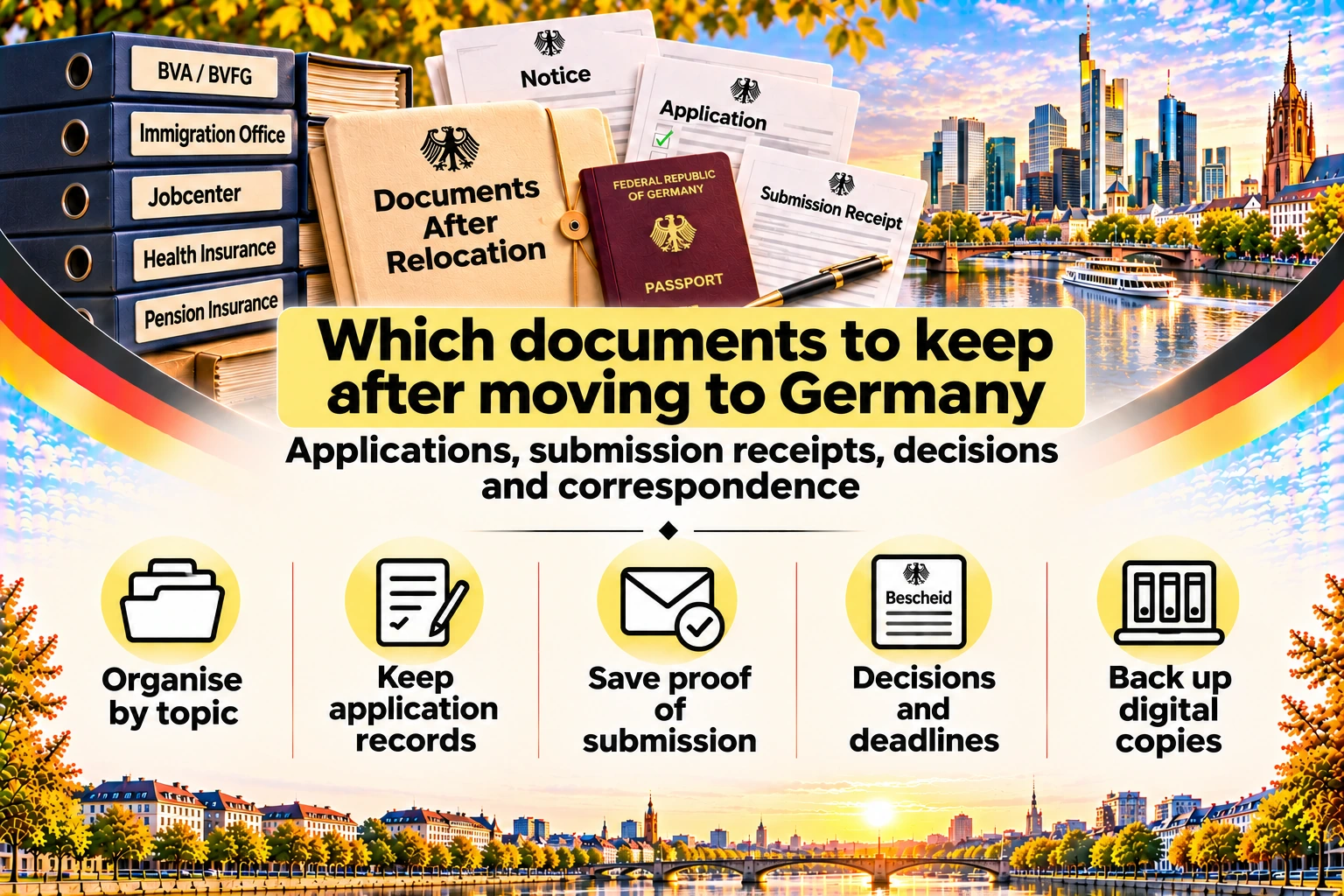
After moving, it is not enough to keep your passport, tenancy agreement and latest letter from an authority. Months later, you may need to prove exactly what you submitted, when you submitted it and which decision you received. That requires more than a pile of scans: each case needs a connected history comprising the application, attachments, proof of submission, correspondence and official decision (Bescheid).
Below is a practical system for a family, including one that has moved under the ethnic German resettlement programme. It helps you find documents and identify unresolved issues. These are recommendations for organising a personal archive, not a single statutory retention period. Business, tax and certain specialised documents have their own rules.
Start with three sections
Permanent family archive. This includes birth and marriage certificates and evidence of name changes, family relationships, education, status and citizenship. Keep originals and complete digital copies. For ethnic German resettlers (Spätaussiedler), include admission notices (Aufnahmebescheid), decisions including relatives, the registration certificate (Registrierschein), certificates under Section 15 BVFG and important documents on which the family’s case was based.
Current cases. Create a separate folder for each procedure: obtaining documents after arrival, insurance, a benefit application or recognition of qualifications. Keep the full exchange with the relevant authority in that folder. Do not mix spouses’ applications simply because they share a surname.
Household and financial documents. Contracts, statements, invoices, payment receipts, employment records and pension documents. Separate them by subject and year, but do not automatically delete them at the end of the calendar year.
Keep an index in your paper archive showing the document name, person, date, reference number and location of the original. Use the same structure digitally. This is consistent with the BBK’s recommendation to gather important documents in a folder accessible to the family and keep additional copies separately. The BBK list is emergency preparedness guidance, not a rule permitting destruction of originals. BBK guidance on safeguarding documents.
If your family’s documents remain scattered across suitcases, inboxes and message threads after moving, FIRMDER can help organise the material you provide and identify gaps. During a consultation on ethnic German resettlement, you can work through which documents relate to each family member and which questions need separate clarification. This is organisational and advisory assistance, not a promise of a particular decision by an authority.
Keep a complete file for every application
A saved blank form does not show what was sent. After submission, the folder should contain:
- The version actually submitted. All pages, signatures and the date; for an online form, an available copy of the completed and submitted application.
- All attachments in the form submitted. Including reverse sides, translations, certifications, apostilles and the covering letter if they formed part of the package.
- An inventory. A short list of attachments with clear names and page counts where needed.
- Proof of dispatch and receipt. Postal documents, an acceptance stamp, portal receipt, acknowledgement of receipt (Eingangsbestätigung) and assigned reference number.
- Later additions. Keep each supplementary submission as a separate package with its date and proof.
Keep drafts separately, marked “not sent”. Do not overwrite the submitted version with a corrected file: otherwise, a year later you may be unable to establish when the authority learned about a change.
A filename pattern such as 2026-10-29_BVA_Ivan_response-to-request_sent.pdf is sufficient. If the document date differs from the dispatch date, record both in the index. Full passport numbers are generally unnecessary in filenames.
Proof of sending is not proof of contents
The archive’s purpose is to link the material to the submission event. Postal tracking alone does not usually show which pages were in the envelope. A copy of an application, meanwhile, does not establish that the recipient received it.
For postal submissions, retain a copy of the whole package, the posting receipt, tracking number and available delivery confirmation. Do not leave a tracking link as your only evidence: save the available result. Choose the delivery method according to the procedure’s requirements, particularly when a deadline must be met.
For in-person submissions, ask for the acknowledgement provided by the authority. Where possible, clarify which documents it lists. A personal calendar entry saying “attended appointment” does not replace proof of submission.
For portal submissions, download the completed application, receipt, transaction number and attachment list. Keep error messages and evidence of resubmission. A screenshot is useful supplementary evidence, but does not replace available original files and the official receipt. “Draft”, “files uploaded” and “application submitted” are not equivalent statuses.
For email, save the sent message itself with addresses, date and attachments, not just its text in a note. Save the authority’s reply separately. An automated notification does not mean that the package’s completeness or compliance with all formal requirements has been checked.
Establish the permitted channel in advance. An authority having an ordinary email address does not mean it can be used for every legally significant action. Electronic communication and alternatives to the written form are governed, among other provisions, by Section 3a VwVfG; social law has its own provision, Section 36a SGB I. In a dispute about deadlines, the requirements of your particular procedure matter.
Keep the decision with its delivery evidence and attachments
A Bescheid is an official decision. Keep it in full: the first page without the reasons, calculation and appeal instructions (Rechtsbehelfsbelehrung) often does not explain its consequences. When a letter arrives:
- check the addressee and reference number;
- keep all pages, reverse sides and attachments;
- retain the envelope, especially any delivery markings;
- record when and how you actually received it;
- save the electronic notification and portal information if the decision arrived online;
- enter stated deadlines and the next action in your calendar.
If a representative received the document, establish their receipt date. The date printed on the decision, the postal dispatch date and the legally relevant notification date may differ.
Do not apply one delivery rule to every authority. General administrative procedures require consideration of whether federal or state law and special provisions apply. Social law procedures are governed by SGB X; the VwVfG expressly excludes procedures under the Social Code from its scope. Postal delivery, electronic transmission, portal availability and formal service also follow different rules. For example, Section 41 VwVfG and Section 37 SGB X contain different provisions on accessing an electronic decision. Section 2 VwVfG, Section 41 VwVfG, Section 37 SGB X.
For your archive, preserving the facts and delivery evidence is therefore more important than calculating a deadline yourself using a formula found online.
An appeal deadline is not a retention period
The Rechtsbehelfsbelehrung explains the available remedy, where to submit it and the deadline. Read it immediately, even if you initially intend only to ask for an explanation.
In administrative proceedings, an objection (Widerspruch) is not always available. Section 68 VwGO permits exceptions to the preliminary review procedure. Where an objection applies, Section 70 VwGO sets a usual one-month period; Section 74 VwGO also provides a one-month period for the corresponding court action, with different triggering events. This is not a universal rule for every letter from Germany. Section 68 VwGO, Section 70 VwGO, Section 74 VwGO.
For matters heard by the social courts, Sections 84 and 87 SGG govern objection and court-action deadlines. They include specific rules on notification abroad. Do not automatically apply those rules to a BVA or immigration authority case. Section 84 SGG, Section 87 SGG.
Missing or incorrect instructions are subject to special provisions, Section 58 VwGO or Section 66 SGG. Do not decide for yourself that “I definitely have a year now”: first establish whether the provision applies and whether the instructions are actually defective. Section 58 VwGO, Section 66 SGG.
Asking for an explanation, making a fresh application or waiting for a consultation does not itself preserve an appeal deadline. A refusal, repayment demand or disputed calculation requires timely individual assistance from an authorised professional, including a lawyer where appropriate. A well-organised archive helps you provide the facts quickly but does not replace legal assessment.
If you do not understand which papers relate to a letter you have received, FIRMDER can help build a chronology, organise attachments and formulate questions for further review. Contact us, stating the document type and whether there is an urgent deadline, without sending unnecessary personal information in your first message. If you need to challenge a decision, do not delay contacting a lawyer while waiting for a consultation response.
Correspondence should explain the case history
Keep not only the final reply but also the request it answers. Each thread should clearly identify the sender, recipient, date, subject, attachments and outcome.
A short log is useful: “request received”, “three documents sent”, “extension requested”, “authority confirmed new date”. Keep an extension request and the reply separately: sending a request does not itself demonstrate agreement.
After a phone call, make your own note of when it took place, who you spoke to, the case concerned and what was discussed. Label it as a personal record, not official confirmation. Important arrangements should be clarified in writing through an accepted channel.
Do not delete notifications of a change of address or representative: they help reconstruct where correspondence was directed. For handling a specific supplementary document request (Nachforderung), see the separate guide to replying to a BVA request.
Originals and digital files serve different purposes
A scan is convenient for searching and sharing, but saving it as a PDF does not turn it into a certified copy. If the authority requires an original or a particular certification, follow that requirement. The BVA separately specifies the required form of different documents and the need for complete copies, including reverse sides. BVA guidance on documents and certificates.
When scanning, check page edges, stamps, signatures, reverse sides and small-print legibility. Do not alter the content of the source image. Keep the translation alongside the document to which it relates, not instead of it.
If a document was originally electronic, keep the received file unchanged, with its accompanying message and any available signature or verification files. Printouts and screenshots are additional working copies, not a reason to delete the digital original. The mere existence of a file, electronic signature or scan does not guarantee its evidential weight in every procedure.
Do not use your originals folder for everyday sharing. If an original is handed to an authority or professional, note to whom, when, on what basis and how it is expected to be returned.
Decide how long to keep documents
Recommended retention. Documents concerning ancestry, marital status, legal status, citizenship and qualifications are sensibly kept permanently. Important pension-history records should not be deleted according to a general household schedule either. This is a practical evidence-preservation strategy, not a claim that every document is subject to a lifelong legal obligation.
Keep current cases in full while assessment, appeals, calculations, repayments or related procedures remain open. After completion, consider which records may be needed to prove past circumstances. Expiry of the appeal period does not mean you will never need the decision again.
Mandatory retention. There is no single rule saying that all documents after a move must be kept for ten years. For example, Section 14b UStG requires private recipients of certain property-related work or services to keep the invoice, payment receipt or another evidential document for two years. The period runs from the end of the calendar year in which the invoice was issued. This is a specific rule, not permission to destroy documents relating to an unresolved dispute after two years. Section 14b of the VAT Act.
Business records and certain tax documents have separate retention duties; Section 147 AO distinguishes document categories, while Section 147a AO concerns particular taxpayers. Do not apply those periods to your entire family archive or use a household filing scheme as an accounting policy. Section 147 AO, Section 147a AO.
Before deleting anything, ask three questions: Is there a specific retention obligation? Are any claims still open? Can the relevant circumstances be proved without this document? If an answer is unknown, establish it first. Making a scan does not by itself justify destroying the original.
Protect your archive against loss and unnecessary access
A folder on your phone and a synchronised cloud copy do not address every risk. An accidental deletion may also propagate to the synchronised folder. Make a separate backup and check that its documents open. The BSI specifically recommends a local backup in case data is permanently deleted from the cloud. BSI guidance on protecting cloud data.
Use a unique cloud password, two-factor authentication and appropriate encryption. Do not grant permanent access to the whole family archive for a single consultation. Send the necessary set of documents to a verified recipient, checking the address and access rights. BSI guidance on safe cloud-service use.
Agree in advance which adult can find an urgent letter if someone else normally manages the archive. Sharing a household does not, however, require giving every relative access to each family member’s medical, financial and other sensitive records.
FAQ
It is better to retain earlier decisions too, especially if the latest one changes an amount, period or condition. Otherwise, you lose the history of changes and the basis for earlier payments or actions.
For an important decision, yes, as a practical precaution. The envelope and delivery details may be needed to establish when it was received. Do not keep only a photograph of the first page.
Download available documents and confirmations into your own archive. Do not rely on indefinite access to the account, old notifications and attachments.
Putting them in your permanent archive is sensible; receiving a passport alone is no reason to destroy them. Keep status documents and the history of the family case. The distinctions are explained in the article on reference numbers, admission notices and Section 15 BVFG certificates.
List the missing items, check email and portals, and ask the issuing organisation for an available copy or its replacement procedure. Do not assume every original can be replaced quickly. If a response or appeal deadline is running, deal with that in parallel rather than waiting to restore the whole archive.
Where to start today
Gather all open cases, find the latest letter for each and write down the next actions. Then add submitted applications, attachments and acknowledgements of receipt. You can organise permanent originals next; an urgent decision must not wait for perfectly arranged folders.
FIRMDER helps turn scattered family papers into a clear working file: a chronology, document inventory and questions requiring clarification after relocation. Book a consultation to agree the scope of reviewing your situation. We are an independent private consultancy, do not issue government documents and do not guarantee authorities’ decisions; individual legal and tax questions require the appropriately authorised professional.