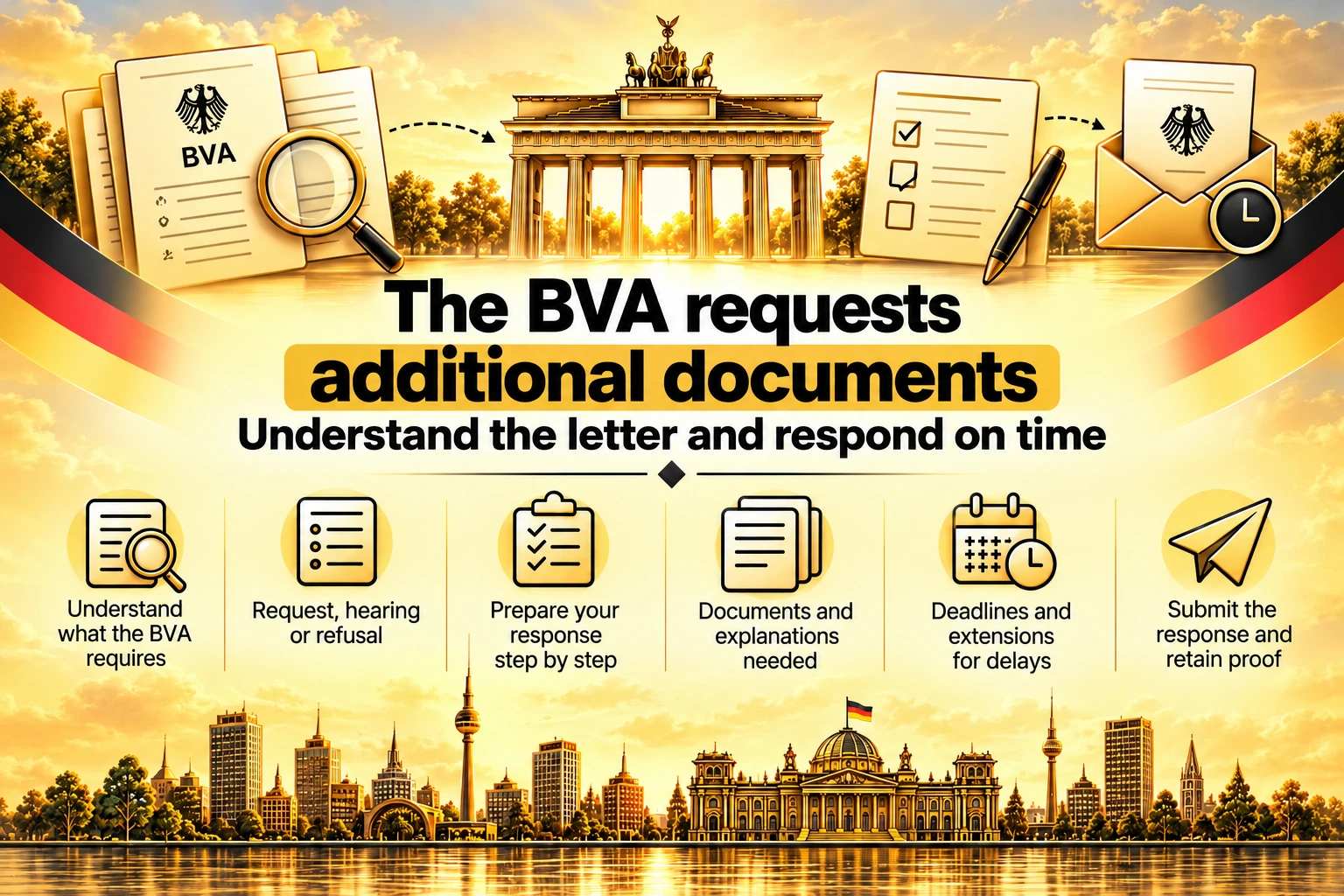
BVA requests additional documents: understanding the letter and responding on time
If the BVA requests additional documents in an ethnic German resettlement case, first identify exactly what is required, by what date and in what form. Match each point in the letter to supporting evidence, prepare explanations and retain proof of submission. If a document is delayed, request an extension in advance and attach evidence of your request to the archive or other authority. Asking for an extension does not itself change the deadline.
This guide concerns the initial admission procedure (Aufnahmeverfahren): the application has already been submitted and the Federal Office of Administration is clarifying the facts before deciding on admission. It explains how to handle a Nachforderung, avoid overlooking individual questions and assemble a verifiable response. General eligibility conditions are set out in our overview of the ethnic German resettlement programme.
Checked against official sources on 8 October 2026. This article is informational; the specific letter and circumstances may require an individual legal assessment.
- What a BVA request for additional documents means
- Distinguishing a document request, a hearing and a refusal
- Preparing a reply to a BVA request
- Step 1: Save the letter and record the details needed for your reply
- Step 2: Break the request into individual tasks
- Step 3: Check document formalities and translations
- Step 4: Explain differences in names and dates
- Step 5: Document the search for missing archive records
- Step 6: Check the deadline and request an extension if needed
- Step 7: Prepare the covering letter and attachment list
- Step 8: Send the response and retain proof
- When specialist review is needed
- FAQ
- Official sources
What a BVA request for additional documents means
Nachforderung usually means a letter asking for further documents or explanations. It shows what information the authority needs to continue its assessment. The request alone does not establish that the case will be approved, refused or decided within a particular period.
The BVA establishes the facts and determines the necessary methods of inquiry. Parties are expected to assist in establishing the facts, particularly by providing circumstances and evidence known to them. These general rules are set out in § 24 VwVfG and § 26 VwVfG.
The letter may concern a gap in the family relationship chain, an illegible copy, insufficient certification, a difference in surname spelling or a question about the application. You do not need to gather the entire original package again if the authority identifies specific missing items. First establish which fact it is checking.
Distinguishing a document request, a hearing and a refusal
Read the complete letter, including the final pages and attachments. A file name or opening sentence does not always convey its meaning.
- A document request lists what must be provided or explained. It may include a warning about the consequences of failing to respond.
- An Anhörung gives you an opportunity to comment on facts relevant to an intended decision. If the BVA already sets out grounds for an adverse finding, your response must address those grounds. General hearing rules are contained in § 28 VwVfG.
- An Ablehnungsbescheid communicates a refusal. The decision, date of receipt and instructions on legal remedies must be checked separately. Simply submitting further documents may not be enough.
- A letter reviewing an earlier decision or status requires a different analysis. Guidance for an initial application does not replace a response in that procedure.
Notice of an intention to refuse is not yet a refusal decision. However, it must not be handled like an ordinary request for a clearer scan. If the content is ambiguous, first clarify the procedural position with a specialist German lawyer.
Preparing a reply to a BVA request
Step 1: Save the letter and record the details needed for your reply
Create a separate folder for the request. Save the letter, attachments, envelope, delivery notice or original electronic message. Check that all pages are available. If a representative forwarded the letter, ask for the complete set and establish when and by whom it was received.
Record the following in your working checklist:
- the full case reference (Aktenzeichen), without abbreviations or alterations;
- letter date and details of receipt;
- names of the applicant and relatives concerned by the request;
- every BVA question, including those within paragraphs;
- response deadline and the exact wording on how it is calculated;
- department address, contact person and permitted submission channel;
- requirements for signatures, copies, translations and originals.
When translating the letter, pay particular attention to negatives, dates and words expressing an obligation or an option. Automatic translation can help with the overall meaning, but ambiguous terms deserve separate review. Confusing ‘if necessary’ with ‘mandatory’ changes what the response must contain.
Step 2: Break the request into individual tasks
The working principle is simple: each BVA question should have a clear answer and a reference to the relevant attachment. For each item, record four things: what is requested, what proves it, what is ready and what still needs doing.
For example, if you need to explain different surnames for your mother, a new translation of the birth certificate may not be enough. Check the marriage or name-change document, compare the dates and explain the connection between the records. If a document from a specific year is requested, do not substitute a later certificate without explanation.
You can use this short checklist:
- The point from the BVA letter has been copied accurately and assigned to the correct person.
- The fact to be established has been identified.
- The appropriate document has been selected and its form and translation checked.
- An explanation of the discrepancy or missing document has been prepared.
- An attachment number has been assigned or the remaining action recorded.
Divide the items into ready, needing preparation and currently unavailable. Each unavailable item should have a next step: request a record, clarify where it is held, correct a translation or obtain a written no-record-found response. Set an interim review date so you discover delays before the BVA deadline.
You can compare the basic document list with our article ‘Documents for ethnic German resettlement in Germany’. For each specific submission, check the current BVA requirements and the letter you received.
Step 3: Check document formalities and translations
Having the correct certificate does not necessarily mean that the copy you have prepared is suitable for submission. The official BVA section on documents and certificates distinguishes between originals, certified copies and ordinary copies depending on the document type.
The BVA specifies complete copies, including reverse sides, and translations of foreign-language material by a sworn translator. Where a certified copy is required, certification of the translator’s signature alone does not establish that the copy matches the original. Apostille requirements depend, among other things, on the document type, country and date of issue; the BVA page lists exceptions.
Do not order the same formalities for every document. Check each item against the official list and the letter. If an apostille cannot be obtained, the BVA recommends contacting it or the competent German mission abroad. Do not automatically send your only original: first establish whether it is specifically required.
Open every file before sending it. Make sure page edges, stamps, numbers and entries on the reverse are visible, and that the translation corresponds to the version attached. File names should distinguish the certificate from its translation without repeated opening.
Step 4: Explain differences in names and dates
First identify the nature of the discrepancy. It may be different transliteration of the same name, a documented surname change, a translator’s typo or differences in the original records. These situations require different actions.
Prepare a short comparison: document, issue date, name spelling and explanation. For example, distinguish the birth surname from the married surname and attach the document linking them. For different Latin spellings, give the original spelling and show which translations introduced the difference.
A translator can correct an error in their translation, but not the contents of a certificate. If dates of birth, parentage or other original information differ, first establish the reason and any available official correction procedure. Do not alter scans yourself or ask a translator to reconcile different facts into a convenient version.
An explanation should separate established facts from assumptions. ‘The reason for the discrepancy has not yet been established; an inquiry has been sent’ is more accurate than a confident unsupported explanation. Take particular care with differences affecting ancestry and family relationships.
Step 5: Document the search for missing archive records
If the archive certificate is not ready, keep a copy of your request, its submission date, registration number and the institution’s response about the search. These materials help show what you have done and why you need more time. They do not themselves prove the fact for which the certificate is required.
If no entry is found, it is useful to obtain a written response identifying the period, collection or area searched. Distinguish between a missing entry, records that have not survived, a request sent to the wrong archive and a search still in progress. The next step depends on which applies.
Check whether the archive request was precise enough: surname variants, former place name, approximate year of the event and family relationship. Repeating a vague inquiry at another archive may not help. Parallel requests make sense where different likely record locations are known.
List any alternative materials and explain which part of the facts they support. Do not assume that a no-record-found response, family recollection or another authority’s decision automatically replaces the required evidence. If the primary document cannot be obtained, the acceptability of a substitute must be assessed separately.
Step 6: Check the deadline and request an extension if needed
There is no universal response period for every BVA request. Do not rely on someone else’s ‘four weeks’ or ‘six weeks’: record the date or period in your own letter. If it runs from receipt, retain delivery information and check how the period is calculated.
§ 31 VwVfG governs time limits in administrative proceedings and permits extensions of deadlines set by the authority. This requires a decision by the authority. An extension request, notice of an archive delay or request for file access does not itself establish a new deadline.
Apply in advance: identify the missing document, reason for the delay, steps already taken and a realistic date until which you request an extension. Attach available evidence and expressly ask for the decision in writing. Until the extension is confirmed, plan around the original deadline.
Clarify whether you may send the ready portion separately. In a partial response, state explicitly which points are covered, which remain and when documents are expected. Do not describe an incomplete package as complete.
If the deadline has passed, act without further delay. The law allows an authority-set deadline to be extended retrospectively, but the result is not guaranteed. If a decision has already been issued, also check the procedure and deadline for challenging it.
Short wording for an extension request
Below is an example structure for an ordinary request. Adapt it to the letter and actual circumstances; for a hearing or a refusal already issued, it does not replace a substantive response.
Sehr geehrte Damen und Herren,
zu Ihrem Schreiben vom [Datum], Aktenzeichen [Aktenzeichen], bitte ich um Verlängerung der Frist bis zum [Datum]. Das angeforderte Dokument [Bezeichnung] wurde am [Datum] bei [Stelle] beantragt und liegt mir noch nicht vor. Als Nachweis füge ich [Bezeichnung der Anlage] bei. Bitte teilen Sie mir schriftlich mit, ob die Frist verlängert wird.
Mit freundlichen Grüßen
[Name]Check every statement and remove anything inapplicable. Do not state that a document has been requested or evidence attached if that has not yet happened.
Step 7: Prepare the covering letter and attachment list
Begin your reply with the case reference, applicant’s name and date of the BVA request. Then answer in the same order as the authority’s questions. This makes it possible to match the request to the response without searching the entire package.
A useful structure for each point is: short answer, explanation if needed, attachment number. If the evidence was submitted before, identify the document and previous sending date. Do not rely on ‘everything is already in the file’ where a specific doubt needs addressing.
Number attachments consecutively. For each, list the title, person concerned, document date and pages. Label the original or copy and its translation so their connection is clear. Use the same numbers in the electronic file names.
Do not turn the covering letter into a new family biography unless one was requested. Include the information needed to respond and do not conceal significant contradictions. If an additional explanation changes a fact previously supplied, identify the correction and its basis explicitly.
Step 8: Send the response and retain proof
Check the address and submission channel in the BVA letter. Do not assume that an ordinary email with scans replaces required certified copies or originals. If the permitted method is unclear, ask the department named in the letter.
Before sending, retain an exact copy of the final package: covering letter, attachment list and attachments. For post, keep the receipt and available proof of delivery. For an electronic channel, save the sent message, attachment list and any acknowledgement issued by the service.
Allow time for delivery: do not plan on the assumption that a postmark necessarily establishes compliance with the deadline. Proof of transmission also does not prove that the documents were considered sufficient. If delivery fails, investigate promptly and retain the correspondence.
After sending, record which archive materials are still pending. When submitting later documents, state the case reference again and connect them to the original response. This preserves the sequence of correspondence, especially when materials arrive in several batches.
When specialist review is needed
Individual legal assessment is especially important if the letter sets out possible grounds for refusal, doubts about document authenticity, significant contradictions concerning ancestry or a review of an earlier decision. A deadline that has already passed also requires particular attention.
If it is unclear which materials support the authority’s findings, access to the case file may be needed. § 29 VwVfG provides parties with access to the file insofar as necessary to protect their legal interests, subject to specified restrictions. It does not mean unconditional disclosure of all internal documents or remove the need to address the response deadline separately.
For an organisational review, prepare the BVA letter, original application, previous correspondence and attachments already submitted. During a consultation on the ethnic German resettlement procedure FIRMDER helps organise materials, compare information and identify questions requiring clarification. The scope of services is agreed separately. The BVA decides the case; where needed, individual legal representation should be discussed with a specialist lawyer.
FAQ
The request alone does not justify that conclusion. Check whether the BVA is asking for a missing document or already describing grounds for an intended adverse decision. In the latter case, a substantive response to those grounds is important.
Follow the content of the letter. For a specific request, a point-by-point reply and attachment list are usually more useful. Sending the complete package again without explanation can make the documents harder to match.
If some materials are unavailable, state this clearly, explain why and address the deadline separately. A partial response does not mean the remaining requirements have been met or that the deadline has automatically been extended.
It depends on the document type and submission requirements. Check the letter and official BVA list. Being able to send a file electronically does not itself remove certification or original-document requirements.
Keep evidence of the request, check its status and tell the BVA which document is delayed. Support the extension request with specific circumstances. Do not remain silent until the last day.
Such a certificate describes the outcome of a search. It does not automatically establish kinship, ethnic affiliation or another fact being examined. Alternative evidence must be assessed against the BVA’s specific question.
Do not treat silence as consent. Ask about the decision and continue preparing your response against the original deadline. Keep the request and proof of transmission.
If the translation contains an error, contact the translator. If the source documents differ, merely replacing the translation will not solve the problem. First establish the reason for the discrepancy and prepare an explanation supported by evidence.
Immediately check the current case status, explain the delay and assess the available procedural steps. It is particularly important to establish whether a decision has been made, because separate rules govern challenging it.
Submitting further documents alone does not reveal when a decision will be made. First confirm receipt, then monitor further correspondence. Compare new BVA questions with the materials already provided.
Official sources
- BVA — Unterlagen und Urkunden: document list, copies, translations and apostilles.
- § 24 VwVfG: establishing the facts of the case.
- § 26 VwVfG: evidence and cooperation by the parties.
- § 28 VwVfG: Anhörung.
- § 29 VwVfG: access to the case file.
- § 31 VwVfG: calculating and extending time limits.
Sources checked on 8 October 2026.