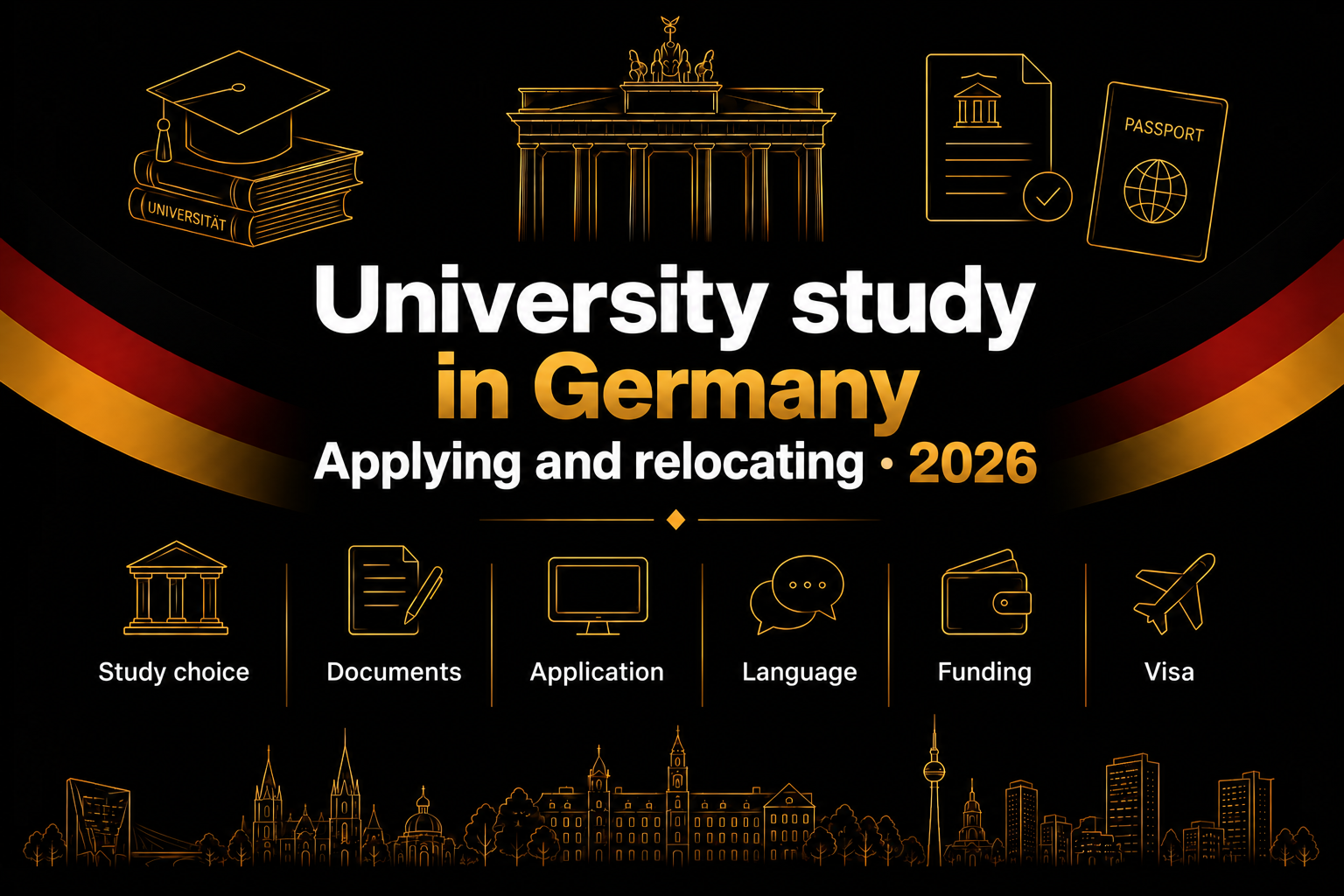
Many public universities offer regular degree programmes without general tuition fees. This does not apply without exception to every institution, programme or international student. Check tuition and semester contributions separately before applying.
In addition to any tuition, universities charge their own semester contribution. Whether a transport ticket is included, and which one, varies. Private institutions and some continuing-education programmes set their own fees. Germany offers a wide range of institutions and programmes. Many international applications use uni-assist – processing normally costs EUR 75 for the first programme and EUR 30 for each additional programme in the same semester; arrangements for covering costs may differ.
The residence-law basis for studying is section 16b of the Residence Act (§16b AufenthG). For study in 2026, the standard blocked-account proof of funding is EUR 11,904 per year. July 15 and January 15 are common application deadlines, but they do not apply to every programme.
Applying in the final week leaves little time to correct missing documents. uni-assist recommends at least eight weeks’ lead time. In the standard procedure, complete documents and payment must arrive by the deadline; with a VPD, you must also submit your own university application on time.
- Entry requirements for university study in Germany
- Checking qualifications: anabin, the university and the ZAB
- How uni-assist works
- Application deadlines
- Language requirements for studying in Germany
- Student visa under section 16b: documents
- Blocked account: amount, opening and providers
- Studienkolleg: who needs it and how to apply
- Working while studying at a German university
- Planning student living costs in Germany
- After admission: registration and residence permit
- FAQ
Entry requirements for university study in Germany
Admission depends on the programme and institution. Key points include eligible prior education, required language evidence and subject relevance for postgraduate courses; further selection criteria may apply.
| Criterion | Bachelor’s degree | Master’s degree |
| Educational qualification | Eligible university-entry qualification, where necessary after Studienkolleg and FSP | Eligible first university degree and the required subject-specific credits |
| German-taught study | DSH-2, TestDaF 4×4 or another expressly accepted certificate; Goethe C1 is not automatically sufficient | Often DSH-2 or TestDaF TDN 4 in all four parts; check the exact requirements |
| English-taught study | Example: IELTS 6.0–6.5 or TOEFL iBT 80–90; the programme’s requirements are decisive | Example: IELTS 6.5–7.0 or TOEFL iBT 90–100; the programme’s requirements are decisive |
| Qualification assessment | Assess the school qualification and prior education; Studienkolleg if required | Assess the university degree and subject requirements under the institution’s rules |
| Submission | Through uni-assist or directly to the university, depending on the procedure | Through uni-assist or directly to the university, depending on the procedure |
A school-leaving certificate from Russia or Kazakhstan does not automatically provide direct university entry. The exact qualification, graduation year and any subsequent study matter. Start by checking anabin is the Standing Conference of Education Ministers’ database on foreign education systems and qualifications. H+ and H− describe an institution’s status, not directly the university-entry rights of a school qualification. Whether Studienkolleg is required depends on the actual prior education and admission rules.
Checking qualifications: anabin, the university and the ZAB
The first step when preparing for university study in Germany starts with checking educational qualifications in anabin, which provides information about foreign education systems and qualifications. An initial search is useful, but the responsible university and its admissions procedure determine eligibility.
- Open anabin.kmk.org.
- Select the country, type of educational qualification and institution.
- H+ indicates a recognised institution; assess the degree and entry requirements separately, H means the conditions in the specific database entry must be checked, H- indicates a negative institutional status; it does not automatically mean that attending Studienkolleg resolves the issue. School-based university-entry eligibility and university qualifications must be assessed separately.
- If a qualification or institution cannot be clearly assessed, ask the admissions office about the next step; assistance may also be available from the ZAB Central Office for Foreign Education (ZAB). A Statement of Comparability is not automatically the right document for a university application.
A ZAB Statement of Comparability describes how a foreign university qualification compares with German qualifications. It costs EUR 208, with standard processing around three months after complete documents and payment. It neither replaces a university’s admission decision nor is automatically required for every master’s application. Follow the university’s or uni-assist’s instructions.
How uni-assist works
Uni-assist supports participating universities in assessing international applications. It is not a single admissions portal for every German university. Depending on the procedure, a complete application is forwarded or preliminary review documentation (VPD) is issued for your subsequent direct university application.
| Criterion | Details |
| Cost | Usually EUR 75 for the first programme and EUR 30 for each additional programme in the same semester; check whether costs are covered |
| Processing time | Often 4–6 weeks; apply early and distinguish the VPD procedure |
| What is assessed | Formal educational evidence and the participating university’s requirements |
| Result | Depending on the procedure, forwarding of the application or a VPD for your own university application; the university decides admission |
| Documents | Educational documents, transcript, language evidence and any further university-specific documents such as a motivation letter |
For a July 15 deadline, plan at least eight weeks ahead. Where required, obtain a VPD from uni-assist first and then submit it with your own university application. Other institutions accept direct applications; check their application pages.
Application deadlines
The dates below are examples, not universal deadlines. Programme, degree level, nationality and application procedure may lead to different dates. The university’s own published rules are decisive.
| Semester | Common application deadline; the actual university’s rules apply | Recommended lead time for uni-assist | Start of studies |
| Winter semester | Often July 15; check the programme | Plan at least 8 weeks before the actual deadline | Usually October; check the university |
| Summer semester | Often January 15; check the programme | Plan at least 8 weeks before the actual deadline | Usually April; check the university |
| Studienkolleg: winter intake | Check the official website | Preferably at least 8 weeks before the deadline | Usually October; check the university |
| Studienkolleg: summer intake | Check the official website | Preferably at least 8 weeks before the deadline | Usually April; check the university |
Specific programmes, selection procedures or applicant groups can have different deadlines. Use the current official application page and check document-submission deadlines and entrance examinations as well.
Language requirements for studying in Germany
German-taught programmes require evidence accepted by the university or a recognised exemption. The table gives examination examples; Goethe C1 in particular is not generally sufficient. Check examination-entry rules, required results and fees with the provider and programme.
| Language certificate | Organisation | Required result | Cost |
| TestDaF | TestDaF-Institut | Usually TDN 4 in all four test sections; TestDaF covers the B2–C1 range | Check the test centre’s current price |
| DSH | German universities | DSH-2 (≥67%) / DSH-3 (≥82%) | Examination fee set by the university |
| Goethe-Zertifikat C1 | Goethe-Institut | C1 | EUR 200–300; illustrative only |
| telc Deutsch C1 Hochschule | telc GmbH | C1 | Check the test centre’s current fee |
DSH is offered by appropriately registered universities and institutions, whose examination-entry rules must be checked. TestDaF and Goethe examinations can be taken independently. Goethe C1 is not universally accepted by universities; Goethe C2 is a recognised form of evidence under the relevant rules. Universities set the IELTS or TOEFL scores for English-taught programmes. Find international programmes here: daad.de.
Student visa under section 16b: documents
The legal basis for study residence is section 16b of the Residence Act (§16b AufenthG) governs residence for study purposes. If you require a visa, apply for a national visa before travelling through the responsible German diplomatic mission. Check its procedure and appointments early; admission, funding evidence and other documents must be available at the required stage.
The visa application normally requires the following evidence:
- Zulassungsbescheid is the admission notice from the university or Studienkolleg. Depending on the purpose, conditional admission or a different statutory applicant route may be relevant; saying that no study-related applicant visa is possible without admission would be too broad.
- Sperrkonto-Bescheinigung normally evidences EUR 11,904 for twelve months of study in 2026. Check other accepted funding evidence, such as a scholarship or declaration of commitment, with the diplomatic mission.
- Educational documents with the translations and, where required, certified copies requested by the university and diplomatic mission.
- Language evidence accepted by the programme, such as TestDaF, DSH or an accepted equivalent; IELTS or TOEFL where required for English.
- Health-insurance cover sufficient for entry and the study stay. A travel policy with only EUR 30,000 cover is not automatically suitable for the entire national-visa residence period.
- Biometric photograph and completed visa application under the current requirements.
The standard national-visa fee for adults is EUR 75, with possible exemptions and reductions. Processing depends on the diplomatic mission and the individual case; four to twelve weeks is not a guaranteed timeframe.
Blocked account: amount, opening and providers
A blocked account is one way to demonstrate funding to the diplomatic mission. The balance remains yours, but access is restricted. Scheduled monthly amounts are released after the required activation; conditions and timing depend on the provider. The standard annual study amount in 2026 is EUR 11,904 (EUR 992 × 12 months). The immigration funding calculation draws on BAföG needs rates; section 13 is one of the relevant provisions (§13 BAföG).
| Provider | Account fees | Timeframe | Features |
| Fintiba (fintiba.com) | Opening and ongoing fees according to the current tariff | Depends on identification, assessment and receipt of funds | Have nationality, residence and transfer route assessed individually |
| Coracle (coracle.de) | Check current pricing and package conditions | Depends on identification, assessment and receipt of funds | Have nationality, residence and transfer route assessed individually |
| Deutsche Bank | Check fees and whether new accounts are available | Check the opening procedure directly with the bank | Confirm current product availability directly with the bank |
| Expatrio (expatrio.com) | Opening and ongoing fees according to the current tariff | Depends on identification, assessment and receipt of funds | Confirm acceptance of your specific case before paying |
Availability and conditions depend on nationality, residence, banking arrangements and compliance checks. Confirm acceptance of your case before paying. Fees in the source article were not consistently current: for new accounts since November 2025, Fintiba lists EUR 159 setup and EUR 9.90 monthly. Always check your chosen provider’s current price list before signing.
Studienkolleg: who needs it and how to apply
A Studienkolleg prepares applicants whose qualifications do not provide direct university entry. It commonly lasts two semesters and ends with the Feststellungsprüfung (FSP). Passing establishes subject-specific university-entry eligibility, but does not guarantee a place. Public courses often have no tuition fees; check semester contributions and any special charges separately.
The stream depends on the intended degree subject; offerings and names may vary by Studienkolleg:
| Stream | Relevant fields | Subjects |
| T course: engineering and sciences | Engineering, mathematics, physics and computer science | Mathematics, physics, chemistry and German |
| W course: economics and business | Economics, business and law | Mathematics, economics and German |
| M course: medicine and life sciences | Medicine, biology and pharmacy | Biology, chemistry and German |
| G course: humanities | History, philosophy and education | History, German and social sciences |
| S course: languages | Linguistics and translation | German and another foreign language |
Studienkollegs and information about courses and application deadlines: studienkollegs.de. B1 or B2 is often required to apply. Entrance tests, resits and recognition of the FSP depend on the Studienkolleg and state rules; there is no general two-year validity limit to assume.
Working while studying at a German university
Section 16b generally permits 140 full or 280 half working days annually, with statutory counting rules including a weekly counting option. The social-insurance 20-hour rule is a separate issue. Common forms of student work include:
- Minijob has a regular monthly earnings threshold of EUR 603 in 2026. Tax treatment and pension-insurance liability or exemption must be checked separately; a minijob does not replace health insurance.
- Werkstudent is employment alongside a predominant course of study. The working-student social-insurance rules commonly use a 20-hour limit with exceptions; pension insurance and separate health cover still matter. Immigration work limits apply in addition.
- Compulsory internship may be treated differently from a voluntary internship when it is a required part of the degree. Confirm how the specific internship is counted before starting.
Exceeding permitted employment can breach residence conditions. Keep records of hours and work types with the employer and clarify uncertain cases with the immigration authority in advance. Do not rely on automatic central tracking by the Federal Employment Agency.
Planning student living costs in Germany
The usual blocked-account arrangement makes EUR 992 available each month. This is an immigration proof-of-funds amount, not a guarantee that it covers every expense. The figures below are simplified examples from the source article, not current city averages; calculate rent, insurance, deposit, semester contributions and personal costs individually.
| Expense | Berlin / Munich: planning examples | Dresden / Leipzig: planning examples | Note |
| Student dormitory room | EUR 350–600 as a dormitory example, not a guarantee of availability | EUR 200–350 as a low-cost dormitory example, not a guarantee of availability | Student dormitory; check availability and waiting lists |
| Food | EUR 200–300; illustrative only | EUR 150–250 as a planning example | Canteen prices vary by location, meal and student status |
| Local transport | May be funded through the semester contribution | May be funded through the semester contribution | Check whether a ticket is included and what travel it covers |
| Health insurance | Individual premium including long-term-care insurance | Individual premium including long-term-care insurance | Statutory insurers such as TK, AOK or Barmer; check your individual premium |
| Calculate the total monthly budget individually | Do not assume EUR 750–1,100 is sufficient; build a complete personal budget | Do not assume EUR 550–800 is sufficient; build a complete personal budget | – |
Even in less expensive cities, the blocked-account amount is not guaranteed to cover every expense. Plan a reserve; a future part-time job is neither guaranteed nor automatically sufficient funding evidence. Dormitories are often run by student-services organisations. Apply early under their rules because waiting times can be substantial.
After admission: registration and residence permit
After arrival, address registration, insurance evidence, the residence permit and enrolment must be arranged. Some steps can be prepared in parallel; check each deadline and its required documents separately.
- address registration is generally required at the registration office within two weeks of moving into the accommodation. You normally need an identity document and housing-provider confirmation; a tenancy agreement alone is not enough. Depending on the provider, banking and insurance can be prepared beforehand.
- Health insurance must fit your study and insurance status. Statutory insurers such as TK, AOK or Barmer offer student rates where eligible; premiums depend on the insurer, age and long-term-care cover, among other factors. Enrolment requires the prescribed notification of insurance status. Learn more: insurance in Germany.
- Residence permit apply to the immigration authority before the visa expires. Continued validity under section 81 depends in particular on a timely application; merely booking or waiting for an appointment is not automatically enough. Keep evidence of submission and obtain a Fiktionsbescheinigung where appropriate.
- Einschreibung means university enrolment: provide admission documents, insurance status and the semester contribution under the institution’s rules.
Start looking for housing early, while planning insurance and enrolment in parallel. Health-insurance evidence can often be prepared before address registration. The university, insurer and authority determine which documents are needed at each stage; there is no single rigid sequence for every case.
Relocation DE: how we help
Studying and moving to Germany need coordinated planning. Missing documents, funding problems or late visa appointments can delay the start, with consequences depending on the programme. Relocation DE supports the organisational preparation of applications and relocation. More information: studying in Germany.
- We assess educational evidence against admission rules to determine whether direct entry or a Studienkolleg may be appropriate.
- We help select suitable universities and programmes based on your subject and language level.
- We arrange required translations by appropriately authorised translators.
- We assist with the blocked account, visa documents and preparation for the consular appointment.
- After arrival, we help with registration, insurance, the residence permit and enrolment.
Send an enquiry and let us plan your next steps.
FAQ
Many public universities charge no general tuition for regular degree programmes. Exceptions include certain non-EU students in Baden-Württemberg, individual Bavarian institutions and specific programmes. Semester contributions are additional, and a transport ticket is not automatically included everywhere. Private universities set their own fees. Check the institution’s actual fee rules.
It depends on the exact school qualification, graduation year and any prior university study. anabin and admission guidance provide an initial assessment; the university decides. A Russian university degree may be suitable for a master’s programme but must meet its academic, language and formal requirements.
Yes. A fully English-taught programme may not require German-language evidence. The university determines English tests, scores and any additional German requirements. Many international programmes are available, especially at master’s level: daad.de.
If the university deadline is July 15, aim to start the uni-assist application at least eight weeks earlier. Language examinations, translations and any required apostille need further lead time. With a VPD, the direct university application must also be submitted on time.
Section 16b generally allows 140 full or 280 half working days per year under the statutory counting rules, including a weekly counting option for work of up to 20 hours. Student ancillary activities may be exempt. The 2026 minijob earnings threshold is EUR 603 per month; this does not mean blanket exemption from tax and contributions.