


Russian source dated 12 November 2026. Checks carried out for the English version are documented in the separate source review.
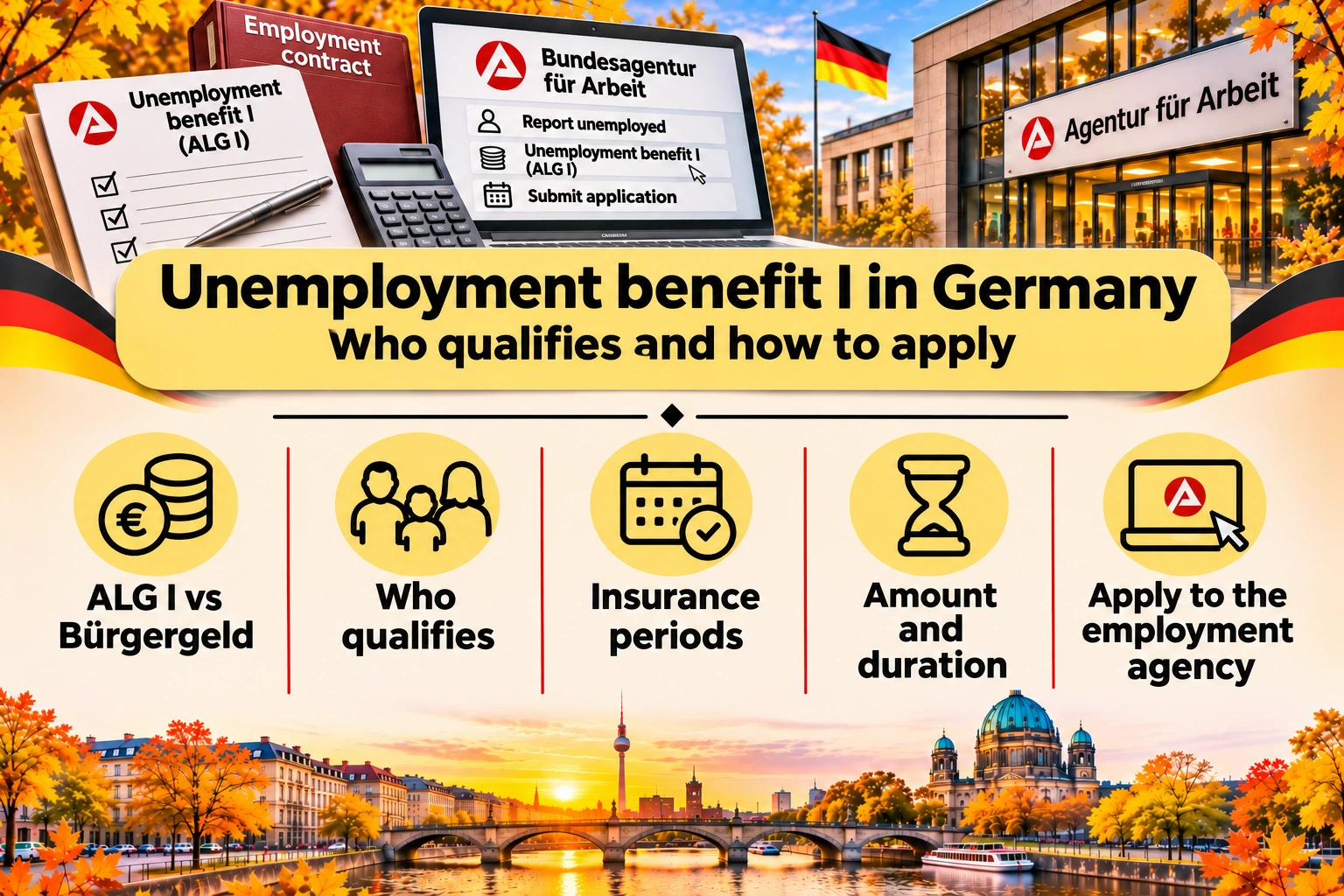
Short answer. Arbeitslosengeld I, or ALG I, is an insurance benefit paid during unemployment. You normally need at least 12 months of unemployment insurance within the previous 30 months, must register as unemployed and must be available for work. The benefit is generally 60% of calculated net earnings, or 67% if the child-related conditions are met. This is not necessarily 60% or 67% of the last amount credited to your bank account. The Agentur für Arbeit awards the benefit, not the Jobcenter. Legal basis: sections 137–143 and 149–153 SGB III.
This article focuses on entitlement, the calculation, the application and the documents. Dismissal rules, disputes with an employer and retaining a particular residence permit require separate assessment. The Agentur für Arbeit makes the final decision on the application.
What is ALG I and how does it differ from Grundsicherungsgeld (formerly Bürgergeld)?
ALG I is financed through the unemployment insurance system. The main questions for an award are whether you have qualifying insurance periods, whether you are unemployed within the legal definition and whether you have fulfilled your obligations as an applicant. The amount is linked to previous earnings, and the payment period is limited.
Grundsicherungsgeld (formerly Bürgergeld) belongs to a different system, SGB II, which involves a means test. An ALG I application does not replace an application for Jobcenter support. A low ALG I award does not automatically create entitlement to a top-up either: potential additional benefits are assessed separately, taking account of income, family circumstances and immigration status. See the ALG I conditions in section 137 SGB III.
Since 1 July 2026, the SGB II cash benefit has been called Grundsicherungsgeld. Older forms may still use Bürgergeld during the transition. See the BA explanation of the change.
Do not decide against applying merely because your spouse works or your family has savings: this is not the means test used under SGB II. However, your own side earnings, certain other payments and the circumstances in which your job ended can affect ALG I.
Who can qualify?
In the usual case, three conditions must all be met:
- You are unemployed within the meaning of SGB III: you have no employment that excludes this status, you are looking for work and you are available for placement.
- You have registered as unemployed: arbeitslos gemeldet.
- You have completed the qualifying insurance period: Anwartschaftszeit.
Availability means, among other things, being able and willing to perform permitted work subject to compulsory insurance for at least 15 hours a week and to cooperate with the Agentur für Arbeit. Having a child does not in itself rule out ALG I, but childcare must actually be arranged for any work you could take up. Special rules may apply if health problems limit your ability to work: the standard approach should not simply be applied after a long period of Krankengeld, or sickness benefit. See section 138 and section 145 SGB III.
Which periods count?
The main rule is 12 months of insurance within a 30-month reference period. They do not have to be with one employer or uninterrupted. Insurance periods matter, not simply the number of months you have lived in Germany. See section 142 and section 143 SGB III.
Besides regular employment, periods of receiving Krankengeld, raising a child under three or paying voluntary unemployment insurance may count if the statutory conditions are met. You must declare and prove these periods. Not every period without work or spent caring for a child automatically counts as insured. Insurance provisions: sections 25–28a SGB III.
A regular Minijob does not itself build up insurance periods for ALG I. Self-employment does not automatically mean participation in unemployment insurance either. For a business owner or managing director, the actual insurance status must be checked first: a job title and a payslip do not settle that question.
When are six months enough?
The shorter qualifying period is not available to everyone who has recently moved or worked for only a short time. It applies to certain cases of predominantly short-term employment: contracts are limited in advance to no more than 14 weeks, the aggregate-period conditions are met and earnings remain within the statutory limit. That limit is linked to 1.5 times the annual reference figure, or Bezugsgröße, under SGB IV applicable when entitlement arises. All the conditions must be checked together. Legal basis: section 142(2) SGB III.
FIRMDER can help compile an employment timeline and a list of evidence for contacting the Agentur für Arbeit. The authority decides which insurance periods count.
How many months is ALG I paid for?
Do not confuse the period used to establish entitlement with the period used to calculate the payment duration. For a standard claim, duration depends on your age when entitlement arises and the insurance periods counted within an extended reference period, normally up to five years. Previous entitlements and periods already used can affect the calculation.
| Qualifying insurance period, at least | Age, at least | Standard ALG I duration |
|---|---|---|
| 12 months | No age threshold for this row | 6 months |
| 16 months | No age threshold for this row | 8 months |
| 20 months | No age threshold for this row | 10 months |
| 24 months | No age threshold for this row | 12 months |
| 30 months | 50 years | 15 months |
| 36 months | 55 years | 18 months |
| 48 months | 58 years | 24 months |
Different figures apply to the shorter Anwartschaftszeit under section 142(2): six, eight or ten months of insurance correspond to three, four or five months of benefit. This is a special scheme, not an extension of the general table. Both sets of figures are based on section 147 SGB III.
For example, a 42-year-old with 24 qualifying months of insurance will normally be awarded up to 12 months of ALG I. Ten years of employment alone does not extend this to two years: the maximum 24 months also requires the age conditions to be met. A Sperrzeit and other circumstances may reduce the original entitlement period.
How is the amount calculated?
The calculation starts neither with family expenses nor with the last payment to your bank account. In the usual case, the Agentur für Arbeit takes the qualifying earnings subject to compulsory insurance during the assessment period, determines daily gross earnings and then applies the standard deductions prescribed by law. The result is the Leistungsentgelt, or calculated net earnings.
The benefit is then:
- 60% as the standard rate;
- 67% as the higher rate when the child-related tax-law conditions are met. The law also covers certain situations involving a spouse's or registered civil partner's child; simply saying “we have children” is not enough for the assessment.
The result depends on the earnings counted, tax parameters, insurance limits and the specifics of the assessment period. If there are too few days with earnings, the assessment framework may be extended, and a notional assessment is used in the cases prescribed by law. Being available to work substantially fewer hours than before can also change the amount. Legal basis: sections 149–153 SGB III.
Illustrative calculation, not a forecast for an individual applicant. If the authority has already established a Leistungsentgelt of EUR 60 a day, ALG I is EUR 36 a day at 60% or EUR 40.20 at 67%. A full month is calculated as 30 days: EUR 1,080 or EUR 1,206 respectively. You cannot insert your own take-home salary into this example in place of the Leistungsentgelt already calculated by the authority. The 30-day rule is in section 154 SGB III.
How to apply: three separate steps
1. Register as a jobseeker
Arbeitsuchendmeldung is generally required no later than three months before your job ends. If you learn about the termination later, you must register within three days of learning about it. Do not wait for your employer to send every certificate. See section 38 SGB III.
2. Register as unemployed
Arbeitslosmeldung is a separate step and is not replaced by registering as a jobseeker. It is completed electronically using the BA's prescribed identification procedure or in person at the competent Agentur für Arbeit, no later than the first day of unemployment. You may register in advance if unemployment is expected to begin within the next three months. If the agency is closed on the first day, the law provides a special rule for registration on its next working day; it is safer not to postpone advance registration when it is already available. Legal basis: section 141 SGB III.
An ordinary email or a future advisory appointment is not equivalent to completed Arbeitslosmeldung. If electronic identification fails, clarify the in-person route in good time. Start with the official page “Ihre Schritte, wenn Sie arbeitslos werden”. The competent agency is determined by where you live, not your former employer's address.
3. Submit the application and calculation details
Complete the Antrag auf Arbeitslosengeld, stating employment periods, how employment ended, other activities and the information requested. Legally, registering as unemployed normally also counts as applying for ALG I unless you state otherwise. Nevertheless, the authority still needs the information and evidence to make its decision. Legal basis: section 323 SGB III.
Keep confirmations of both registrations and of document submissions. Check not only that you have a BA account but that each action has been completed. Do not delay mandatory registration because a document is missing: the missing-document list can be clarified and supplemented separately.
Documents and information to prepare
There is no single identical document package for every applicant. A practical preparation list is:
- proof of identity and residence details;
- for foreign nationals, where applicable, the Aufenthaltstitel and Zusatzblatt showing work conditions;
- social insurance number, tax identification number, health insurance fund and bank details;
- employment dates for each employer, contract termination date and last working day;
- the dismissal notice, fixed-term contract or termination agreement, if one was signed;
- details of termination payments, compensation for unused leave and continued salary payments;
- evidence of a child, other insurance periods, foreign employment or a side job where relevant to the case.
An Arbeitsbescheinigung is not the same as an Arbeitszeugnis. The former supplies information for calculating benefits; the latter is an employment reference describing the employee's work. Ask your employer to transmit the required Arbeitsbescheinigung. In the cases prescribed by law, it is sent electronically to the BA. Legal basis: sections 312 and 313a SGB III.
Payslips are useful for checking figures, but do not assume that a few Lohnabrechnungen always replace the Arbeitsbescheinigung. If the employer delays providing information, notify the agency and identify the employer and the dates of your requests. Do not alter the employer's certificate yourself: identify the specific discrepancy and attach evidence.
FIRMDER can help organise documents and draft a request about a missing certificate or an unclear passage in a letter. A dispute over entitlement should, where necessary, be discussed with a qualified specialist.
Sperrzeit: when payments are temporarily suspended
A Sperrzeit may arise when an applicant commits a statutory breach without an important reason. Examples include voluntarily ending a job and thereby causing unemployment, signing a termination agreement in relevant circumstances, refusing suitable work or missing a mandatory registration.
For voluntarily leaving work, the standard period is 12 weeks, although the law provides grounds for shortening it. Late jobseeker registration carries one week. These are different situations: not every delay means 12 weeks, and not every resignation inevitably results in a suspension. Whether there is an important reason is assessed against the facts and evidence. Legal basis: section 159 SGB III.
A Sperrzeit may not only postpone payments but also reduce the total entitlement period. For a 12-week Sperrzeit for leaving work, the reduction is at least one quarter of the original entitlement duration. You should therefore not assess a termination agreement solely by the severance amount. Legal basis: section 148 SGB III.
Distinguish a Sperrzeit from Ruhen, or suspension on other grounds: for example, continued salary, payment for unused leave, or a termination payment where the applicable notice period was not observed. A severance payment alone does not automatically eliminate ALG I. The termination conditions and the relevant statutory ground for suspension must be examined. See sections 157–158 SGB III.
Side jobs and health insurance
Can you work while receiving ALG I?
Work must normally amount to less than 15 hours a week; hours from all activities are added together. Even low earnings will not preserve entitlement if working hours exclude unemployment status. You must inform the agency about the activity and any changes.
When assessable side income is calculated, the prescribed taxes, social insurance contributions, work-related expenses and the usual allowance of EUR 165 a month are deducted. This is not a general permission to earn any amount up to the Minijob limit without a benefit reduction. A higher protected amount may apply to certain long-standing side jobs that existed before unemployment. See section 138(3) and section 155 SGB III.
Who pays for insurance?
While receiving ALG I, you are normally compulsorily insured under statutory health and long-term care insurance, with contributions paid by the Agentur für Arbeit. During a Sperrzeit or suspension due to compensation for unused leave, insurance is provided from the beginning of the relevant period, but no earlier than the start of unemployment. This cannot be applied to every reason why no benefit is being paid.
If your application is still being processed, entitlement is disputed or you previously had private insurance, clarify coverage with your Krankenkasse or insurer in advance. Exceptions and reimbursement limits apply to private health insurance. Do not terminate an existing policy yourself on the assumption that a switch is automatic. Official explanation: BA, Merkblatt 1, section 9.
What matters after moving to Germany?
Ethnic German resettlers and German citizens
Spätaussiedler status or German citizenship does not itself create insured months for ALG I. Insurance periods and the other conditions must be established separately. German citizens do not need a residence permit for employment; instructions about extending an Aufenthaltstitel should not be addressed to them merely because they have recently arrived.
EU citizens and work in another country
Insurance periods in the EU, EEA and Switzerland may count under coordination rules. In the usual case, foreign employment must be followed by insured employment in Germany, but there are exceptions, including special rules for cross-border workers. The competent country, place of residence and sequence of employment matter; a foreign employment contract alone is insufficient. Tell the agency about foreign periods and clarify evidence using PD U1. Overview: BA, section on employment abroad and ALG I.
Do not automatically apply this approach to employment in every country worldwide. In particular, recognition of a foreign period for pension purposes does not mean it automatically counts towards unemployment insurance.
Foreign nationals with a residence permit
You must separately check whether your status permits the work for which you are available and whether the conditions of your particular residence permit remain fulfilled. ALG I is contribution-based: section 2(3) AufenthG does not classify such benefits as recourse to public funds for the purposes of that provision. This does not guarantee renewal of your permit: the purpose of residence, sufficient means of subsistence and the other conditions are assessed independently.
Receiving ALG I does not automatically extend an EU Blue Card or replace notification to the Ausländerbehörde. Details for cardholders are covered in the separate article on changing employer and losing a job with an EU Blue Card. The Russian source records a check of the link and page availability on 12 November 2026.
What to check in the Agentur für Arbeit decision
Compare the following items in your Bewilligungsbescheid, or award notice:
- The start date and total entitlement period.
- The employment periods and earnings taken into account.
- The daily amount and application of 60% or 67%.
- The treatment of side income and other payments.
- Any Sperrzeit or other suspension, its legal ground and duration.
- The health insurance details.
If documents are missing or the calculation is unclear, request an explanation and a specific list of outstanding evidence. If you disagree with the decision, follow the Rechtsbehelfsbelehrung, or appeal instructions: simply asking for the amount to be explained does not necessarily preserve the appeal deadline. Do not wait indefinitely for the employer's reply when a deadline on a decision already received is running.
FAQ
No. That conclusion cannot be drawn from one number. Check other insurance periods and the conditions for the special shorter qualifying period. However, paying contributions for 11 months does not in itself replace the usual 12-month requirement.
No. Arbeitsuchendmeldung and Arbeitslosmeldung are separate actions. You must then provide the details needed to award and calculate the benefit.
Do not postpone mandatory registration. Tell the agency which document is missing and submit the information available. A missing certificate may delay the calculation but should not cause you to miss registration.
The higher rate is assessed for each recipient under section 149 SGB III. It depends on the statutory conditions, not on one spouse choosing it. You need to substantiate the circumstances the agency uses in the calculation.
No. Entitlement and a potential Sperrzeit are separate questions. Register on time and explain the circumstances with evidence. Do not assume there will be no Sperrzeit merely because your reason for leaving seems justified to you.
Leaving without agreeing your availability with the agency is not a reliable option. Jobseeking in another country and temporary absence are governed separately. Check the conditions before travelling; transferring ALG I for a job search abroad does not happen automatically.
ALG I does not consist of a living-cost allowance plus an automatic rent payment. Eligibility for Wohngeld or other additional support is assessed separately. Do not include an assumed top-up in your budget before the competent authority has decided.
There is no universal guaranteed processing time: complete information and the necessary checks matter. ALG I is paid for the month that has just ended. Budget for a possible gap before the first transfer, and tell the agency about delays and urgent financial need. See the BA explanation of payment and application processing.
Key checks before applying
Check not only your insurance history but also the dates of both registrations, employer evidence, termination conditions, availability for a new job and insurance coverage. For foreign nationals, add a separate residence-status check. Saved submission confirmations and a clear timeline help resolve discrepancies more quickly, but they do not guarantee an award or a payment date.
If letters and procedures are difficult to understand after moving, FIRMDER can help organise an action plan and documents for the next step. ALG I entitlement, the amount and immigration consequences are assessed by the competent authorities and, where needed, a specialist lawyer.
This article provides general information and does not replace individual legal advice. Checks of the federal rules for this translation are documented in the source review; the actual decision depends on the facts of the case.