


Russian source checked on 27 October 2026.
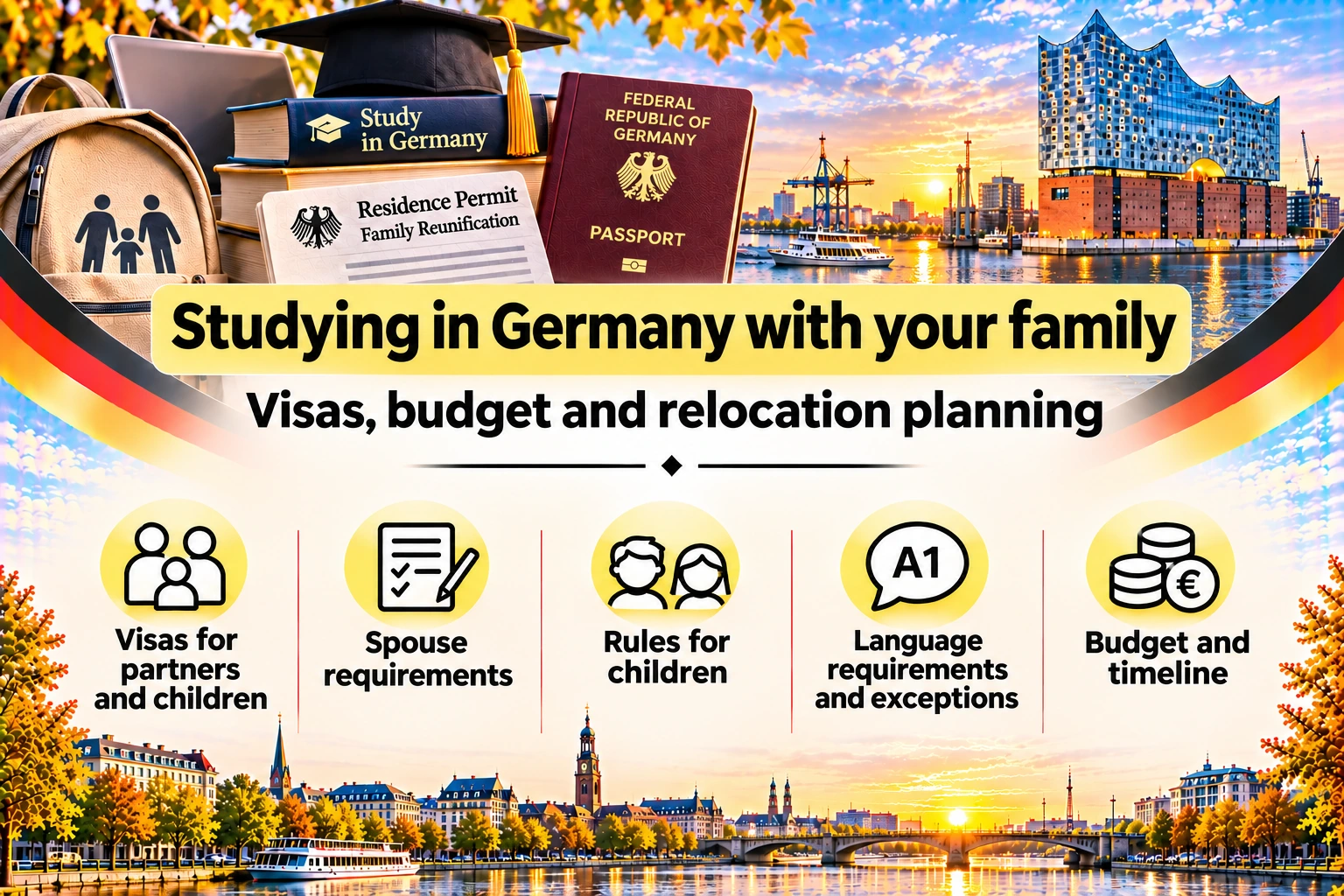
You can move to Germany to study with your spouse and minor children. However, one family member’s admission to university does not automatically give the others a right to enter. The student applies for a study visa; the spouse and children need separate family reunification visas. Before applying, check the marriage requirements, the spouse’s language skills, the children’s ages, financial support for the whole family, housing and insurance.
For a first move from a CIS country, the main question is whether you can prepare linked applications and demonstrate that each person meets the conditions in time for the relevant semester. This article covers university studies under Section 16b AufenthG. It does not replace the rules for a standalone language course, seeking a university place or vocational training. The legal basis for student residence is Section 16b of the Residence Act.
- Which visas a student’s family needs
- When a spouse can join a student
- Does the spouse need A1 German?
- Children: age, moving together and custody
- Can applications be submitted together?
- Required funds: the student minimum and the family budget
- What accommodation must be demonstrated?
- Will student insurance cover a spouse and children?
- Can the spouse work?
- Documents and preparation steps
- Mistakes that disrupt a family’s plans
- FAQ
- Where your family should start
Which visas a student’s family needs
A family relocation involves several separate cases.
| Person moving | Main legal basis | What to check |
|---|---|---|
| Student | Studies, Section 16b | Admission or a qualifying preparatory programme, funding, insurance |
| Spouse | Family reunification, Sections 29–30 | Marriage, both spouses’ ages, German language skills, expected duration of residence |
| Unmarried minor child | Family reunification, Sections 29 and 32 | Family relationship, custody, age and circumstances of the move |
Each applicant needs their own application form, passport and supporting documents. The family’s documents must be consistent: one accommodation plan, clear sources of funds and matching dates. Germany’s Federal Foreign Office expressly refers to separate family visas and the need to support the family. See its official answer on the family of an international student.
University admission is covered in our separate guide to studying and the student visa. Here, the priority is checking the family requirements before incurring major expenses.
When a spouse can join a student
For a typical first move under Section 16b, the following conditions matter: both spouses must be at least 18, the marriage must already have existed when the relevant residence permit was issued, and the student’s expected stay in Germany must exceed one year. This does not mean the student must first live in Germany for a year. For example, a two-year master’s degree and the remaining duration of a short programme provide different starting points for the assessment.
If the marriage took place later, family reunification should not be considered automatically impossible. Section 30 provides other grounds and allows the authority to waive certain conditions at its discretion. However, that possibility must not be turned into a promise that a visa will be granted. The dates of the marriage, national visa and residence permit, the programme’s duration and an individual assessment are needed. There is no general rule requiring all students’ spouses to wait two years. The legal basis is Section 30 AufenthG.
If you are still choosing a programme, FIRMDER can help coordinate the study and family routes: collect the relevant marriage and child details, identify questions for the consulate and put the preparation steps in order. You can discuss this as part of our support for studying in Germany.
Does the spouse need A1 German?
Usually, yes. A spouse joining the holder of a student residence permit normally needs to communicate in basic German, generally demonstrated at A1 level. The student’s English-taught master’s programme does not itself exempt the spouse. Check the examination and evidence requirements with the competent German mission.
Exceptions exist, including a documented illness or disability that prevents proof of the required knowledge, or particular circumstances that make efforts to learn German before entering impossible or unreasonably difficult. An exception may also apply where the need for integration is demonstrably low. A university degree alone does not guarantee this exception: prospects for qualified employment and integration are also assessed. These distinctions are explained in the Federal Foreign Office’s information on language requirements.
Section 16b itself is not among the residence statuses giving spouses of skilled workers the corresponding language exemption. Do not apply EU Blue Card conditions to a student’s family. An exception must be supported by evidence; simply explaining that little time remains before the semester starts is not enough.
Children: age, moving together and custody
The usual child reunification route is for an unmarried minor. For a child who has already turned 16, another detail matters: whether the child is relocating their centre of life to Germany together with their parents or the parent who has sole custody.
If not, Section 32(2) provides for German proficiency or a favourable integration prognosis based on education and personal circumstances. In relevant cases, consular information sheets specify C1. It is incorrect to say that every child aged 16 or over needs C1. Equally, a teenager who stays behind to finish school separately from their parents should not be assumed automatically to retain the conditions applicable to moving together. The legal basis is Section 32 AufenthG.
Where parents share custody and the child moves to join only one parent, the other parent’s consent to the child living in Germany or a corresponding legally binding decision by the competent authority is required. Divorce alone does not establish sole custody. Ordinary permission for a tourist trip may be insufficient.
If a child will soon turn 16 or 18, check the procedure promptly: joining an appointment queue and submitting an application may have different legal significance. An example document list, including consent from the other parent, is provided in the German missions in Kazakhstan’s information sheet. For another country, use that country’s own list.
Can applications be submitted together?
Applications coordinated in time are possible, but the procedure depends on the mission. For example, German missions in Kazakhstan provide for TLS to accept applications from spouses and children moving in connection with a student’s application. This is described in their national visa instructions.
This does not guarantee simultaneous decisions, visa issuance or entry. A time window stated in local appointment instructions is likewise not a universal right for all families to move within the same period.
In practice, two scenarios are possible:
- The family prepares together. You clarify appointment categories, whether the cases can be linked, and evidence of accommodation and funds before the student enters.
- The student goes first. They arrange accommodation and gather missing documents, after which the family continues its procedure. This requires a budget for living separately; the consequences of postponement for a teenager must be checked separately.
Identify related applications and their reference numbers if already assigned. Do not resign from employment or buy non-refundable family tickets simply because the student’s visa has been approved.
Required funds: the student minimum and the family budget
At the time of checking, the official Make it in Germany portal states EUR 11,904 per year, or EUR 992 per month, for a student using a blocked account as proof of funds. This is a benchmark for supporting the student, not the entire family. See the official study visa requirements.
There is no single universal sum for “a student, spouse and child” in every situation. Family reunification involves assessing support for the family in light of its composition, expenses and documented financial resources. Accommodation and adequate health insurance matter. Family members’ income may be taken into account; the general legal bases are Section 2 and Section 5 AufenthG.
Do not multiply EUR 992 by the number of people and call the result an established visa requirement. Prepare two separate tables: financial evidence for the authority and the family’s actual expenses.
| Expense | What to include in your calculation |
|---|---|
| Housing | Rent, service charges, electricity, internet |
| Health insurance | A confirmed option for each person, not just the student rate |
| Everyday living | Food, transport, communications, clothing, medicines |
| Children | Childcare, meals, school supplies and activities |
| Studies | Semester contributions, any programme fees, materials |
| Initial move | Deposit, temporary accommodation, tickets, translations, fees, setting up home |
| Reserve | Visa delays, a later start to employment, expenses in two countries |
A hypothetical calculation, not an estimate of German prices: if you budget EUR 1,300 for housing, EUR 300 for insurance, EUR 800 for everyday expenses, EUR 200 for a child and EUR 150 for study-related payments, the total is EUR 2,750 a month. With EUR 992 available from the student’s account, EUR 1,758 remains to be covered. The deposit and relocation costs are not yet included. Use actual offers from your chosen city; the consular calculation of sufficient funds may differ.
A spouse’s promise to “find work after arriving” is not documented income. If there is an employment contract, establish which documents and conditions for starting work would allow it to be considered in your case.
A Verpflichtungserklärung issued for the student does not automatically provide support for the spouse and children either. Check which people the declaration covers and whether the proposed arrangement is accepted for the family applications. This article does not explain how to obtain such a declaration; for the family, the key issue is avoiding an undocumented funding gap.
What accommodation must be demonstrated?
A student’s family must have sufficient living space. The housing exemption for certain employment statuses and Section 21 does not automatically extend to Section 16b. See Section 29 AufenthG.
Before paying, establish:
- whether all family members are allowed to live there;
- how the floor area, number of rooms and move-in conditions are documented;
- whether the accommodation document is suitable for your stage of the visa process;
- whether you can register at the address and obtain confirmation from the accommodation provider.
A single room in a student residence should not be treated as a ready-made solution for three people. Check temporary accommodation options and the required evidence separately. Sufficient living space and address registration are related but distinct checks. Practical details are covered in our article on first accommodation and Anmeldung.
Will student insurance cover a spouse and children?
Germany’s statutory health insurance system, GKV, allows qualifying relatives to receive free family insurance, or Familienversicherung. However, student insurance does not mean everyone will automatically be included. Residence in Germany, income, relatives’ own insurance status and other conditions are assessed. For children, the other parent’s insurance and income may matter. The Federal Ministry of Health explains the general rules.
The student rate itself must also be checked. Compulsory student insurance is generally limited to those under 30; continuation beyond that age is possible on statutory grounds. Not every student arriving for the first time after 30 can simply choose a low-cost rate or voluntary GKV membership. Check this before finalising the budget. The age rule appears in Section 5 SGB V.
Ask the health fund or insurer to confirm in writing the conditions for each family member, the start of coverage and its cost. If family insurance is unavailable, budget for separate coverage. Do not assume without checking that a policy for entry is adequate throughout your residence: agree the transition from entry cover to continuing insurance in advance.
Can the spouse work?
A spouse with a family reunification residence permit is generally entitled to work. The principal applicant’s student working-time limit does not automatically apply to them. Before starting work, check the employment annotation in the visa, residence permit and supplementary sheet. General employment-access rules and the requirement to specify restrictions are set out in Section 4a AufenthG.
Permission to work does not replace professional authorisation in a regulated occupation. When calculating the family budget, also allow time for job hunting and childcare: permission does not mean earnings will start in the first month.
Documents and preparation steps
Gather documents using your mission’s official checklists. A working family checklist includes:
- For the student: evidence of the study basis, programme duration, funding and insurance.
- For the spouse: passport, marriage certificate, documents ending previous marriages where necessary, A1 or evidence supporting the claimed exception.
- For the child: passport, birth certificate, adoption or custody documents where applicable, the other parent’s consent or a decision by the competent authority.
- For everyone: separate applications, photographs, evidence of accommodation, insurance and funds, and details of linked cases.
- Document formalities: required translations, apostille or another applicable authentication procedure. Rules depend on the document’s country of issue and consular requirements.
First check legal eligibility and timing for each person, then language, finances and housing. Next coordinate submission, and plan travel based on documents actually issued. An example of a separate spouse application package appears in the consular information sheet for Kazakhstan.
Contact FIRMDER to prepare consistent study and family application packages. We can help check lists and translations, align dates, identify missing evidence and organise preparations for visa submission. This helps reveal discrepancies between applications in advance; the German authorities decide on them.
After entry, check registration requirements, the start of insurance, residence permit appointments, school enrolment deadlines and childcare availability. School and nursery procedures depend on where you live; investigate them while choosing your city.
Mistakes that disrupt a family’s plans
- Treating university admission as permission for the whole family to relocate.
- Applying benefits for spouses of EU Blue Card holders to students.
- Showing funds only for the student while leaving family expenses unexplained.
- Counting on free insurance for relatives without the health fund’s confirmation.
- Postponing a teenager’s documents until the school year ends without checking the consequences.
- Replacing consent to permanent residence with permission for a short trip.
- Treating simultaneous submission as a guarantee of identical processing times.
FAQ
The Federal Foreign Office describes the usual situation of joining a student who already has a residence permit. However, linked applications for first entry are possible under the competent mission’s procedure. Clarify it beforehand; simultaneous visa issuance cannot be promised.
The usual basis for spousal reunification depends on an expected stay exceeding one year. A programme lasting exactly one year needs an individual assessment; do not assume that any admission is enough.
Not automatically. An exception depends on the applicable legal grounds and documented circumstances, including employment and integration prospects. A degree alone does not replace that assessment.
There is no basis for treating this as a family threshold: it is the amount stated for 2026 to support a student through a blocked account. A family needs a separate calculation and evidence.
This may be possible, but the consequences depend on age, custody and circumstances. Check a delay particularly carefully for a child aged 16 or over: it may affect language and integration conditions.
Do not plan this as the standard family route. Entry normally requires a visa matching the purpose of residence. Possible exceptions depend on nationality and individual circumstances, not merely on being married.
Where your family should start
Prepare one page of basic information: each person’s nationality and country of residence, marriage date, children’s ages, custody arrangements, chosen programme, dates, language skills and demonstrable funds. This makes it easier to identify what can be prepared in parallel and what is holding up the whole move.
Contact FIRMDER for a plan to relocate for studies with your family: we can help work through the sequence of steps, document and visa-package preparation, housing and insurance questions. Start through FIRMDER’s contact page. The scope of assistance is agreed for your circumstances; visa issuance and a single relocation date cannot be guaranteed.
This article is general information. Legislation, consular checklists and local practice may change; individual legal issues require a separate professional assessment. Check current requirements at your place of application and intended residence.










