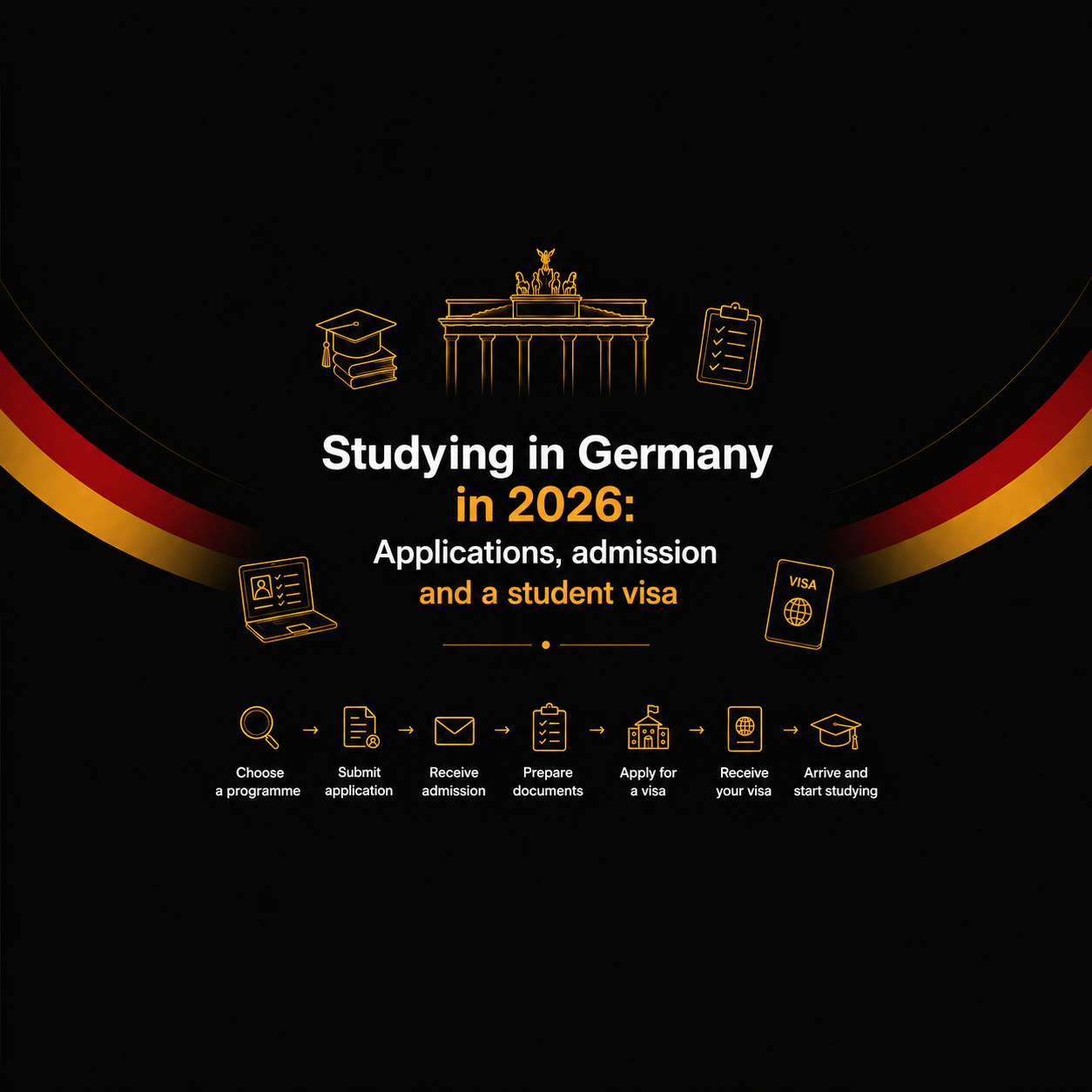
Study and vocational training can provide routes to residence in Germany. Many public degree programmes are tuition-free but charge semester contributions, and exceptions apply. Company-based vocational training pays an allowance that varies by occupation and training year. Main options:
- Bachelor’s and master’s degrees have programme-specific language and admission requirements; common application deadlines fall in July or January. A preparatory college may be needed if your particular qualifications do not provide direct university entrance eligibility.
- Ausbildung (dual vocational training with a training employer). Preparation time depends on language skills, finding an employer, the training start date and visa processing.
- Schooling for children: compulsory attendance, admission and grade placement depend on the federal state, age and previous education. There is no general minimum age of 16 for foreign children. Moving independently for school attendance is subject to separate immigration requirements.
Many education programmes are taught in German. If your skills are not yet sufficient, a preparatory language course may help. Read about suitable immigration routes on our page about language courses in Germany Everyday language practice can support progress; the pace and outcome depend on the course and your own efforts.
Check your university entrance eligibility first. An application without the required educational background or submitted through the wrong procedure may be rejected. Official information: DAAD, uni-assist, BAMF. We explain the available education routes and help identify avoidable preparation mistakes.
Contents
- Which education route in Germany suits you?
- Studienkolleg: eligibility and applications
- Vocational training: the dual system, allowance and visa
- Application deadlines and procedure
- uni-assist: applications and preliminary assessment
- Blocked accounts for studying in Germany: providers and funding evidence
- Documents for a German student visa
- Translations: authorised translators and certification
- Student visa: application, timing and fees
- Working while studying: what is permitted?
- Schooling for children moving with you
- How FIRMDER can help
- FAQ
Which education route in Germany suits you?
Choose a suitable education route first. It determines language requirements, admission, costs and application procedures. Check eligibility before paying for preparation.
The overview below shows key education routes. Many public universities charge no general tuition fees, but semester contributions and exceptions must be checked. Admission requirements and deadlines depend on the specific programme.
| Education route | Cost | Required language skills | Preparation time |
| Bachelor’s degree at a public university | Often tuition-free, with a semester contribution; check local exceptions | Often advanced German or English; check accepted tests | Plan approximately six to twelve months ahead |
| Master’s degree at a public university | Often no tuition fees; exceptions depend on the university and programme | Programme-specific evidence of German or English | Allow several months and check the specific process |
| Studienkolleg (university preparatory college) | Often tuition-free, plus semester contribution; check exceptions | Often German B1 or B2, depending on the institution | Depends on language level and admission procedure |
| Ausbildung (dual vocational training) | Company-based training with an allowance; check school-based programmes separately | Often German B1 to B2; check specific requirements | Allow several months to find a training employer |
| Private university | Tuition fees depend on the institution and programme | Language requirements depend on the programme | Several weeks to months; check with the responsible authority |
Participating universities use uni-assist — preliminary assessment of international applications for participating universities. Fees are €75 for the first course choice per semester and €30 for each additional choice. Check current processing times, university deadlines and any separate VPD submission requirements.
If you are unsure, FIRMDER reviews your education, language skills and goals during an initial consultation to identify suitable routes.
Preparatory college in Germany: who needs it and how to apply
Studienkolleg — university preparation for applicants whose qualifications do not provide direct entrance eligibility. Whether it is needed depends on the specific qualification, country, graduation year and any prior higher education.
Check university entrance eligibility and whether a preparatory college is needed: database anabin. Direct university entrance eligibility means no Studienkolleg is required. Otherwise, a preparatory college and assessment examination or other recognised prior study routes may qualify. Check your specific credentials before applying.
A preparatory college teaches German and subject knowledge. Passing the assessment examination can establish subject-specific university entrance eligibility; it does not guarantee admission.
| Parameter | Details | Potential issue |
| Language skills for admission | Often B1 or B2, depending on the preparatory college; check its entrance examination. | Language level or test certificate does not meet entry requirements |
| Cost | Public preparatory colleges are often tuition-free; check semester contributions and local fees | |
| Duration | Usually one academic year (two semesters) | |
| Final examination | Assessment examination — subject-specific university entrance eligibility; application is still required | Resit options and consequences depend on the examination regulations |
| Course tracks | Examples include T (technical subjects), W (economics), M (medicine), G (humanities) and S (languages); check availability and recognition | Choose a course track appropriate to your intended degree subject |
| How to apply | Directly to the preparatory college or through uni-assist, depending on the institution | Places are limited; plan six to twelve months ahead where possible |
Preparatory colleges and contact details: studienkollegs.de. Where possible, start planning about a year ahead: language tests, obtaining documents, and any required apostilles and translations take time.
FIRMDER helps assess your educational background using anabin, select a suitable preparatory college and prepare application documents. More information is available on our page about education in Germany.
Vocational training in Germany: the dual system, allowance and visa
Ausbildung (dual vocational training) combines vocational school and workplace training, either on different weekdays or in blocks. The training employer pays an allowance. Its amount depends on the occupation, training year, collective agreement and employer.
A visa for a specific vocational training programme requires evidence of a training place, normally a training contract for company-based training. A residence permit to seek a training place under Section 17 is a separate route with its own requirements.
| Parameter | Details | Where to look | Potential issue |
| Language requirements | Usually B1 for the visa unless another permitted form of evidence applies; employers and vocational schools may require higher skills, such as B2 in nursing. | Check with the specific training employer | Applying without the specifically required language skills |
| Finding a training employer | Ausbildung.de, Make it in Germany, the Federal Employment Agency and employers’ career websites | Start looking six to twelve months before training begins where possible | |
| Visa or residence permit | Vocational training visa (governed by §16a AufenthG), a separate residence category for vocational training | Responsible German mission | Processing time depends on the mission and individual case |
| Course or training duration | Usually two to three and a half years, depending on the occupation | ||
| Training allowance | Allowance depends on occupation, training year and collective agreement | ||
| Qualification or outcome | Recognised vocational qualification, for example through IHK or HWK examinations where applicable; access to employment abroad must be checked separately |
Possible training fields include nursing, mechatronics, IT, hospitality and retail. Entry requirements, allowances and relocation support vary by occupation and employer.
Vocational training is a full career pathway. The training employer may offer employment afterwards, but this is not guaranteed.
Application deadlines for studying in Germany
Application deadlines may be binding cutoffs. Check the specific programme, any permitted later document deadlines and the VPD procedure where relevant; a late application may delay your start.
| Education route | Work | Application deadline | Important |
| Winter semester | October | Often 15 July; the programme’s actual deadline governs | Common deadline; uni-assist recommends applying at least eight weeks before the deadline |
| Summer semester | April | Often 15 January; programme-specific deadlines may differ | Not every programme admits students for the summer semester |
| Preparatory college: winter semester | October | Often June or July; check the college’s deadline | Check the relevant preparatory college’s website |
| Preparatory college: summer semester | April | Often December or January; check the college’s deadline | Not offered by every preparatory college |
| Ausbildung | Often August or September; check the training start date | Start looking for a training employer six to twelve months ahead where possible | The vocational training visa requires evidence of a specific training place |
uni-assist recommends applying at least eight weeks before the deadline to allow time for queries. Check current processing times and university deadlines. If a VPD is required, you must also submit that preliminary review document to the university yourself by its deadline.
FIRMDER works with you on an individual schedule for documents, any apostilles, translations, language tests and applications.
uni-assist: how the application process works
Uni-assist (Universitats-Zulassungsservice fur internationale Studierende) assesses international applications for participating universities. The university decides whether you apply through uni-assist, directly, or using a preliminary review document (VPD).
How the process works:
- Create an application account on uni-assist.de. Upload complete, legible scans and provide certified copies if additionally required.
- Pay the processing fee: €75 for the first course choice per semester and €30 for each additional course choice in the same semester.
- Wait for the assessment: uni-assist publishes current processing times. Depending on the procedure, it forwards the application or issues a VPD that you must submit to the university yourself by its deadline.
- The university makes its decision on admission or rejection. Processing times vary between universities.
- If admitted — enrol by the specified deadline. Otherwise, you may lose your place.
Submit complete, legible documents early. Allow for queries and, where applicable, a separate university application using the VPD; the specific deadlines remain binding.
Blocked accounts for studying in Germany: providers and funding evidence
Sperrkonto (blocked account) is one way to prove funding for your studies. Monthly withdrawals are limited, but the funds remain yours. An accepted scholarship or a sufficient declaration of commitment may also qualify.
Standard study funding requirement in 2026: €11,904 per year (€992 per month for twelve months in 2026). The amount may change; check the responsible German mission’s current requirements before applying.
| Where to open an account | Cost | Timing or deadline | Key points |
| Fintiba (fintiba.com) | Check current setup and account maintenance fees | Online; timing depends on checks and provider | Check the provider’s available support languages |
| Expatrio (expatrio.com) | Check current setup and account maintenance fees | Online; timing depends on checks and provider | Sometimes bundled with insurance; check coverage |
| Coracle (coracle.de) | Check the provider’s costs and fees | Online; individual processing time | Check fees, terms and insurance coverage |
| Deutsche Bank | Check contributions and coverage | Check the provider’s opening and identification procedure | Check availability and activation requirements |
The funding evidence must meet the German mission’s requirements. An ordinary bank statement does not automatically count as proof of a blocked account. Check the provider, blocking arrangement, availability and acceptance requirements before transferring funds.
Within the agreed service scope, FIRMDER helps select and open a suitable blocked account, for example with Fintiba or Expatrio, and check supporting documents for the German mission.
German student visa: key documents at a glance
Use the responsible German mission’s current checklist and your university’s requirements. Pay particular attention to the accepted language test and required scores. Supplementary evidence does not replace mandatory documents.
| Document | Where to obtain it | Timing or deadline | Potential issue |
| Valid passport meeting the visa checklist requirements | Competent passport authority | Ask the issuing authority about processing times and expedited options | Check validity against the current checklist |
| Letter of admission (Zulassungsbescheid) | University or preparatory college | After the admission decision | Normally required for the study route; seeking a study place is a separate immigration route |
| Blocked account confirmation | Fintiba, Expatrio or Coracle; check current eligibility and acceptance requirements | Check processing times with the provider | Insufficient funds or an unacceptable form of financial evidence |
| School-leaving certificate or degree with transcript | Issuing school, university or competent authority | Allow time for issuance and any required apostille | Missing required authentication or an unacceptable translation |
| Language certificate | Goethe-Institut, TestDaF, telc, DSH | Check test availability and result times with the provider | Unrecognised language test or insufficient score |
| Proof of health insurance | TK, Barmer, AOK, Fintiba, Expatrio | Varies by provider and identity checks | Ensure suitable health insurance from entry and throughout your stay |
| Required document translations | Accepted translator; request an individual quote | Agree on a deadline with the translation provider | Translation fails to meet the receiving institution’s requirements |
| Motivation letter | Write in the language required by the university or German mission | Allow time to prepare and revise | Generic statements without a clear educational goal |
Whether an apostille or another form of authentication is required depends on the issuing country and receiving institution. The competent authority determines fees and processing times. Check university and German mission requirements early.
Student visa translations: requirements and certification
The receiving university or German mission specifies which documents need translation and which translators it accepts. Translations by authorised or sworn translators are often required. Notarial certification does not automatically replace a required certified translation; follow the specific rules.
| Parameter | Details | Common mistake |
| Where to find one | The German state justice administrations’ joint interpreter and translator database can help you find a professional. Also check which translators the receiving institution accepts. FIRMDER can arrange suitable translations within the agreed scope. | Hiring a translator without checking the required authorisation |
| Cost | Prices depend on language, length and certification; request a quote in advance. | Failing to budget for translations, certifications and any required apostilles |
| Timing or deadline | Turnaround depends on the volume and the provider’s workload. | Ordering translations just before the deadline |
| Education route | The translation must use the required certified format and clearly identify the source document. | Required original or certified copy is missing |
Coordinate the complete document set with the translation provider where possible. This helps maintain consistent name spellings and plan deadlines. Translate only the documents and formats actually required.
German student visa: application, timing and fees
Residence for study under §16b AufenthG normally requires visa applicants to apply through the responsible German mission for their habitual place of residence. The standard adult visa fee is €75; processing times vary. Any visa exemptions must be checked separately.
- Receive your admission letter from the university or preparatory college, or the evidence required by the visa checklist for your chosen route. Seeking a study place under Section 17(2) has separate requirements: a stay of up to nine months, generally €1,091 in monthly funding in 2026 and employment for up to 20 hours per week.
- Open a blocked account or prepare other accepted funding evidence and obtain suitable confirmation for the visa application.
- Assemble the documents required by the checklist including the specifically required translations and certifications. Missing documents can lead to further requests, delays or refusal.
- Arrange the visa application and appointment. Appointment procedures and waiting times vary by German mission. Check early whether online application is available.
- Attend the appointment in person. Provide your biometric data. The standard national visa fee for adults is €75; reductions or exemptions may apply.
- Wait for the decision: depends on the mission and individual case; allow several weeks to months.
- After arrival: generally register your address within two weeks of moving in, complete enrolment and ensure suitable health insurance.
For more about health insurance, see our page on insurance in Germany. Suitable health insurance must be demonstrated. Check coverage and start dates; insurance is not automatically included in every package.
Working while studying in Germany: applicable limits
A study residence permit under Section 16b allows employment within statutory limits. Check your permit and supplementary sheet; do not base your funding solely on a part-time job you have not yet secured.
- Students holding a permit under Section 16b of the Residence Act may generally work up to 140 full or 280 half days per year. Statutory counting rules also cover weeks of up to 20 hours; student ancillary work is treated separately.
- Minijob: the regular earnings limit in 2026 averages €603 per month. A minijob is not automatically exempt from tax or pension contributions and generally counts towards immigration-related work limits.
- Working student employment: often subject-related part-time work. The social-insurance rule concerning 20 hours during term time is separate from immigration-related work limits.
- Exceeding permitted employment can breach your residence conditions.
Many universities operate job boards. Campus work may be a useful starting point, but language requirements, working hours and qualifications vary by position.
Schooling for children when moving to Germany to study
Compulsory schooling is governed by the law of the relevant federal state. After moving, contact the local school authority to arrange enrolment and an appropriate school for your child.
School types and progression rules differ between federal states. Check early which pathway fits your child’s previous education.
| School type | Grades | Progression | Who it is for |
| Primary school (Grundschule) | 1-4 | Progression to secondary school | Children of compulsory school age under state law |
| Hauptschule | 5-9 | vocational training and practical career routes | Practical education pathway |
| Realschule | 5-10 | vocational training or upper secondary education | Intermediate school qualification with further progression options |
| Gymnasium | 5-12/13 | Abitur — general university entrance qualification; admission requirements still apply | Academic pathway towards university studies |
| Vorbereitungsklasse | According to age and educational level | Progression to a mainstream class according to individual learning needs | Children who need German language support |
Language support and class placement depend on the federal state, age and learning level. Preparatory classes may be available, but arrangements and duration vary. Ask the school which documents it requires, such as a birth certificate, school records, registration certificate and required vaccination or measles evidence.
FIRMDER: support with moving for study or vocational training
Study and vocational training can provide routes to residence in Germany. Early planning matters: admission, deadlines, language certificates, funding, health insurance and document formats must align. Within the agreed scope, FIRMDER supports the following steps:
- We assess your education using anabin and university requirements, clarify possible entrance routes and help select a preparatory college and course track.
- Document translations: within the agreed scope, we arrange suitable professional translators and coordinate formats and deadlines.
- Blocked account: assistance with selection, opening and checking evidence, for example with Fintiba or Expatrio, within the agreed service scope.
- Language preparation: we help select suitable courses, including FIRMDER options, and assess a possible language-course residence route. Course availability and immigration requirements are checked individually.
- Visa application: we help assemble documents according to the responsible German mission’s current checklist. Further requests and the authority’s decision cannot be ruled out or guaranteed.
An education stay in Germany requires careful preparation. Within the agreed scope, FIRMDER supports you from reviewing your qualifications to preparing the visa application. Admission and visa decisions remain with the responsible institutions and authorities.
Legal basis: residence for studying — §16b AufenthG, Ausbildungsvisum – §16a AufenthG, skilled employment — §18a AufenthG and §18b AufenthG, Chancenkarte – §20a AufenthG. After successfully completing a degree or vocational training, you can switch to an appropriate employment residence permit if its requirements are met.
Technical errors, missing documents or unsuitable language certificates can delay an application. Early review helps reduce these risks. Send an enquiry — we will start by assessing your circumstances.
FAQ
This depends on your specific school certificate, graduation year and any previous higher education. Check anabin, the DAAD admissions database and the university. A preparatory college is not universally mandatory for all Russian school graduates; different entrance routes exist.
German-taught degrees often require advanced proficiency, such as B2 or C1, and specific test certificates. English-taught programmes have their own requirements. Vocational training often requires B1, or B2 for some occupations. For preparation options, see language courses in Germany.
TestDaF specifically assesses German for university admission. Goethe certificates cover general German at different levels; Goethe-Zertifikat C2 is generally recognised for university entrance. Not every Goethe certificate is sufficient. Check the tests and scores accepted by your programme, such as TestDaF, DSH or telc Deutsch C1 Hochschule.
Dual trainees receive a training allowance. A residence permit under Section 16a allows additional employment unrelated to the training for up to 20 hours per week. Working-time law and contractual obligations also apply.
Actual living costs depend mainly on your city and housing. The standard study funding requirement in 2026 is €992 per month; this does not guarantee that your personal budget will be sufficient. Budget separately for rent, deposit, food, health insurance, semester contributions and transport, especially in expensive cities such as Munich.
Yes, foreign degrees can generally be translated. However, the university decides whether your degree qualifies you for master’s admission. Follow its requirements for translators, certification and any apostille, and obtain an individual quote beforehand.
Check immediately for other programmes, later deadlines or expressly permitted later submissions. After a binding cutoff, you generally need to wait for the next suitable application round. Start planning early, preferably ten to twelve months before your intended start.