


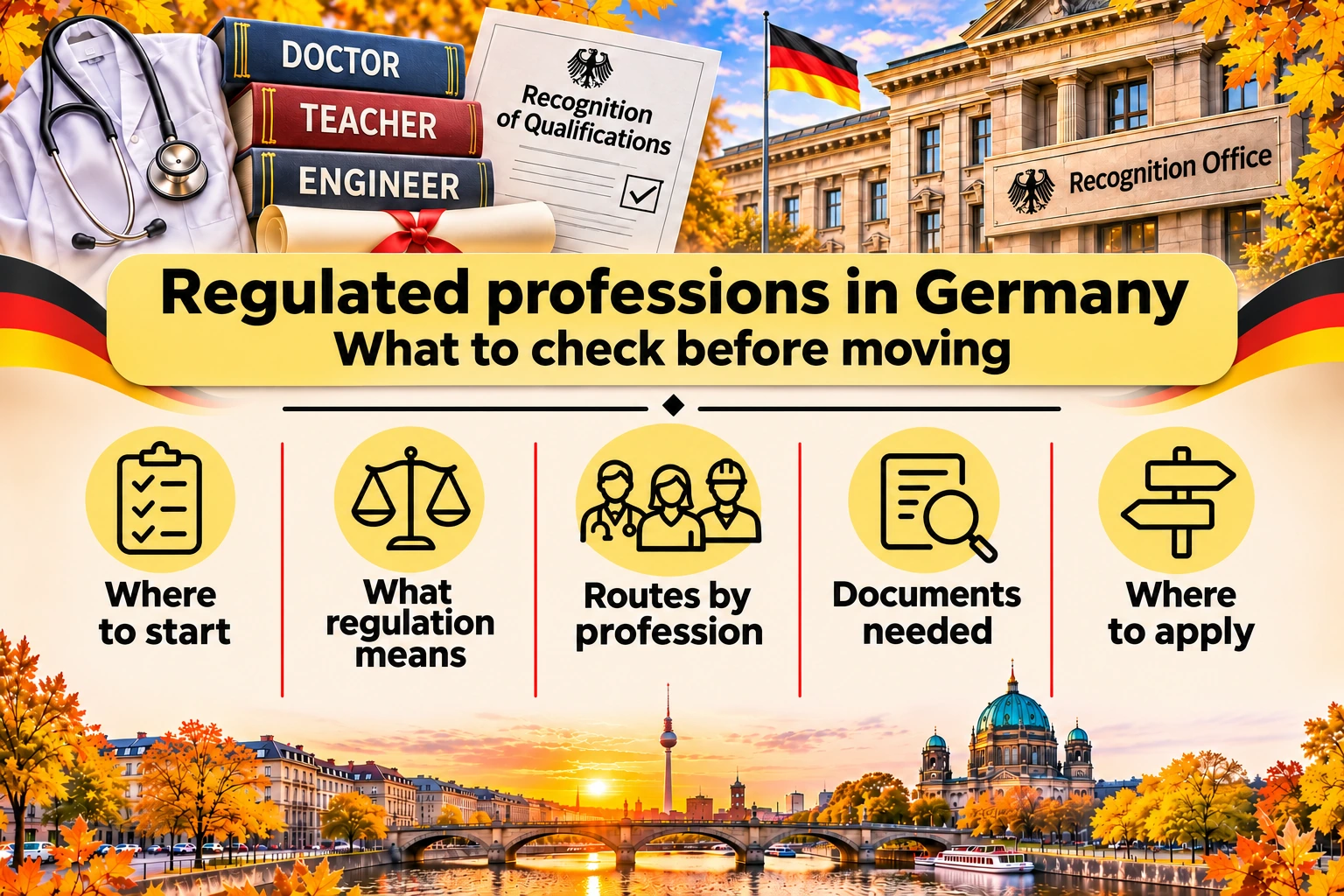
A doctor, a teacher and an engineer may face different rules even though they all have degrees from foreign universities. One may need a licence to practise medicine, another recognition of a teaching qualification for a particular school type, and a third permission to use a protected professional title. The main question before moving is therefore not “Will my degree be recognised at all?” but “What exact work do I want to do, and what authorisation does it require in my chosen federal state?”
This guide helps you draw up a checking plan. It does not replace the competent authority's decision on a particular qualification.
Russian source dated 12 November 2026; the translation's source checks are recorded separately. Particular attention is needed for doctors with third-country qualifications: a new procedure applies from 1 November 2026, with transitional rules for applications made earlier.
The short answer: where to start
Before ordering translations or signing an agreement with an intermediary, establish four things:
- The German profession corresponding to the work you plan to do.
- The federal state and city where you intend to work.
- The country where you qualified and whether that qualification gives full access to the profession there.
- Which decision is needed: recognition of professional qualifications, permission to practise, permission to use a title, or several documents at once.
The official starting point is Anerkennung in Deutschland. In the Recognition Finder, select the profession and intended place of work: these determine the competent authority. Do not send your documents to the nearest authority simply because it deals with “diplomas”.
FIRMDER can help during preparation: compare your qualification with the planned work and draw up questions for the competent authority before you spend money on translations and an application.
What “regulated profession” means
In a regulated profession, access to the activity or use of the professional title depends on conditions laid down by law. A foreign diploma alone does not demonstrate that all those conditions are met.
Distinguish three independent questions:
- Education: what level and content does your qualification have?
- Professional authorisation: are you allowed to do the particular work or use the protected title?
- Residence and employment rights: does your status allow you to live and work in Germany on those terms?
A positive assessment of education does not replace a professional licence. An employment contract does not remove the need for one either. The reverse situation is also possible: the professional requirements have been met, but immigration conditions still need to be addressed separately.
ZAB explains the distinction between regulated and non-regulated professions. We discuss Anabin, Statements of Comparability and DAB in detail in a separate article about qualifications for Germany. Here we focus on professional barriers that an academic assessment does not remove.
Doctor, healthcare professional, teacher, engineer: four different routes
| Planned work | What to establish before moving | What is insufficient |
|---|---|---|
| Doctor | Approbation requirements; the applicable foreign-qualification procedure; language; availability and limits of a temporary Berufserlaubnis | A diploma, an offer from a clinic or a university entry in Anabin |
| Nursing professional or another healthcare professional | The exact German profession and requirements for permission to use its title or practise it | A general description such as “healthcare worker” or a translation of the diploma title |
| Teacher in a state school | Recognition of the teaching qualification under state rules, school type, subjects and language | Any education-related degree without checking the professional teaching qualification obtained |
| Engineer | Whether the chosen role requires a protected title, a specific right or entry in a professional register | Assuming all engineering work is prohibited without recognition, or that the title Ingenieur can be used freely |
The table indicates what to check; it does not establish an individual's right to work. Each route has additional conditions.
Doctors: clarify the Approbation procedure before planning employment
Normal medical practice requires Approbation, the full licence to practise. The law also provides exceptions, including temporary permission to practise medicine. The statement “A doctor cannot work under any circumstances without Approbation” is therefore too absolute. The legal basis is section 2 of the Bundesärzteordnung.
Besides qualifications, the authority checks professional trustworthiness and fitness, health and the necessary German-language skills: section 3 BÄO. Recognition of a diploma and fulfilment of the other licensing requirements are not a single step.
Important change for applications from 1 November 2026
Under the current section 9d BÄO, holders of a completed medical qualification from a third country demonstrate the required knowledge through a Kenntnisprüfung, unless the applicant chooses a document-based equivalence assessment. That choice can only be made within four weeks after applying and is binding for the duration of the Approbation procedure.
A document assessment does not automatically remove the examination requirement: substantial differences may still lead to a Kenntnisprüfung. Advice to “submit something first and decide on the recognition route later” is therefore particularly risky.
For applications submitted by the end of 31 October 2026, section 15 BÄO retains the previous provisions of section 3(2) and (3). If your case is already open, clarify its application date and applicable procedure instead of starting a second application solely to use the new route.
A practical question for the authority is: “Which procedure applies to my application, how is my choice recorded, and which documents are required specifically for that route?” Do not automatically apply this rule for doctors to physiotherapists, nursing professionals or another healthcare occupation.
Language and specialist training are separate checks
The official Make it in Germany page on working as a doctor specifies general German at B2 level and, normally, a medical language examination oriented towards C1. This does not mean that any general C1 certificate replaces the Fachsprachenprüfung. Check the accepted documents, examination organiser and possible exceptions in your state.
If you are already a specialist, for example a surgeon or cardiologist, recognition of your Facharztweiterbildung must be checked separately from basic medical licensing. Do not assume that Approbation automatically confirms an overseas specialisation.
A temporary Berufserlaubnis under section 10 BÄO may be limited to particular activities and workplaces. It is not a universal licence for any medical vacancy. Before signing a contract, agree with the clinic which permission the role is based on and what happens if it is not issued by the planned start date.
Healthcare professionals: identify the profession, not just the diploma title
“Healthcare worker” is a useful everyday term but not the name of a single German procedure. Nurses, midwives, physiotherapists, medical technologists and doctors follow different professional routes.
For qualified nursing, section 1 of the Pflegeberufegesetz provides for permission to use the relevant professional title. This does not mean every clinic employee follows the Pflegefachperson procedure.
Before applying, prepare a description of your training and what it entitles you to do in the country where you qualified. It is particularly important to retain details of clinical placements, their duration and content. If someone you know with a similar diploma gained recognition in another profession, that is a useful reason to ask a question, not a ready-made answer for your own case.
Ask the employer three questions in writing:
- What is the contractual job title before recognition is completed?
- Which duties may you carry out at that stage?
- How will the role and terms change after the required authorisation is obtained?
Do not substitute a promise to “start as an assistant and sort it out later” for recognition. Any possible support role must comply with your status and the lawful limits of the particular position. A detailed nursing-recognition route requires separate treatment. The key point here is to choose the right profession and avoid paying for an unsuitable procedure.
Teachers: state, school type and subjects matter more than a general translation of a degree
Working as a teacher in a state school involves assessment of the professional teaching qualification. Conditions fall within the federal states' responsibility: the intended place of work significantly affects the authority and procedure. General information about professional recognition is available from KMK/ZAB.
Before moving, gather not only your diploma but answers to these questions:
- What teaching rights did you obtain in the country where you trained?
- Which ages, year groups and school types were you trained for?
- Which subjects did you study as a future teacher?
- What teaching practice formed part of the programme?
- Which further stages of professional training did you complete?
A foreign philology degree, a university-lecturer qualification and a school-teaching qualification cannot be treated as interchangeable. Even a shortage subject does not remove the need to assess qualifications for the particular school role.
Regional example: North Rhine-Westphalia
The current NRW regulation on recognition of teaching qualifications has its own rules, including conditions for applying them to certain qualifications from third countries. Section 1 specifies ways of proving German-language ability, including a C2 certificate meeting the prescribed requirements or a special language colloquium, as well as other routes expressly listed in the provision.
Section 1(4) also provides for opening the procedure with the corresponding language evidence at C1 level. If no substantial qualification differences are identified, the authority secures fulfilment of the language requirement through additional conditions attached to the decision. If compensatory measures are required, successfully completing them counts as the required language evidence. Starting the procedure with C1 does not mean unconditional permission to teach with that level.
This is an NRW example, not a claim that “every teacher in every state specifically needs Goethe C2”. Before paying for an examination, obtain a list of acceptable evidence from your authority. Separately establish when language evidence must be presented: with the application, before a compensatory measure or for admission to employment.
Vacancies through alternative entry routes, private schools and teaching outside schools require separate checks. Do not read an advert for a “teacher without recognition” as an exemption from all qualification requirements. Ask the employer to identify the exact route and basis for appointment.
Engineers: distinguish the work, the title and specific powers
Engineering commonly gives rise to two opposite mistakes: “Without recognition I cannot take any technical job” and “If I have been hired, I can automatically call myself Ingenieur”.
Separate these questions. For many technical tasks, the employer assesses the applicant's competence, while use of the protected German professional title is regulated separately. A particular activity may also require additional powers or entry in specific registers.
Regional example, Berlin: Baukammer Berlin explains that professionals with overseas qualifications may apply for engineering vacancies and work in the field without German professional recognition. However, use of the protected title Ingenieur or Ingenieurin requires the corresponding recognition. This example illustrates the distinction; it does not make the Berlin chamber the competent body for all Germany.
Before applying, check:
- how the position and qualification will be described in the contract, signature and public profile;
- whether independently signing professional documentation is expected;
- whether special registration or a specific right is required in the chosen state;
- whether the role involves employed technical work or self-employment with additional conditions.
Do not translate your qualification into a protected German title on your CV merely to make it sound more attractive. State the foreign education actually obtained and separately establish which wording is permissible before a decision is issued.
What changes for ethnic German resettlers and family members
German citizenship and recognition of professional qualifications serve different purposes. Acquiring citizenship on the applicable basis does not automatically grant Approbation, teaching recognition or the right to use a protected professional title.
For ethnic German resettlers, section 10 BVFG contains special provisions on recognition of examinations and qualifications acquired in the resettlement regions where they are equivalent. There is also a separate provision for loss of certain supporting documents. Applicability is assessed against the person's status and documents, not solely the fact that a family moved together.
If you are an included family member, do not automatically copy the principal applicant's application. State your own status basis and ask the competent authority which provisions apply to you. An EU citizen, a German citizen and a foreign national with a particular residence permit may face different immigration questions, but that does not remove professional requirements.
Nationality and the place of education are also different things: a German passport does not turn a third-country diploma into an EU diploma. Conversely, the procedure for a European qualification cannot be decided solely by its holder's passport.
Documents worth preparing in advance
The competent authority provides the definitive list. For an initial assessment, it helps to gather:
- proof of identity and details of name changes;
- the diploma and its supplement;
- documents showing the right to practise in the country of qualification, if such documents are issued there;
- information about the programme, practical training and professional experience;
- language evidence;
- previous recognition decisions, if any.
An official reference is the application documents page on Anerkennung in Deutschland. Not every applicant needs all the listed material, and not always at the first stage.
Before ordering translations, clarify in writing whether scans are acceptable, whether certified copies are needed, what requirements apply to the translator, and whether authenticity must be confirmed and in what form. Do not obtain apostilles for every document “just in case”. Do not send irreplaceable originals without an explicit requirement and a clear return procedure.
It can be especially useful to request a detailed curriculum while you still have access to the educational institution's archive. However, spending should match the chosen procedure: the documents needed for an examination route may differ from those for a documentary comparison.
FIRMDER can help organise the package: separate professional-recognition documents from immigration documents, list missing items and prepare questions about translations and certification. The authority determines requirements and makes the decision.
Planning time and money without false expectations
Divide the plan into stages: obtaining documents, translations, assessment, language, possible examinations or adaptation measures, final authorisation and starting work. The time required for one administrative stage must not be presented as the time until you can start employment.
There is no single price for “recognition of any profession in Germany”. Ask the competent authority to specify the fee for your procedure; calculate translations, examinations, training, travel and living costs separately. If an employer covers costs, establish who pays each item.
Check funding possibilities before paying: programmes may have requirements concerning when you apply, where you live and your personal circumstances. The official financial-support page helps identify options but does not confirm your personal entitlement to cost reimbursement.
Online applications are not equally available for every profession and state. Use the channel specified by the competent authority. If the application is accepted, keep the case reference, submission confirmation and requests for missing documents.
A practical checklist before moving
- The German profession has been identified, rather than merely translating the diploma title.
- The state of employment has been selected and the competent authority found.
- Qualification recognition, professional authorisation and immigration conditions have been separated.
- The rules applicable to the country of education and application date have been clarified.
- The current document list and translation requirements have been obtained.
- Language level, examination type and accepted certificates have been checked.
- Duties before and after recognition have been agreed with the employer.
- Separate costs have been calculated and funding checked before payment.
- Possible additional stages have been allowed for; the start date is not based solely on an intermediary's promise.
- Decisions and correspondence have been retained; no repeat application in another state is made without clarifying the consequences.
Frequently asked questions
This is possible in many procedures. Start with the authority responsible for the intended place of work and ask how to demonstrate your intention to work there and apply from abroad. You do not need to wait until moving merely to make an initial check of the route.
If the law requires authorisation for the agreed activity, the employer's agreement does not replace it. Clarify which role you are being hired for and which duties are permitted before you receive the required document.
Check territorial jurisdiction first, rather than advertised speed. If the intended workplace changes, ask about transferring the case and using documents already supplied. Do not launch parallel applications without understanding the authorities' requirements.
Special European rules apply to some professions and qualifications, but they depend on the type and date of qualification and other conditions. An automatic mechanism does not mean no application, document checks or additional professional-licensing requirements. For doctors, the relevant provisions are in section 9c BÄO.
Not for every profession. A doctor may need a separate medical language examination, while school teaching is subject to the state's own requirements. Ask not only about the level but also the precise form of evidence.
Not necessarily. The decision's contents matter more than the everyday label “refusal”: it may identify differences and a further compensatory measure. Read what is actually permitted, what needs to be added, and the stated appeal procedure and deadline. No universal appeal deadline for every document is given here.
It depends on the purpose. An assessment of education may meet a separate employer or immigration requirement, but it does not replace permission to use a protected title where that is required. First establish which document is being requested and why.
Plan lawful entry into a particular job, not just “degree recognition”
The best outcome of preparation is a clear sequence: profession, state, competent authority, applicable procedure, documents, language, professional authorisation and a separate check of residence conditions. That plan lets you discuss real stages with an employer instead of an unsupported promised date.
If you are preparing to move, FIRMDER can help draw up an individual organisational plan and connect document preparation with the chosen route. Decisions about recognition, professional authorisation and residence are made by the competent authorities; their outcome cannot be guaranteed in advance.
This material is for information. The Russian source records a check of the federal rules and regional examples on 12 November 2026; the checks for this translation are logged separately. Confirm requirements for your particular case with the competent authority before applying.