



How to find a university and degree in Anabin, apply for a Statement of Comparability or document a vocational qualification.
If you plan to work in Germany, you may be told to have your qualification “recognised”. That expression can refer to different procedures. For a university degree, Anabin or a Statement of Comparability from the Central Office for Foreign Education (ZAB) may be appropriate. For a non-academic vocational qualification, some immigration routes require a Statement on a Foreign Vocational Qualification, known in German as the Digitale Auskunft zur Berufsqualifikation (DAB). Regulated professions require a separate assessment by the competent recognition authority.
If your qualification comes from a college or technical school, start by identifying its level and the purpose of the assessment. The word “diploma” alone is not a reason to order a paid academic assessment. This guide explains how to choose the right procedure, read the database and avoid unnecessary applications.
- Anabin, a ZAB statement and professional recognition are different
- College and technical-school diplomas: identify the level first
- DAB: evidence of a non-academic vocational qualification
- Step 1: find the university in Anabin
- Step 2: check the specific degree
- When Anabin is sufficient and when to use ZAB
- Applying for a Statement of Comparability
- ZAB fees and processing times
- EU Blue Card: qualifications and experience
- Bring the evidence together before the next application
- Frequently asked questions
- Help choosing the right procedure
Anabin, a ZAB statement and professional recognition are different
Anabin is a database of foreign institutions and qualifications. A ZAB Statement of Comparability is an individual assessment of a completed foreign higher education qualification. It identifies the comparable German qualification level and describes matters such as the institution, programme and length of study. It does not grant university admission, a professional licence or a visa.
Three separate questions may arise when applying for a job and moving to Germany:
- Does the employer consider your education and experience suitable for the job?
- What qualification evidence is required for the particular residence route?
- Does the profession require formal recognition or a licence to practise?
For non-regulated work, including many IT and business roles, you can generally apply directly to employers. An academic immigration route may nevertheless require evidence that your degree is comparable to a German one. For regulated professions, such as medicine or teaching, a ZAB statement alone is insufficient. Use the official Recognition Finder, specifying the profession and intended place of work. An academic assessment of a medical degree is not an Approbation, the licence to practise medicine. ZAB explains the distinction.
For the academic skilled-worker route under section 18b of the Residence Act or an EU Blue Card, qualifications form part of the immigration assessment. Our guide to moving to Germany for work covers the other requirements.
College and technical-school diplomas: identify the level first
Labels such as “college”, “technical school” or “specialist diploma” do not establish which German procedure applies. What matters is the programme’s status in the country of education, the qualification awarded, entry requirements, duration and successful completion. An institution affiliated with a university may still deliver non-academic vocational training.
Ask the institution for clarification where necessary. Prepare the diploma, transcript and information about the programme. For a vocational qualification, the two-entry Anabin method below is not automatically the right approach. A medical-college diploma also raises a separate question: is the specific healthcare occupation you want to pursue regulated in Germany?
| Your situation | What to check | What the document does not resolve |
|---|---|---|
| University degree, non-regulated work and an academic immigration route | Anabin; a ZAB Statement of Comparability if the database is insufficient | The remaining residence requirements |
| Non-academic qualification and a route accepting qualifications recognised in the country of training | A DAB where required by that route | German equivalence, permission to work and all other visa conditions |
| Vocational training and the skilled-worker route under section 18a | Recognition by the competent authority | A suitable job and the remaining immigration requirements |
| Regulated work, such as medicine or nursing | Professional recognition and the required licence | A DAB or academic statement cannot replace that licence |
| Uncertain qualification level | Clarify educational status and supporting documents first | A title or duration alone does not establish a university-level qualification |
DAB: evidence of a non-academic vocational qualification
A positive DAB confirms that a foreign vocational qualification was completed, is state-recognised in the country of training and is equivalent in duration to at least two years of full-time training. It does not establish full equivalence to a German vocational qualification. See ZAB’s explanation of the DAB.
The document can be relevant to the route for professionally experienced workers, a recognition partnership or the Opportunity Card. Each route has its own additional conditions. A positive DAB does not by itself entitle you to a visa.
An existing decision on full or partial professional recognition may make a further DAB unnecessary if ZAB’s conditions are met. These include a decision from the competent German recognition body and evidence of the required training duration of at least two years. Check whether your actual decision meets those requirements; the DAB FAQ explains the details.
DAB documents, fee and processing time
The online application normally requires the qualification certificate, a subject and grade transcript covering the entire training programme, and identification. Evidence of a name change and a power of attorney may be necessary where applicable. Apply through the ZAB portal using BundID and upload PDF documents. Follow the individual instructions for original-language documents and any additional translations. A subsequent visa application may have different document requirements.
The DAB fee is EUR 150. ZAB states a processing time of two months once all documents are complete and the fee has been paid in full. This is the DAB processing period, not the visa processing time. Shorter procedures for academic Statements of Comparability do not automatically apply to the DAB. A negative DAB result does not lead to a refund of the fee.
Years of work experience do not turn an unfinished or shorter course into a completed vocational programme lasting at least two years. Report the actual training dates and qualification accurately. RelocationDE can help review the educational background and identify the appropriate procedure before you submit a paid application.
Step 1: find the university in Anabin
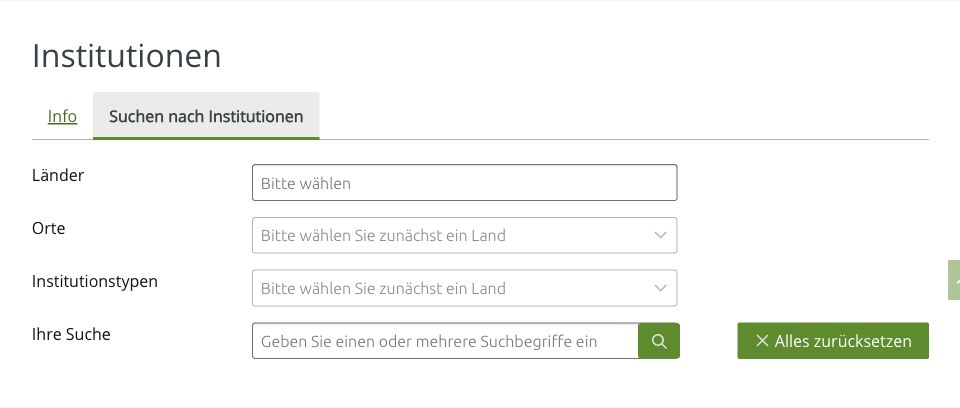
Open Anabin, select “Institutionen”, then “Suchen nach Institutionen”. Choose the country and search using the institution’s name or a distinctive part of it. Check the city, former names, branch campuses and the institution that actually awarded the degree. Names originally written in non-Latin scripts are transliterated in the database; a search using only Cyrillic characters may therefore miss the entry.
Open the full record and read both the status and the notes:
- H+ is a positive institutional status. It does not assess your particular degree.
- H+/- requires checking the conditions and associated qualifications. Not every qualification awarded there automatically meets the requirements.
- H- is not positive institutional evidence for an academic immigration route.
Save the complete entry, including the name, status and explanatory notes. A cropped “H+” screenshot without the identifying information is not a properly documented check. The official institution search guide explains the steps.
Step 2: check the specific degree
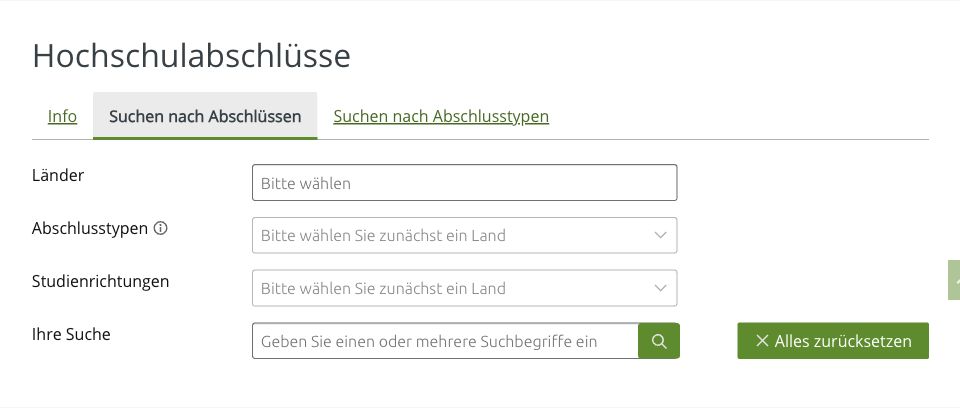
Select “Hochschulabschlüsse”, then “Suchen nach Abschlüssen”. Choose the country, search for the qualification name shown on your certificate and open the matching record. Search for the degree, not your intended job title. Try relevant spelling variants and transliteration.
In the “Bewertung” section, “entspricht” and “gleichwertig” are positive assessments when they refer to a German higher education qualification. Read the German comparison in full: a comparison with a Fachschule is not a comparison with a university degree. The subject, level and explanatory conditions must match your qualification.
The separate “Suchen nach Abschlusstypen” tab can provide initial guidance. A general entry for a degree type does not usually replace an assessment of the specific degree. The official Anabin degree-search instructions make this distinction.
Save both full records: the institution and the degree. Do not use the assessment of a similarly named qualification simply because it looks close enough.
When Anabin is sufficient and when to use ZAB
If both the institution and the specific degree have clear, relevant positive assessments, Anabin printouts can be sufficient evidence of comparability for a visa application. The requirements of the competent authority and the chosen residence route still matter. A paid ZAB assessment is not automatically necessary “just in case” if the required evidence is already complete. The government portal Make it in Germany explains the two-entry approach.
An institution or degree being absent from Anabin is not a negative assessment. The database is not exhaustive. An individual ZAB Statement of Comparability may be the next appropriate step. An H+ institution entry alone does not resolve a missing degree assessment.
For H+/- entries, examine the additional conditions. If the institution or programme was genuinely unrecognised, paying for an assessment does not guarantee a positive outcome. For regulated professions, the professional recognition authority remains responsible. IT specialists without a university degree should first consider whether an experience-based route applies, rather than ordering an assessment for a degree they do not hold.
Applying for a Statement of Comparability
Start with ZAB’s preliminary check. It identifies whether the procedure is available for your qualification and provides a document checklist. A generic list from a chat or advice article cannot replace that individual checklist.
For the digital application, you need access through BundID. Typical documents include the degree certificate, transcript or diploma supplement, identification and, where required, records of earlier education or name changes. Scan all requested pages, including relevant reverse sides. Names, study dates and institutions must be consistent and traceable across the application and supporting evidence.
Select the actual purpose of the assessment. After submission, the fee notice, application status and requests for further documents appear in “Mein Bereich”. Submit additional evidence under the existing application. Creating an account does not start the processing period: all required documents and full payment must first be received.
Translations, certified copies and apostilles
According to ZAB’s FAQ, a simple scan is normally sufficient, without certification or an apostille. Follow any different requirements in your preliminary-check checklist. The checklist also tells you whether a translation is required in addition to the original-language document. A translation never replaces that original-language evidence.
Do not assume that a German mission, university or professional recognition body has the same requirements. Different recipients may require different supporting formalities for the same certificate. Identify the recipient before commissioning translations.
ZAB fees and processing times
A Statement of Comparability costs EUR 208. Additional expenses, such as translations, are separate. Payment is available through PayPal, Visa or Mastercard, or a bank transfer within the SEPA area. The normal payment deadline is three weeks. If an application is cancelled, up to 50% of the fee may be retained depending on the stage reached. See ZAB’s fee information.
ZAB distinguishes the following processing periods:
| Procedure | Stated processing period | Key condition |
|---|---|---|
| Regular Statement of Comparability | Three months | Complete documents and full payment received |
| Fast-track skilled-worker procedure under section 81a | Two months | The procedure is handled through the competent foreigners authority |
| Statement for an EU Blue Card | Two weeks | Complete documents, payment and suitable employment evidence |
For the EU Blue Card procedure, ZAB requires an employment contract signed by both parties or a job offer signed by the employer. Its Blue Card information page explains the evidence. The two-week period concerns the academic assessment, not the complete visa process. Requests for additional documents and high application volumes can affect planning.
The fast-track skilled-worker procedure is not an express checkbox that any applicant can select in an ordinary application. The employer and foreigners authority must initiate the relevant route. When discussing a start date with an employer, allow time for obtaining documents and for the subsequent visa procedure too.
EU Blue Card: qualifications and experience
The current legal basis is section 18g of the Residence Act. In 2026, the general salary threshold is EUR 50,700 gross per year; the threshold for specified eligible groups is EUR 45,934.20. Applicants cannot simply choose the lower figure. Suitable employment and any required Federal Employment Agency approval remain necessary. The official Blue Card overview explains the eligible groups.
Certain IT professionals can qualify without a formal university degree. Among the requirements are at least three years of relevant professional experience within the previous seven years and knowledge at the required university or comparable tertiary level. General experience using computers is not enough. Document the employment periods and actual duties clearly. Our EU Blue Card guide for IT professionals explains the route in more detail.
Bring the evidence together before the next application
Before applying for the job or visa, check the following:
- Have you established whether the qualification is academic or vocational?
- Do the institution, specific degree and all Anabin conditions match your documents?
- Do you have complete database printouts or the individual ZAB document?
- Are names and dates traceable, including any name changes?
- Is additional professional recognition or a licence required?
- Does the employer know which evidence is ready and which is still being processed?
The digital ZAB statement has a digital signature and a verifiable digital seal. Keep the original PDF. A printout or photograph does not preserve every digital verification feature. Share the file and seal only with the intended recipients, as they contain personal information.
A simple list of “document – recipient – ready or pending” helps prevent confusion. If an employer asks for “recognition”, clarify whether they mean Anabin printouts, a Statement of Comparability or a professional recognition decision. See also our guides to working and relocating to Germany and jobs in Germany for Russian professionals.
Frequently asked questions
A university degree is not required for every residence route. The qualification level, recognition or other accepted evidence, and the specific immigration requirements determine the options. Choose the procedure based on your documents.
Not automatically. First establish whether you completed vocational training or higher education. A DAB may be relevant for a suitable non-academic qualification. The university database alone does not settle that question.
No. A DAB concerns a non-academic vocational qualification; a Statement of Comparability concerns a higher education qualification. Their purposes, fees and procedures differ.
No. It provides qualification evidence for certain procedures. Employment, funding, language and other conditions depend on the residence route.
For an academic qualification, the specific degree must also have a suitable assessment. H+ alone is an institutional status, not an assessment of your individual degree. The other Blue Card requirements must be checked as well.
No. Anabin is not exhaustive. Try the appropriate search variants and consider an individual ZAB assessment where necessary; absence from the database is not a negative decision.
Check the exact qualification name and transliteration first. If the database cannot provide sufficient evidence, a Statement of Comparability may be required.
Generally yes in non-regulated professions. Employers may request particular evidence, and immigration requirements still apply. Explain clearly whether an assessment is pending.
A simple scan is normally sufficient. Follow your individual preliminary-check checklist. Other authorities may impose different requirements.
No. It refers to ZAB’s academic assessment for an EU Blue Card under the specified conditions. The visa procedure is a separate stage.
No. Regulated professions have separate professional recognition and licensing requirements.
An EU Blue Card requires employment appropriate to the qualification. Under section 18b, another type of qualified employment may also be possible. Professional licensing and the other requirements still need checking.
It is generally valid indefinitely. If you find an error, contact ZAB through “Mein Bereich”. A corrected statement replaces the incorrect version. Further details are available in the ZAB FAQ.
Help choosing the right procedure
RelocationDE can help review your educational documents, research Anabin and prepare the appropriate application. Contact us for a consultation if you are unsure whether you need Anabin evidence, a Statement of Comparability, a DAB or professional recognition.
We are a private consultancy. Assessments and official decisions are made exclusively by the responsible bodies. This article provides general information; the legal assessment of a specific case requires an individual review.