


Russian source checked against official sources on 29 October 2026.
After moving, changing your address at the Bürgeramt and arranging mail forwarding is not enough. Documents, benefits, pending applications and contracts require separate action. There is no single “14-day deadline for every organisation”: the two-week registration deadline cannot be applied to the Jobcenter, your car or an insurance policy.
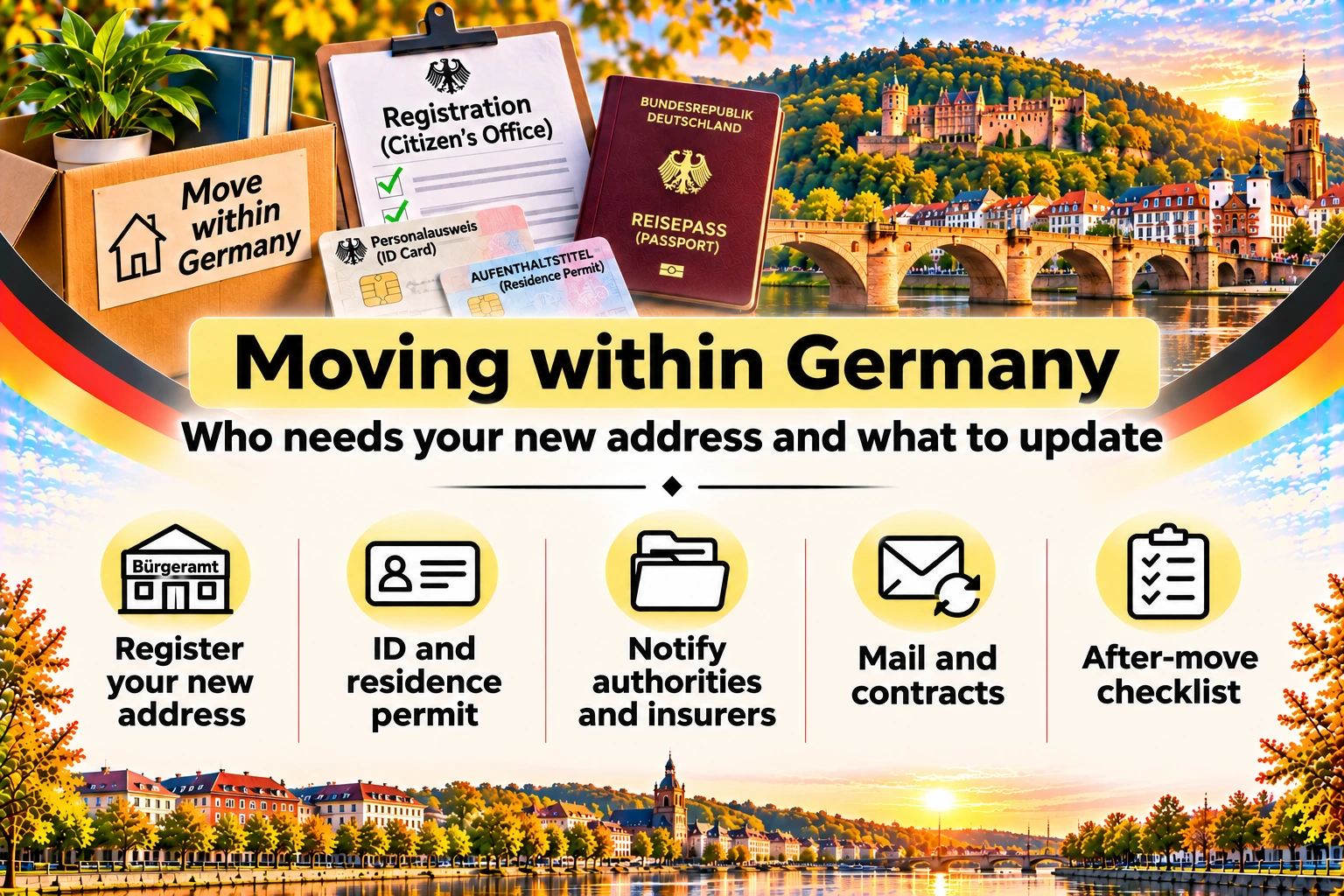
This article covers moving from one German address to another. Choosing your first accommodation, obtaining the housing provider’s confirmation (Wohnungsgeberbestätigung) and completing address registration (Anmeldung) are covered in the separate guide to first accommodation and registration. The aim here is to keep receiving letters and benefits, update documents and maintain contact with authorities.
Start with a notification list
Begin with letters and online accounts from recent months. List who handles your case, pays benefits, sends bills or provides services. For each recipient, record your customer or case number, the notification method and proof of sending.
Prepare your old and new addresses with postcodes, moving date and the names of family members moving with you. Add the registration confirmation (Meldebestätigung) once available. Do not send full passport sets indiscriminately: use the recipient’s official channel and provide only the information and evidence that recipient needs.
Before the move, check residence restrictions, Jobcenter approval of costs, and electricity and internet contracts. Registration at the new address does not replace these arrangements.
If a family with different documents and pending cases is moving, FIRMDER helps prepare an individual notification list, gather registration documents and organise further contact with authorities. You can start with a consultation on registration and changing address: support is agreed around your circumstances, without promising a decision on an authority’s behalf.
Registering your new home and updating identity documents
For an ordinary move into a dwelling, the federal rule requires registration with the registration authority (Meldebehörde) within two weeks of actually moving in. When moving to another home within Germany, separate deregistration at the old address is generally unnecessary. If you keep the old property, report both: the main and secondary residence must be correctly designated. Section 17 BMG.
After registration, check the address, names and move-in date on the confirmation. Separately make sure that documents have been updated, not just the register entry.
- German identity card (Personalausweis): the address on the card and in the chip is updated; a change of address alone does not normally require a new identity document. Federal portal service description.
- German passport (Reisepass): it shows your municipality of residence, not a full street address. If you move to another town, the place of residence is corrected; an ordinary move does not itself require a new passport. Federal portal on changing passport details.
- EU/EEA citizen’s eID card and electronic residence permit (eAT): the electronic address details need updating. These are different card types and their procedures must not be confused. Federal portal on changing an electronic address.
Check with your municipality who performs the update and whether it can be combined with registration. Berlin, for example, states that identity cards, eID cards and eATs can be updated during in-person registration. Its electronic residence registration service has separate requirements and cannot be used with an eAT. This is a Berlin procedure, not a promise of the same online service in every town. Service Berlin.
Immigration authorities and pending applications
If you hold an eAT or temporary certificate (Fiktionsbescheinigung), are waiting for a card or have a residence permit renewal pending, check two distinct matters: changing the document’s address and changing the correspondence address for your case.
It is practical to notify the authority handling your case, including the reference number (Aktenzeichen), moving date and new address. When moving to a different district or town, clarify which authority is now responsible, whether the file has transferred and whether an existing appointment remains valid. Neither automatic register-data exchange nor a changed online-account address confirms that the specific case has already been accepted by a new caseworker.
Moving does not replace a residence permit renewal application. If your document is about to expire, separately ensure the required application is submitted on time and retain proof of receipt. Continuation of the previous permit depends on the conditions in Section 81 of the Residence Act, not on the move. Section 81 AufenthG.
If a residence restriction (Wohnsitzauflage) or allocation decision applies, establish whether you may move before signing a tenancy agreement. Certain categories of foreign nationals are subject to residence rules; changing state or town may require amendment or removal of the restriction. This is not a universal rule for every foreign national. Section 12a AufenthG.
A German citizen does not need the eAT-renewal steps. EU/EEA citizens should not automatically be assigned the procedure for third-country residence permit holders: follow the documents actually held. For a foreign family member of an EU citizen, check their residence card (Aufenthaltskarte) separately.
Ethnic German resettlers and BVA correspondence
After acquiring German citizenship, ethnic German resettlers update German documents under the ordinary rules for German citizens. Under Section 7 StAG, citizenship on this basis is acquired upon issue of the certificate under Section 15(1) or (2) BVFG. Relatives who arrived together may have different statuses; a shared surname alone is not enough. Section 7 StAG.
If the Federal Office of Administration (BVA) is still issuing documents, considering a relative’s inclusion or handling other correspondence, notify it of the new address for that case, quoting the reference number (AZ). Also check the authorised recipient’s address if letters go to a representative. This is a practical step for an open case, not a claim that every ethnic German resettler must report every move to the BVA for life. For clarification, use the official BVA contact under the Aussiedler subject.
If you are unsure which stage is complete, first compare your documents with the explanation of AZ, admission notices and Section 15 certificates.
Notify the Jobcenter and employment agency separately
If you receive Jobcenter benefits
Submit a change notification (Veränderungsmitteilung) without undue delay, including the new address and information about housing, rent and occupants. Do more than edit a profile’s contact field: the details are needed to assess your benefit. Use your Jobcenter’s service or its specified paper procedure. Official information on reporting changes.
Since 1 July 2026, Grundsicherungsgeld has replaced Bürgergeld; the old name still appears in documents and services. For moving, the decision’s content and SGB II rules matter more than the form’s title. Federal Employment Agency explanation of the reform.
Before entering into the new tenancy, obtain prior assurance (Zusicherung) that costs will be recognised from the authority responsible for the new property. Moving expenses and the deposit are agreed separately: Section 22 distinguishes the responsibilities of the old and new municipal authorities. Special conditions apply to people under 25. Previously approved rent does not automatically mean that the new property, removal expenses and deposit will be paid. Section 22(4)–(6) SGB II.
If you receive unemployment benefit
Tell the employment agency (Agentur für Arbeit) your new address before moving, so it can reach you by post and identify the responsible office. If responsibility changes, follow the new agency’s invitation. The BA expressly warns that a mail-forwarding order is insufficient: the employment agency’s mail is not forwarded. BA guidance on moving while receiving unemployment benefit.
If you also receive supplementary Jobcenter benefits, you must notify it too. The institutions are not a single recipient simply because their services are connected. BA guidance on change notifications.
Tax office and tax numbers
Tell the tax office (Finanzamt) your new address, particularly if you are awaiting a decision, answering a request or handling a dispute. Mein ELSTER provides a specific change-of-address form. For joint assessment it allows shared addresses to be changed; if you move separately, clarify the appropriate procedure.
The Bavarian tax administration recommends informing the former tax office after moving so it can transfer the case to the new office. This is useful state-level procedural guidance, not grounds for inventing a single nationwide notification deadline in days. Enter the current address and last known tax reference number (Steuernummer) on your return. Bavarian tax administration FAQ.
Your personal tax ID remains unchanged when you move. Do not request a “new tax identification number” solely because you have changed towns. The personal identification number (IdNr) and tax-case reference number (Steuernummer) are different. Federal Central Tax Office explanation.
Employer, bank and insurers
Tell HR or payroll your address and check it in the employee portal. Separately update your bank, lender and other financial contracts. If your correspondence address differs from your residence, do not confuse the fields: establish which information the organisation requires.
Notify your statutory health insurance fund (Krankenkasse) or private health insurer through its procedure. Informing the fund does not necessarily mean replacing the plastic card. TK, for instance, explains that an address-only change does not result in a new health card; the details are updated at the next medical appointment. Check your own insurer’s rules. TK’s answer.
For home contents, liability and motor insurance, establish whether an address notification is enough or whether risk-related details change, such as floor area, household composition or where the vehicle is kept. Deadlines, documents and consequences depend on the relevant contract; there is no single formula for every policy.
When your address, insurance and case-handling authority change together, FIRMDER offers organisational support in Germany. You can agree a contact list, document preparation and monitoring of replies. Any issue requiring an individual legal opinion should be referred separately to an authorised professional.
Vehicle and registration certificate
For a vehicle registered in your name, update the keeper’s details with the vehicle registration authority (Zulassungsbehörde) and on registration certificate Part I. The federal Vehicle Registration Ordinance (FZV) requires relevant changes to be reported unverzüglich, meaning without undue delay, not within a universal “two weeks”. For an address-only change, Section 15(1) does not require presentation of Part II. Section 15 FZV.
You may retain your existing number plates when moving to another registration district, but the duty to update the registration details remains. The registration office for residents can handle this only where the relevant procedure is offered. Check the local document list, appointments and online-service conditions in advance. Informing your motor insurer is a separate item, not evidence that vehicle registration has been updated.
Family benefits, pensions and local services
You must notify the Family Benefits Office (Familienkasse) directly: reporting to the Bürgeramt, Jobcenter or employment agency does not replace this. Include your child-benefit number (Kindergeldnummer) and establish whether only the address or also household composition changes. Familienkasse guidance on changes.
If your pension is paid through Deutsche Post’s Pension Service (Renten Service), notify that service. Deutsche Rentenversicherung explains that the Pension Service passes the details to it. This is a specific confirmed mechanism, not universal automatic notification of every organisation. German pension insurance guidance on moving in retirement.
Separately check the housing benefit office, social welfare office, parental allowance office and BAföG office if you receive those benefits. For schools, childcare, universities, parking permits and dog registration, ask about the local procedure. Moving to another state may mean different forms and responsible bodies; do not assume that a service or benefit transfers solely because of the new Anmeldung.
Electricity, internet and broadcasting contribution
Tell energy suppliers your move-out and move-in dates, meter numbers and readings at handover. Photograph meters and keep the handover record. Arrange electricity for the new property in advance: the Federal Network Agency states that a contract with your chosen supplier must be concluded before consumption starts. The technical “24-hour supplier switch” does not override contractual notice periods. Federal Network Agency guidance on switching suppliers.
Send the internet provider your new address in advance so it can check whether the connection can be transferred. Clarify the date, equipment and what happens to the old contract. Leave your landlord an address for final accounts and correspondence after returning the property.
For the broadcasting contribution (Rundfunkbeitrag), update your address under your contribution number. If someone already pays for the home you are joining, use the specified deregistration procedure for your former home and provide that payer’s number. If the person in whose name the contribution was registered leaves your former home, those remaining must arrange their own registration. Contribution Service explanation dated 13 July 2026.
Mail and checking the result
Mail forwarding (Nachsendeservice) is useful additional protection, but it does not replace notifying recipients. Deutsche Post recommends arranging standard forwarding at least five working days before it starts. Exceptions apply to certain mail types; a sender’s “Nicht nachsenden” marking prevents forwarding. Formal service is also subject to special conditions. Mail-forwarding terms.
List all relevant recipients and put surnames on the new letterbox. After moving, check letters and online accounts, not merely the “sent” status.
Keep in one folder:
- registration confirmation and details of document updates;
- notification copies with case numbers;
- submission receipts and organisations’ replies;
- cost agreements and new contracts;
- a list of matters still awaiting an answer.
If an important address remains unchanged or an authority has not acknowledged receipt, ask about the status through its official channel. Do not resend an entire package of sensitive documents unnecessarily.
FAQ
There is no single service that removes all your notification obligations. Certain data is exchanged under specific rules, but the Familienkasse, Jobcenter and contractual organisations have their own procedures. Check each recipient separately.
Not always. The employment agency asks for your new address before moving, and Jobcenter cost approval is needed before the new tenancy. Residence restrictions and supplier contracts should also be checked in advance.
No. The address on a German identity card is updated, and the municipality shown in a passport is changed if necessary. For eAT and eID cards, check the data and update procedure. Notifying an organisation and issuing a new card are different actions.
If the address changed, check the same basic items. Remaining in the same town may simplify authority responsibilities, but it does not make the old house number correct.
Do not assume this automatically. One institution may have a joint case, while another has separate files for each adult and child. List everyone affected and their case numbers according to the recipient’s rules.
Finish the administrative side of your move
First check actions needed before the move, then registration and documents, and then work through your list of authorities and contracts. Completion means more than sending notifications: you need confidence that important replies reach the correct address.
FIRMDER helps organise these steps through its post-relocation support. Write to us with where you are moving from and to, when, who is in the family and which cases remain open; we can discuss a suitable scope of assistance. The company is not a government authority and does not guarantee authorities’ decisions.
This material is informational. Federal rules, procedures in your state and municipality, contract terms and the content of individual decisions must be checked separately.