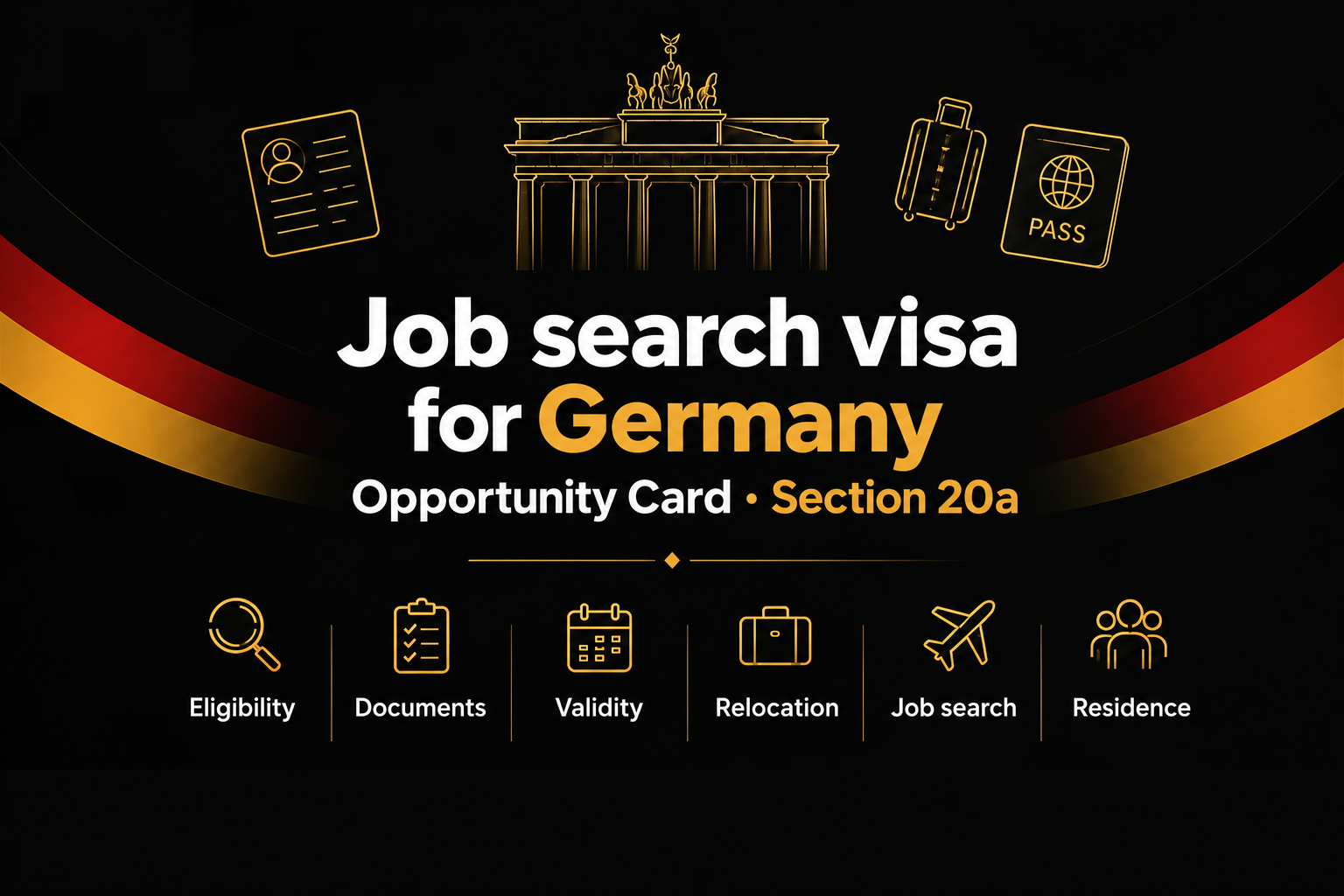
Germany introduced the Opportunity Card on 1 June 2024 under Section 20a of the Residence Act (§20a AufenthG).
It allows you to look for work in Germany without a prior job offer, generally for up to twelve months. The points route requires at least 6 points; recognised skilled workers do not need points.
The points route requires an eligible qualification recognised in the country of training, German A1 or English B2, and at least 6 points. Vocational training must have lasted at least two years. Recognised skilled workers can use the direct route. For twelve months in 2026, the usual financial requirement is €13,092, and the standard visa fee is €75. Secondary employment averaging up to 20 hours a week is allowed during the search.
The Opportunity Card expands the routes available for job searching. Full recognition in Germany is not always required under the points route, but the qualification must meet the statutory requirements; a diploma alone is not enough. A separate direct route is available to recognised skilled workers.
- Two Opportunity Card routes: points and direct skilled worker access
- The Opportunity Card points system: reaching at least 6 points
- Shortage occupations: an additional point for certain qualifications
- Proving sufficient funds for the Opportunity Card
- Documents for the Opportunity Card
- Working with the Opportunity Card: what is permitted?
- Switching from the Opportunity Card to an employment residence title
- Opportunity Card or employment visa: which should you choose?
- Opportunity Card for Russian citizens: specific considerations
- Address registration and first steps after arriving with the Opportunity Card
- FAQ
Two Opportunity Card routes: points and direct skilled worker access
There are two routes to the Opportunity Card: as a skilled worker with a German, recognised or comparable qualification, and through the points system.
| Route | Requirements | Who is it for? |
| Direct skilled worker route without points | German qualification or a qualification fully recognised or comparable in Germany; no statutory language certificate requirement for this route | Applicants with a German or fully recognised or comparable qualification |
| Points route | Eligible qualification recognised in the country of training + German A1 or English B2 + at least 6 points | Applicants with an eligible foreign qualification who meet the points requirements |
The direct route does not require a points assessment. Eligibility depends on the individual qualification and its recognition or comparability. In anabin, H+ describes the institution’s status, not the equivalence of every qualification it awards. A blanket conclusion based on the country of origin is therefore unsuitable.
The Opportunity Card points system: reaching at least 6 points
Points are awarded for criteria defined by law. At least 6 points are required; each category has maximum scores and rules on combining points.
| Criterion | Requirement | Points |
| Qualification in a shortage occupation | Qualification in a statutory shortage occupation group applicable to the Opportunity Card | +1 |
| Professional experience | At least 2 years of relevant experience within the past 5 years | +2 |
| Professional experience | At least 5 years of relevant experience within the past 7 years | +3 |
| German A2 | Accepted evidence of German A2 | +1 |
| German B1 | Evidence of German B1 | +2 |
| German B2 or higher | Evidence of German B2 or higher | +3 |
| Age: not older than 35 | At the time of application | +2 |
| Age: older than 35 and not older than 40 | At the time of application | +1 |
| Previous residence in Germany | At least 6 continuous months of lawful residence within the past 5 years; tourism and visits do not count | +1 |
| Spouse or registered partner also applies for an Opportunity Card | Partner independently meets the Opportunity Card requirements; joint application and intended entry together | +1 |
The points route requires at least German A1 or English B2. German A2 earns 1 point, B1 earns 2 and B2 or higher earns 3. English C1 or higher adds 1 point. Partial recognition of a qualification can earn 4 points. Use the official self-check: Make it in Germany.
Shortage occupations: an additional point for certain qualifications
The Federal Employment Agency publishes analyses of skilled labour shortages. However, the statutory occupation classification determines the Opportunity Card point; not every occupation identified as being in short supply automatically earns a point.
The statutory shortage occupation groups include certain IT, healthcare, engineering, education and management occupations. A relevant qualification can earn 1 point. The occupation classification applicable to the Opportunity Card is decisive, rather than any general labour market shortage statistics. Check the current classification: statistik.arbeitsagentur.de.
Before applying, check the applicable statutory occupation groups and how your qualification is classified. The Federal Employment Agency’s general shortage analysis is not the same as the legal list used for points.
Proving sufficient funds for the Opportunity Card
You must have sufficient resources for your job search stay. In 2026, the usual requirement is €1,091 net per month, or €13,092 for twelve months. Eligible income from permitted employment or an appropriate declaration of commitment may be taken into account.
| Method | Evidence to provide | Specific considerations |
| Blocked account (Sperrkonto) | Blocked account confirmation for €13,092 for twelve months (2026) | A common form of evidence; check current eligibility and fees, for example with Fintiba or Coracle |
| Declaration of commitment (Verpflichtungserklärung) | A formal undertaking by a sponsor to cover the costs of your stay | Issued by the responsible authority where the sponsor lives; financial capacity must be assessed |
| Bank statements | Statements showing sufficient funds for your stay | Confirm acceptance with the responsible German mission in advance |
A blocked account is a common form of evidence because it documents the balance and monthly withdrawals. Further questions are still possible. Check with the responsible German mission in advance whether alternative evidence will be accepted.
Documents for the Opportunity Card
Typical documents for an Opportunity Card application; the responsible German mission’s current checklist is decisive:
| Document | Note |
| Passport, generally biometric for Russian citizens | Since 1 January 2026, Russian citizens generally need a biometric passport. Check the official visa guidance for transitional exceptions and the required remaining validity. |
| Qualification certificate and transcript | Certified copy and translation in accordance with the responsible mission’s checklist |
| Language certificate | German A1 or English B2 as a basic requirement for the points route |
| Proof of sufficient funds | A blocked account with €13,092 for twelve months or an eligible declaration of commitment (2026) |
| Evidence of professional experience | Employment record or employer certificates, with translations as required by the responsible authority. |
| Visa application form | Through the Consular Services Portal or as instructed by the responsible German mission |
The standard visa fee is €75. Processing times vary; 4–12 weeks is not a guaranteed timeframe. If you require a visa to enter, you initially receive a national visa. Check its validity and apply to the foreigners authority in time for any subsequent residence title you need.
Working with the Opportunity Card: what is permitted?
The job search Opportunity Card is intended for finding gainful employment. It does not give unrestricted permission to work, but certain employment is already allowed:
- Permitted: one or more secondary jobs totalling an average of no more than 20 hours per week, including work outside your profession.
- Permitted: trial employment of up to two weeks per employer, intended to lead to qualified employment, vocational training or a qualification measure.
- Regular full-time employment requires the appropriate permission. The separately permitted trial employment is a distinct exception.
- You may start self-employment only when your residence title permits it; the job search Opportunity Card alone does not grant that permission.
At the 2026 statutory minimum wage of €13.90, 20 hours a week amount to approximately €1,205 gross per month on average. Whether this covers your needs depends particularly on rent, insurance and deductions.
Switching from the Opportunity Card to an employment residence title
Before starting regular work beyond the permitted secondary or trial employment, you need an appropriate residence title or employment authorisation. Signing a contract alone does not expand your permission to work.
- Sign an employment contract. The job offer and employment must meet the requirements of the relevant residence title: Blue Card (§18c), §18a or §18b.
- Apply to the foreigners authority for the appropriate residence title. Apply in good time; local processing times can vary considerably.
- Submit additional documents: employment contract, qualification evidence and any additional required documents.
- Your existing residence title may remain valid until a decision on a timely application, subject to Section 81(4) of the Residence Act. Permission to work remains subject to the applicable conditions.
If the salary is below the EU Blue Card threshold, a permit under Section 18b for academic professionals or Section 18a for vocationally qualified workers may be possible. Employment conditions and any applicable salary or pension requirements must still be met. Read more: employment visa for Germany.
Opportunity Card or employment visa: which should you choose?
One key consideration is whether you already have a specific job offer.
| Feature | Opportunity Card | Employment visa (Section 18a/18b/EU Blue Card) |
| Job offer required before entry | No | Yes, a specific job offer is required |
| Duration | Up to 12 months for the search; an extension of up to a further 24 months is subject to specific requirements | Up to 4 years depending on the title and contract; renewal may be possible |
| Work | Secondary employment averaging up to 20 hours a week | Qualified employment permitted by the residence title and any required professional licence |
| Permanent settlement permit | Once the requirements of an applicable settlement route are met | EU Blue Card: 27 months with A1 or 21 with B1; skilled workers under Sections 18a/18b: generally 3 years, subject to further conditions in each case |
| Risk | Not finding a suitable job within the permitted search period | Restrictions linked to the authorised employment; changing employer may require approval |
The Opportunity Card may suit applicants who do not yet have a job offer but have an eligible qualification and sufficient funds. If you already have a suitable offer, an employment visa can be assessed directly. The faster and more suitable route depends on your circumstances.
Opportunity Card for Russian citizens: specific considerations
Russian citizens may qualify for an Opportunity Card without full German recognition of their qualification if the other requirements are met. Since 1 January 2026, Germany generally requires a biometric Russian passport; transitional exceptions apply, particularly to certain residence titles issued earlier.
Blocked account restrictions may depend on nationality, residence and provider. Before opening an account, check the current eligibility rules, for example with Fintiba or Coracle; mentioning a provider does not confirm availability.
The responsible German mission is generally determined by your habitual place of residence. Short-term registration in another country does not automatically make you eligible to apply there. Check jurisdiction and appointment procedures directly with the relevant mission.
Address registration and first steps after arriving with the Opportunity Card
If you need a visa to enter Germany, the Opportunity Card is initially issued as a national visa. A national visa is itself a residence title. Whether and when you then need a residence permit depends on its validity and your plans. Consider the following steps after arrival.
- address registration – generally register with the citizens’ office within two weeks of actually moving in. Required documents include your passport and landlord confirmation; a tenancy agreement does not replace that confirmation.
- Foreigners authority (Ausländerbehörde) – establish early whether you need a residence permit after your visa and apply before it expires. Waiting times vary.
- Appropriate health insurance cover. You need appropriate health insurance for your stay. If you are not eligible for statutory insurance, suitable private cover is often an option. Eligibility, benefits and premiums must be checked individually; one flat price does not apply to everyone. Read more: insurance in Germany.
- Steueridentifikationsnummer (Steuer-ID/IdNr) – your tax identification number is generally sent by post after address registration and is needed for employment.
Address registration is needed for many subsequent steps, although banks and insurers have different evidence requirements. Contact the foreigners authority well before your visa expires. A timely application matters, not merely booking an appointment; waiting times vary by location.
Relocation DE: how we support you
Errors in calculating points, unsuitable financial evidence or an unacceptable passport can delay an application. Relocation DE reviews your circumstances, identifies points you can substantiate and helps compile your documents. Read more on our page about the Opportunity Card.
- We assess your points based on qualifications, professional experience, language skills, age and eligible previous stays.
- Help with a blocked account, taking nationality and provider requirements into account.
- Document translation by sworn translators.
- After arrival: address registration, residence permit applications and switching to an appropriate residence title after finding work.
Send us your enquiry and we will discuss your next steps!
FAQ
Third-country nationals may qualify as recognised skilled workers without a points assessment or through the points route. The latter requires an eligible qualification recognised in the country of training, German A1 or English B2 and at least 6 points. Sufficient financial resources are required. A university’s H+ listing alone is not enough.
The standard visa fee is €75. For twelve months in 2026, the usual proof of sufficient funds is €13,092; the blocked balance remains your money. Account fees depend on the provider. This website gives an indicative translation budget of €300–800; an individual quotation is decisive.
An Opportunity Card extension of up to two further years is possible if you have qualified employment, the Federal Employment Agency approves it and you do not qualify for another employment residence title. Applications or interviews alone are not sufficient.
Yes, a Russian qualification may be eligible. The points route requires recognition in the country of training and the prescribed evidence; the direct skilled worker route requires German recognition or comparability. The other requirements must also be met.