


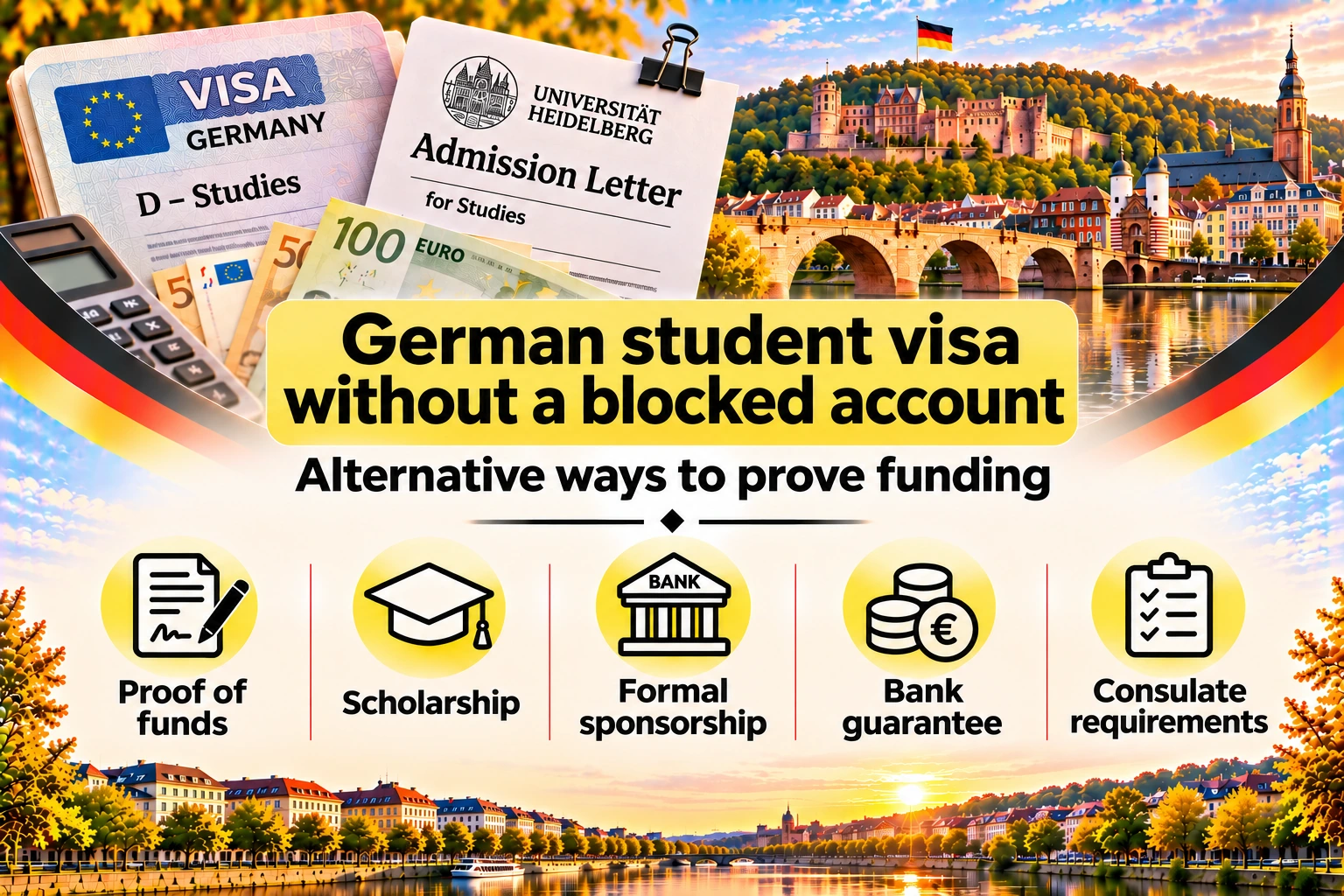
It is possible to obtain a German student visa without a blocked account. However, you cannot replace a Sperrkonto with just any document showing that money exists. The suitable option depends on your study programme, admission documents, source of funds and the requirements of the German mission processing your application.
The German Federal Foreign Office lists a formal declaration of commitment, or Verpflichtungserklärung, certain scholarships, a bank guarantee and evidence of parents’ income and assets among the ways to demonstrate funding. An option appearing in this general list does not mean that a particular certificate will be accepted for your application. Source: Federal Foreign Office.
The practical question is: who pays for your stay, which document proves this, and why will the money be available during the required period? We examine four alternatives, their limitations and the checks to complete before applying.
The Russian source article was prepared using official sources checked on 16 October 2026. It concerns proof of funding for applicants who need the relevant national visa. Individual circumstances and the competent mission’s current document checklist must be checked separately.
- First establish the visa category and required amount
- Verpflichtungserklärung: a formal commitment to support a student
- Scholarship: check the organisation, amount and payment period
- Bank guarantee: establish exactly which document is required
- Parents’ finances: a possible option with important local restrictions
- Money in an account and an accessible budget serve different purposes
- Can a future part-time job replace savings?
- Checklist before choosing an alternative
- Three hypothetical examples
- Frequently asked questions
- Where to start preparing
First establish the visa category and required amount
The official government portal Make it in Germany states an amount of EUR 11,904 for studying in 2026. This equals EUR 992 per month. Searching for a university place, or Studienplatzsuche under Section 17(2) of the Residence Act, has a different benchmark: EUR 1,091 per month. These amounts are not interchangeable. Source: Make it in Germany.
For a nine-month search for a study place, the calculation gives EUR 9,819. This is the amount stated, for example, in the German Embassy in Tashkent’s guidance. For regular study, the same guidance specifies EUR 11,904 for the first year. Source: German Embassy in Tashkent.
For a Studienkolleg, read the institution’s actual letter carefully. Section 16b includes preparatory study measures, including attendance at a Studienkolleg where acceptance has been confirmed. Conditional university admission, the absence of final acceptance and an invitation solely to take an examination may lead to different application routes. Saying “I am going to a Studienkolleg” does not by itself establish the visa category. Legal basis: Section 16b of the Residence Act.
Before choosing a financial instrument, compare three documents: the university or Studienkolleg letter, the guidance for your visa category and the requirements in the application. If their wording differs, clarify the category based on the actual circumstances and attach the admission letter. Transferring money on the assumption that a lower threshold applies is risky.
The general preparation process is explained in our article on obtaining a German student visa.
Verpflichtungserklärung: a formal commitment to support a student
A Verpflichtungserklärung is issued through a prescribed procedure. Typically, a person living in Germany contacts the competent immigration authority and assumes financial obligations for the applicant. This may be a relative or another person willing to undergo the assessment. The government portal expressly mentions friends and family members as possible providers of the commitment. Source: Make it in Germany.
For the student, the main issue is that person’s financial capacity. Berlin, for example, assesses income in light of family status, existing maintenance obligations and the visitor’s purpose of stay. Having a job does not by itself mean that income is sufficient. A document marked to indicate that financial capacity has not been demonstrated does not provide the required proof of funding. Source: Service Berlin.
Check in advance:
- whether the commitment is specifically for study or the required preparatory programme;
- whether financial capacity has been demonstrated in the required form;
- whether the personal details and anticipated entry date match;
- whether the document meets requirements concerning how recently it was issued;
- whether the original or other required copy will reach you before the application.
For example, the German mission in France requires a Verpflichtungserklärung issued no more than six months earlier and marked “Bonität nachgewiesen”, meaning financial capacity has been demonstrated. Do not automatically apply this period to every country: consult the guidance applicable to your own application. Source: German missions in France.
The consequences for the person signing are substantial. Section 68 of the Residence Act provides for reimbursement of certain public expenditure on subsistence, housing, healthcare and care needs for five years from the entry enabled by the commitment. The precise scope of liability and the conditions for its termination should be understood before signing. Legal basis: Section 68 of the Residence Act.
Do not therefore ask an acquaintance to “just sign a piece of paper”. First discuss the actual budget, transfers and what happens if income is lost. The commitment also does not automatically transfer money to the student: practical payment of expenses must be arranged separately.
Scholarship: check the organisation, amount and payment period
A scholarship may replace a blocked account entirely or cover part of the required funding. The Foreign Office’s official list includes scholarships from German public funds and organisations recognised in Germany. Funding from the country of origin’s public resources is subject to additional conditions concerning German organisations’ involvement in placement at the university. An arbitrary letter from a private “sponsor” does not become a scholarship simply because of the document’s title. Source: Federal Foreign Office.
When reviewing a scholarship award, identify:
- The organisation’s full name and the funding programme.
- The recipient’s name and study programme.
- The start and end dates of payments.
- The monthly amount, currency and payment arrangements.
- Expenses covered separately, such as insurance or tuition.
- The conditions that must be fulfilled before payments actually begin.
Distinguish an undertaking to consider your candidacy from a final funding decision. Entering a competition, receiving an interview invitation or awaiting results does not prove that funding has already been awarded.
If the scholarship is partial, the shortfall must be demonstrated in a form accepted by your mission. Procedural differences are especially apparent here. The French guidance allows suitable bank statements to cover the remainder. Tashkent directs applicants to the alternatives listed in its own guidance. The French procedure cannot be transferred to an application in another country. France, Tashkent.
Check for timing gaps separately. If you arrive in September but the scholarship starts in November, the first months require a separate financial solution. Similarly, a scholarship for one semester does not automatically cover a full academic year.
Bank guarantee: establish exactly which document is required
The Federal Foreign Office lists an annually renewable bank guarantee deposited with a financial institution in Germany as a possible funding document. This is a distinct instrument involving obligations for the bank; an ordinary account-balance certificate is not such a guarantee. Source: Federal Foreign Office.
Before paying to arrange it, establish the mission’s requirements for the guarantee and the bank’s actual terms. Useful questions include:
- Does the bank offer this product specifically as proof of student funding?
- What amount and period must be stated?
- Who must be named as the beneficiary of the guarantee?
- What collateral will the bank require?
- How much do issuance and renewal cost?
- What happens if the studies last longer than originally planned?
Do not assume that an option saves money merely because it is not called a Sperrkonto. Compare the bank’s offer with alternatives in terms of total costs, timing and the funds the family will still be able to use. If the collateral requirements are unknown, the financial effect of the guarantee is also unknown.
Checking the wording beforehand is particularly important where a bank offers its own standard template. Before paying, establish whether it meets the requirements of the particular application. Compare the bank’s statement that a document is “suitable for visas” with the official guidance.
Parents’ finances: a possible option with important local restrictions
Evidence of parents’ income and assets appears in official information. Yet this is precisely where a common mistaken expectation arises: if parents have enough money, any bank statement will suffice.
The Foreign Office’s current Visa Handbook makes acceptance of this evidence dependent on the mission’s assessment of whether suitable and sufficiently reliable documents are available in the country concerned. A strict assessment is required. Arrange translations and notarised declarations only after establishing the requirements for your case. Source: Visa Handbook, Studierende section.
A specific restriction appears in the German missions in Kazakhstan’s FAQ: a local bank account and a parental undertaking to cover expenses are not accepted as the relevant financial evidence in the visa procedure described. This is an important reason not to copy the document package of someone applying in another country. Source: German missions in Kazakhstan.
If your proposed option is allowed, request the exact list. Questions may concern proof of relationship, regular income, savings, an undertaking to support the student, document language and certification. Do not treat this as a universal list of mandatory certificates: the final package depends on the procedure.
For financial planning, prepare a clear explanation of the amount your parents will provide each month, its source and how it will reach you. An apartment, business or other assets may demonstrate family wealth but do not themselves pay next month’s rent. Show the connection between the resources declared and actual support for the student.
Money in an account and an accessible budget serve different purposes
With a Sperrkonto, funds are allocated by month: the entire annual amount cannot be withdrawn at once. The Foreign Office also states that bank charges must be paid in addition to the blocked funds. If you choose an alternative, you still need a clear mechanism for receiving money after arrival. Source: Foreign Office guidance on blocked accounts.
Check access as well as the balance: whether the required transfer works, how long it takes, who may operate the account and what to do if it is delayed. Keep a reserve for initial expenses based on your relocation plan. The amount depends on accommodation, the move-in date and the institution’s payment arrangements.
Keep three parts of preparation separate:
- Evidence of funds for living expenses.
- Payment of tuition and the institution’s mandatory charges.
- Suitable health insurance and evidence of that cover.
For example, Tashkent separately lists financial documents for fee-paying study at a private university. An amount shown for living expenses therefore does not automatically demonstrate that you can pay the university’s invoice. Source: embassy guidance.
The scope of health insurance also needs a separate check. For a student residence permit in Berlin, proof of insurance is a separate document requirement. However, do not mechanically add a single supposedly “mandatory for everyone” insurance amount to the visa minimum: the cost and suitable option depend on the circumstances. Source: Service Berlin.
Can a future part-time job replace savings?
The plan “I will arrive and quickly find work” leaves the start date, hours and income uncertain. Expected earnings cannot be treated as already secured funding.
However, the opposite claim that “work is never taken into account” is also inaccurate. The Visa Handbook allows an existing, specific employment relationship for permitted part-time work to be considered. The contract, permitted work arrangements, period and adequacy of income must be assessed. This does not automatically remove the need for additional financial evidence. Source: Visa Handbook, Studierende section, point 3.3.1.
Also distinguish a visa application abroad from obtaining or renewing a residence permit after arrival. Berlin’s list, for example, includes a part-time employment contract and, for renewal, bank statements for the previous six months and other income. This local procedure does not replace the German mission’s requirements for the initial visa. Source: Service Berlin.
Checklist before choosing an alternative
- Record your study status. Write down what you already have: final admission, conditional admission, acceptance at a Studienkolleg or an examination invitation. Do not substitute your own interpretation for the wording.
- Identify the competent mission. Check the application rules for your place of residence. Guidance for another country may be a useful example but is not the basis for your application package.
- Save the current requirements. Record the date checked, link, amount, funding period and accepted documents. An old screenshot from a chat is difficult to rely on when information conflicts.
- Choose the main source. Establish what is actually ready for submission: a completed formal commitment, an awarded scholarship, an agreed guarantee or acceptable parental evidence.
- Check coverage month by month. Mark the beginning and end of each payment, the shortfall and how it will be demonstrated. Identify the time before the first payment separately.
- Check details and form. Compare names with the passport, currency, amounts, dates, signatures, translations and original-document requirements. Establish how recent documents must be.
- Calculate actual expenses. Include housing, food, insurance, study payments, travel and initial settling-in costs. The visa minimum does not replace a personal budget.
- Prepare a fallback. Decide in advance what to do if the person providing the commitment fails the assessment or the scholarship does not cover the required period. Do not pay for several instruments without understanding refund conditions.
If a question remains unresolved, make your enquiry to the mission specific: state the category, period, document type and amount. Asking “Can I apply without a blocked account?” without those details often prevents a useful answer.
What to do if information conflicts
First ensure that you are comparing the same procedure. Different amounts may concern studying and searching for a study place; different document lists may concern a visa and residence-permit renewal. Check the publication date: even an official website may contain an old information page.
If the contradiction remains, save both links and ask the competent mission to clarify the applicable requirements. Until you receive an answer, do not treat an oral assurance from a bank or intermediary as confirmation that the arrangement is acceptable. A short record helps: what is officially confirmed, what remains under clarification and which decision depends on the answer.
Compare alternatives by preparation time as well. Scholarship decisions, the undertaking provider’s appointment with the authority and bank checks involve different processes. Establish those timeframes before planning the application, allow time to correct documents and agree with the university what happens if your arrival is delayed.
Three hypothetical examples
A scholarship of EUR 800 per month has been awarded for a year. If the applicable threshold is EUR 992, the arithmetic shortfall is EUR 192 per month, or EUR 2,304 over twelve months. You need to establish which evidence can cover the remainder. The calculation does not itself confirm that the chosen document is acceptable.
An aunt in Germany is willing to help. The family first establishes whether she can provide a Verpflichtungserklärung, the income requirements and the timeframe. The student separately agrees when and how money will be received. If the aunt’s financial capacity is not demonstrated, her promise of help does not replace missing financial evidence.
The parents have saved more than EUR 11,904. The applicant is applying in a country where their ordinary bank statement is not accepted for this purpose. The appropriate next step is to choose an accepted form of evidence. An additional German translation of the same statement does not by itself remove the restriction.
All examples are fictional. They illustrate the checking process, not a predicted visa decision.
Frequently asked questions
This is possible if sufficient funding comes from another accepted source, such as a suitable scholarship or a Verpflichtungserklärung. You should also understand who will pay for travel and initial expenses if the funding starts later.
Do not rely on one without checking. An ordinary letter, a formal Verpflichtungserklärung and a scholarship award have different evidential value and follow different rules.
Partial coverage is possible, but the form of evidence for the remainder must meet the mission’s requirements. Prepare a monthly calculation to ensure sufficient funds throughout the required period.
The Visa Handbook permits an individual assessment of this funding. Depending on the case, the lender’s corresponding commitment may be accepted or, for example, depositing the money in a Sperrkonto may be required. Loan approval does not automatically replace a blocked account. Source: Visa Handbook.
Yes. Funding is also needed for your continued stay. Find out the local immigration authority’s requirements for the first residence permit and renewal, especially if a scholarship is ending or your source of funds changes.
No. Funding is one requirement. The basis for studying and the other requirements of the individual application are also assessed.
Where to start preparing
Start with the admission letter and the mission’s current guidance. Then compare the available options by document acceptance, timing, costs and obligations of the person or organisation funding you.
If you need help preparing, you can discuss your study route and documents at relocationde.com. For an initial review, have the institution’s letter, country of application, proposed entry date and a description of the funding source ready. FIRMDER is a private consultancy; the competent German authorities decide on the visa.