


The Russian original was checked against official sources on 7 November 2026. The main procedural rules were checked again for this translation on 12 November 2026.
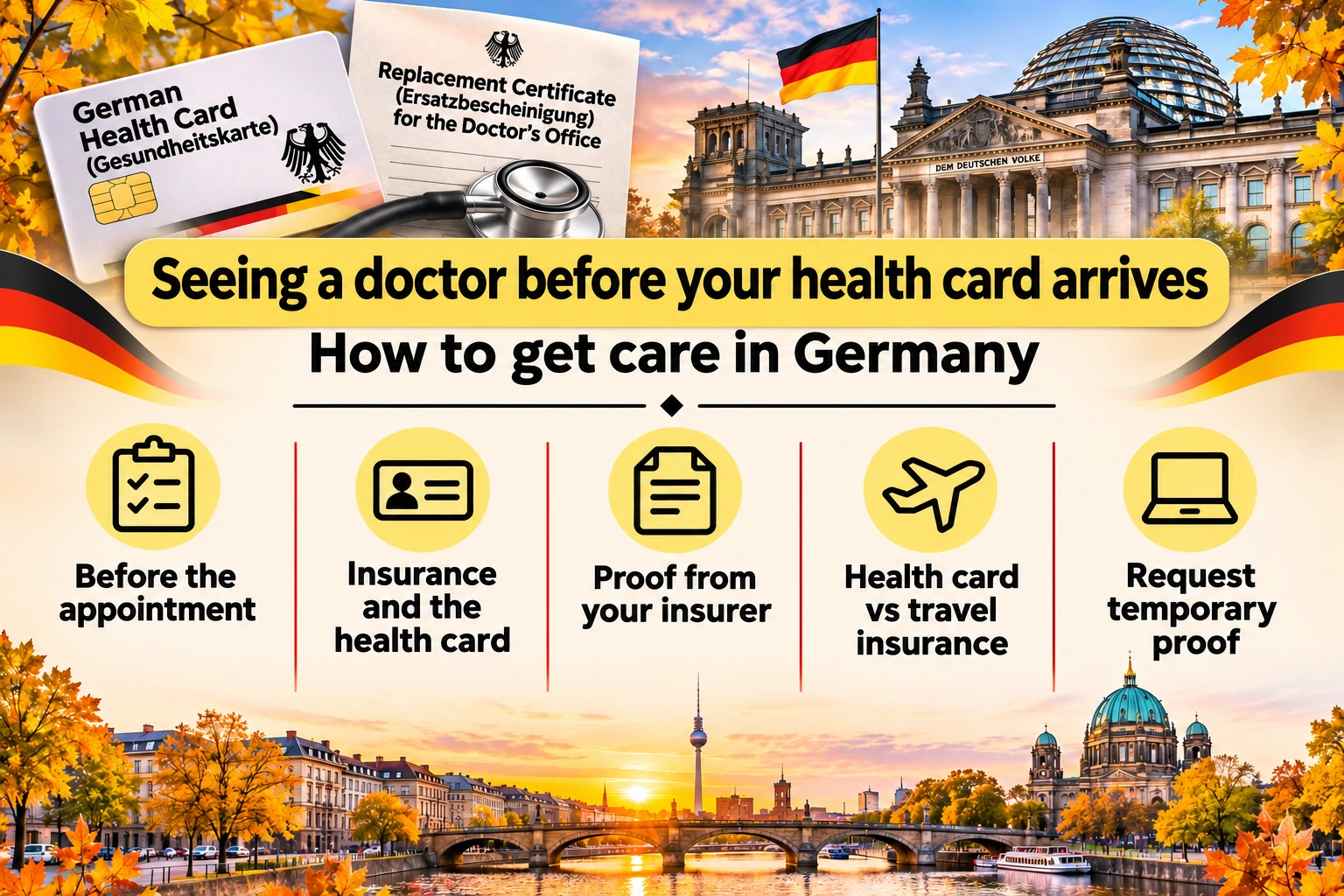
If your cover with a German statutory health insurance fund is already in place, you normally do not need to wait for the plastic card before seeing a doctor. Ask your Krankenkasse for an Ersatzbescheinigung, a temporary certificate confirming your entitlement to healthcare. It may be issued on paper, made available for download or sent electronically straight to the practice. This option is also available to newly insured people who have not yet received their first card. AOK confirms this in its guidance on replacement insurance certificates.
First, however, you need to establish that your cover has actually started. Sending an application and waiting for the fund's reply does not justify saying that a particular appointment will already be covered.
This article concerns an ordinary appointment in Germany with a doctor participating in the statutory health insurance system, GKV. For private insurance, an incoming travel policy, dental treatment and inpatient care, check the payment arrangements and required documents separately.
A short checklist before your appointment
- Contact your health insurance fund and check your insurance status for the actual date of the appointment.
- Ask for an Ersatzbescheinigung zur Vorlage in der Arztpraxis, rather than just any letter confirming membership.
- Tell the practice that your eGK has not arrived and ask how to send the proof.
- Send the document or arrange electronic delivery through KIM, and make sure the practice has received it.
- At the same time, find out why the card is delayed: a missing photograph, an address check or an incomplete registration.
For example, a new TK member can obtain a temporary certificate through Meine TK from the start of membership. This is explained in TK's answer about a card that has not arrived by the start of insurance. Other funds may provide different ways of obtaining a certificate.
The difference between insurance cover and the insurance card
The elektronische Gesundheitskarte, or eGK, is used to confirm insurance status. The plastic card itself does not determine when your entitlement to treatment begins. Under Section 291 SGB V, the fund issues a card to every insured person. It is valid only during the insurance period with the fund that issued it and cannot be transferred to someone else.
There are therefore two different possible situations:
- Your cover is confirmed, but the card is still being produced or is in the post. You need a replacement document for the doctor.
- Your insurance registration is incomplete or the fund does not confirm entitlement to services on the relevant date. First, establish the basis and period of your cover. Ordering a new card does not resolve that problem.
After moving from another country, it is useful to ask the fund three separate questions: from which date your insurance applies, whether access to healthcare is confirmed for that date, and what document you can show a doctor now.
This is equally important for an employee, a student or a relative covered by family insurance. The name of an immigration status, including that of a late ethnic German resettler or an included family member, does not replace confirmation from the particular fund. This article does not determine any individual's right to join statutory health insurance.
FIRMDER can help you organise documents for insurance registration and prepare questions about the dates of cover. The Krankenkasse determines your insurance status and whether it can issue confirmation.
Which proof to request from your health insurance fund
State what you need the document for: “Ersatzbescheinigung für einen Arztbesuch” or “Anspruchsnachweis zur Vorlage in der Arztpraxis”. The fund will understand that you need proof for the medical practice's billing while you do not have an eGK.
Do not rely solely on the heading of a letter. A general Mitgliedsbescheinigung, a certificate for an employer, a letter for the immigration authority and evidence of entitlement to treatment can serve different purposes. Ask the fund to confirm expressly that the document it issues is suitable for your appointment.
Check your name, date of birth, the fund's name and the validity period on the temporary document. If a period is specified, it must cover the date of treatment. AOK specifically warns that the certificate is time-limited; its precise duration depends on the fund and is stated on the document. Do not assume that every Ersatzbescheinigung lasts exactly one month or a whole calendar quarter.
A child needs a document bearing their own details. Even when the child is insured through a parent, the adult's card must not be presented as the child's card. The conditions for including relatives are discussed in the separate article on family health insurance.
Do not confuse the document for Germany with one for travel abroad
You can also ask a German fund for a temporary replacement for the European Health Insurance Card, EHIC: a provisorische Ersatzbescheinigung, or PEB. AOK distinguishes between these documents: the eGK certificate is for treatment in Germany, while an EHIC replacement is for relevant trips to European countries. When requesting it, state where the treatment will take place.
Three ways to obtain an Ersatzbescheinigung
Download a certificate from your online account
Depending on the fund, you can obtain the document through an app or a website. TK, for example, offers a PDF under Bescheinigungen, while BARMER allows you to download and print a temporary document through Meine Barmer. See the relevant guidance from TK on certificates for doctor visits and BARMER on the Gesundheitskarte.
Download the document through your fund's official members' account. Ask the practice beforehand whether showing a PDF is sufficient, whether a printout is needed or whether the fund itself must send it. Do not edit the certificate yourself, even if you spot a mistake in your surname: request a correction from the issuer.
Arrange electronic delivery to the practice
An elektronische Ersatzbescheinigung, eEB, is sent by the fund to the practice's information system through the secure KIM service, Kommunikation im Medizinwesen. It is not a photograph of a card or an ordinary email to reception.
The usual sequence is:
- The practice provides its KIM-Adresse, often as a QR code.
- You open the relevant function in your fund's app.
- You scan the code or enter the address provided and request delivery of the proof.
- The fund sends the details to the practice, whose staff check that they have arrived.
According to gematik's information on the eGK and electronic replacement, the eEB application has been mandatory for medical practices and statutory funds since July 2025. This does not oblige patients to use a smartphone: a paper certificate remains an option.
If you have never signed into the app before, do not assume you can complete registration in a minute just before your appointment. Ask by phone about an alternative. Clicking “send” does not by itself confirm that the practice has received a usable document.
Call the fund or visit one of its branches
If you do not have the app, cannot sign in or your details do not match, ask the fund to find an accessible way to issue the document. For example, BARMER expressly provides for telephone requests, and AOK lists online and telephone options; procedures may differ between regional AOK funds.
Look for contact details on the fund's official website or in its letters, rather than in a random advertisement. During the call, have your insurance number ready if one has already been assigned, along with the appointment date and practice contact details. Ask whether you will receive the document yourself or whether it will go to the doctor, and when you should check that it has arrived.
Can the practice request the certificate itself?
Under the current rules, this is possible in exceptional cases for patients already known to the practice and with their consent. The practice requests the eEB from the fund through KIM and records the patient's consent in its system. This is expressly provided for in Annex 4a BMV-Ä, Appendix 1, paragraph 2.9, version effective from 1 July 2026.
Do not therefore promise a new patient that every reception desk must request everything for them. For a first appointment, it is more convenient to contact the fund yourself or use delivery through its app.
A short phrase to use at the practice:
“Meine Gesundheitskarte ist noch nicht angekommen. Ich bin bei [Name der Krankenkasse] versichert. Wie kann ich Ihnen die Ersatzbescheinigung übermitteln?”
In English: “My health insurance card has not arrived yet. I am insured with [name of health insurance fund]. How can I send you the temporary certificate?” Only state that you are insured once your status has been confirmed.
What to bring to your appointment
It is helpful to prepare:
- the Ersatzbescheinigung or details of the electronic delivery already completed;
- an identity document to confirm personal details;
- your insurance number and the fund's contact details;
- a referral and medical records if needed for the particular visit;
- a list of medicines you take, if relevant to the consultation.
This is a practical checklist, not a uniform compulsory set of documents for every doctor. Check the particular practice's requirements beforehand. An insurance certificate addresses proof of cover but does not replace a referral, an appointment or a doctor's medical decision.
If your surname has recently changed or documents use different spellings, tell the fund and the practice before the visit. Do not try to fix the discrepancy by presenting someone else's card.
FIRMDER can help organise correspondence about insurance documents after your move. This is organisational support, not a guarantee of a doctor appointment, payment for a particular service or a decision by the fund.
If you have already attended without proof
At an ordinary medical practice participating in GKV, it is important not to delay providing the document. If valid insurance proof is not presented, after ten days the doctor may require private payment for treatment. This is a right to issue an invoice, not a universal fine for forgetting a card. TK explains the deadline in its guidance for patients without a card.
Under Annex 4a BMV-Ä, Appendix 1, paragraph 2.1, a fee already paid must be refunded if, by the end of the relevant quarter, the doctor receives proof that was valid on the treatment date: an eGK or another valid certificate of entitlement.
Practical steps:
- Ask the fund the same day for proof covering the date of the appointment that has already taken place.
- Send it to the practice and keep evidence of delivery.
- If an invoice has already arrived, contact the practice with the treatment date and invoice number. Ask about correcting the bill and, if you have already paid, obtaining a refund.
- If the matter remains unresolved, ask your fund to help clarify the billing. Do not ignore the invoice.
Calendar quarters end on 31 March, 30 June, 30 September and 31 December. If your appointment falls near the end of a quarter, sending the document immediately is particularly important. Do not assume that a refund will automatically be available after the quarter has ended.
This procedure concerns a private bill issued specifically because insurance proof was missing. It does not mean automatic reimbursement for every paid service you choose yourself, individual health services (IGeL), private treatment or all medication costs. If a prescription was issued with a note that proof was missing, clarify the subsequent payment procedure separately with the fund.
Errors when reading the card at the terminal
Not every error means your insurance has ended. KBV distinguishes a technical fault from an invalid card: if the problem concerns the card or equipment, the practice uses the prescribed substitute procedure, Ersatzverfahren. If the system reports that the card is invalid, the reason must be clarified with the fund.
Tell reception exactly what happened: the card cannot be read, you received a new card, you recently changed funds or the old card was reported lost. After changing funds, do not keep using the old card just because a future date is still printed on it.
If an eEB has already been accepted, you normally do not need an extra visit solely to have the plastic card read. However, at your next in-person visit during the same quarter, you must show the new card if it has arrived by then. KBV describes this procedure on the same page.
Special rules for children and teenagers
Since 1 January 2026, the Ersatzverfahren has been provided for insured patients under 18 who cannot present an eGK and for whom an electronic replacement certificate cannot be sent. If the minor attends without an accompanying representative, the signature normally required for that procedure is waived. The rule is set out in the official agreement between KBV and GKV-Spitzenverband dated 15 October 2025.
This matters for families still arranging cards after a move. Ask the paediatric practice about using the Ersatzverfahren and provide the known details of the child and their fund. The rule concerns proof and billing for an insured minor, not automatic insurance registration or consent to any and all treatment.
Even if the appointment went ahead, continue arranging the child's own card and resolve outstanding insurance questions. Do not stop at providing the parent's details.
Obtaining medication without the card
If the doctor has prescribed medication and issued an E-Rezept, ask for a printout with the prescription code. An electronic prescription can be redeemed at a pharmacy not only using the eGK but also using this paper printout. The Federal Ministry of Health confirms this in its E-Rezept FAQ.
The Ersatzbescheinigung itself does not replace a prescription. If you only have an insurance certificate, you still need a prescription issued by a doctor. Ask the practice how to obtain the actual prescription and, where necessary, ask the fund about coverage of the cost.
Private insurance or a temporary incoming policy
The eGK and GKV arrangements described above do not automatically apply to private insurance. Under private health insurance, PKV, medical bills are reimbursed within the terms of the contract. A private insurer's card and the statutory eGK serve different purposes; using a private insurance card is voluntary for most policyholders. The PKV Association explains the differences in its section on proof of insurance and reimbursement.
Before a planned appointment, ask your insurer:
- which document proves that the policy is valid;
- whether your tariff covers the care you need;
- whether prior approval is required;
- who pays the invoice initially and how to submit it for reimbursement.
For incoming or travel insurance, follow the particular contract's conditions and the insurer's instructions. Do not wait for a statutory health card if you have not joined GKV at all. If treatment is funded under another statutory arrangement, ask the responsible payer which document is needed instead of automatically describing it as family insurance or private insurance.
Urgent medical help and insurance documents
For a life-threatening emergency, call 112 and do not delay seeking help because of the card. If you need urgent help outside normal practice hours that cannot wait until the next appointment, but the condition is not life-threatening, contact 116117. The official 116117 service explains the distinction.
In urgent cases, Section 15(5) SGB V allows the eGK or entitlement certificate to be provided afterwards. This does not mean that all help is free for everyone: the basis of insurance and billing are dealt with separately.
Frequently asked questions
Do not cancel solely for that reason without contacting the fund and the practice. If insurance is in place, first request temporary proof and agree how to deliver it. A medical professional assesses how urgently you need treatment.
Do not rely on a photograph as a replacement for official proof. Request a document from the fund or an eEB that it sends to the practice. An ordinary photograph does not complete the procedure for checking current insurance status.
A paper Ersatzbescheinigung remains a valid option if its content and validity period are suitable. The electronic channel allows details to be sent straight to the practice. There is normally no need to request both documents again without a reason.
Temporary proof does not excuse you from cooperating in the issue of an eGK. If the card cannot be issued for reasons attributable to you, a further certificate depends on your cooperation with the card-issuing process. This is provided for in Section 15(6) SGB V. Ask what steps the fund expects you to take.
Contact the fund through an official channel and explain that this is your first membership application. Ask it to check the application and your details, explain the current status and tell you how to identify yourself. Do not use your spouse's or another relative's number.
Tell the fund your new address and ask whether its verification is complete. For example, BARMER explains that it checks the address against registration authority data before posting the card; a missing photograph can also delay issue. While the cause is being resolved, separately request proof for your appointment.
Do not assume the documents are interchangeable. Check the authority's requirements and ask the fund for a document specifically for that purpose. This article concerns seeing a doctor, not whether a policy is sufficient for a particular basis of residence.
Checking documents and billing after the appointment
Make sure the fund has confirmed cover for the required date, the practice has received the document and the cause of the delayed plastic card has been resolved. If an invoice was already issued, separately establish the outcome of its correction. Keep the correspondence and certificate until billing is complete.
Contact FIRMDER for help organising insurance documents after your move. We can help prepare a clear list of next steps. The insurer decides on cover, while the doctor decides on medical help and its urgency.
This article is for information and does not replace individual advice from your fund, a doctor or, in a dispute, a legal professional. The Russian original states that these procedures were checked on 7 November 2026; the main procedural rules were checked again for this translation on 12 November 2026.