


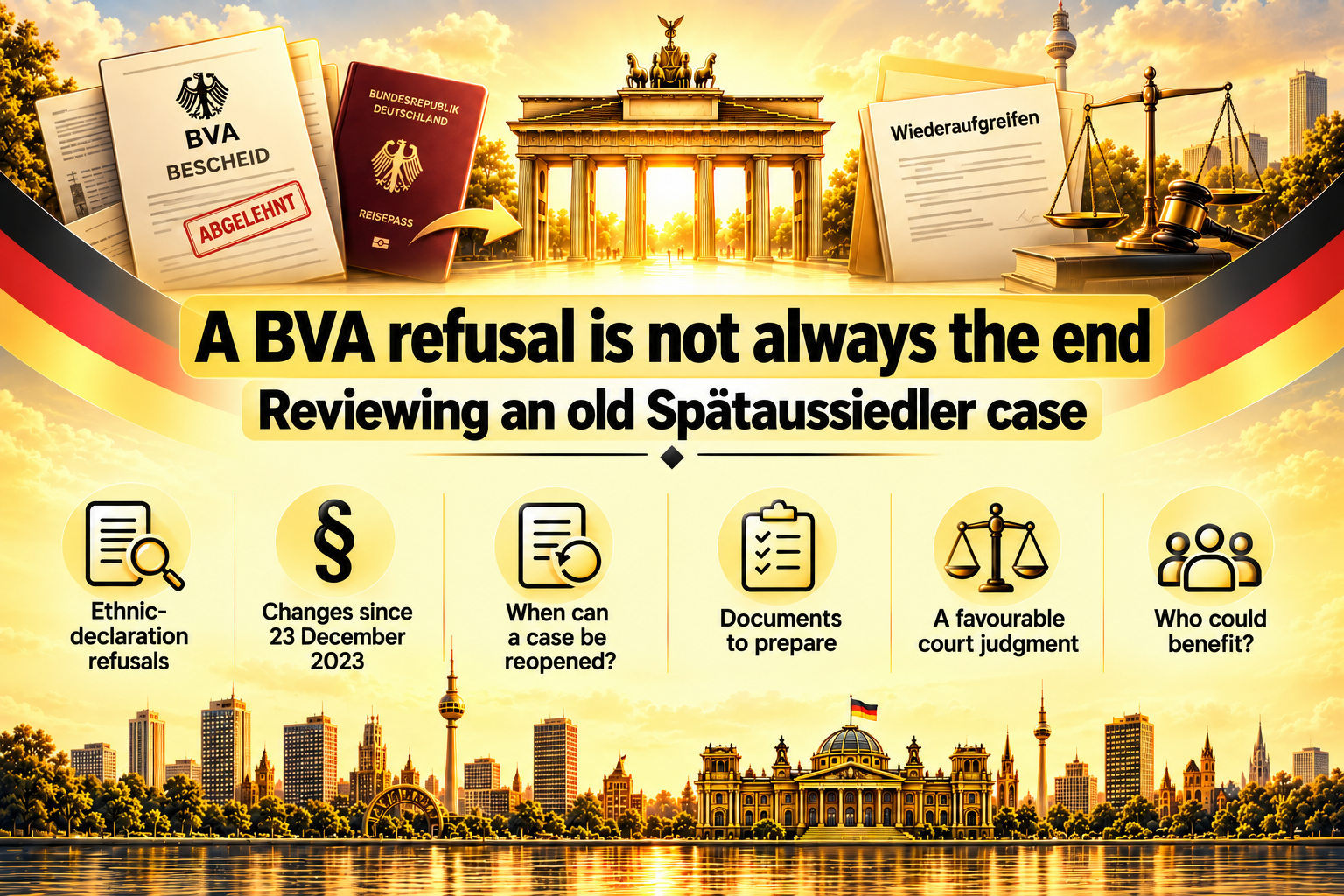
A BVA refusal is not always the end: reviewing an old Spätaussiedler case
Author: Alex Richstein, RelocationDE / FIRMDER. Original article reviewed on 11 October 2026.
Was your Spätaussiedler admission application refused because a passport, marriage certificate or your children’s documents recorded a non-German ethnic affiliation? Even years later, your file may merit another review. Since 23 December 2023, section 6 of the Federal Expellees Act (BVFG) has contained rules allowing a previous declaration of non-German ethnic affiliation to be overcome. Section 27(3) also places no time limit on an application to reopen a finally concluded admission or family-inclusion procedure.
This offers a specific legal basis for returning to a case. It does not automatically overturn every refusal. The BVA’s reasons, subsequent changes and all remaining admission conditions must be examined. Section 6 BVFG and section 27 BVFG.
In our client’s case, we obtained a favourable judgment from the Higher Administrative Court of North Rhine-Westphalia: on 23 May 2025, in case 11 A 2449/24, the OVG NRW ordered the BVA to issue an admission decision (Aufnahmebescheid). The court set aside the refusal and amended the first-instance judgment. Below, we explain the case, its possible relevance to other applicants and the documents needed to review your refusal. Published OVG NRW judgment.
Key points if your application has been refused
- An old entry recording Russian, Ukrainian, Kazakh or another non-German ethnicity does not always close the Spätaussiedler route permanently.
- A declaration changed exclusively to German ethnic affiliation before leaving the statutory area of origin takes precedence over a previous non-German declaration. Serious efforts to obtain a change may also suffice.
- A finally closed case and an appeal still in progress are different procedural situations.
- No deadline for a reopening request does not mean no deadline for challenging a new refusal.
- German descent, personal declaration, language and residence are assessed separately. Removing one obstacle does not establish all other conditions.
You can start even if you only have the refusal letter. Contact RelocationDE with its year, BVA reference and your current country of residence. We can then establish which additional materials are needed.
Why non-German ethnic entries could lead to refusal
In these cases, the German term Nationalität normally refers to ethnicity, not citizenship. Russian, Kazakh or another citizenship is not itself a Gegenbekenntnis. What matters is how a person declared their ethnic affiliation and how that declaration was recorded.
Bekenntnis zum deutschen Volkstum means a declaration of belonging to the German ethnic community within the meaning of the BVFG. A Gegenbekenntnis is a previous declaration of another ethnic affiliation that may obstruct recognition. For example, the dispute may concern the applicant’s non-German ethnic entry in a first internal passport or a child’s birth certificate.
Entries cannot all be treated alike. Ask whom the entry concerns, who made it, whether a choice existed, where it appears and whether it was later amended. In our case, the court examined the choice available when the first passport was issued and later entries. One word in one certificate is insufficient for a proper assessment. See paragraphs 93–116 of the linked judgment.
The issue became particularly significant after the Federal Administrative Court’s judgment of 26 January 2021, case 1 C 5.20. Where a previous Gegenbekenntnis existed, applicants had to demonstrate the seriousness of a later change in ethnic self-identification and its outward expression. Simply changing entries could be regarded as insufficient, especially when connected with an admission application.
An applicant could therefore gather documents, change the ethnic entry and pass a language test yet still be refused on the ground that these steps were taken only to relocate. The subsequent amendment addressed this approach. The OVG discusses that history in paragraphs 119–130.
What changed on 23 December 2023?
Section 6(2) now contains two express provisions dealing with an earlier Gegenbekenntnis. Our translation of the current wording is:
Declarations of ethnic affiliation changed exclusively to German ethnic affiliation before leaving the area of origin take precedence over earlier declarations of non-German ethnic affiliation. Serious efforts to change a declaration of ethnic affiliation may suffice for the purposes of sentence 2.
Source: section 6(2), sentences 2–3 BVFG.
A previous non-German declaration must therefore be assessed alongside later changes. Reconstruct which entry existed, where and when it changed, which documents prove this and whether the change occurred before departure from the statutory area of origin (Aussiedlungsgebiet).
On 23 May 2025, the OVG NRW held that an amended declaration within the new provision replaces the earlier declaration without additional requirements. In that case, amendments made during the admission procedure did not prevent a successful outcome.
The reform does not remove German-descent requirements, language conditions or other admission criteria. It should address the actual refusal ground rather than serve as a universal argument for every case.
The German government confirmed the reopening mechanism
On 5 June 2024, the Federal Government’s reply in Bundestag printed paper 20/11669 was published. It concerns Spätaussiedler admission following the fourteenth BVFG amendment and is an official parliamentary document.
Its introductory remarks by the questioners must be distinguished from the government’s own answers. The introduction quotes a BVA notice of 4 January 2024: people refused solely because a formal ethnic-entry amendment was not accepted as a declaration could submit a formal reopening request with good prospects of success. That assessment concerns the specified category, not every refusal.
In answer 7, the government confirms that the BVA’s website explains reopening following the amendment effective on 23 December 2023. It also reports that the BVA explained in issue 2/2024 of “VOLK AUF DEM WEG” that BVFG reopening applications have no filing deadline and that the legal position had changed for people refused because of a Gegenbekenntnis.
Answer 6 gives historical figures: 312 reopening applications were recorded between January and April 2024, and 254 proceedings were concluded during that period—126 positively, 49 negatively and 79 by discontinuance.
These figures are not a success rate for refusals based on ethnic affiliation. Individual reopening grounds were not recorded statistically. Applications received and cases concluded during the same period also need not represent the same group.
The practical point is that reopening is an established mechanism used in practice. Prospects must still be assessed from the individual file. See questions 6–7 of the government reply.

Our OVG NRW case: the BVA ordered to issue an admission decision
- Court: Higher Administrative Court of North Rhine-Westphalia.
- Date: 23 May 2025.
- Case number: 11 A 2449/24.
- First instance: Cologne Administrative Court, 7 K 4842/22.
Our client applied for admission under the BVFG on 23 January 2020. His birth certificate recorded his mother as ethnically German. The file contained evidence of the German family line, special-settlement restrictions and rehabilitation. Earlier documents relating to the applicant himself nevertheless recorded Russian ethnicity.
In November 2020, he passed all four Goethe-Zertifikat B1 modules. In February 2021, the BVA asked him to remedy the absence of an express declaration of German ethnic affiliation. The relevant entries were subsequently amended.
Despite this, on 23 May 2022 the BVA refused admission. It regarded the amendments and language certificate as steps taken for relocation rather than proof of a serious inner change of ethnic self-identification. The administrative objection (Widerspruch) was rejected on 26 July 2022. Cologne Administrative Court dismissed the claim on 24 September 2024.
We continued working on our client’s case. On appeal, the OVG amended the first-instance judgment, set aside the refusal as upheld by the objection decision and ordered the BVA to issue an Aufnahmebescheid. It also ordered the defendant to bear the costs of both instances. See the operative part and paragraphs 2–39.
Why the court found for the applicant
First, it applied the new section 6(2). Amendments made during admission proceedings could overcome the previous Gegenbekenntnis. In this situation, no additional inner transformation of convictions beyond the new statutory conditions had to be proved.
Second, the court established German descent. Much of the judgment examines certificates, archives, special-settlement records, family relationships and the authority’s objections. It did not rely only on B1 and a new ethnic entry.
Third, the court found the ability to conduct a simple conversation in German established through the B1 certificate. See paragraphs 42–92 and 117–133.
What this judgment means for another applicant
It provides specific judicial reasoning for cases where the BVA did not accept an amended ethnic declaration as overcoming a previous Gegenbekenntnis. Your refusal, amendment dates and descent evidence can be compared with that reasoning.
However, this was an appeal in ongoing litigation, not a decision reopening every previously closed case. The OVG allowed an appeal on points of law (Revision). Publication alone does not establish whether such an appeal was lodged or its possible outcome. This article therefore describes the confirmed contents of the 23 May 2025 judgment without asserting its final subsequent procedural history.
What if the refusal is many years old?
Age alone does not prevent review. Section 27(3) places no filing deadline on a request to reopen a finally concluded admission or inclusion procedure. It is not limited to refusals issued in 2015–2022.
But “no deadline” does not mean “no conditions”. Section 51 of the Administrative Procedure Act sets out grounds including favourable changes in facts or law, new evidence that could produce a better decision and specific reopening grounds. Admissibility, including subsection 2, also needs review. Section 27(3) concerns the filing period; it does not remove the rest of the analysis.
| Your procedural situation | First issue to check |
|---|---|
| A recent refusal | Service date, instructions on remedies and the applicable challenge deadline. |
| An objection or court case is still pending | How to introduce new law and evidence in the existing proceedings. |
| The refusal is final; challenges ended or were not lodged | Whether there is a basis for a formal reopening request. |
| The case was deferred but never finally refused | Its actual status, BVA requests and missing documents. |
Do not delay reviewing a fresh refusal because reopening has no filing deadline. That rule does not extend objection or court deadlines and does not guarantee a later substitute for a missed challenge.
If the old case went to court, supply every judicial decision. Reopening the administrative procedure and the consequences of a final court judgment must be assessed together.
Unsuccessful attempts to change an ethnic entry
The law expressly allows serious efforts to change a declaration to suffice. However, any refusal from a civil registry or court does not automatically establish eligibility.
The content and sequence matter: which authority was approached, which entry was to be changed, what grounds and documents were provided and why the request failed. An irrelevant application or unclear letter may not prove the necessary effort.
Keep applications and attachments, submission confirmations, replies, court decisions and appeal information. If a representative acted, obtain copies of what was actually filed. A short chronology—date, document, request and result—is useful.
In case 11 A 2449/24, the entries were actually changed. The judgment therefore cannot be cited as proof that every unsuccessful attempt is sufficient. Such cases require a separate assessment under section 6(2), sentence 3.
Why B1 does not replace descent and other evidence
Language evidence can serve different purposes. Section 6(2) allows a declaration “in another way” to be shown particularly through B1 German or German learned within the family. Separately, it requires the ability to hold a simple conversation, subject to the stated exceptions for illness or disability.
Distinguish three questions: Is German descent proved? Is the applicant’s own declaration established and any earlier contrary declaration overcome? Is the language condition met? One certificate does not automatically answer all three.
Our case involved a full B1 certificate, proven German ancestry and amended ethnic entries. The combined facts met the conditions. If you have B1 but the refusal disputes a family relationship, that issue still needs evidence.
An ordinary Sprachtest is not automatically equivalent to proof of full B1. Establish what was tested, what result was recorded and which legal condition the document addresses. B1 is also not the only statutory way to prove a declaration. Section 6(2) BVFG.
Read the whole refusal, not just its main paragraph
An applicant may remember only that “the ethnic declaration was rejected”. The file may also discuss descent, document authenticity, name discrepancies, departure dates or language. A reform can resolve one issue while leaving others open.
The absence of another objection does not prove that the corresponding condition was finally established in your favour. In answer 11 of paper 20/11669, the government explained that once a refusal ground is identified, the authority does not examine every additional possible ground. A renewed review must therefore cover all relevant conditions.
In our litigation, the BVA disputed descent as well as the declaration. The court assessed archival evidence collectively, addressed alleged contradictions and checked the family chain.
If you were previously told there was “no chance”, or another representative handled the case, provide their complete file. The reason for that assessment matters: changed law, insufficient evidence or an obstacle still relevant today.
Can spouses, children and grandchildren be included?
If the main case has prospects, review the current family at the same time. Section 27(2) requires an express inclusion request by the principal applicant and fulfilment of the conditions for each spouse or descendant. Overturning a refusal does not automatically include relatives.
Ordinary spousal inclusion requires, among other things, a marriage of at least three years. Spouses and adult descendants normally need basic German, subject to statutory illness or disability exceptions. Residence in the statutory area of origin, exclusion grounds under section 5 and the particular joint or subsequent relocation situation also matter.
Minor descendants have specific inclusion rules involving their parents or a parent with custody. Turning 18, divorce, remarriage, a birth or moving to another country may change the steps needed.
Prepare an up-to-date family list with birth dates, marriage date, countries of residence and language documents. Do not rely only on the old application. Section 27(2) BVFG.
Does your current country of residence matter?
Yes. Ordinary admission under section 27(1) is linked to residence in the statutory areas of origin. A special provision covers people already in Germany without an admission decision where refusal would cause particular hardship and the other conditions are met.
An old refusal, a changed entry or presence in Germany does not itself establish that exception. If you moved after refusal, provide precise dates, the nature of your stay and your status. A visit, temporary stay and relocation of residence are different.
Do not plan departure, return or a status change solely from a general article. The sequence must fit your case, particularly because section 6(2) links the relevant amendment to the period before leaving the area of origin.
Documents for reviewing a BVA refusal
Start with what you have and identify gaps. You do not need to reconstruct the entire family archive yourself before asking.
- The complete refusal: every page, case reference, date, reasons and remedy instructions. For a recent refusal, keep the envelope or service confirmation.
- The objection: its text, submission evidence and objection decision, if available.
- Court papers: claims, judgments and orders from every instance, appeals filed and known current status.
- The old application and BVA correspondence: what information was already provided and which requests were answered.
- German ancestry and relationships: birth and marriage certificates, name changes, archives, special-settlement and rehabilitation records where relevant.
- Old and amended ethnic entries: both versions and the actual amendment date, not merely the date of reissue.
- Attempts to amend entries: applications, attachments, receipts, authority replies and court decisions.
- Language evidence: certificates with module results, Sprachtest records and correspondence.
- Current circumstances: residence, moves since application and refusal, family composition and marital-status changes.
See also our guide to Spätaussiedler documents. The case-specific list depends on the file and BVA requests.
Do not reorder every translation, apostille or court procedure simply because someone advised “starting everything again”. First establish what is missing and what each document needs to prove.
How we work with refused Spätaussiedler applications
We already submit reopening requests for clients whose applications were refused and continue supporting complex Spätaussiedler cases. The favourable judgment in 11 A 2449/24 is a concrete result achieved in our client’s case.
We start with the refusal and procedural history, compare the BVA’s grounds with current rules, identify evidence gaps and plan the sequence of action. Where court protection is needed, representation is agreed with an authorised lawyer.
The agreed work may include reconstructing the chronology, examining family documents, preparing missing evidence, explaining the request and supporting further correspondence. Any obstacle not removed by the 2023 reform should be identified before resubmission.
We do not promise every applicant the same outcome. The BVA or competent court makes the decision. Our role is to identify the individual grounds and evidence and prepare the case accordingly.
Frequently asked questions
Its age alone does not prevent a reopening request for admission or inclusion; section 27(3) has no filing deadline. The reopening ground, admissibility and programme conditions still need review.
No. Section 27(3) contains no such restriction. The refusal ground, former law and subsequent changes matter. The date alone does not determine success.
Do not assume so. Deferred and pending cases differ from final refusals. For a finally closed case, the need for a formal Wiederaufgreifensantrag must be checked.
The entry alone does not resolve eligibility. Section 6(2) gives precedence to declarations changed exclusively to German affiliation before departure. Descent and other conditions remain necessary.
In 11 A 2449/24, the court accepted amendments made during the admission procedure. The law links the relevant rule to changes before leaving the area of origin. Dates, documents and departure circumstances must be assessed together.
Not automatically. Serious efforts may suffice, but need evidence. The application’s content, actual steps and reasons for refusal matter.
B1 may matter for language and the declaration, but it does not prove ancestry or cure every refusal ground. Any earlier Gegenbekenntnis requires separate assessment.
Not automatically. Establish the scope and result of the examination. The law distinguishes evidence of a declaration from the ability to hold a simple conversation.
The list follows from the actual entries. One new certificate is not always enough, but rebuilding the whole archive is not automatically required. Our case involved amended children’s and marriage records and the invalidity of the earlier passport.
That conclusion would be premature without the file. All judicial decisions, their finality and new grounds must be assessed. A legal change may matter, but completed litigation creates a separate procedural question.
Review this separately under section 27. An express request and the conditions for each relative are required, including marriage, language and residence where applicable.
Not necessarily. The authority may have stopped after finding one sufficient refusal ground. Descent, language, residence and other relevant conditions therefore also need checking.
Yes. Residence and departure chronology can affect admission. Provide all countries and dates of residence since the application and refusal, not only your current address.
A refusal alone does not allow a reliable estimate. File size, archives, translations, correspondence and possible litigation matter. Agree the scope and fees after an initial document review.
Yes. Send the refusal you have, the reference and known dates. List missing records and where they may be held—by a former representative, family or authority. How to obtain them is decided after the first review.
No. Our client’s court result does not guarantee another applicant’s outcome. Facts, evidence and applicable rules determine prospects; the authority or court decides.
Start by checking the reasons for your refusal
Do not resend an unchanged old file merely because you have seen a favourable judgment. First identify the obstacle, what has changed and the evidence proving the change.
Contact RelocationDE / FIRMDER through our contact page or the current messenger on this page. Tell us immediately if documents are missing; an initial review can begin with the materials available.
You can use this first-message template:
Hello, I would like to check whether my refused BVA Spätaussiedler case can be reopened. Refusal dated [date], reference [Aktenzeichen]. Stated reason: [wording]. I currently live in [country]. Since refusal, the following has changed: [ethnic entries / language / new archival evidence / other]. I [did / did not] challenge the decision. I would like to relocate with [family members]. Which documents should I send for review?
More about our support: Spätaussiedler programme.
This article provides general information. A specific refusal and procedural strategy require individual document review; court strategy should be agreed with a lawyer authorised to act in the relevant proceedings.
Primary sources and complete translations
- Section 6 BVFG: ethnic affiliation.
- Section 27 BVFG: admission, family inclusion and reopening.
- Section 51 VwVfG: reopening proceedings.
- Federal Government reply of 5 June 2024, paper 20/11669.
- OVG NRW judgment of 23 May 2025, 11 A 2449/24.
The following appendices contain complete unofficial English translations of two official documents. Historical context, numbering and anonymisation are preserved. These are not certified translations and do not replace the authoritative German originals. Editorial notes are identified separately.
Appendix 1. Complete translation of the Federal Government reply: printed paper 20/11669
Source: German Bundestag, printed paper 20/11669, 5 June 2024.
Translation status: unofficial English translation by RelocationDE. Dates, statistics and office-holders reflect the document as at 5 June 2024, not necessarily the position when you read it. The introductory remarks are those of the questioners; the answers are those of the Federal Government. Question numbering and jointly answered questions are retained.
Document details and title
German Bundestag. Printed paper 20/11669. 20th electoral term. 5 June 2024.
Reply of the Federal Government to the minor interpellation by the CDU/CSU parliamentary group—printed paper 20/11494.
Status of Spätaussiedler admission in Germany following the fourteenth amendment of the Federal Expellees Act.
The reply was transmitted on behalf of the Federal Government by letter from the Federal Ministry of the Interior and Community dated 5 June 2024. The printed paper additionally includes the questions, shown in smaller type in the original.
Preliminary remarks by the questioners
On 16 November 2023, the German Bundestag adopted by a broad majority the fourteenth amendment of the Act on the Affairs of Displaced Persons and Refugees (Federal Expellees Act, BVFG; here, Bundestag printed paper 20/8537). The amendment primarily concerns people who initially declared in documents an ethnic affiliation other than German, known as a Gegenbekenntnis. One objective was to allow such a contrary declaration to be withdrawn by simply changing the ethnic entry in the documents, and to establish that amended declarations exclusively of German ethnic affiliation take precedence over earlier declarations of non-German affiliation.
The BVFG amendment is a necessary response to the Federal Administrative Court judgment of 26 January 2021, case 1 C 5.20, which increased the requirements for proving a declaration of German ethnic affiliation. Once that judgment was implemented administratively, it led in practice to a de facto halt in admissions. The CDU/CSU group, as the only parliamentary group in the Bundestag’s Committee on Internal Affairs, repeatedly raised this issue and called for a return to the previous admission practice (see the minor interpellation in printed paper 20/5929). The amendment entered into force on 23 December 2023. The former legal position, more favourable to applicants, now applies again.
According to the BVA’s notice of 4 January 2024, it had deferred affected cases since a legislative amendment was announced in March 2023: “The applications are now being resumed by the authority without further action and processed or decided under the new legal position. This concerns many applications. It may therefore take until the second half of 2024 for those affected to receive correspondence from the Federal Office of Administration. Many refusals were also issued in 2022 and 2023 in implementation of the case law. Anyone affected can submit a formal reopening request with good prospects of success if the refusal was based solely on a formal change of ethnicity not being recognised as a declaration.” See the BVA notice.
Question 1
When did the BVA last inform the Federal Ministry of the Interior and Community about the status of Spätaussiedler admission in Germany, and in what form?
At the most recent meeting of the Advisory Council on Spätaussiedler Affairs on 27 November 2023, the BVA comprehensively informed the Federal Ministry of the Interior and Community (BMI) about the status of admission in Germany. The BMI receives monthly BVA statistics on incoming applications and registered and allocated persons. Cross-cutting issues are discussed weekly in a telephone conference with the BMI’s specialist supervisory unit. Information on individual questions is exchanged almost daily.
Question 2
How many applications for admission under the BVFG from former Soviet states did the BVA receive in 2023, in total and broken down by country and month?
In 2023, the BVA received 8,400 applications from former Soviet states: January 695, February 857, March 900, April 550, May 453, June 578, July 470, August 623, September 1,101, October 967, November 702 and December 504.
These 8,400 applications were distributed as follows: 4,905 from the Russian Federation, 1,930 from Kazakhstan, 1,071 from Ukraine, 130 from Kyrgyzstan and 123 from Belarus. The remainder came from other former Soviet states.
Question 3
How many admission applications under the BVFG were approved or refused by the BVA in 2023, broken down by country and month?
In 2023, a total of 10,932 admission applications under the Act on the Affairs of Displaced Persons and Refugees (BVFG) were concluded: January 1,822, February 1,339, March 1,284, April 1,270, May 737, June 893, July 860, August 557, September 569, October 440, November 800 and December 411.
Of these 10,932 applications, 5,302 were approved and 1,172 refused. During the period, 1,894 proceedings were discontinued. In 2023, 2,607 proceedings were coded inactive in the system because the applicant had not responded to the BVA’s request even after a long time.
The BVA does not maintain statistics breaking down positive and negative outcomes by country of origin.
Question 4
How many admission applications under the BVFG from former Soviet states did the BVA receive in the first quarter of 2024, in total and broken down by country and month?
From January through April 2024, the BVA received 2,290 applications from former Soviet states: January 500, February 544, March 582 and April 664.
These were distributed as follows: 1,208 from the Russian Federation, 569 from Kazakhstan, 381 from Ukraine, 42 from Belarus and 32 from Kyrgyzstan. The remainder came from other former Soviet states.
Question 5
How many admission applications under the BVFG were approved or refused by the BVA in the first quarter of 2024, broken down by country and month?
From January through April 2024, 2,990 applications were concluded in the written procedure: January 793, February 826, March 672 and April 699. These include the reopening applications listed in answer 6.
Of the 2,990 applications, 2,299 were approved and 207 refused. During this period, 484 proceedings were discontinued. The BVA does not maintain statistics recording positive and negative outcomes separately by country of origin.
Question 6
How many reopening requests—where refusal was based solely on a formal change of ethnicity not being recognised as a declaration—were received by the BVA in 2024, and how many were approved or refused? Please give monthly figures.
From January through April 2024, 312 reopening applications were recorded: January 40, February 77, March 93 and April 102. The individual grounds for reopening are not recorded statistically when applications arrive.
During the same period, 254 reopening applications were concluded: 126 were approved and 49 refused. A further 79 reopening proceedings were discontinued.
Question 7
What measures has the Federal Government taken to inform affected people about the possibility of reopening proceedings, for example by initiating and supporting relevant projects run by their own organisations? Where applicable, please describe their form in detail.
In the Spätaussiedler admission section of its website, the BVA points out the possibility of reopening proceedings following the BVFG amendment that entered into force on 23 December 2023: BVA admission information.
In issue 2/2024 of “VOLK AUF DEM WEG”, the association magazine of the Landsmannschaft der Deutschen aus Russland e. V., the BVA stated that applications to reopen BVFG proceedings are not subject to a deadline. The article pointed out that the legal position had changed for people refused because of a Gegenbekenntnis.
Question 8
What information does the Federal Government have on whether the amendment to section 6(2) BVFG is being implemented by the courts as intended by the legislature—precedence for a declaration exclusively of German ethnic affiliation before leaving the area of origin, with serious efforts to amend an entry potentially sufficient?
As the law entered into force only recently, no general statement can yet be made about how the case law as a whole will respond to the amendment. A small number of individual judgments cannot show the general response in the case law.
Question 9
Does the Federal Government plan another BVFG amendment if it becomes apparent that the objectives of the amendment of 23 December 2023 are not being achieved? If so, what changes and on what timetable?
No general statement can presently be made, since the response in the case law must be awaited; see answer 8.
Question 10
In how many cases in 2024 did the BVA refuse applications for other reasons? Please break down refusals by ground.
The BVA does not record refusal grounds statistically. As shown in answer 5, refusals have accounted for less than 10% of concluded cases in 2024 so far.
Question 11
If individual refusal grounds are not recorded in BVA statistics, why not, also in light of the adopted BVFG amendment?
Recording refusal grounds would be arbitrary because once a refusal ground is identified, no examination of possible additional grounds takes place. Against this background, statistical recording is unsuitable.
Question 12
To what extent is the Federal Government aware of further refusal grounds in current case law that conflict with previous admission practice and legislative intent? If so, does it plan to propose legislative amendments in these cases?
The Federal Government is not aware of any such further refusal grounds in current case law.
Questions 13 and 14
13. How many of the 64,623 written proceedings pending according to the Federal Government’s reply to the minor interpellation in Bundestag printed paper 20/6267, Annex 2, have since been concluded positively or negatively?
14. How many of those 64,623 written proceedings are still unresolved?
Questions 13 and 14 are answered together.
This cannot be determined because only the total backlog existing at a given time is recorded. For figures on concluded cases, reference is made to answers 3 and 4.
Question 15
How many admission applications under the BVFG from Ukraine were refused in 2023 and the first quarter of 2024 respectively because applicants had left their country of origin for more than six months?
No statistics are collected on this.
Questions 16–18
16. How many admission applications under the BVFG from Russia were refused in 2023 and the first quarter of 2024 respectively because applicants had left their country of origin for more than six months?
17. How many refusals referred to in questions 15 and 16 concerned applicants who previously held protection status under section 24 of the Residence Act or similar EU rules, or had left their area of origin for other reasons? Please provide a separate breakdown.
18. Of the refused applicants who previously held protection status under section 24 or similar EU rules, how many had found protection in Germany and how many in other EU countries? Please break down by country.
Questions 16 to 18 are answered together.
No information is available in the sense of these questions.
Question 19
When did the Advisory Council on Spätaussiedler Affairs at the Federal Ministry of the Interior and Community, chaired by Federal Commissioner for Resettler Affairs Natalie Pawlik, last meet? Was the status of Spätaussiedler admission in Germany discussed, and if not, why not?
The Advisory Council last met on 27 November 2023. The status of Spätaussiedler admission is a regular agenda item at its meetings.
Question 20
Does the Federal Government plan to hold a meeting of the German-Ukrainian Government Commission for the Affairs of the German Minority in Ukraine? If not, why not?
Discussions on the possible holding of a meeting of the German-Ukrainian Government Commission for the Affairs of the German Minority in Ukraine are taking place at working level.
Questions 21 and 22
21. What humanitarian assistance has the Federal Government provided to members of the German minority in Ukraine since 2023?
22. What support do members of the German minority receive in the areas of Ukraine occupied by the Russian Federation?
Questions 21 and 22 are answered together.
The Federal Government provides extensive humanitarian assistance to people in Ukraine, but does not distinguish between Ukrainian citizens who belong to the German minority and those who do not. For the extent of that assistance, reference is made to publicly accessible sources, for example the Federal Government’s information on assistance to Ukraine.
Opportunities to provide support in the parts of Ukraine temporarily occupied by Russia are very limited because of repression of the civilian population by the Russian occupation authorities and the fighting.
Question 23
What support is available to members of the German minority in Russia who have left the Russian Federation and remain in third countries to avoid wartime mobilisation?
No specific support is provided in the sense of this question.
Original publication details
Production: H. Heenemann GmbH & Co. KG, book and offset printers, Bessemerstraße 83–91, 12103 Berlin, www.heenemann-druck.de.
Distribution: Bundesanzeiger Verlag GmbH, Postfach 10 05 34, 50445 Köln, telephone (02 21) 97 66 83 40, fax (02 21) 97 66 83 44, www.bundesanzeiger-verlag.de. ISSN 0722-8333.
Translation notes—not part of the government reply
Questions 4 and 5 refer to the first quarter of 2024, whereas the answers cover January through April. This discrepancy is retained. The total and listed figures in answer 3 do not fully reconcile; they are reproduced without correcting the original. The reference to answers 3 and 4 in the joint answer to questions 13–14 is also retained.
The references to six months in questions 15–18 reproduce the parliamentary questions and do not themselves create a universal permitted-absence rule for BVFG applicants. The historical resumption of deferred cases does not mean automatic reopening of every final refusal.
Appendix 2. Complete translation of the OVG NRW judgment of 23 May 2025—11 A 2449/24
Source: NRWE, the official North Rhine-Westphalia case-law database.
Status: unofficial English translation of the published German text. All 136 paragraph numbers, anonymised names and places, concealed dates and case citations are retained for comparison with the original. Statements of the parties’ arguments do not mean that the court accepted them. The court’s reasoning begins at paragraph 39.
Terminology: Bekenntnis is a declaration of ethnic affiliation; Gegenbekenntnis is a contrary declaration of non-German affiliation. Volkszugehörigkeit refers to ethnicity, not citizenship. Aufnahmebescheid means admission decision. Revision is an appeal on points of law to the Federal Administrative Court.
Judgment details
Court: Higher Administrative Court of North Rhine-Westphalia. Date: 23 May 2025. Formation: 11th Senate. Decision type: judgment (Urteil). Case number: 11 A 2449/24. ECLI:DE:OVGNRW:2025:0523.11A2449.24.00.
Previous instance: Cologne Administrative Court, 7 K 4842/22. Keywords: descent; amendment; admission decision; declaration; German ethnic affiliation; contrary declaration; declaration of ethnicity; Spätaussiedler. Provision: section 6(2) BVFG.
Headnote
An amended declaration of ethnic affiliation within the meaning of section 6(2), sentence 2 BVFG, as amended, replaces an earlier declaration without further requirements.
Operative part
The judgment under appeal is amended.
The defendant is ordered to issue the claimant an admission decision, with the BVA decision of 23 May 2022, as upheld by the objection decision of 26 July 2022, being set aside.
The defendant bears the costs of both instances.
The judgment is provisionally enforceable as to costs. The defendant may avert enforcement by providing security or depositing 110% of the amount enforceable under the judgment, unless the claimant provides security of 110% of the amount to be enforced before enforcement.
Leave to appeal on points of law is granted.
Facts—paragraphs 1–37
1. Facts:
2. The claimant, born on 00 February 0000 in L., Russia, applied for admission under the Federal Expellees Act on 23 January 2020.
3. In the application form, he stated that his mother, I. E., née Y., born on 0 July 0000, was of German ethnicity. Her parents, W. Y., born on 20 November 1905, and U. Y., née D., born on 7 December 1908, had also been ethnic Germans. His father was ethnically Russian. His mother was forcibly resettled in 1941 and, like his maternal grandmother, was under commandant supervision in the L. region from 1948. He had learned German from his mother since birth, understood almost everything and had sufficient German for a simple conversation. He provided no information about the ethnic entry in his first internal passport. His current internal passport had been issued on 6 March 2009. No official identity document or register contained a German ethnic entry.
4. The claimant’s birth certificate, issued on 18 March 1964, records his father as ethnically Russian and his mother as ethnically German.
5. His son N. C. P.’s birth certificate, issued on 30 November 1994, records the claimant as ethnically Russian.
6. The claimant also submitted his mother’s birth certificate, issued on 4 April 2019, recording both her parents, W. O. Y. and U. Z. Y., as ethnically German.
7. He further submitted an archival certificate of the B. regional internal-affairs administration dated 24 March 1995, confirming that I. S. Y., born in 1932, “was indeed in a special settlement in the B. region from 10 December 1948 to 24 September 1954, with restrictions on rights and freedom; she was registered in the special settlement on grounds of ethnic origin”.
8. He also submitted a rehabilitation certificate dated 24 November 1995 stating that “E./Y./I. S.”, born in V. in 1932, was resettled with her family to the B. region in 1941 under a decree of the Council of People’s Commissars of the USSR and the Central Committee of the CPSU, and entered in the special-settler register there in 1948. The stated reason for repression was: “recognised as socially dangerous on grounds of ethnic origin”.
9. The claimant further submitted a rehabilitation certificate of the B. regional internal-affairs administration dated 24 November 1995 for U. Z. Y., born in 1908. It states that in 1948 she was entered in the special-settler register at her place of residence in the B. region as a person of German ethnicity.
10. A marriage certificate issued on 29 August 2019 was also attached, stating that W. O. Y. and U. Z. Y. married on 16 July 1927. Both are recorded as ethnically German.
11. The claimant also submitted an archival certificate issued on 18 September 2019 by the governmental-affairs administration for the G. region. It states that the baptismal register of the church in village K., R. X. of M. G., for 1908 contains entry no. 180 of 4 December concerning the birth of daughter U. F. to farmers A. and Q. D., née H.
12. On 24 December 2020, the claimant’s representative forwarded a Goethe-Zertifikat B1 dated 18 November 2020 showing that he had passed all four modules.
13. By letter of 19 February 2021, the BVA stated that “a declaration of German ethnic affiliation cannot yet be established”. An admission decision could therefore be issued only after the applicant supplied the missing express declaration by applying to the competent authority for an official amendment of the ethnic entry in the children’s birth certificate. The BVA also requested an officially certified complete copy of the birth-register entries concerning the birth of I. EC.
14. In response, on 12 October 2021 the claimant sent a birth-record certificate for I. Y., issued on 00 March 0000, recording both her parents, W. O. Y. and U. Z. Y., as ethnically German. Under other information it states: “The birth entry contains no note recording additions or amendments.”
15. Finally, by letter of 14 January 2022, the claimant sent copies of his marriage certificate issued on 00 November 0000 and his son N. XL. P.’s birth certificate issued on 0 December 0000, both recording the claimant as ethnically German.
16. The application for an admission decision was refused on 23 May 2022. The reason given was that a declaration of German ethnic affiliation under section 6(2) BVFG could not be established. The claimant, born in 1964, had not stated which ethnicity he had entered in his first internal passport. In 1994, he had had Russian ethnicity entered for himself in the ethnicity column of his son’s birth certificate. The German entries made in his son’s birth certificate and his marriage certificate in 2021, like the B1 certificate, were not suitable expressions of a serious inner change in ethnic self-identification. Rather, both obtaining language certificates and changing ethnic entries during the pending admission procedure were purposeful conduct aimed at the desired admission to Germany as a Spätaussiedler.
17. The claimant lodged an objection on 31 May 2022. He argued that the German entries in his son’s birth certificate and his marriage certificate constituted a declaration of German ethnic affiliation. A change was permissible until departure from the country of origin. He had additionally demonstrated a declaration in another way under section 6(2), sentence 2 BVFG by proving German proficiency. No express contrary declaration continued to exist. In a personal statement, he said that when he collected his first passport, the head of the passport office had told him that both Russian and German ethnicity were passed through the father. After his son’s birth, he had asked, referring to Article 26 of the Russian Federation’s Constitution, for German ethnicity to be entered. This had been refused because the corresponding law had not yet been enacted and the old passport recorded Russian ethnicity. He had always considered himself German.
18. The objection was rejected on 26 July 2022. The decision stated that the claimant had declared Russian ethnic affiliation when applying for his first internal passport. His assertion that he had no choice was not credible: passport applicants from ethnically mixed marriages could choose either parent’s ethnicity. Nor was it credible that ethnicity could not yet be changed when his son was born in 1994. This had been possible without difficulty in all successor states of the former USSR since the early 1990s. Where an express non-German contrary declaration existed, special requirements continued to apply to the seriousness and outward recognisability of a later change. The December 2021 changes could not be regarded as a serious change because they were first made after the admission application had already been submitted.
19. The claimant brought proceedings on 23 August 2022. He argued that a declaration of German ethnic affiliation existed. The Russian entry in the first internal passport was not a contrary declaration by him, because it had been made against his will. Although he had felt German since birth, he had been forced to accept a first passport recording his father’s Russian ethnicity. No valid declaration could be made in that coercive situation. The outward statement and inner ethnic identity plainly did not coincide; he had never identified with Russian ethnicity. The entries in his children’s birth certificates were not valid declarations either. At the time, he still held the imposed passport recording Russian ethnicity, and on that basis the same ethnicity was entered in the children’s birth records against his will. Changing ethnicity in the former Soviet successor states continued to involve considerable difficulties. Moreover, he had already tried to have his German ethnicity recorded when his son’s birth certificate was issued. Treating the later entries as mere lip service was incompatible with the purpose of the 2013 amendments. By recording German ethnicity in essential official documents and obtaining the full B1 certificate, he had removed the “lip service” associated with the first passport and the children’s certificates. The assumption that the change was made solely to emigrate was incorrect. Had that been the case, the legally represented claimant would have obtained the German entry before applying. His son’s birth certificate, attached to the application and still recording him as Russian, showed that at application he believed admission could not fail because of his merely verbal Russian declaration. People around him had perceived him exclusively as German. He had been raised by his German mother and had always felt exclusively connected to German ethnicity. Even if a contrary declaration were assumed, he had moved away from it.
20. The claimant was also of German descent. The child’s mother and grandparents had been subjected to expulsion measures in the L. region. As a precaution, the archival certificate of 5 December 2023 and W. Y.’s rehabilitation certificate were submitted. The defendant’s objections to the substantive accuracy of I. Y.’s birth certificate and birth-record certificate were unfounded. Those documents reproduced the precise contents of the birth entry of 10 July 1932. Birth entries in the 1930s recorded neither the child’s patronymic nor the parents’ birthplaces or birth dates. Unlike the form used until 1946, the birth-certificate form issued on 4 April 2019 provided for ethnicity. The registry had therefore transferred that information from the 10 July 1932 entry. Since that entry did not provide for place of birth, it was not recorded in the 4 April 2019 certificate. The child’s patronymic and birthplace were absent because they were absent from the original 1932 entry. The objections concerning the family’s persecution were also unfounded. At the relevant time, the family was already in the L. region. When the claimant’s mother turned 16, she was personally placed under commandant supervision. No contradictions were apparent. The 5 December 2023 archival certificate showed that the grandmother lived with the children in KF. XD., L. region, from 1941 to 1945. The grandfather was mobilised into the labour army in 1942. In 1945, the grandmother and children moved to her husband in JF. With permission from the commandant’s office, the claimant’s mother could attend vocational school in L. The claimant was recorded as German in all essential official documents, including his son’s birth certificate and his marriage certificate.
21. By submission of 23 September 2024, the claimant produced an archival certificate dated 5 December 2023 for U. Z. Y. and a rehabilitation certificate dated 24 November 1995 for W. O. Y.
22. The claimant requested
23. that the defendant be ordered to issue him an admission decision under the BVFG, setting aside the decision of 23 May 2022 as upheld by the objection decision of 26 July 2022.
24. The defendant requested
25. dismissal of the claim.
26. It argued that a legally effective declaration of German ethnic affiliation could not be positively established. The Russian entry in his first internal passport constituted a contrary declaration in favour of his father’s Russian ethnicity, excluding a German declaration. The German entries obtained in newly issued civil-status certificates in 2021 could indeed be regarded as an express German declaration. However, he had sought to change his ethnicity only in 2021, after applying. In those circumstances, telling the registry that he now wished to be German could readily amount to mere lip service solely to obtain residence in Germany. No reliable facts establishing an inward turn towards German identity alongside the objective features were apparent or asserted. The claimant also failed to meet the descent criterion in section 6(2). There were substantial doubts about the authenticity of the certified contents of his mother’s birth certificate of 4 April 2019, which omitted the child’s patronymic and birthplace, and the birth-record certificate of 00 March 0000, which also omitted the parents’ birth dates while recording their ethnicities. The same applied to archival certificates concerning I. Y. Apart from the unexplained fact that she was registered as a special settler only from 1948, the certificate contradicted her actual life history. Nor could U. Y.’s rehabilitation certificate establish persecution typical of ethnic Germans. Although born in the G. region, she had lived in UO., L. region, before the repressive measures began. She was said to have been entered in the special-settler register there only in 1948 as an ethnic German. No suitable documentary proof that the grandmother was still alive in 1941 had been submitted. Furthermore, the claimant had not declared affiliation “only” to German ethnicity: his son’s birth register and his marriage register still recorded him as Russian.
27. The Administrative Court dismissed the claim by judgment of 24 September 2024. It reasoned that the claimant had made no declaration of German ethnic affiliation. His first internal passport, marriage certificate and children’s birth certificates had originally recorded Russian ethnicity. This was a contrary declaration of foreign ethnic affiliation excluding German ethnicity. Whether he actually had the option of a German entry was immaterial. He could not successfully rely on changing the Russian entries in the marriage and children’s certificates because the necessary seriousness of the outwardly German declaration was lacking. After last declaring Russian ethnicity in 1994, he had retained it until 2021 and changed it only after applying for admission. The amendments represented mere lip service solely to obtain residence in Germany. Further evidence of seriousness was neither adequately presented nor otherwise apparent. In particular, his assertion that he had always felt German because his German mother had raised him and transmitted German culture in childhood did not establish this: he had nevertheless subsequently declared Russian ethnicity. Because of that express contrary declaration, he could not successfully rely on his language certificate either.
28. In support of the appeal admitted by the Senate’s order of 5 March 2025, the claimant argues that the German entries in official documents are not mere lip service. Under section 6(2), declarations changed exclusively to German ethnic affiliation before leaving the area of origin take precedence over earlier non-German declarations, and serious amendment efforts may suffice. He had recorded German ethnicity in all essential official documents: the marriage certificate of 00 November 0000, his son’s birth certificate of 0 December 0000 and his daughter’s birth certificate of 00 August 0000. This constituted an effective declaration under section 6(2). The amended provision plainly did not make effectiveness depend on the date of the declaration. The legislative reasons showed that the amendment aimed to restore Spätaussiedler immigration to the extent permitted by administrative practice before it adapted to the highest-court case law. Both that former practice and the practice introduced after 23 December 2023 treated an amended ethnic entry as an effective declaration even when temporally connected with the admission procedure. The legislature intended to simplify examination of applications involving contrary declarations. Removing the applicants’ burden of proving a change in ethnic self-identification was also intended to reduce processing time. The Administrative Court’s approach instead required him to prove seriousness, contrary to that intention. In the legislature’s view, a change before departure from the area of origin was an effective declaration under section 6(2).
29. The claimant was also of German descent and had proved the ability to hold a simple German conversation by obtaining B1. His biological descent from his mother and grandparents, and their declarations, were established. Both grandparents were registered in a special settlement, and the grandfather was mobilised into the labour army. The family’s move to the L. region before the expulsions did not alter the fact that his mother and grandparents fully suffered the persecution of Germans in the USSR. Nothing suggested that the rehabilitation certificates were substantively incorrect. The certificate of 24 November 1995 merely listed residences before the expulsion measures. Before those measures, his mother had lived in both the G. and L. regions. She and the grandmother were resettled within L. The grandmother’s rehabilitation certificate of 24 November 1995 simply identified the prior residence more precisely. The archival certificate of 5 December 2023 showed that the grandmother and children came to JF., L. region, to join her husband, and that she was registered in the special settlement there. That certificate did not state when she was registered. The claimant’s mother was personally registered as a special settler in 1948 at age 16. The grandfather’s information was not contradictory. His rehabilitation certificate also listed pre-persecution residences, including UO., as did the 5 December 2023 archival certificate. After the labour army he lived in the special settlement in JF., where the grandmother and children joined him in 1945.
30. By submission of 22 May 2025, the claimant produced copies of U. Y.’s internal passport, her questionnaire from the special-settler file and the certificate of 8 October 1954 from that file confirming release from the special settlement. He explains that the documents are submitted in the form provided by the Department for Special Archival Holdings and Rehabilitation of Victims of Political Repression at the Information Centre of the Main Directorate of the Russian Federation’s Ministry of Internal Affairs for the L. region. Every page from the special-settler file had been certified with the department’s stamp. Translations by a generally sworn interpreter were attached. The passport copy also came from the grandmother’s archived special-settler file.
31. The claimant requests
32. that the judgment under appeal be amended and the defendant ordered to issue an admission decision, setting aside the BVA decision of 23 May 2022 as upheld by its objection decision of 26 July 2022.
33. The defendant requests
34. dismissal of the appeal.
35. It argues that the claimant has not even proved descent from an ethnic German in the legal sense. His mother’s German entry in his birth certificate of 18 March 1964 does not prove a declaration at the relevant time. No declaration by either grandparent immediately before 22 June 1941 had been proved. All documents submitted for this purpose were newly created much later. A declaration by the grandparents followed neither from the marriage certificate of 29 August 2019 concerning their marriage on 16 July 1927 nor from the mother’s birth certificate of 4 April 2019 and birth-record certificate of 00 March 0000. Even if the ethnic entries were assumed true, contrary to the defendant’s view, they could not establish a declaration in 1941 because both events occurred many years before the expulsions. Moreover, according to the claimant, his mother’s family had moved from the G. region in 1936, so the forced resettlement from G. in 1941 initially alleged had not occurred. The rehabilitation certificates did not establish the grandparents’ declarations either. The defendant had substantial doubts about their evidential value. The mother’s certificate of 24 November 1995 certified an event that never occurred: forced resettlement from G. to L. in 1941. The archival certificate of 24 March 1995 also differed from the application and the certificate of 5 December 2023. According to the former, the mother was in a special settlement in B. from 10 December 1948 to 24 September 1954 with restrictions on rights and freedom. According to the application, the grandmother attended the technical college in L. from 1952 to 1955, after working as a bookkeeper in JF. from 1947 to 1952. Her special-settler status would have prevented travel in 1952 from JF. to L., approximately 400 km away. The grandmother’s rehabilitation certificate of 24 November 1995 contradicted the archival certificate of 5 December 2023: the former said she was registered as an ethnic German only in 1948, the latter that she was registered as German in the special settlement in 1945. The passport copy and 1953 personal questionnaire were also unsuitable to prove a declaration at the start of the expulsions, since copies lacking notarisation were unsuitable evidence. Moreover, their translations had been made not by a sworn translator but by the female claimant’s father. It was historically and practically implausible that a copy of an internal passport which expired in 1942 would have been made and handed to a special settler. Independently of the failure to establish biological descent from grandfather NG. EC.—because the birth-record certificate of 00 March 0000 was incomplete and did not establish identity—there was no proof of his declaration at the relevant time in 1941. His rehabilitation certificate of 24 November 1995 had no evidential value because the same person had issued it on the same day as the mother’s and grandmother’s certificates. That person had already issued two substantively false certificates, so the third also lacked probative value. It was additionally incomplete because it did not state when coercive measures ended. It also contradicted the archival certificate of 5 December 2023. According to the rehabilitation certificate, the grandfather suffered repression at his residence in KF. UO., KF. MF., L. region, whereas the archival certificate placed him in JF., L. region.
36. By submission of 8 May 2025, the defendant produced a copy of U. Z. Y.’s passport dated 31 October 1937 and valid until 16 April 1942, translated by the claimant. It also produced her special-settler questionnaire dated 16 April 1953, likewise translated by the claimant.
37. For further details of the facts and the dispute, reference is made to the court file and the defendant’s administrative files obtained for the proceedings, including those concerning the claimant’s daughter, case 11 A 2372/24.
38. Reasons
39. The appeal is well founded. The BVA decision of 23 May 2022, as upheld by the objection decision of 26 July 2022, is unlawful and infringes the claimant’s rights (§ 113(5), sentence 1 VwGO). The claimant is entitled to an admission decision under §§ 26 and 27(1) BVFG, in the version of the Act of 20 December 2023 applicable at the time of the Senate’s decision.
40. Under § 27(1), sentence 1 BVFG, an admission decision is issued on application to people resident in the areas of origin who, after establishing permanent residence within the territorial scope of the BVFG, will meet the requirements for Spätaussiedler status. Under § 4(1) BVFG, a person from the former Soviet Union—the area of origin relevant here—can qualify as a Spätaussiedler only if they are an ethnic German, have left the republics of the former Soviet Union after 31 December 1992 through the admission procedure, and previously resided in the areas of origin at the specified times, which are not disputed here. Under § 6(2), sentence 1 BVFG, an ethnic German is a person descended from a German citizen or ethnic German who, before leaving the areas of origin, declared their German ethnic affiliation through an appropriate ethnicity declaration or in another way, or belonged to the German ethnic group under the law of the country of origin. Under § 6(2), sentence 2 BVFG, in the version of the Act amending the Federal Expellees Act in force since 23 December 2023 (Federal Law Gazette I, no. 390), declarations amended before departure to declare exclusively German ethnicity take precedence over earlier declarations of a non-German ethnicity. Under sentence 3, serious efforts to amend an ethnicity declaration within the meaning of sentence 2 may suffice. Under sentence 4, a declaration in another way may in particular be established by proof of sufficient German at level B1 of the Common European Framework of Reference for Languages or by proof of German language skills acquired within the family.
41. The claimant meets the requirements of § 27(1), sentence 1 BVFG. He is an ethnic German within the meaning of § 6(2) BVFG.
42. I. The claimant is descended from an ethnic German within the meaning of § 6(2), sentence 1 BVFG.
43. 1. According to the Federal Administrative Court’s case law, §§ 4(1), no. 3 and 6(2), sentence 1 BVFG use a broad, multigenerational concept of descent encompassing not only parents but also earlier generations, namely grandparents and, where relevant, great-grandparents.
44. See BVerwG, judgment of 29 October 2019 — 1 C 43.18 —, BVerwGE 167, 9 = juris, paragraph 12.
45. Accordingly, the claimant can in principle derive descent from an ethnic German through his mother I. E., née Y. (born 1932), and her parents W. Y. (born 1905) and U. Y., née D. (born 1908). German ethnic affiliation is not asserted for any other ancestors.
46. 2. However, Spätaussiedler status under § 4(1), no. 3 BVFG requires descent from a German citizen or ethnic German who was still alive and resident in the area of origin on the relevant reference date under § 4(1), no. 1 or 2 BVFG.
47. See BVerwG, judgment of 29 October 2019 — 1 C 43.18 —, BVerwGE 167, 9 = juris, paragraphs 23 et seq.
48. For both § 4(1), no. 3 and § 6(2), sentence 1 BVFG, the ethnic German status of the person through whom descent is claimed is assessed under the law in force when the applicant was born. When the claimant was born in 1964, § 6 BVFG applied in the version of 19 May 1953 (Federal Law Gazette I, p. 201) which remained in force until 31 December 1992 (“old version”). Under that provision, an ethnic German is a person who declared German ethnic affiliation in their homeland, provided that this declaration is confirmed by characteristics such as descent, language, upbringing or culture. The declaration must have been made in the period immediately before the persecution and expulsion measures directed against the German population began. In the former Soviet Union, these measures began after the outbreak of the German-Soviet war on 22 June 1941.
49. See BVerwG, judgment of 13 June 1995 — 9 C 392.94 —, BVerwGE 98, 367 (368 et seq.) = juris, paragraph 20.
50. A declaration of German ethnic affiliation under § 6 BVFG, old version, consists in the binding outward expression, supported by the corresponding awareness, of the intention to belong to the German people as a culturally defined national community and to no other ethnic group: that is, to feel attached to that community above any other national culture. Such a declaration may be established directly by facts documenting an express declaration or a declaration through consistent overall conduct. Alternatively, it may be inferred indirectly from sufficient evidence, particularly the objective corroborating characteristics listed in § 6 BVFG, old version.
51. See BVerwG, judgments of 17 October 1989 — 9 C 18.89 —, Buchholz 412.3 § 6 BVFG no. 62 = juris, paragraph 11, and of 29 June 1993 — 9 C 40.92 —, Buchholz 412.3 § 6 BVFG no. 71 = juris, paragraph 11; summarised in BVerwG, judgment of 13 June 1995 — 9 C 392.94 —, BVerwGE 98, 367 (368 et seq.) = juris, paragraph 21.
52. 3. Applying these standards, both the claimant’s mother and her parents U. and W. Y. were ethnic Germans.
53. Under § 6 BVFG, old version, the claimant’s mother, born on 0 July 0000, was a so-called Frühgeborene: a person born before the expulsions who was too young to make her own declaration. She was still eight years old when the general expulsion measures directed against the German population began on 22 June 1941 and was not yet capable of making such a declaration herself.
54. On the term Frühgeborene, see BVerwG, judgments of 29 October 2019 — 1 C 43.18 —, BVerwGE 167, 9 = juris, paragraph 29, and of 29 August 1995 — 9 C 391.94 —, BVerwGE 99, 133 (136 et seq.) = juris, paragraph 15.
55. For these children, who could not yet declare an ethnic affiliation and therefore did not fall within § 6 BVFG, old version, the decisive consideration was their parents’ ethnic affiliation. Where the parents belonged to different ethnic groups, the question was whether the parent who shaped the family was an ethnic German at the relevant time. It therefore depended on whether the parents, or the parent shaping the family at that time, had declared German ethnic affiliation shortly before the expulsion measures began.
56. See BVerwG, judgments of 23 February 1988 — 9 C 41.87 —, BVerwGE 79, 73 = juris, paragraphs 11 et seq.; of 16 February 1993 — 9 C 25.92 —, BVerwGE 92, 70 (73) = juris, paragraph 14; of 29 October 2019 — 1 C 43.18 —, BVerwGE 167, 9 = juris, paragraph 29; and of 26 January 2021 — 1 C 5.20 —, BVerwGE 171, 210 = juris, paragraph 26.
57. Such a child, unable to make their own declaration, may then be an ethnic German simply through attribution of the parental declaration, without further requirements.
58. See BVerwG, judgment of 5 November 1991 — 9 C 77.90 —, Buchholz 412.3 § 6 BVFG no. 66, p. 58 = juris, paragraph 16.
59. It does not, by contrast, matter whether the claimant’s mother would have been regarded as an ethnic German under a later or the current version of § 6 BVFG.
60. See BVerwG, judgment of 26 January 2021 — 1 C 5.20 —, BVerwGE 171, 210 = juris, paragraphs 26 et seq.
61. The declaration made by her parents W. and U. Y. is attributable to the claimant’s mother.
62. a. The Senate is satisfied (§ 108(1), sentence 1 VwGO) that W. Y. (born 1905) and U. Y. (born 1908) were ethnic Germans.
63. aa. The claimant has not produced a document from the period immediately before June 1941 showing that his grandparents declared German ethnic affiliation, for example through a German ethnicity entry. Nevertheless, the conditions for establishing a declaration indirectly are met.
64. (1) This applies first to the claimant’s grandmother, U. Z. Y.
65. According to the rehabilitation certificate of 24 November 1995, U. Z. Y., born in 1908, was entered in the special-settler register in 1948 “as a person of German ethnicity at her place of residence in the B. region”. According to the archival certificate of 5 December 2023, she had lived in UO., L. region, from 1936. From 1941 to 1945, she lived in KF. XD., L. region. On 10 November 1945, she moved to JF., L. region, for family reunification with her husband W. O. Y. and was registered as German in the special settlement. The special-settler questionnaire of 16 April 1953 also confirms this sequence. It states that in 1936 U. Y. moved from the town of V. to O. district. On 10 November 1945, she moved from XD. district to JF., where she lived with her husband and three of their four children.
66. (2) The conditions for establishing a declaration indirectly are also met for the claimant’s grandfather, W. Y.
67. According to the rehabilitation certificate issued by the Administration of Internal Affairs for the L. region on 24 November 1995, W. O. Y., born in 1905 in CD., KF. V., G. region, was mobilised into industry at his place of residence in the L. region in 1942 and transferred to a special settlement as a German in 1944.
68. Mobilisation into the Trudarmiya (labour army) is, in any event, substantial evidence that immediately before the general persecution and expulsion measures against the German population began (21 June 1941), the Soviet authorities regarded the claimant’s grandfather as an ethnic German and that he had declared German ethnic affiliation. Since the start of the war, “100,000 Germans” had been transferred to the labour army. Apart from them, only other national minorities, such as Finns, Italians or Crimean Tatars, were recruited,
69. see OVG NRW, judgment of 27 November 2020 — 11 A 1075/19 —, juris, paragraphs 78 et seq., referring to Pinkus/Fleischhauer, Die Deutschen in der Sowjetunion: Geschichte einer nationalen Minderheit im 20. Jahrhundert, 1st edition 1987, pp. 331 et seq.,
70. to which the claimant’s grandfather, judging by his name, did not belong.
71. (3) The defendant’s objections to the documents submitted do not succeed.
72. In assessing documents from the former Soviet Union, the Senate applies the following principles. Although obtaining forged or substantively inaccurate documents in the territories of the former Soviet Union is readily possible and common,
73. see OVG NRW, judgment of 3 July 2014 — 11 A 166/13 —, juris, paragraph 33, and orders of 30 November 2009 — 12 A 995/08 —, juris, paragraph 7, and of 8 July 2005 — 2 B 51/05 —, juris, paragraph 10,
74. documents submitted are unsuitable as evidence only where specific indications cast doubt on their authenticity or substantive accuracy.
75. See OVG NRW, judgment of 3 July 2014 — 11 A 166/13 —, juris, paragraph 33, and order of 22 July 2010 — 12 A 2971/08 —, juris, paragraph 8; also BVerwG, order of 28 June 2010 — 5 B 49.09 —, NVwZ 2010, 1162 = juris, paragraph 5.
76. Nor has this court’s 19th Senate established a principle that documents issued in the territories of the former Soviet Union after 1990 inherently lack any evidential value.
77. See OVG NRW, judgment of 27 February 2019 — 19 A 1999/16 —, juris, paragraphs 42 et seq., concerning citizenship law.
78. Since approximately 1990, ethnicity entries in civil-status documents in the former Soviet Union have been amendable on application by the persons concerned, if necessary with judicial assistance. As the Senate knows from numerous proceedings, this is possible even where the persons affected by an amendment have already died. Documents and certificates issued since 1990 reflect the content of the relevant record or archive as it stood when they were issued. Newly issued documents generally do not show whether previous entries were amended or whether and how such amendments were documented. Whether the particular content of a document issued since 1990 can prove facts dating back several decades is therefore a matter for assessment in each individual case.
79. See OVG NRW, order of 23 September 2021 — 11 A 3811/19 —, juris, paragraphs 22–28.
80. Applying these standards, the Senate is satisfied that W. and U. Y. were ethnic Germans within the meaning of § 6 BVFG, old version.
81. The defendant’s objections to the evidential suitability of the rehabilitation certificate of 24 November 1995 and the archival certificate of 5 December 2023 do not succeed. Both concern U. Z. Y., born in 1908 in the village of K. These personal details agree with those in the claimant’s application and in the marriage certificate issued on 29 August 2019 for his grandparents’ marriage on 16 July 1927. Nor is there a contradiction with the claimant’s account that the family had already moved to UO. in the L. region in 1936. The archival certificate of 5 December 2023 in fact confirms it: U. Y. lived in UO., L. region, from 1936; in KF. XD., L. region, from 1941 to 1945; and in JF., L. region, from 10 November 1945, having moved there for family reunification with her husband W. O. She was registered as German in the special settlement. This sequence is also supported by the special-settler questionnaire of 16 April 1953. The rehabilitation certificate of 24 November 1995 likewise lists UO. and PB. KF., B. region, as her residence before the repressive measures.
82. The statement in the rehabilitation certificate that she was entered in the special-settler register as a person of German ethnicity at her place of residence in the B. region only in 1948 does not necessarily contradict the archival certificate of 5 December 2023. The latter merely states that U. Y. was registered as German in the special settlement; it does not say when. Moreover, late registration as a special settler does not necessarily argue against a declaration of German ethnic affiliation at the relevant time. Initially, the locally resident German population of Siberia, Kazakhstan and Central Asia was not registered as special settlers by the specially created internal-affairs departments or special commandant’s offices, although it was evidently still monitored by the security authorities. Locally resident Germans mobilised into labour columns later came under the supervision of the Interior Ministry’s bodies. In 1945, together with the other Germans conscripted into the so-called labour army, they received special-settler status to restrict their freedom of movement and tie them to the enterprises where they worked. Following a subsequent tightening of the special-settlement regime, all Germans who had not been resettled were ultimately registered as special settlers in 1949.
83. See Eisfeld/Herdt (eds.), Deportation Sondersiedlung Arbeitsarmee, Deutsche in der Sowjetunion 1941 bis 1956, 1996, p. 17.
84. Contrary to the defendant’s view, there is no contradiction with the rehabilitation certificate of 24 November 1995 for the claimant’s mother, I. S. Y. That certificate also lists the B. region, alongside the G. region, as her residence before the repressive measures, albeit imprecisely. Its subsequent statement that she and her family were resettled to the B. region in 1941 can therefore only mean that she was moved within that region or subjected to special-settler restrictions. Her own registration in the special-settler register in 1948 is likely explained by the developments described above and by the fact that she was then 16 years old.
85. The inconsistencies identified by the defendant in the claimant’s application concern the years given there. Although these differences are correctly identified, they do not undermine the evidential suitability of the documents submitted. Individual discrepancies in years may result from inaccuracies when the claimant’s representative completed the form, which contained only a tabular account, or from the claimant’s imperfect recollection. They do not call into question the entire sequence of events, which is otherwise consistently described and documented. The application also states that I. initially attended school in UO. and BK., then attended school and later worked as a bookkeeper in JF., and finally lived in L. Her eventual residence in L. apart from the rest of her family is confirmed both by the archival certificate for U. Y. of 5 December 2023 and by U. Y.’s special-settler questionnaire of 16 April 1953. These give JF. as the residence of U. and W. Y. and three of their children, but L. as I.’s residence. Nor is there an irreconcilable contradiction between the archival certificate for I. S. Y. of 24 March 1995 and the application. That certificate states that I. was in a special settlement in the B. region from 10 December 1948 to 24 September 1954 without specifying the locality. Both JF., where the application says she worked as a bookkeeper, and L., where it says she attended technical college from 1952, are in the B. region.
86. The claimant’s grandmother U. Y.’s presence in a special settlement is also established by the special-settler questionnaire and the copy of her passport issued on 16 April 1937. Both come from archival file no. 28485, to which the archival certificate of 5 December 2023 also refers. The defendant’s objections to these documents do not succeed. The reverse of each copy bears the note: “Copy from archival file no. 28485, Š. Ė. D., certified: 18.06.2024.” In his submission of 22 May 2025, the claimant also provided a translation by a sworn interpreter. Contrary to the defendant’s view, the passport copy cannot be challenged on the ground that it is implausible for an expired passport to have been presented to a special settler. It is a copy of the passport held in the archive. That passport, still valid in June 1941, records U. Y. as German. This too supports a declaration by the claimant’s grandmother of German ethnic affiliation at the relevant time.
87. The defendant’s objections to W. O. Y.’s rehabilitation certificate of 24 November 1995 likewise do not succeed. The mere fact that the same person issued it and the certificates of the same date for U. and I. Y. raises no doubts about its evidential suitability. Nor does it contradict the archival certificate of 5 December 2023. The rehabilitation certificate states that W. O. was mobilised into industry at his place of residence in the L. region in 1942 and transferred to a special settlement as a German in 1944, without naming the settlement. According to the archival certificate of 5 December 2023, U. Y. moved to JF., L. region, in November 1945 for family reunification with her husband W. Y. It can therefore be assumed that the special settlement to which W. Y. was transferred in 1944 was in JF. This is also supported by the archival certificate for W. O. Y. of 24 March 1995 submitted in the claimant’s daughter’s proceedings (11 A 2372/24). It states that he was mobilised into the labour army, worked in various occupations until 1943 at the place of mobilisation, JF., L. region, and was in a special settlement in the L. region from 1944 until 8 October 1954.
88. Although the entry of I. Y. as German in the claimant’s birth certificate of 18 March 1964 cannot establish her parents’ declaration in June 1941, it may at least provide supplementary evidence that she had previously been regarded as German.
89. bb. The grandparents’ declaration of German ethnic affiliation is also corroborated by the characteristic of “language” listed in § 6 BVFG, old version. According to the claimant’s application, both grandparents spoke German.
90. b. The claimant has also proved to the Senate’s satisfaction that he is biologically descended from U. and W. Y.
91. aa. The claimant’s biological descent from I. E., née Y., is established by his birth certificate issued on 18 March 1964. The defendant does not dispute this.
92. bb. The Senate is satisfied that I. Y. is the daughter of U. and W. Y. First, this is established by the birth certificate issued on 4 April 2019 and the birth-record certificate issued on 00 March 0000 for I. Y., born on 0 July 0000, which name W. O. Y. and U. Z. Y. as her parents. Irrespective of the defendant’s objections to these newly issued documents, both the archival certificate of 5 December 2023 and the special-settler questionnaire of 16 April 1953 also list I. Y. as the daughter of U. and W., or German respectively. The claimant has also submitted a marriage certificate issued on 29 August 2019 for the marriage of W. O. Y. and U. Z. D. on 16 July 1927. There are no indications that I. Y. is not the daughter of W. and U. Y.
93. II. There is also a valid declaration of German ethnic affiliation. The claimant initially made a contrary declaration of Russian ethnic affiliation (1 below), but subsequently validly moved away from it (2 below).
94. 1. The claimant declared Russian ethnic affiliation by having Russian ethnicity entered in his first internal passport (b below). He also declared Russian ethnic affiliation through the Russian ethnicity entry in his son’s birth certificate in 1994 (c below).
95. a. A declaration of German ethnic affiliation under § 6(2), sentence 1 BVFG consists in the binding outward expression, supported by the corresponding awareness, of the intention to belong to the German people as a culturally defined national community and to no other ethnic group: that is, to feel attached to that community above any other national culture.
96. See, for example, BVerwG, judgments of 17 October 1989 — 9 C 18.89 —, Buchholz 412.3 § 6 BVFG no. 62 = juris, paragraph 11; of 13 June 1995 — 9 C 392.94 —, BVerwGE 98, 367 (368 et seq.) = juris, paragraph 21; and of 13 November 2003 — 5 C 40.03 —, BVerwGE 119, 192 = juris, paragraph 20.
97. The concept of a declaration of German ethnic affiliation is value-neutral. It is not intended to reward service or loyalty to German ethnicity, but solely to delimit the group of persons covered by the statutory conditions.
98. See Häußer/Kapinos/Christ, Die Statusfeststellung nach dem Bundesvertriebenengesetz, 1990, § 6, paragraph 12.
99. b. By having Russian ethnicity entered in his first internal passport, the claimant declared Russian ethnic affiliation.
100. Section I, no. 3 of the former Soviet Union’s 1974 Passport Regulations allowed children of mixed-ethnicity marriages to choose between their parents’ respective ethnicities. When applying for an internal passport, the applicant had to complete a form, the so-called Forma 1, which included an ethnicity field.
101. See BVerwG, judgments of 12 November 1996 — 9 C 8.96 —, juris, paragraph 19, and of 17 June 1997 — 9 C 10.96 —, juris, paragraph 16; OVG NRW, judgments of 1 February 2007 — 12 A 839/05 —, juris, paragraph 42, and of 30 September 2021 — 11 A 1665/17 —, juris, paragraph 62.
102. The applicant’s wish was generally followed and the ethnicity they specified was entered in the internal passport.
103. See BVerwG, judgment of 12 November 1996 — 9 C 8.96 —, juris, paragraph 19.
104. The claimant accordingly had this right to choose the ethnicity entry because his father was recorded as Russian and his mother as German. Specifying an ethnicity other than German to public authorities, as happened here, generally constitutes a contrary declaration of another ethnic affiliation that excludes ethnic German status.
105. See OVG NRW, judgment of 1 February 2007 — 12 A 839/05 —, juris, paragraph 44.
106. If the entry of a non-German ethnicity is attributable to the person concerned, they thereby outwardly turn towards another ethnic affiliation. This is the case where the non-German ethnicity reflects the declarant’s will, or where they do not use an available opportunity to oppose the entry. However, if accepting and using a passport recording a non-German ethnicity does not reflect the holder’s will and they cannot successfully resist accepting and using it—so they must take and use it against their will—neither acceptance nor use can be regarded as a turn towards a non-German ethnic affiliation attributable to that holder.
107. See BVerwG, judgment of 13 September 2007 — 5 C 25.06 —, Buchholz 412.3 § 6 BVFG no. 110 = juris, paragraph 10.
108. Even taking into account the claimant’s account that the head of the passport office said Russian ethnicity was passed on through the father—who, in this case, was Russian—it cannot be assumed that the entry did not reflect his will or that he had no opportunity to oppose it. In that situation, it was for the claimant to insist on a German ethnicity entry. There is no indication that he attempted to do so.
109. The fact that the claimant was only 16 at the time does not preclude a declaration of Russian ethnic affiliation either.
110. Under Soviet law, which is decisive in this respect, he had a right of choice at that age and could therefore himself validly choose his mother’s German ethnicity or his father’s Russian ethnicity.
111. See BVerwG, judgment of 29 August 1995 — 9 C 391.94 —, juris, paragraph 22; OVG NRW, judgment of 30 September 2021 — 11 A 1665/17 —, juris, paragraph 64.
112. Moreover, the claimant could also have used the objectively available opportunity in Russia, existing by November 1992 at the latest, to amend the ethnicity entry in his internal passport,
113. see, for example, OVG NRW, orders of 10 January 2011 — 12 A 982/10 —, juris, paragraph 10, and of 31 May 2011 — 12 A 1376/10 —, juris, paragraphs 4 et seq.
114. The claimant could have used that opportunity.
115. c. Even if, in light of the circumstances described by the claimant, the Russian ethnicity entry in his first internal passport were not regarded as a contrary declaration of Russian ethnic affiliation, the entry of Russian ethnicity in his son’s birth certificate in 1994 would in any event constitute such a declaration.
116. Even assuming his account that the registry office refused to enter German ethnicity was true, he had the option of having the entry amended—an option he subsequently used successfully during the admission procedure.
117. 2. The claimant revised this contrary declaration within the meaning of § 6(2), sentence 2 BVFG by obtaining German ethnicity entries in his children’s birth certificates and his marriage certificate from 2021 onwards.
118. Section 6(2), sentence 2 BVFG now treats a formal outward declaration as sufficient to revise an earlier declaration of a non-German ethnic affiliation. It is immaterial that the claimant made these ethnicity declarations only after the BVA, in its letter of 19 February 2021 during the admission procedure already under way, drew his attention to the absence of a declaration of German ethnic affiliation, since he had previously been recorded as Russian.
119. a. The question whether a declaration of German ethnic affiliation can also exist where a person previously declared a non-German ethnic affiliation—a so-called contrary declaration—was originally not regulated by statute. Under the case law on § 6(2), sentence 1, no. 3 BVFG in the version applicable from 1 January 1993 until 6 September 2001, a person could, under certain conditions, move away from an earlier declaration of a non-German ethnicity by turning towards German ethnic affiliation before the relevant time.
120. See BVerwG, judgments of 29 August 1995 — 9 C 391.94 —, BVerwGE 99, 133 = juris, paragraphs 28 et seq.; of 17 June 1997 — 9 C 10.96 —, BVerwGE 105, 60 = juris, paragraph 19; and of 23 March 2000 — 5 C 25.99 —, Buchholz 412.3 § 6 BVFG no. 92 = juris, paragraph 12.
121. In the version applicable from 7 September 2001 until 13 September 2013, § 6(2), sentence 1 BVFG required the person to have declared “only” German ethnic affiliation, so the question of moving away from a contrary declaration could not arise.
122. See BVerwG, judgment of 13 November 2003 — 5 C 40.03 —, BVerwGE 119, 192 = juris, paragraph 12.
123. b. In the version of § 6(2), sentence 1 BVFG applicable from 14 September 2013, the word “only” was deleted again. It thus became possible once more to move away from an earlier declaration of non-German ethnicity before the relevant time of departure from the area of expulsion.
124. The BVA subsequently accepted amended ethnicity declarations in its administrative practice without imposing further requirements or demanding additional evidence, including during an admission procedure already under way. The defendant’s representative expressly confirmed this at the hearing. Accordingly, in its letter of 19 February 2021 during the ongoing admission procedure, the BVA informed the claimant that an admission decision could be issued only once he supplied the missing express declaration of German ethnicity by applying to the competent authority for an official amendment of the ethnicity entry in his children’s birth certificates.
125. However, in its judgment of 26 January 2021, the Federal Administrative Court held that § 6 BVFG in the version applicable since 14 September 2013 was to be understood as continuing to impose particular requirements concerning the seriousness of a subsequent change of awareness and its outward recognisability where an express contrary declaration of non-German ethnic affiliation had been made.
126. See BVerwG, judgment of 26 January 2021 — 1 C 5.20 —, BVerwGE 171, 210 = juris, paragraph 25, referring to BVerwG, judgment of 23 March 2000 — 5 C 25.99 —, Buchholz 412.3 § 6 BVFG no. 92 = juris, paragraph 12.
127. c. In response, the legislature expressly regulated for the first time the possibility of revising an earlier contrary declaration in § 6(2), sentences 2 and 3 BVFG, through the Act amending the Federal Expellees Act of 20 December 2023 (Federal Law Gazette I, no. 390). The provision imposes no requirements beyond making the “amended ethnicity declarations”. Admittedly, the explanatory memorandum reproduces the concept of a declaration and states that it must not be directly connected with a wish to leave the country.
128. See Bundestag printed paper 20/8537, p. 14.
129. However, the explanatory memorandum makes clear in several places that, where ethnicity declarations have been amended, no further requirements are intended to apply, unlike under the Federal Administrative Court’s case law: “The amendment to § 6 BVFG is therefore intended to enable a return to the previous administrative practice. This allowed a change of declaration simply by changing ethnic affiliation in all official documents (ethnicity declarations) …” (Bundestag printed paper 20/8537, p. 1). “Instead of a complex substantive assessment of a genuine move away from the previous affiliation under the requirements of the case law, a purely chronological examination of ethnicity entries will in future be sufficient, at least where a contrary declaration has been amended” (ibid., p. 2). The memorandum further states that the intention is to return to a “previous administrative practice” under which “the applicants concerned could amend their documents before leaving the areas of origin”. By contrast, the new case law—BVerwG, judgment of 26 January 2021, 1 C 5.20—regards “simply rewriting the documents, particularly in connection with the Spätaussiedler application procedure, as insufficient for a declaration of German ethnic affiliation”. It is to be expressly provided “that, where German ethnic affiliation is entered in an ethnicity declaration, the earlier contrary declaration is no longer relevant within the meaning of the Act”. This would allow the administration “to return to its former practice” (ibid., pp. 14 et seq.).
130. d. This interpretation, supported by the wording of § 6(2), sentence 2 BVFG, must guide application of the provision. An “amended ethnicity declaration” within the meaning of that sentence therefore replaces an earlier declaration without further requirements. In particular, it need not meet the conditions for a declaration “through an appropriate ethnicity declaration” within the meaning of § 6(2), sentence 1 BVFG.
131. A different view is taken by VG Köln, for example in its judgments of 19 March 2024 — 7 K 1405/23 —, juris, paragraphs 19 et seq., and of 13 March 2025 — 10 K 2162/22 —, juris, paragraphs 35 et seq.
132. e. On this standard, the claimant has now made a declaration of German ethnic affiliation. Before leaving the area of origin, he made amended ethnicity declarations referring exclusively to German ethnicity. He submitted a marriage certificate issued on 00 November 0000 recording him as an ethnic German. He also submitted a birth certificate issued on 0 December 0000 for his son N. XL. P., in which he is now likewise recorded as German. In her own admission procedure, his daughter O. C., née E., submitted a birth certificate issued on 00 August 0000 in which the claimant is now also recorded as German. All documents in which he had previously been recorded as Russian—his children’s birth certificates—now record him as German. Under § 6(2), sentence 2 BVFG, these more recent German ethnicity entries take precedence over the earlier declarations of Russian ethnic affiliation. His first internal passport, which must have been issued in the early 1980s and which he says also recorded Russian ethnicity, has long since expired. It is no longer possible to enter ethnicity in the current internal passport.
133. III. The claimant also meets the requirements of § 6(2), sentence 5 BVFG. By producing the B1 certificate issued by the Goethe-Institut in Moscow on 18 November 2020, he has proved his ability to conduct a simple conversation in German.
134. The costs decision follows from § 154(1) VwGO.
135. The order provisionally enforcing the costs decision follows from §§ 167 VwGO, 708 no. 10, 709 sentence 2 and 711 sentence 1 ZPO.
136. Leave to appeal on points of law is granted because the question of the conditions under which a declaration of non-German ethnic affiliation may be revised under § 6(2), sentences 2 and 3 BVFG is of fundamental importance.
Editorial note: This unofficial English translation reproduces the published decision, including its anonymised names, dates, references and paragraph numbering. Variations in names, dates and family descriptions in the German source have not been silently reconciled. The German original is authoritative. The judgment grants leave to appeal on points of law; this publication does not establish whether the judgment subsequently became final or whether further proceedings took place.
Have your BVA refusal reviewed
If your refusal concerns ethnic affiliation, an earlier declaration or disputed family documents, contact RelocationDE/FIRMDER. Start with the full refusal decision, your file reference and a short account of what has changed since then. If documents are missing, tell us what you already have: we can identify the evidence needed for a further review.