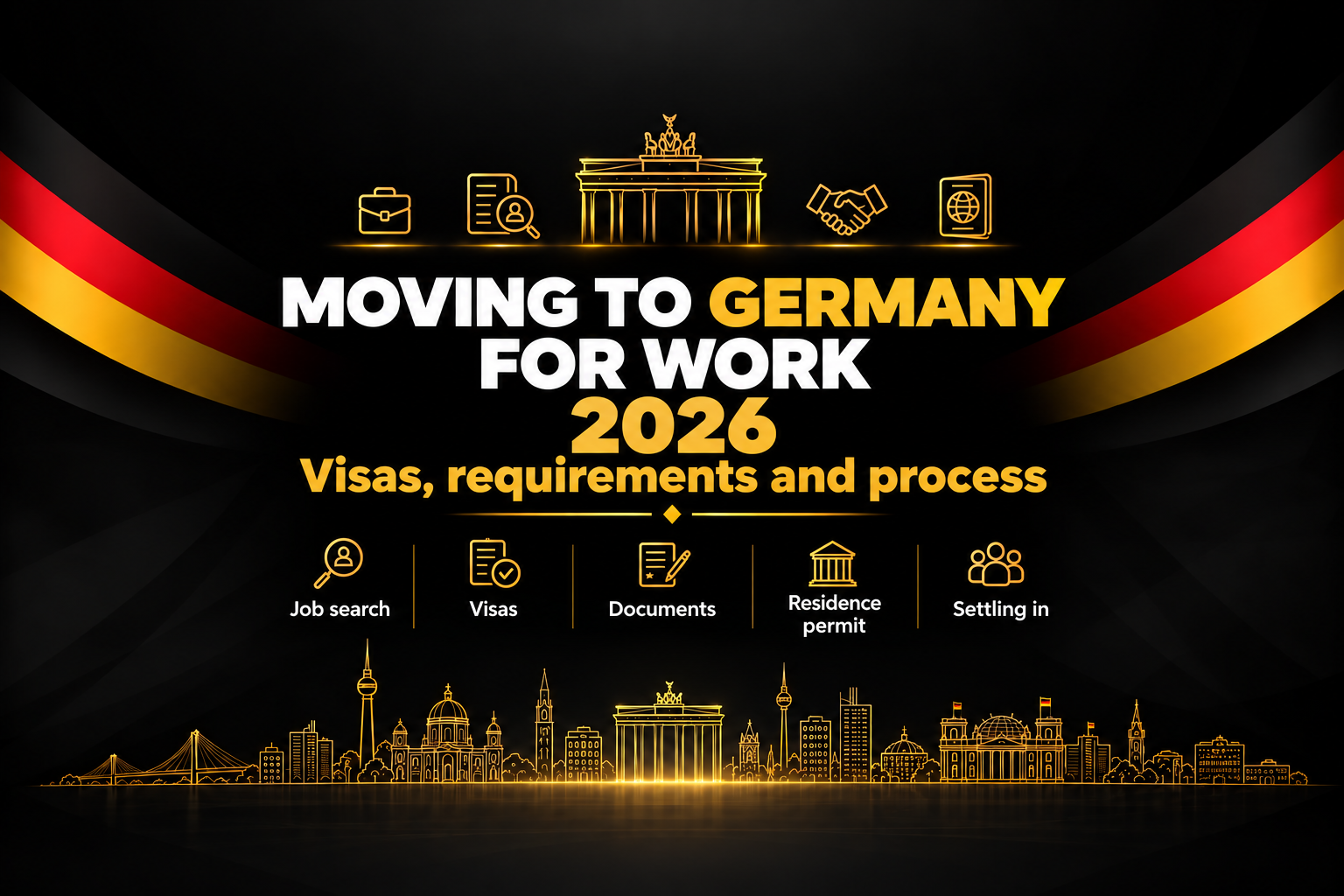
In 2026, a move to Germany for work can follow several routes: the EU Blue Card (§ 18g AufenthG), residence for professionals with academic qualifications (§ 18b), for professionals with vocational qualifications (§ 18a), employment based on substantial professional experience without German equivalence recognition (§ 6 BeschV), the Opportunity Card (Chancenkarte, § 20a) for job searching in Germany, and a recognition partnership (§ 16d).
For the first four employment routes, a specific job offer and the required qualification or experience evidence are central. The fast-track procedure under § 81a can coordinate and shorten specific stages. It does not establish a fixed overall processing time. Below, we explain route selection, contract requirements, the process and common problems.
- Moving to Germany for work: choosing the right route
- EU Blue Card: qualified employment with a salary threshold
- Residence for academically qualified professionals (section 18b AufenthG)
- Residence for vocationally qualified professionals (section 18a AufenthG)
- The experienced-worker route without German recognition (section 6 BeschV)
- Job searching: the Opportunity Card and other statutory search routes
- Applicant and employment-contract requirements
- Employment contract: pay, hours and duties
- Proving qualifications: anabin, ZAB and vocational recognition
- Language skills: requirements by residence route
- From job offer to residence permit: the steps
- Family reunification when working in Germany
- How FIRMDER supports your move for work
- Frequently asked questions about moving to Germany for work
Moving to Germany for work: choosing the right route
Labour migration covers different residence routes for employment and job searching under the Residence Act. Skilled-immigration reforms expanded these options. Eligibility depends on the specific statutory category, rather than solely on a general claim of labour shortages.
These six routes differ in eligibility, salary requirements and prospects for permanent residence:
- Blue Card (section 18g): an eligible qualification or the special IT-experience route; annual gross pay of at least €50,700 in 2026, or €45,934.20 where the reduced-threshold conditions apply. Settlement after 27 months with A1 or 21 months with B1, subject to the remaining requirements;
- academically qualified professionals (section 18b): an eligible degree and qualified employment; settlement generally after three years if the other conditions are met;
- vocationally qualified professionals (section 18a): recognised vocational training and qualified employment; settlement generally after three years if the other conditions are met;
- experienced-worker route (section 19c(2), section 6 BeschV): generally two years of relevant experience, an eligible foreign qualification and at least €45,630 annual gross pay in 2026; check collective-agreement and IT exceptions;
- Opportunity Card (section 20a): job searching without an existing contract, either as a recognised skilled worker or through the points system. Secure financial support is required; employment averaging up to 20 hours weekly is permitted;
- recognition partnership (section 16d(3)): employment and recognition after entry, subject to the requirements, generally including A2 German.
With a job offer, the first four employment routes are often the main options. Qualifications, recognition status, occupation, experience, salary and age together determine the appropriate route.
EU Blue Card: qualified employment with a salary threshold
The EU Blue Card offers a special settlement route and family-reunification advantages. In 2026, the general salary threshold is €50,700 and the reduced threshold €45,934.20, including for specified shortage occupations, recent graduates and eligible IT-experience cases. Special notification and review rules apply to employer changes during the first year. Meeting the salary threshold alone is insufficient: qualifications, duties and contract duration must also qualify.
Residence for academically qualified professionals (section 18b AufenthG)
Section 18b permits qualified employment for professionals with a recognised or comparable academic qualification. The job does not generally have to match the degree subject; regulated professions still require a licence. Where BA approval is needed, it assesses employment conditions. There is no general Blue Card salary threshold. For first issuance at age 45 or above, the 2026 requirement is generally €55,770 gross annually or adequate pension provision, subject to statutory exceptions. Section 18c generally allows settlement after three years, 36 contribution months, B1 German and the other requirements.
Residence for vocationally qualified professionals (section 18a AufenthG)
Section 18a is for professionals with recognised vocational training and an offer of qualified employment. The competent recognition body depends on the occupation, such as a state authority, chamber or IHK FOSA. Regulated professions also require the applicable licence to practise. Identified differences may require compensatory measures. Where eligible, a recognition partnership allows entry before recognition is complete; it does not replace a required professional licence.
The experienced-worker route without German recognition (section 6 BeschV)
Section 19c(2) AufenthG with section 6 BeschV allows non-regulated employment based on professional experience. It generally requires an eligible qualification recognised in the country of training, at least two years of relevant experience in the previous five years, and €45,630 annual gross pay in 2026. A salary exception may apply to employers bound by a collective agreement who employ the applicant under its terms. Eligible IT employment has a special exemption from formal qualification evidence. German equivalence recognition is unnecessary, but evidence about the foreign qualification can still be required. The Blue Card’s special settlement timetable does not apply.
Job searching: the Opportunity Card and other statutory search routes
The job-search Opportunity Card can initially be issued for up to one year. Recognised skilled workers do not need points but must meet the other conditions, particularly financial support. The points route requires the specified foreign qualification, A1 German or B2 English, and at least six points. Recognition, experience, additional language skills, age and previous stays in Germany can contribute points.
For financial support in 2026, the federal portal states at least €1,091 monthly, for example through a blocked account or a declaration of commitment. The responsible authority may specify the exact evidence and amount. The search Opportunity Card permits employment averaging up to 20 hours weekly and qualifying trial work of no more than two weeks per employer. After a suitable offer, apply for the corresponding residence title; the offer alone does not authorise unrestricted work. Other statutory search routes may be available depending on previous residence.
Comparing three common routes:
- EU Blue Card: €50,700 annual gross pay, or €45,934.20 under the reduced-threshold rules. An eligible qualification or special IT-experience route is required. No general German test for the card; settlement after 27 months with A1 or 21 months with B1, subject to other requirements. The statutory language exemption applies to joining spouses;
- Section 18b: a recognised or comparable academic degree and qualified employment. No general Blue Card salary threshold, but appropriate conditions, a secure livelihood and, where relevant, the age-45 rule apply. Settlement is generally possible after three years and 36 contribution months, subject to other conditions. The joining-spouse language exemption also applies here;
- Opportunity Card: initially up to one year for searching. The points route requires an eligible foreign qualification, at least A1 German or B2 English, and at least six points. Meeting the language minimum alone does not provide six points. Recognised skilled workers use a separate route. Family reunification needs a separate assessment; sufficient funds alone do not establish eligibility.
Start with qualifications, duties and pay. If the requirements are met, consider the EU Blue Card; otherwise, section 18a or 18b may fit. Without German recognition, the experienced-worker route or a recognition partnership may be suitable. Without an offer, the Opportunity Card is one possible search route. No option follows automatically from just one factor.
Applicant and employment-contract requirements
Requirements differ by residence category. The German mission, immigration authority and, where applicable, Federal Employment Agency assess the conditions within their respective responsibilities.
Unmet conditions can lead to requests for evidence or refusal:
- a specific employment contract or binding job offer;
- the qualification or relevant experience required for the route;
- employment conditions meeting the statutory requirements;
- adequate health insurance;
- Federal Employment Agency approval where legally required;
- language requirements arising from the residence route, professional rules and employer;
The contract, qualification evidence and language requirements deserve a closer look.
Employment contract: pay, hours and duties
Where approval is required, the Federal Employment Agency assesses employment conditions against those for comparable domestic workers. Collective agreements, pay, working hours and actual duties must be clear. Part-time work is not universally excluded; applicable salary thresholds and livelihood requirements still matter.
Before signing, FIRMDER recommends checking in particular:
- binding gross pay is clearly stated and conditional bonuses are separately identifiable;
- the contract duration meets the chosen title’s requirements; for the EU Blue Card, at least six months;
- the duties and qualification requirements are clear and fit the selected residence route;
- the employer relationship and any temporary agency arrangement are clear.
Distinguish recruitment services from temporary agency work, which can trigger a statutory refusal ground. Salary thresholds depend on eligible, contractually binding pay; conditional bonuses or merely promised future increases require separate assessment.
Proving qualifications: anabin, ZAB and vocational recognition
For academic qualifications, both the institution and the degree need an appropriate assessment. An institution’s H+ status in anabin alone is insufficient. If clear evidence is unavailable, a ZAB Statement of Comparability may be needed. Regular processing is generally three months after complete documents and payment; special procedures differ. Vocational qualifications are assessed by the competent recognition bodies. Partial equivalence may require further measures. Establish the appropriate evidence early rather than selecting a route solely from the institution’s status.
Already have an offer from a German employer? Request a review of your contract and qualification evidence with FIRMDER to resolve avoidable inconsistencies before applying.
Language skills: requirements by residence route
The EU Blue Card, sections 18a/18b and the experienced-worker route do not impose a general German-certificate requirement solely for the residence title. Employers and professional licensing can add requirements; medical professions often require B2 and profession-specific language skills. The Opportunity Card points route requires at least A1 German or B2 English, and recognition partnerships generally require A2 German. Settlement and family reunification have their own rules and statutory exceptions.
From job offer to residence permit: the steps
Many employment routes follow a similar sequence, but their assessments differ. Recognition, completeness, appointments and official workloads affect timing. Fast-track processing can shorten individual stages, but does not guarantee a visa in four to eight weeks.
Factors affecting timing:
- contract and employer declaration: dependent on preparation and coordination;
- qualification assessment: dependent on the type of evidence, complete documents, payment and competent body;
- BA approval: the procedure and completeness matter; the special one-week period generally applies in the fast-track procedure;
- visa: ordinary appointments depend on the mission; fast-track timeframes start at the relevant preliminary-approval and complete-application stages;
- residence permit after arrival: appointments, assessment and card production depend on the local procedure.
Recognition and visa processing can involve substantial waits. Early coordination with the employer helps reduce avoidable delays.
Step 1: employment contract and employer declaration
The employer normally completes the Erklärung zum Beschäftigungsverhältnis, the declaration of employment. Duties, gross pay, hours, fixed-term arrangements and collective-agreement information must match the contract. Inconsistent titles, net-pay figures or missing details can lead to enquiries. Corrections after submission are possible but can require additional assessment.
Step 2: assess and document qualifications
Establish early whether anabin evidence is sufficient or a ZAB assessment or vocational recognition is needed. Independent documents can be prepared in parallel, including required translations, a CV and evidence of relevant experience. The appropriate sequence depends on the selected procedure.
Step 3: consider the fast-track procedure
Under section 81a AufenthG, the employer acts with the applicant’s authorisation and concludes an agreement with the responsible immigration authority. The procedure costs €411, with other fees potentially payable separately. The authority coordinates the bodies involved without replacing their specialist decisions. The required BA approval is generally subject to a one-week response period in the fast-track procedure, under the statutory conditions.
After preliminary approval, the visa appointment is requested. Section 31a AufenthV provides for an appointment within three weeks in the fast-track procedure, with a decision normally within a further three weeks after a complete application. This does not guarantee the overall time from signing the employment contract.
An employer is not obliged to use the fast-track procedure. Discuss the work involved, authorisation, fees and expected benefit together.
Three points to discuss with the employer:
- a coordinated process can improve planning for the start date without guaranteeing a fixed time saving;
- compare the €411 fee with the business value of possible acceleration;
- the immigration authority coordinates the bodies involved; the employer and applicant still need to provide documents and answer enquiries.
An example described by FIRMDER: a design engineer from Kazakhstan received a Stuttgart offer under section 18b. The institution’s H+/- status required clarification of the qualification evidence. The employer used the fast-track procedure, with a visa following assessment and preliminary approval. The case illustrates the value of coordinated documentation, but does not promise the same timing for other applicants.
Step 4: national visa through the responsible German mission
Use the application process specified by the responsible German mission, which may involve the Consular Services Portal, VIDEX or an authorised provider. Typical documents include a passport, application, photograph, employment contract, employer declaration, qualification evidence, CV and suitable insurance; the fast-track procedure adds preliminary approval. Appointment availability and processing times vary by mission and case. Check the current checklist early.
Step 5: entry, address registration, insurance and residence permit
Register your address generally within two weeks of moving into a home. Coordinate insurance with the start of work and apply for the residence permit before the visa expires. An appointment alone does not extend a visa. Continued rights under section 81 AufenthG depend on the application and status. Read more about cover between arrival and starting work in our guide to residence permits and health insurance.
Family reunification when working in Germany
Eligible relatives may enter together or later. Certain skilled-worker categories benefit from facilitated rules; check the following:
- spouses and unmarried minor children may enter together where reunification conditions are met;
- the statutory A1 exemption includes spouses joining EU Blue Card holders and holders of section 18a/18b permits;
- secure livelihood for the family under the applicable rules;
- for skilled-worker titles listed in section 29(5), housing evidence is waived for spouses and unmarried minor children;
- In 2026, Kindergeld is €259 monthly per child where eligibility is established; entry into Germany alone does not create entitlement.
We distinguish personal eligibility from the evidence required for the employment.
Spouses and children moving together
Family applications may be made together or later. The fast-track procedure can include spouses and unmarried minor children where the timing and family conditions are met. Family-reunification titles generally permit economic activity; the title actually issued governs the permission. Section 36(3) offers an additional possibility for parents and, in some cases, parents-in-law of specified skilled workers whose qualifying title was first issued on or after 1 March 2024, with secure livelihood including insurance. This is not an automatic entitlement for every family.
Livelihood, housing and language for family reunification
Livelihood is assessed for the actual household, housing costs and insurance, subject to statutory exceptions. Section 29(5) AufenthG removes the housing-evidence requirement for spouses and unmarried minor children joining certain skilled workers. Section 30’s A1 exemptions include sections 18a/18b as well as Blue Card families. Children’s age, custody and other admission conditions require separate assessment.
Possible reasons for delays and refusals
Carefully prepared documents can reduce avoidable enquiries. This does not establish a reliable general refusal rate or fixed delay.
Three common areas:
- the Federal Employment Agency does not approve the employment conditions;
- qualification evidence or assessment applications are incomplete or inconsistent;
- No response from the immigration authority.
For each problem, assess the cause, deadlines and appropriate options separately.
BA assessment: appropriate employment conditions
Inadequate pay, inconsistent hours or unclear duties can prompt enquiries or refusal. Part-time employment is not universally prohibited. Temporary agency work needs particular scrutiny: where BA approval is required, section 40(1)(2) AufenthG generally provides a refusal ground. The six-month minimum contract period applies particularly to the EU Blue Card, not universally to every employment route.
Errors in qualification evidence and ZAB applications
Missing supplements, different institution names or incomplete information can lead to enquiries. Check both the institution and degree, plus ZAB’s country-specific requirements. Translation rules depend on the procedure. A missing anabin entry does not automatically prevent a Statement of Comparability, and there is no fixed extra delay for every error.
Immigration-authority delays: possible next steps
An action for failure to act under section 75 VwGO can generally be considered three months after the application if no decision has been made without sufficient reason. Special circumstances may justify an earlier action; a sufficient reason for delay can lead the court to suspend proceedings. Filing does not guarantee success. Ask a qualified lawyer to assess the conditions and costs.
Before litigation, the following steps may help:
- a written status enquiry with the file reference and application date;
- a coordinated enquiry from the employer;
- for timely applications in Germany, check whether section 81 AufenthG continues the previous title and work permission; a Fiktionsbescheinigung documents the actual status and does not automatically permit every new job.
A factual status enquiry should give the file reference, application date and any documents supplied later. Whether citing section 75 VwGO or filing proceedings is appropriate depends on the case; neither guarantees faster processing.
How FIRMDER supports your move for work
We review the offer, qualifications and professional experience and compare suitable residence routes. We then help with the contract, employer declaration, recognition documents and coordination of the fast-track procedure. After the visa, we support practical steps including entry, insurance, address registration and the residence permit. Family documents can also be included. We explain progress and outstanding issues; we cannot guarantee official processing times or decisions.
We support your move for work, from coordination with the employer and application preparation to the steps after arrival. Discuss your case in a personal consultation.
Frequently asked questions about moving to Germany for work
With an appropriate recognised qualification, sections 18a or 18b may apply, subject to livelihood, employment conditions and any age-related rule. Without German recognition, section 19c(2) together with section 6 BeschV may fit: generally €45,630 annual gross pay in 2026, with a collective-agreement exception and further conditions. A recognition partnership is another option to assess.
In some cases, yes. The experienced-worker route permits non-regulated employment without German equivalence recognition, but generally requires an eligible state-recognised foreign qualification and relevant experience; IT has a special rule. A recognition partnership combines work with recognition pursued after arrival and has its own conditions, generally including A2 German.
The EU Blue Card and sections 18a/18b have no general immigration-law German test, though professional licensing rules and employers may require language skills. The Opportunity Card points route requires at least A1 German or B2 English. Recognition partnerships generally require A2 German.
Your employer applies with your authorisation and concludes an agreement with the competent immigration authority; the fee is €411. Preliminary approval can follow the required assessments. Special timeframes apply to the subsequent visa stages, but there is no universal four-to-eight-week overall duration.
Joint applications are possible where the family-reunification conditions are met. The A1 exemption applies not only to EU Blue Card families but also, among others, to sections 18a and 18b. Permission to work follows the visa or residence title issued; crossing the border alone does not create it.