


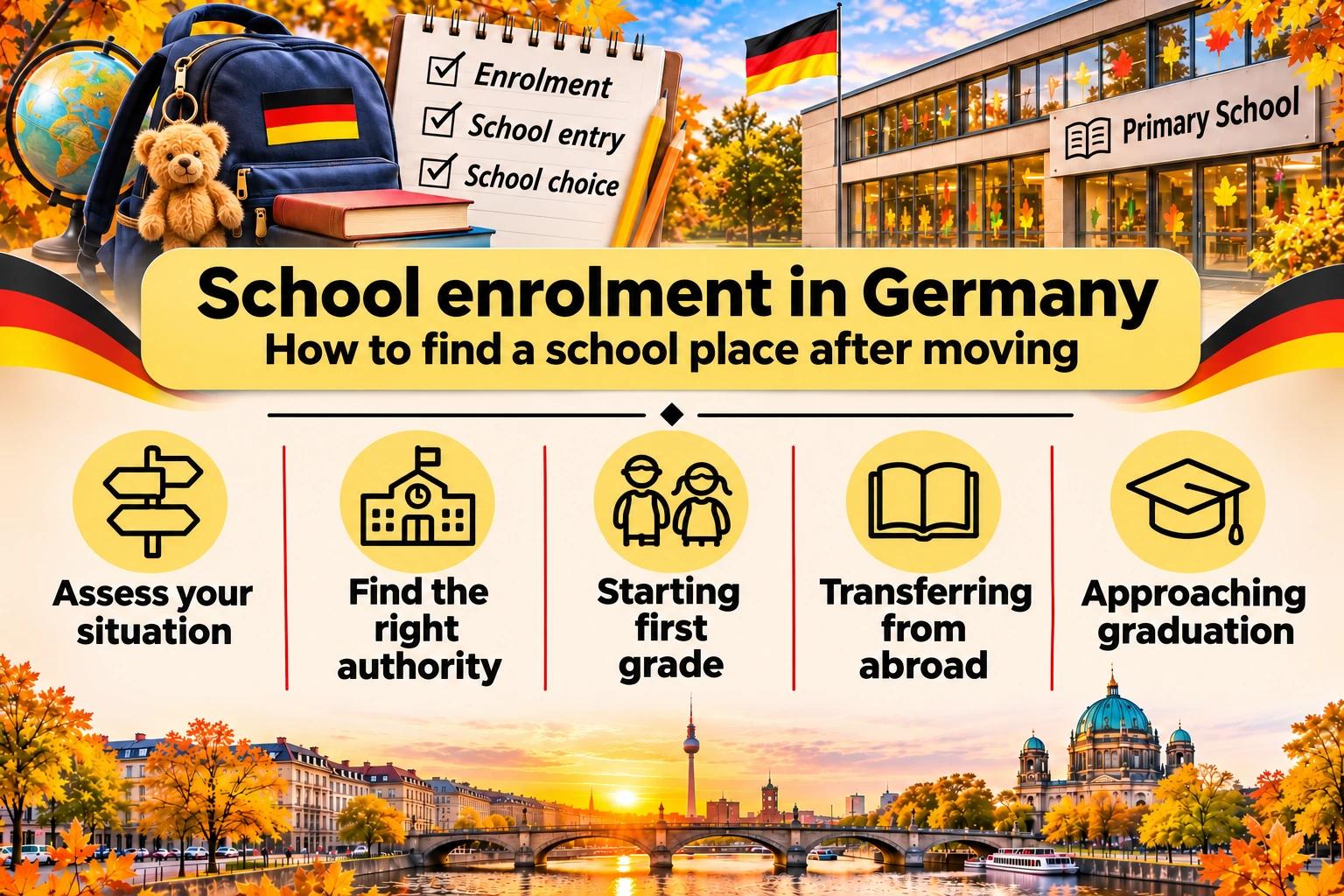
A first-year pupil, a child who has spent several years at school abroad and a teenager approaching graduation need different solutions. The first needs the Einschulung procedure; the second needs an appropriate class and language support; the third needs a viable route to a qualification and further education. Start with age, previous schooling and the future address, rather than an application to a preferred school.
Germany's federal states set school rules. The start of compulsory schooling, school allocation, German-language provision and admission to higher grades vary. This article explains three practical routes and provides official starting points for all 16 states. Examples from individual cities are not nationwide rules. State school legislation in the KMK directory.
The Russian source records 10 November 2026 as its review date. Checks for this translation are documented separately. Specific deadlines and documents must be checked for your place of residence and school year. This article helps you prepare an enquiry; it does not replace an individual decision by the school or school authority.
First establish which issue you need to resolve
Your child has not attended school before. Search for Einschulung or Schulanmeldung Grundschule. The relevant factors are birth date, the state's cut-off date, the school catchment, the school-entry examination and possible preschool language preparation. Being “six years old” alone does not establish the starting year.
Your child has attended school abroad and will continue schooling. Search for Seiteneinstieg, neu zugewanderte Schülerinnen und Schüler or Schulaufnahme nach Zuzug aus dem Ausland. You need to establish the school, education stage, grade and language-support model. Here Seiteneinstieg means entering the local school system after studying in another country.
A teenager is nearing graduation or already holds a foreign school-leaving qualification. Schullaufbahnberatung — guidance on their educational pathway — is needed. Separately clarify remaining compulsory-schooling obligations, admission to gymnasiale Oberstufe, whether completed education needs recognition and what vocational schools offer.
Do not confuse grade placement with recognition of a school-leaving certificate. The KMK explains that an unfinished school career does not involve separate administrative recognition of every completed year. The headteacher decides how schooling continues, in cooperation with the school authority, pupil and parents. Recognition of a qualification already obtained is a different procedure. KMK guidance on school recognition.
Find the authority responsible for your address
The state ministry publishes rules and directories, but is usually not where a family applies for a particular school place. Initial advice, allocation and admission may fall to different bodies: the school, a Staatliches Schulamt, municipal Schulamt, a specialist newcomer centre or the school supervisory authority.
Start with your state's official portal in the directory below. Then find your city or Landkreis and check three things: territorial responsibility, age group and type of enquiry. For primary school, also look for Schulbezirk, Einzugsgebiet or Schulsprengel. These terms mean the area assigned to a school. The nearest school building on a map does not necessarily serve your address.
For example, Brandenburg advises finding the responsible Grundschule through the Schulbezirkssatzung, or school-catchment rules, or through the Schulträger — city, municipality or municipal association. Hesse has Aufnahme- und Beratungszentren attached to state school offices for newly arrived children with limited German. These are different ways of starting the process. Primary-school procedure in Brandenburg, ABZ centres in Hesse.
If the address is still provisional, say so clearly. Ask whether advice is already available, when an application can be made and what changes if you move to a neighbouring district. Discussing a future procedure does not reserve a place.
FIRMDER helps coordinate the choice of neighbourhood and moving date with school arrangements: identifying contacts, preparing questions and organising the family's steps. This is particularly useful when children are different ages and several bodies are involved. Discuss preparations for your move.
If your child is starting first grade
Check the starting year and local calendar
First-time school entry is planned ahead. A family moving in summer before lessons begin may discover that the main registration took place the previous autumn or winter. Contact the responsible school immediately to ask about the procedure for recent arrivals; do not independently postpone schooling by a year.
In Bavaria, children turning six between 1 July and 30 September fall within the Einschulungskorridor. Parents can defer the start of compulsory schooling by a year, but the child still goes through the normal registration and admission procedure and the school advises the family. The decision to start later must be communicated in writing by 10 April. This mechanism cannot be applied to other states or confused with an unrestricted parental choice to defer. Starting primary school in Bavaria.
Saarbrücken publishes a different specific calendar: registration for the 2027/28 school year must be completed by 13 November 2026. Families who moved after 1 September 2026 and received no letter are asked to contact the responsible school immediately. The all-day primary schools listed on the page have separate dates. This example shows why you should not wait for a letter if the child was not yet on local lists. First-year registration in Saarbrücken.
Separate registration, examination and admission decisions
Ask whether the child must attend in person, who arranges the Schuleingangsuntersuchung and how readiness for school is assessed. Early admission and deferral have separate conditions. Preschool language preparation is also regulated by each state: it is not possible to promise that limited German never affects the timing of first admission. For example, Bavaria's ministry describes a particular deferral option for a child who attended neither Kita nor Vorkurs and lacks the necessary German. Guidance on preparation and school entry.
A first-year pupil does not always follow the same route as an older newly arrived child. In Saxony, since the 2025/26 school year, first-year pupils normally start in a mainstream class rather than a preparatory class. They do not undergo the Besondere Bildungsberatung used for other newly arrived schoolchildren. Make clear that your enquiry concerns first grade. Official Saxony guidance.
If you want another school, ask what additional application is needed and whether you must still contact your catchment school. An application sent is not confirmation of admission. In Brandenburg, for example, choosing another Grundschule is handled separately, with deadlines and decisions within the local admission process. Admission stages in Brandenburg.
If your child already attended school abroad
Discuss knowledge and educational history, not only the grade number
“Completed sixth grade” says little about curriculum content. Prepare a short learning history: when schooling began, years completed, subjects and foreign languages studied, any interruptions, and the languages in which the child reads and writes. Reports and subject lists help show their preparation but do not guarantee automatic placement in the same numbered grade.
In Brandenburg, school leaders consider age, previous education and German proficiency. If reports are missing, an interview establishes the grades attended, language skills and any completed qualifications. The programme, class and additional support are then determined. If there are insufficient places, the school involves the competent school supervisor. This is a particular state procedure, not a promise of document-free admission at every German school. Admission of foreign-language pupils in Brandenburg.
At the meeting, discuss not just the first day but also future review of the placement. Who monitors progress? When can the family discuss the grade and programme again? Which subjects will the child attend with a mainstream class? If placement in a lower stage is proposed, ask about its educational purpose and the conditions for moving forward. This helps you understand the proposal without assuming the previous grade must be retained.
Clarify what language support involves
“Preparatory class” can mean different models. In some places children learn German separately for part of the time while also attending their class; elsewhere more intensive preparation comes first. DaZ stands for Deutsch als Zweitsprache — German as a second language. The programme name alone does not explain the timetable or access to subject teaching.
In Lower Saxony, newly arrived pupils without sufficient German are assigned to an age-appropriate class at admission. They participate in mainstream lessons at least partly from the start and receive additional DaZ. The official portal also states that inadequate German is generally not a reason to refuse school admission. This is that state's rule, not a universal account of every first-entry procedure. School admission in Lower Saxony.
Bavaria provides schulartunabhängige Deutschklassen for newly arrived pupils in grades 5 and 6 with insufficient German. These classes can be based at different types of school. A recommendation on the subsequent educational pathway follows the preparation. Therefore, a language class in a Gymnasium building does not itself mean final admission to the Gymnasium programme. Section 47 BaySchO, version effective from 1 August 2026.
Ask the school to explain the weekly timetable, participation in mathematics and other subjects, assessment and transition conditions. If your child cannot use the Latin alphabet, mention this separately: it is a different learning need from a limited German vocabulary alone. Hesse, for example, offers literacy provision alongside intensive courses. Language support through ABZ.
If a teenager is approaching graduation
For a teenager, choose a programme leading to a clear next step. A place in a German-learning group does not answer which qualification can be obtained, when examinations may be taken or how to move into vocational training or further schooling.
Begin the consultation with four questions:
- Which compulsory-schooling obligations remain, considering age and years already completed?
- What school outcome or qualification is available through the programme, and under what conditions?
- What does the next stage require, including grades, foreign languages and evidence of previous education?
- Who is responsible for the transition after the language or preparatory programme?
Compare general and vocational education routes
Do not apply a rule of “vocational school only for everyone over 16”. In Lower Saxony, for example, where completion of the compulsory primary and lower-secondary schooling required by section 66 sentence 1 NSchG cannot be established for newly arrived teenagers aged 15 or above, parents choose between general and vocational schools with the involvement of the relevant professionals. Educational and local support options are taken into account. Lower Saxony rules for teenagers.
Bavaria's Berufsintegration model is intended for teenagers and young adults with a migration background, compulsory vocational-school attendance and particular language-support needs. The ministry gives an admission age range of 16–21, exceptionally up to 25 where justified. It is normally a two-year preparation programme; the subsequent outcome depends on successful participation. Check the particular programme's conditions before applying. Integration programmes in Bavaria.
Hamburg has a separate contact for newly arrived 16- and 17-year-olds with limited German: Informationszentrum HIBB. It advises on AvM Dual, a vocational preparation programme. Corresponding language support at vocational schools in Hesse is called InteA. The names and rules are not interchangeable when moving between states. IZ HIBB, ABZ and InteA in Hesse.
Check qualifications and foreign languages
If the teenager has completed a stage of schooling abroad, establish whether Gleichstellung — equivalence to a German school qualification — is required. For vocational purposes, this is handled by the states' Zeugnisanerkennungsstellen; recognition for university admission is the responsibility of higher education institutions. Do not start one procedure instead of the other merely because both documents are commonly called school-leaving certificates. KMK explanation of responsibilities.
For gymnasiale Oberstufe, check the actual admission conditions. In Lower Saxony, for example, a pupil without the corresponding German certificate needs a proven or established foreign qualification equivalent to the Erweiterter Sekundarabschluss I. Age or good marks in a few subjects does not replace this assessment. Upper-secondary admission in Lower Saxony.
Foreign-language sequence is a separate issue for older pupils. Under certain conditions in Lower Saxony, a first language may count instead of a foreign language on the basis of a report or Sprachfeststellungsprüfung. It is not an automatic replacement for English for every child. Ask early about permissible options so that missing years of language study do not emerge just before a transition or examination. Special foreign-language rules in Lower Saxony; current decree, section 8.
FIRMDER helps prepare the teenager's educational history, available evidence and questions about the next stage for school counselling. We can organise enquiries and help interpret replies so that the family compares concrete educational options. Decisions on grade placement, document recognition and admission remain with the competent institutions. Discuss family support.
What to prepare before departure and after arrival
Before moving, gather the school documents available and keep the previous school's contact details. Besides reports, information on subjects, languages and support needs may be useful. Order translations and certification according to the future recipient's requirements: there is no universal requirement to have the entire school archive translated by a sworn translator for every admission.
Prepare a brief record of the child: birth date, previous school, completed years, teaching language, expected address and arrival date. This makes it easier to establish the route without sending a complete file of personal and medical information in advance.
After arrival, confirm the current address and where to apply. Obtain a list of missing documents, examination information and the next step after counselling. If your German is not yet sufficient for the meeting, ask about an interpreter beforehand. Hamburg, for example, allows an interpreter to attend a parental school meeting at the school's expense; that arrangement cannot be assumed elsewhere. Hamburg Welcome Center information.
If address registration, or Anmeldung, is not yet complete, do not postpone the initial enquiry. State where the child actually lives and ask what evidence is accepted before the Meldebescheinigung is available. But do not assume a registration certificate is never required: it appears in the document list for the Hamburg procedure described here. The responsible authority must decide on alternative documents, not a general internet recommendation. Documents for school allocation in Hamburg.
If reports are missing, explain why and what can be recovered. Ask how previous learning will be assessed. Brandenburg expressly provides for discussing educational history without reports; this useful example does not remove the qualification evidence required for a particular advanced programme. Brandenburg admission procedure.
If the family is in an asylum procedure or initial reception accommodation, separately clarify the start of compulsory schooling and available education. There is no single “from the day of entry” deadline for every situation in all states. NRW law, for example, links the school obligation of asylum seekers' children to allocation to a municipality. Section 34 of the NRW School Act.
General housing, registration and authority-notification issues are covered in our article on moving a family to Germany. Here the priority is to complete the school route: know who is considering the application, which decisions remain and when the child must start attending.
Medical examination and measles protection
The school medical examination and proof of measles protection serve different purposes. Ask who arranges the examination and what medical information is needed for school admission. Do not substitute an ordinary paediatrician's certificate without agreement.
Section 20 IfSG requires the schoolchildren covered by it to provide evidence of adequate measles protection. For a child aged two or above, this includes evidence of two vaccinations. Medical confirmation of immunity or a contraindication, and an admissible confirmation that evidence was previously supplied, are also provided for. Where evidence is missing, the school notifies the Gesundheitsamt through the prescribed procedure.
A child subject to statutory compulsory schooling is exempt from the prohibition on school attendance for lack of this evidence. The exception is in section 20(9), sentence 9, and section 20(12), sentence 5, IfSG. The duties to provide evidence and cooperate with the health authority remain. The exception cannot automatically be applied to a Kita or separate Hort, and does not remove other measures relating to infectious disease. Current section 20 IfSG.
School, nursery and after-school care have separate procedures
Kita provides preschool care and development, Grundschule provides school education, and Hort or Ganztagsangebote provide care outside normal lessons. Even if they are next to each other or in one building, check whether separate applications and contracts are needed, the charges for meals and care, and holiday opening hours.
Since the 2026/27 school year, the right to all-day provision is being introduced gradually, beginning with first grade; by 2029/30 it will cover grades 1–4. The federal framework provides eight hours a day, Monday to Friday, including lesson time. The right extends to holidays, although a state can allow up to four weeks of annual closure. School admission does not therefore automatically enrol a child in the preferred Hort. Local application procedures, the specific service and holidays must be clarified separately. Federal ministry explanation of all-day provision.
If you are considering a private or international school
Teaching at state schools is generally free; private and international schools may charge fees. Compare not only the teaching language but also the final qualification, transfer options into the German system, admission requirements and full budget. Check entrance and registration fees, meals, transport and contract termination terms. School-system overview on the German government portal.
The word “international” in a school's name does not itself establish that attendance fulfils local compulsory-schooling requirements. Ask about the institution's legal status and, where necessary, approval by the school supervisory authority. Saxony's official information, for example, distinguishes genehmigte and anerkannte Ersatzschulen: authorisation permits admission of children fulfilling compulsory schooling, while state recognition also involves the right to conduct examinations independently and issue the relevant qualifications. Check the particular school and state. Saxony guidance on private schools.
Do not stop pursuing the state-school option merely because you sent an application to a private school. First obtain the admission decision and clarify what notifications are needed so the local authority knows where the child will fulfil compulsory schooling.
Official starting points in all 16 states
This is not a list of institutions to which everyone should send the same documents. These pages help you find your procedure. Choose the state, then the city or district and the child's age. The Russian source records a link check on 10 November 2026; the scope of additional checks appears in the source review.
Baden-Württemberg. The page on education for newcomers describes general and vocational school programmes. Clarify the local route into a mainstream class, VKL or VABO; these serve different learning needs.
Bavaria. The Integration section allows comparison by educational stage. For first grade, start with the responsible Grundschule and its catchment. For language classes or vocational preparation, identify the responsible school and supervisory authority instead of choosing solely by programme name.
Berlin. The page for newly arrived families provides information on district coordination offices for Willkommensklassen. Select the district where you actually live and state the child's age. For ordinary transfers or first entry, check whether another route applies.
Brandenburg. Fremdsprachige Schülerinnen und Schüler describes contacting a school near the home or within the catchment, the interview and class placement. For first grade, also consult the local Ü1 calendar.
Bremen. For the city of Bremen, use the school registration page with its online form. Do not automatically apply it to Bremerhaven: the official In Bremen ankommen section separately identifies the Bremerhaven magistrate's Schulamt.
Hamburg. The Hamburg Welcome Center explains allocation and documents. For younger newly arrived pupils, a contact is the Zentrum für Schul- und Jugendinformation (ZSJ, formerly SIZ); a separate IZ HIBB route exists for 16- and 17-year-olds needing language preparation. Check age responsibility before booking.
Hesse. Find your Aufnahme- und Beratungszentrum. Centres attached to state school offices advise newcomers with limited German and help identify suitable provision. State whether you need general or vocational education.
Mecklenburg-Western Pomerania. The Integration section describes preparatory classes, DaZ and migration-related school contacts at the four state school offices. Choose the office for your residence area, then clarify the school and learning format.
Lower Saxony. The Schulaufnahme page distinguishes primary, secondary, upper-secondary and vocational schools. The first school contacted by a pupil's family must help find a solution with the Schulträger; this does not mean unrestricted choice of any oversubscribed institution.
North Rhine-Westphalia. The ministry's framework describes advice from municipal integration centres and the role of school offices. Check the current procedure in your municipality. For example, Duisburg publishes its own newcomer procedure rather than directing everyone straight to a chosen school.
Rhineland-Palatinate. Use the school language-support contacts. General and vocational education and the ADD school supervisors are listed separately. Identify the responsible school and local procedure rather than automatically sending the application to every listed adviser.
Saarland. The official school-system overview on Saarbrücken's website explains school types and provides family materials. Ask your municipality for the responsible school and deadlines. The Saarbrücken calendar above applies only to that city.
Saxony. Newly arrived pupils use the educational counselling registration portal to begin Besondere Bildungsberatung. For prospective first-year pupils, use the Einschulung procedure; the age-related exception is explained above.
Saxony-Anhalt. The state school office's Migration section contains rules, resources and support routes. Ask the city or district which local body submits information for allocation by the Landesschulamt and how examinations are arranged.
Schleswig-Holstein. Language-support contacts are in the official directory of district DaZ advisers. Select your district or city. Clarify admission and allocation with the relevant school authority; a DaZ contact is not a confirmed place.
Thuringia. The official Schulämter directory lists five regional offices and links. Use your district or city to identify the responsible office and ask about admission after schooling abroad. The directory locates the authority but does not replace its document instructions.
FAQ
Contact the responsible Grundschule and explain that the child did not attend a local Kita. Clarify school-readiness assessment, language preparation and examination. Do not replace the procedure with your own decision to keep the child home for another year. Options depend on the state; the Bavarian Vorkurs example is explained above.
This is not guaranteed. Present the learning history and ask how age, subjects mastered and language preparation are considered. Clarify when and on what results the initial placement can be reviewed.
Tell the receiving institution immediately. Prepare details of completed years and subjects, and request available copies from the former school. Ask how preparation will be assessed without the original and what must be supplied later. Separate requirements may apply to proof of completed education.
You do not need to wait to clarify the procedure. Formal processing may require a Meldebescheinigung or another agreed address document. State the actual residence and request instructions for your situation.
There is no nationwide rule to that effect. Check the state, previous school years, remaining school obligations and programme conditions. Compare available general and vocational routes in counselling, taking account of the teenager's goal.
Ask in writing who is responsible for your specific address, the child's age and the current stage. Include information about the previous enquiry without creating several contradictory applications. Use the official territorial directory, not only a search for the nearest school.
Do not assume it is arranged automatically. Check separate Hort or Ganztag registration, schedules and holidays. The phased all-day entitlement from 2026/27 does not remove the need to follow the local process.
What to check after receiving a place
Ask for the start date, class, responsible staff member and first-day arrangements. Keep the admission decision or confirmation, not just correspondence about counselling. Separately check language support, meals, after-school care and travel.
After foreign schooling, agree early when the family can discuss initial progress. For a teenager, record the next educational step: the qualification needed, transition conditions and application dates. If there is no place yet, establish who handles allocation and what schooling arrangement or other next step applies pending a decision. Do not replace the authority's answer with waiting until September.
A reliable school-start plan identifies the school or responsible office, the age-appropriate route, outstanding documents and a clear sequence of decisions. FIRMDER helps organise this preparation alongside the family move and support with enquiries. We do not guarantee a preferred school, a particular grade or a decision outcome. Request support.