


Original information current as of 4 November 2026. Key legal provisions checked again on 12 November 2026.
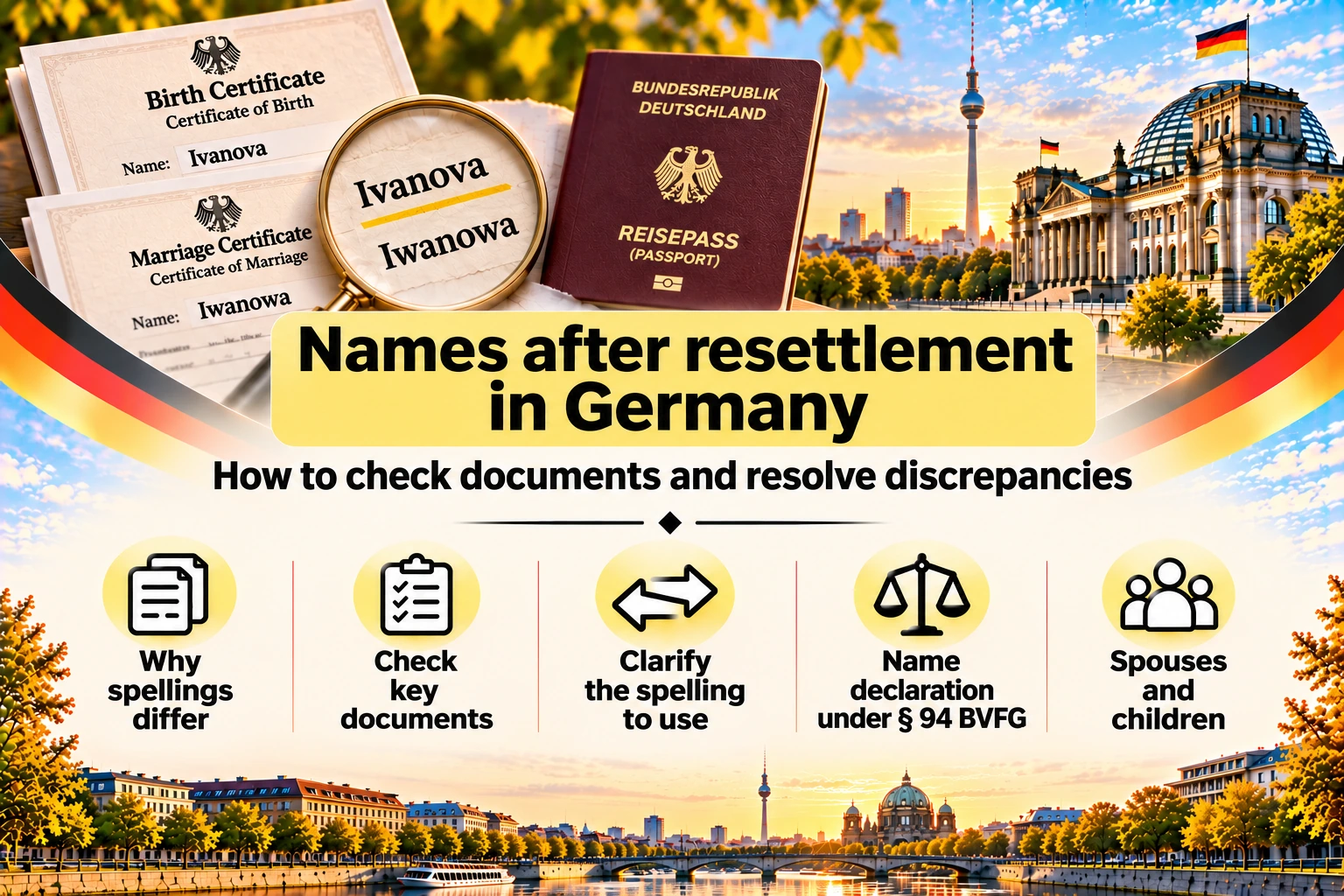
The short answer: if your first name or surname is written differently, establish the reason first. A typo, a different way of transliterating Cyrillic into Latin letters, a previous surname following marriage and a legally declared name change require different actions. Put the documents in chronological order, identify the specific discrepancy and contact the authority responsible for the relevant record. Do not try to replace your name in every document yourself at once.
Late resettlers, or Spätaussiedler, have a special declaration option under section 94 of the Federal Expellees Act (BVFG). However, it applies to a defined group of people and particular changes. It is not a universal way to choose any surname, nor a mandatory condition of relocation for every relative.
This article explains which papers to compare, how to distinguish correction from Namensangleichung, or name adaptation, what to consider for spouses and children, and the order in which to update records. Evidence of ancestry and the original BVA dossier are covered separately in our article on late-resettler documents.
- Why different spellings are not always errors
- Which documents to compare first
- Create a discrepancy table
- If a document contains a typo
- If transliteration differs
- What a declaration under section 94 BVFG permits
- Taking spouses and children into account
- Why the May 2025 name-law changes matter
- Where to apply and what to ask before booking
- What to do once your name is confirmed
- Mistakes that complicate the process
- FAQ
- Where to start checking your family's records
Why different spellings are not always errors
The same life history may be reflected in documents issued in different languages and at different times. A new surname after marriage does not make an old diploma incorrect. Differences between Cyrillic and Latin spellings cannot be assessed solely by how similar a name sounds.
For an initial check, it is useful to distinguish four situations.
| Situation | What needs to be established |
|---|---|
| Obvious typo | Which underlying record proves the correct version and where the mistake occurred |
| Different transliteration | Which documents and rules produced the different Latin forms |
| Different surnames in different years | Whether there is an uninterrupted chain of marriage, divorce or name-change records |
| A desired new name | Which legal basis permits the change and who receives the declaration |
This is a working classification, not a legal decision about a particular surname. For example, two similar versions in a passport and translation may result from letter-conversion rules, but may also be a translator's error. The answer comes from comparing the originals, not choosing the most familiar spelling.
The legal procedures also differ. Obvious errors in an administrative act may be corrected under section 42 VwVfG; correction of a completed German civil-status register entry is governed by sections 47 and 48 PStG; section 94 BVFG provides for a specific name declaration.
Which documents to compare first
Start with one person, then repeat the check for the others. Do not try to derive a child's correct name solely from their parents' current surname.
Collect the following for comparison:
- The current passport and previous identity documents, if they explain changes.
- The birth certificate and documents recording subsequent changes to personal details.
- Marriage and divorce documents and name declarations, if they affected the surname.
- The Aufnahmebescheid, Einbeziehungsbescheid, Registrierschein and certificate under section 15 BVFG, if already issued.
- Confirmation of any previous Namenserklärung or Namensangleichung.
- German identity documents and registration details, if already available.
- Diplomas, employment and pension documents using the earlier version.
This is a list for your own review, not a requirement to present every document to every authority. The exact set depends on the procedure. For example, Service Berlin lists identity documents, civil-status records and relevant status documents for a name-adaptation declaration, allows additional requirements and states that prior consultation is necessary. Berlin's list does not replace the instructions of a Standesamt in another city.
Record the details exactly as written: first name, surname, birth surname, patronymic, date and place of birth. Separately note the document's language and issue date. Do not equate a patronymic with a second given name on your own assumption.
If your family's documents already differ, you can discuss an initial organisation of them with FIRMDER. A table of variants and documents explaining the transition between them help make the discussion concrete. The competent authority establishes or corrects the legally significant record.
Create a discrepancy table
A working table separates the problem from the general impression that “everything is written differently”. A few fields are enough.
| Field | What to record |
|---|---|
| Document and date | Which authority issued the document and when |
| Exact spelling | Copy it without making corrections yourself |
| Basis | Birth, marriage, previous passport, name declaration or another event |
| Discrepancy | Which letter, name component or surname differs |
| Next step | Check the translation, request confirmation or contact the issuing authority |
Suppose an old diploma shows the surname before marriage and the current passport shows the married surname. The first document needed to explain this is evidence of the relevant change. A new diploma translation that substitutes the current surname may conceal the history rather than resolve the issue.
Another example: one letter differs in the BVA decision even though the submitted passport shows an unambiguous version. This is a reason to request a check of that particular record, attaching proof. The request should clearly differ from a wish to change the surname legally.
Do not send the complete family dossier to every organisation indiscriminately. For an initial enquiry, identify the document, discrepancy, case number and your question about the necessary evidence. Send sensitive copies through official channels only to the extent required for the review.
If a document contains a typo
For an administrative decision, such as a written Verwaltungsakt, section 42 VwVfG provides for correcting obvious clerical mistakes and similar manifest inaccuracies. Contact the issuing authority and identify exactly what differs from the supporting document. The authority may request the document itself for correction. Text of section 42 VwVfG.
If the error is in a German civil-status register, the responsible body and procedure differ. Section 47 PStG permits the Standesamt to correct obvious clerical mistakes and certain other proven errors. Outside the specified cases, a completed entry can only be corrected by court order under section 48 PStG. A promise that “any incorrect character will be fixed after one letter” is therefore unreliable.
A foreign certificate or passport is corrected by the competent authority of the relevant country under its rules. A German translator cannot alter the underlying civil-status record. If the error is only in the translation, discuss correcting it with the translator and ask the receiving authority how to submit the new version.
Keep the earlier and corrected versions, the authority's response and the date of your request. If another deadline is running in the case, do not assume that asking for a correction automatically suspends it. Separately clarify what to do while awaiting the result.
If transliteration differs
Transliteration represents a spelling in another alphabet. It is not the same as translating a surname's meaning or choosing a German form of a name. The reviewing authority needs to establish which version belongs to the person and on what basis it is used.
Do not choose a single Latin spelling just because it is convenient for email. First compare the passport, civil-status records, translations and German entries already accepted. If different systems or generations of documents are involved, ask the receiving authority and translator to explain the required form.
Ask specific questions:
- Is the difference an acceptable way of representing the original name or a mistake?
- Is an explanation from the translator, a new translation or confirmation from an authority required?
- Which spelling will appear in the particular German document?
- Is there an existing effective name declaration that must be taken into account?
- Which documents establish the connection between the earlier and new versions?
Advice to “make all translations match the passport” without checking may be wrong for a particular register or civil-status document. It is equally wrong to assume that differing letters automatically mean different people. The practical task is to establish a documented link between the records.
If your intention is to adopt a German form of the name, that is a question of the legal basis for a declaration, not a technical correction to a translation. For late resettlers, the relevant options are set out in section 94 BVFG.
What a declaration under section 94 BVFG permits
Section 94 BVFG covers the expellees and late resettlers specified in it, their spouses and descendants who are Germans within the meaning of Article 116(1) of the Basic Law. Eligibility to make the declaration is assessed against the person's own legal position. Being related to a late resettler is not enough to apply the provision to every accompanying relative without checking.
Within the provision, it is possible in particular to:
- drop name components that German law does not provide for;
- adopt the original form of a name modified according to gender or family relationship;
- adopt a German-language form of a first name or surname; if no such first-name form exists, adopt new given names;
- in the specified circumstances, determine a married surname and make the corresponding declaration under the Civil Code (BGB);
- adopt a German translation of the surname if it produces a surname appropriate in the German-speaking context.
This is a list of legal options, not permission to replace a surname with any word you like. The specific outcome depends on the original name, family situation and applicable provision. Section 94(1) BVFG.
The declaration may be made to the BVA during the allocation procedure or to the Standesamt. The law requires public authentication of the signature or formal recording, except for the specified case of a declaration during marriage before a German registrar. A simple message saying “please spell my name differently” is insufficient. Section 94(2) BVFG.
The wording of the law creates an option, not a general obligation to change your name. If you are happy with the current form, first establish whether any declaration is needed at all. Do not agree to a change merely on the assumption that all your documents would otherwise necessarily be invalid.
How to take spouses and children into account
Where there is a shared married surname, one person's decision may affect the other. In the cases listed in section 94(1), points 3–5, if the surname is used as the Ehename, both spouses must make the declaration while the marriage exists. A spouse's agreement to the change cannot be assumed merely because they travelled to Friedland together.
For the change to extend to the birth surname of a descendant who has reached the age of five, the law requires that descendant to join the change by declaration. A child with limited legal capacity who has reached 14 makes the declaration personally with the consent of their legal representative. These are specifically the rules of section 94 BVFG; a different legal basis for a change may involve different rules.
A family should therefore clarify the children's ages, legal representation, whether a married surname exists and the content of earlier declarations in advance. If parents live separately or travel at different times, consent and representation must be resolved before signing, not after new documents have been issued.
A relative participating in allocation under section 8(2) BVFG does not automatically receive all the principal applicant's options. The basis for applying section 94 and any alternatives must be checked separately. Status differences are explained in our article on a late resettler's family.
With FIRMDER, you can discuss preparing family documents and questions before approaching the authority. It is particularly useful to separate the spouse's name issue from the child's in advance and bring existing evidence of earlier changes. Selecting a legally available procedure and formalising the result fall within the relevant authorities' competence.
Why the name-law changes from May 2025 matter
The old blanket formula that “a name is always determined solely by nationality” should no longer be used. In the current version of Article 10 EGBGB, the principal connecting factor is the law of the state of habitual residence at the time of the relevant name-acquisition event; options for choosing the applicable law are provided. For events completed before 1 May 2025, the earlier private international law continues to apply under Article 229 section 67(8) EGBGB. Current EGBGB text and point 4.1.1.2 of the Passport Administrative Regulation, PassVwV.
This does not mean an automatic name change when crossing a border or permission to ignore an old declaration. Establish which event determined the name, when it occurred, which law applied and whether a permissible choice of law was made. The date of moving does not always answer all these questions.
A separate provision, Article 47 EGBGB, allows certain adaptations of a name acquired under applicable foreign law if the name is now governed by German law. Its conditions and options should not be confused with section 94 BVFG. For example, the absence of a basis for a special BVFG declaration does not determine whether Article 47 applies; that question is assessed independently.
If the desired change falls outside the relevant civil-law rules, a separate public-law name change may need to be considered. Section 3 NamÄndG requires an important reason to justify changing a surname. This is not a guaranteed fallback route to any preferred spelling. If there is a legal dispute or a refusal, individual advice from a lawyer qualified in the relevant matter is advisable.
Where to apply and what to ask before booking
During allocation, a section 94 declaration can be discussed with the BVA. Afterwards, contact the competent Standesamt. Under section 43 PStG, responsibility depends, among other things, on German birth or marriage entries, the declaration's relationship to a married surname and place of residence. The nearest Bürgeramt is not necessarily the authority deciding your legal name.
For an initial contact, clearly describe the circumstances and request a list of required documents. State which German register entries already exist, whether you have made declarations before and who needs to participate. Separately clarify requirements for originals, translations and authentication of foreign documents.
Do not apply a municipal price list or attachment checklist to all of Germany. At the same time, section 94(2) expressly provides that no fees or expenses are charged for the declaration's authentication or formal recording under that provision. This does not promise free translations, new passports or every associated document. Clarify the costs of additional steps separately.
At the meeting, ask which name will be legally effective, from when, to whom the result extends and which document will confirm it. If you plan to travel, clarify the effect on existing identity documents and whether replacements are needed before booking.
What to do once your name is confirmed
First obtain and retain the document proving the result. When applying for a German passport, proof of your name under German law may be required. For example, the German Embassy in Vilnius lists a name declaration under section 94 BVFG or the relevant German civil-status documents in its guidance for late resettlers. This is an example of passport practice at a particular mission, not a complete checklist for every applicant.
Next, list the organisations already holding records about you: the passport authority, registration authority, Ausländerbehörde if relevant, health insurer, employer, bank, pension authority, Familienkasse and educational institution. Ask each about its updating procedure. Do not assume all information changes simultaneously without your involvement.
Do not correct or destroy old education or employment documents yourself. Retain the documented connection between your earlier and current name. If a particular organisation requires a replacement, ask for the basis and document checklist instead of immediately ordering replacements for the entire family's documentary history.
A German declaration does not automatically change a foreign passport or another country's register. Recognition abroad and the procedure for replacing foreign documents must be checked separately. Before travelling, establish which documents you will use and how to demonstrate the connection between names if needed.
Mistakes that complicate the process
- Calling every discrepancy a name change when it may be a typo.
- Asking a translator to replace a historical surname with the current one without indicating it.
- Signing a declaration without understanding its effect on a spouse or children.
- Assuming every family member automatically qualifies under section 94 BVFG.
- Applying old advice on international name law without considering the date of the event.
- Correcting only a bank or insurance record without establishing the underlying legal record.
- Assuming that a change in Germany has simultaneously changed foreign documents.
A practical way to avoid most problems is to use one chronology, a precise description of the discrepancy and documented grounds for the currently effective name.
FAQ
There is no universal obligation to drop a patronymic automatically when moving. Section 94 BVFG gives the people specified in it the option of dropping name components not provided for in German law. First establish how your particular record is treated under the applicable law and whether you want a change.
No. Section 94 contains a limited list of options. In particular, adopting new given names is linked to the absence of a German-language form of the original first name. Check whether your preferred version is permissible before making the declaration, not after ordering a passport.
Yes. Section 94 provides for the Standesamt as well as the BVA during allocation. However, first establish the competent authority, required documents and whether any declarations have already been made. Do not assume every change can be freely repeated or reversed: check the consequences before signing.
Not necessarily. A former surname in a document issued before a lawful change may accurately reflect that period. Usually, the first task is to prove the link between records. Whether a particular document needs replacement depends on its purpose and the receiving organisation's requirements.
That conclusion cannot be drawn from a single difference. Establish whether it is an obvious clerical error, transliteration or a substantive identity issue. Request a check in the case concerned. Correcting a record and reviewing the decision itself are separate matters.
For official documents, follow your confirmed current legal name. A preferred spelling in correspondence does not replace correction of the register or a legally effective declaration. First establish the basis, then update the associated records.
Where to start checking your family's records
Take your current passport, birth and marriage records, BVA documents and earlier name declarations. Draw up a chronology for each person and identify the exact discrepancy. Then determine the right recipient: the issuing authority, translator or competent Standesamt. This sequence helps avoid paying for unnecessary replacements and creating further contradictions.
If you need help preparing materials for review, contact FIRMDER. You can start with an inventory and a specific question about the discrepancy. The company is a private adviser, does not alter government registers and does not guarantee acceptance of a chosen name. Legal representation or a challenge to a decision requires an appropriately qualified professional.
This article is informational. The applicable law, relatives' status, dates of events and content of previous declarations must be assessed individually.