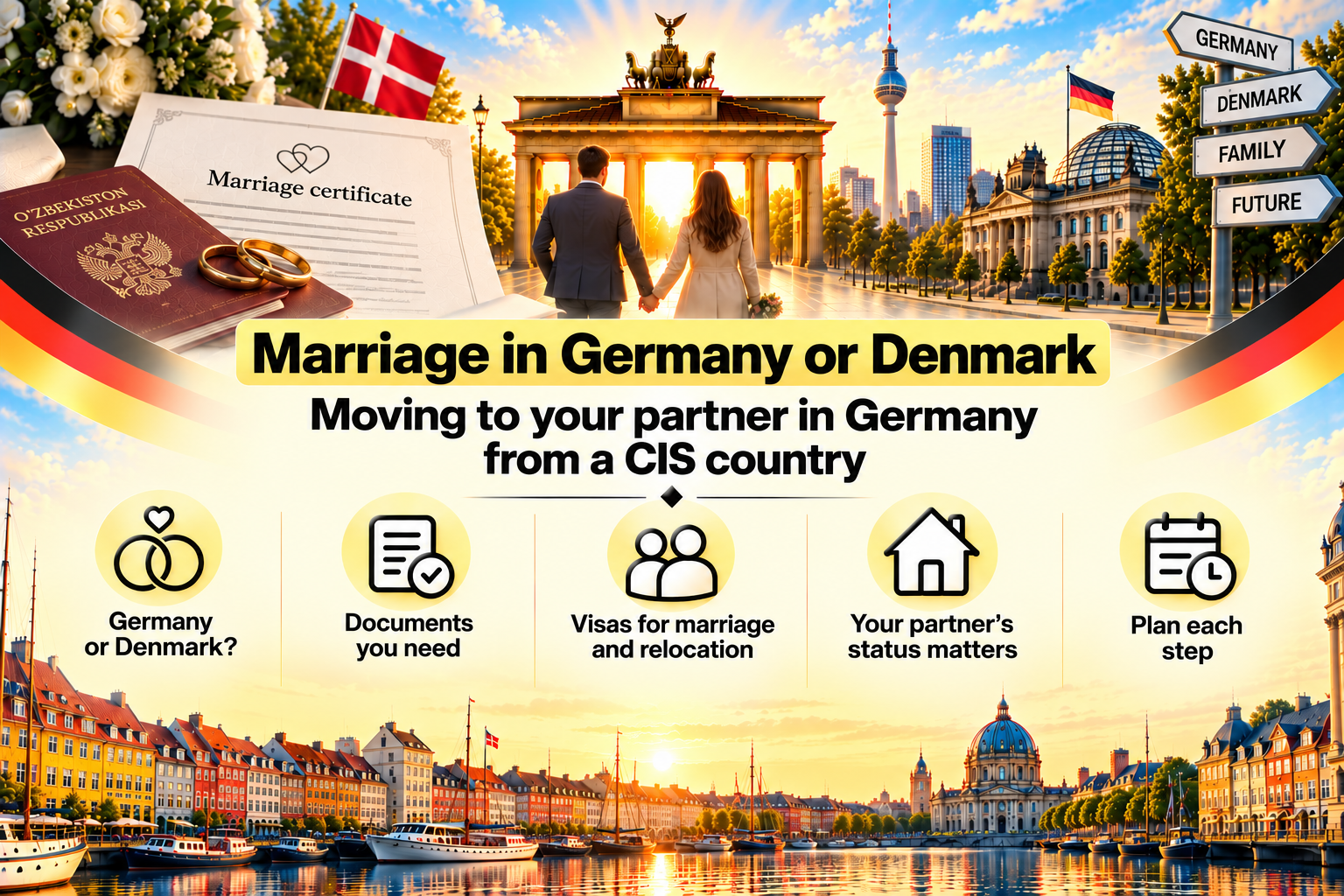
Quick answer: Getting married in Germany or Denmark and obtaining the right to live together in Germany are separate procedures. A Danish marriage certificate does not replace the required visa or residence permit. The appropriate route depends on both partners’ nationality and immigration status, where they normally live and whether a permanent move was intended from the start.
Your partner already lives in Germany, while you are in Uzbekistan, Kazakhstan, Russia or another CIS country. You want to marry and build a life together. Friends suggest Denmark because the paperwork may be simpler, followed by “legalising the marriage” in Germany. Others recommend an invitation from your fiancé and a visitor visa.
Start with the intended outcome. If the aim is relocation rather than a short visit, plan both the marriage and the permission to live in Germany. A more convenient wedding procedure does not necessarily shorten the immigration process. The examples below apply equally whichever partner lives abroad. The precise documents depend on nationality, residence, previous marriages and the partner’s status.
First establish your partner’s status in Germany
“My partner lives in Germany” is not enough to choose a visa. Before booking a ceremony, check their passport, the legal basis of their residence and where you intend to live together.
Your partner is a German citizen
Ordinary reunification with a German spouse is governed by section 28 of the Residence Act, AufenthG. It requires a valid marriage and intended married family life in Germany. Age and basic German requirements must be assessed together with the statutory exceptions. The law contains particular rules on maintenance in this situation, so financial requirements for joining a foreign spouse cannot simply be copied across.
If you have not married yet, consider a national visa for marriage followed by residence in Germany. That route allows you to disclose the genuine long-term purpose before travelling.
Your partner holds a German residence permit or settlement permit
The specific legal provision matters, not just the expiry date on the residence card. Spousal reunification is governed by section 30 AufenthG alongside the general family reunification conditions. EU Blue Card holders and holders of certain skilled-worker or entrepreneur permits benefit from special rules, including exceptions to proving German before arrival. Other immigration categories may have different conditions.
For some routes, it matters whether the marriage already existed before the permit was granted or before the sponsor moved to Germany. “They have a residence permit, so they can definitely bring me over” is not a reliable basis for planning. Our guide to joining an EU Blue Card holder explains one particular route; the actual status must still be checked.
Your partner is a citizen of another EU country
For example, a Polish citizen working and living in Germany may be joined by family members under EU free-movement rules rather than the ordinary national Residence Act route. The EU citizen’s own basis of residence must also be established. Entry and a family member’s residence card follow a different framework; the usual national A1 language requirement should not be applied automatically. See the EU’s official family residence guidance.
A German citizen permanently living in Germany does not become an EU-law “returnee” simply by spending a weekend in Denmark to get married. Genuine family residence in another EU state is different from a brief wedding trip.
Option one: marry in Germany and remain together
If you intend from the outset to live together permanently, first examine the national visa for marriage. A tourist or visitor visa is not necessarily your only option before the wedding.
The couple’s first step is to work with the German Standesamt, the civil registry office. The partner in Germany should request a document list tailored to your nationalities and marital histories. An available ceremony slot is not sufficient: the legal conditions for marriage must be checked first. The German diplomatic mission’s explanation describes this preparation.
Documents to discuss with the registry office
Preparation normally involves passports, birth and marital-status documents and residence details. If either person was married before, evidence that the marriage ended is needed; recognition of a foreign divorce may also be required. Ask separately about originals, how recently certificates must have been issued, translations and authentication.
German law provides for an Ehefähigkeitszeugnis: confirmation that there is no impediment to the marriage under the applicable foreign law. If the relevant country does not issue that document, an exemption may be available through the president of the competent Higher Regional Court, the Oberlandesgericht. This is addressed in section 1309 of the Civil Code, BGB. A certificate of being unmarried, a notarised declaration and an Ehefähigkeitszeugnis are not necessarily interchangeable.
This is often where international couples need extra preparation. Do not order documents at random: obtain a written list from the actual Standesamt first. A checklist for Russian citizens cannot replace the requirements for an Uzbek citizen. Someone who has divorced abroad may need a substantially different set of documents from someone marrying for the first time.
Apply for the visa after coordinating the documents
The national route normally requires the appropriate confirmation from the registry office, the partner’s documents and information about your future life together, financing and health insurance. Basic German evidence should be prepared unless an exception applies.
The German mission in Russia publishes a marriage visa checklist illustrating the sequence. The document is dated October 2023 and remained available in the official section when checked. It is not a new universal 2026 instruction for every CIS country. Obtain the current requirements of your competent mission before applying.
- Identify the future family residence route from your partner’s status.
- Obtain the Standesamt’s requirements and prepare civil-status documents.
- Agree which registry confirmation is needed for the visa application.
- Apply for the appropriate national visa at the competent German mission.
- After the visa is granted, enter Germany, marry and apply for the family residence permit in good time.
Coordinate the immigration timetable with the ceremony. Paying for a wedding does not oblige a consulate to speed up its decision.
FIRMDER can help you plan the move to your partner, prepare an invitation and visa documents and choose insurance suited to the journey’s purpose. Contact us to discuss your status and paperwork before buying tickets.
Can you visit your fiancé on a visitor visa?
A “visitor visa” usually means a category C Schengen visa for a short visit. An invitation explains the visit and accommodation. A Verpflichtungserklärung, a formal declaration of financial commitment by the host, primarily concerns financial support. It does not convert a visitor visa into a national visa or guarantee approval.
Marriage during a lawful short stay may in principle be possible if the registration requirements are met. However, being allowed to hold the ceremony and being entitled to remain are separate matters. If the genuine plan is to marry and then return abroad to arrange family migration, your documents should reflect that. If you intended to stay permanently from the beginning, do not present the trip as ordinary short-term tourism and assume the marriage certificate will resolve the visa position afterwards.
The general rule in section 5(2) AufenthG requires entry with the necessary visa and disclosure of the relevant circumstances in the visa application. Exceptions exist: the requirement to complete the visa process again may be waived where the conditions for a legal entitlement are met, and must be waived where special circumstances make completing it unreasonable. These are individual assessments, not a promise that nobody has to leave after marrying.
Why couples consider Denmark
Denmark offers an international marriage procedure through the specialist Agency of Family Law, Familieretshuset. Couples do not have to become Danish residents just to marry. Both people must nevertheless be entitled to enter and stay lawfully.
The document assessment differs from Germany’s. For example, the Danish authority does not demand the same marital-status certificate in every case without exception; it may request one when necessary. Previous marriages must still have ended, and divorce or a former spouse’s death must be documented under the authority’s rules. Both partners must be at least 18. See the official marriage conditions.
For a particular couple, the Danish procedure may genuinely be more convenient. But “only two passports”, “no translations” and “everyone married in one day” do not accurately describe it. A complicated divorce history, insufficient documents or questions about the relationship can extend the Danish assessment too.
How to organise a wedding in Denmark
Check permission to enter first
A person from a CIS country must establish whether their nationality and travel document require a visa. If they already hold a Schengen visa, check its territorial validity, dates and remaining permitted days. The partner’s German residence permit must also be checked together with the passport: not every temporary paper automatically permits departure and re-entry.
Danish rules recognise, among other forms of proof, a visa or residence permit from another Schengen country. Approval to marry does not replace entry documents. Consult the Danish lawful-stay guidance.
If you do not have a visa yet, choose the competent mission according to the real itinerary and main purpose, not whichever appointment is easiest to obtain. A wedding in Denmark followed by a visit to Germany should be disclosed honestly. A booked ceremony does not make the visa a formality. Denmark’s short-stay rules for private and tourist visits include assessing the applicant’s intention to leave on time.
The application and supporting documents
Select the appropriate international-couple scenario on Familieretshuset’s website. Before the ceremony, you need a Certificate of Marital Status, confirming that the legal conditions for marriage have been met. This is not yet a marriage certificate.
The authority asks for high-quality images of every passport page, including blank pages and covers, proof of lawful stay and, where relevant, evidence of living together, shared children and the end of a previous marriage. The checked application fee is DKK 2,100. The administrative fee is not refunded after submission; it does not represent the entire wedding and travel cost. See the official application and fee information.
Foreign documents must meet translation and authentication requirements. The Danish guidance specifically includes Uzbekistan, Kazakhstan, Kyrgyzstan, Tajikistan, Russia and Belarus among countries whose documents are not automatically exempt from additional formalities. An apostille or legalisation may be required depending on the document and applicable international arrangements. Translations must follow the authority’s requirements; German and English are among the accepted languages. Check the official document guidance.
Proof of lawful stay and EES in 2026
Familieretshuset distinguishes entries and exits before and after 10 April 2026 in its guidance connected with the Entry/Exit System, EES. For relevant short stays, evidence may include printouts of both the data and result pages of the EES calculator and flight tickets or boarding passes. Visa-required nationals must also provide the visa sticker; a Schengen residence permit is a separate form of proof. Check the scenario covering your actual or intended journey rather than relying on old advice to show an entry stamp. See the current lawful-stay documentation instructions.
Approval and booking the ceremony
After the assessment, you receive the relevant certificate and arrange the ceremony with your chosen municipality. The authority’s processing time and the availability of a wedding appointment are different issues.
For a complete application meeting all requirements, Familieretshuset generally indicates five working days. Where additional information is requested, the wait may be substantially different: when checked on 24 October 2026, the authority stated that it was processing such applications received in August 2026. That is a dated queue update, not a personal deadline. Recheck the processing-time page before making plans.
The certificate is normally valid for four months, but an earlier passport, visa or residence-permit expiry may shorten it. Avoid paying for a non-refundable “wedding next week” package before the documents have been assessed. First establish the paperwork, then coordinate travel and an available ceremony.
If you are considering Denmark, FIRMDER can help coordinate the visa plan with the subsequent move to Germany, prepare necessary invitations and visa documents and select suitable insurance. Speak to us before booking: you should know in advance where, and under what status, you will wait for permission to relocate permanently.

Does a Danish marriage need to be “legalised” in Germany?
Three different issues are often confused: the marriage’s legal validity, the certificate’s authenticity and the right to reside.
According to the German Federal Foreign Office, a marriage concluded abroad is generally recognised if the applicable substantive and formal requirements were met. There is no single mandatory recognition procedure for every foreign marriage and no special authority handling all such cases. The German body dealing with a particular procedure assesses the issue as needed. Some couples may have the marriage subsequently recorded in a German register, but this is not compulsory for everyone.
A Danish marriage certificate submitted in Germany normally does not require a separate apostille or consular legalisation because of the European rules on public documents. A multilingual certificate including German can be requested. Check with the receiving authority which paper certificate and translation it needs. See the German Embassy in Copenhagen’s information.
An exemption from an apostille simplifies circulation of the document; it does not remove assessment of the marriage’s legal consequences. It also does not extend Danish rules to birth or divorce certificates previously issued in a CIS country. Using the Danish certificate outside the EU may involve different formalities.
After the wedding, present the marriage certificate where required, for example with a family visa application or to update marital-status records. A change of name is a separate matter. Coordinate a new passport and tickets in a new surname so the travel documents remain consistent.
Can you remain in Germany immediately after the Danish wedding?
For a CIS national with a short-stay visa and a German spouse, the ordinary plan is a lawful wedding trip, timely departure and a national family reunification visa application from the country where the competent German mission can accept it. That is not necessarily the country of nationality: lawful habitual residence and the mission’s jurisdiction rules matter.
Unused Schengen days may permit a short visit, but they do not resolve permanent residence or employment rights. Submitting an application to the Ausländerbehörde should not be treated as automatically extending every Schengen stay.
Section 39 of the Residence Ordinance, AufenthV, sets out situations where a residence title may be obtained within Germany. Its exceptions have different requirements. For one exception, the entitlement must arise after entry. In a case involving a Danish wedding, the Federal Administrative Court referred to the most recent entry into Germany: marrying abroad before returning did not meet the required sequence. A brief wedding trip also did not establish an EU-law returnee case. See BVerwG, judgment of 11 January 2011, 1 C 23.09.
The analysis may differ if you already hold a German national residence status, a qualifying status in another Schengen state or other special circumstances apply. Have that position assessed individually before lawful stay expires. “Go to Denmark and sort everything out in Germany afterwards” is not dependable advice without examining the documents.
German language and insurance after marriage
The country of the ceremony does not itself waive German language requirements for family immigration. Where the ordinary rule applies, it concerns basic German at A1 level. Exemptions depend on the legal route and personal circumstances, not on the certificate being Danish. A qualifying skilled-worker status of the sponsor may remove the pre-entry language requirement; establish that before booking an exam or submitting an application.
Insurance also needs more than the assumption that “after the wedding I will be included in my spouse’s policy”. Family insurance is available only where the relevant system’s conditions are satisfied. Your partner may be privately insured, and separate cover may be necessary before the appropriate long-term insurance starts. Travel policies sometimes exclude a planned permanent stay. State the real purpose of the trip and ensure that coverage dates bridge the transition.
How to choose the more practical route
Compare not just the wedding date, but when you can lawfully begin living together.
- Germany may suit you if the Standesamt can process your documents and you want to arrange national entry for marriage and residence in advance.
- Denmark may be more convenient for the ceremony if both partners can travel there legally and its procedure better suits their documents. German family immigration still needs separate planning.
- An existing right of residence changes the calculation. Someone with their own lawful German residence basis should not copy a visitor’s procedure without checking.
- A complicated divorce, uncertain nationality, a visa refusal or an overstay calls for individual assessment before choosing a country on the strength of an advertisement.
Build a timetable covering documents, language where required, the visa appointment, eligibility-to-marry assessment, ceremony, any departure, family visa and insurance. That complete timetable reveals the likely number of journeys and real cost.
Frequently asked questions
An invitation explains the circumstances of a trip but does not replace the appropriate visa category. If marriage followed by permanent residence is planned from the outset, assess the national route.
No. Marriage eligibility and lawful stay must be assessed, and the document set depends on the couple’s history. Additional certificates, translations and evidence that earlier marriages ended may be needed.
A Danish marriage certificate covered by the European rules normally does not need a separate apostille. Do not confuse this with documents issued in a CIS country or requirements for using the certificate outside the EU.
No. The residence basis, required visa and any exceptions must be assessed. A brief wedding trip to Denmark does not itself create a right to remain.
The wedding location does not remove the German family route’s language conditions. An exemption must arise from the applicable law, not from the place where the marriage certificate was issued.
There is no universal answer. It depends on the registry office, document readiness, access to visa appointments and whether departure is needed after the ceremony. A quick wedding may still be followed by a lengthy family visa wait.
Prepare the family move before booking the wedding
Start with both partners’ nationality and status, lawful country of residence, records of previous marriages and intended date for living together. You can then compare Germany and Denmark meaningfully, without paying for a trip that does not achieve your main objective.
FIRMDER helps prepare family relocation: the route, invitation, visa documentation and medical insurance. Contact us and tell us where each partner lives and what status they hold. We will discuss the available support and necessary steps without promising a guaranteed visa or authority decision.










