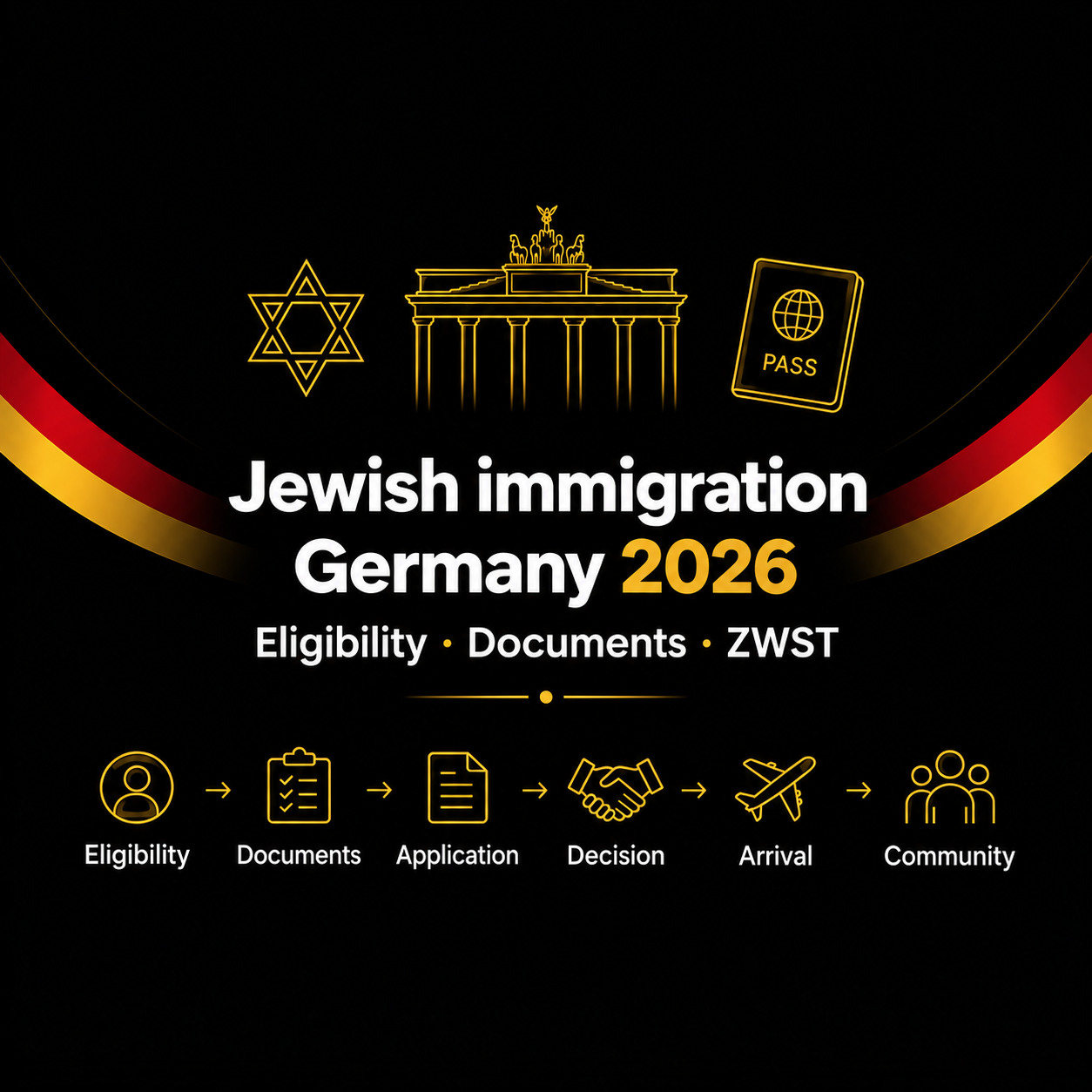
Jewish immigration is an admission procedure for eligible applicants from the successor states of the former Soviet Union, excluding Estonia, Latvia and Lithuania. Its legal basis is §23(2) AufenthG. The regulated admission procedure has existed since 1991. Key points:
- maternal or paternal ancestry can qualify. A1 German is generally required, subject to specific exceptions. Exam fees, accepted certificates and appointment availability depend on the provider and responsible authority;
- the possibility of admission to a Jewish community must be established through an assessment involving ZWST and the Union of Progressive Jews. There is no universally guaranteed BAMF processing time;
- following admission, independently eligible applicants generally receive a permanent settlement permit with permission to work. Dependants without independent eligibility receive a residence permit; later permanent residence depends on the applicable statutory conditions, including those under §26 AufenthG.
Gaps in the ancestry chain and unsuitable translations can lead to additional requests and delays. Check documents against the current BAMF checklist and meet every deadline for supplementary evidence. There is no fixed delay per request. Official information: BAMF: Jewish immigration. Community organisation involved: ZWST.
Contents
- Legal basis and residence after admission
- Requirements for Jewish immigration to Germany
- Ancestry through the mother or father
- Ancestry records: where to find them and how long it takes
- Documenting name changes clearly
- A1 language evidence: exam providers, costs and preparation
- ZWST’s role in the community assessment
- Translations: why notarisation alone is not enough
- Ukraine special procedure
- The process: from research to arrival
- After admission approval: visa, entry and address registration
- Pensions and social benefits
- How FIRMDER can help
- Jewish immigration to Germany: frequently asked questions
Jewish immigration: legal basis and residence status
The procedure is based on §23(2) AufenthG – a provision of Germany’s Residence Act. Admission is decided by BAMF (Germany’s Federal Office for Migration and Refugees).
The key document is the Aufnahmezusage (admission approval). This is BAMF’s decision admitting you under this procedure. In the standard procedure, you need it to apply for the subsequent entry visa.
Residence and support after entry:
- Generally, a permanent settlement permit for independently eligible applicants and a residence permit for dependants without independent eligibility, with employment permitted. Check the wording in the visa or residence document.
- access to an integration course subject to statutory conditions: normally 600 language and 100 orientation units of 45 minutes each; check fee-exemption eligibility separately;
- later permanent residence for dependants without independent eligibility if the statutory conditions are met, normally including five years holding a residence permit, financial self-sufficiency and other requirements;
- naturalisation generally after five years of lawful habitual residence if all other requirements are met, including established identity, qualifying residence status, language and civic knowledge, livelihood conditions and statutory loyalty and criminal-record requirements. Time spent in Germany alone does not create an automatic entitlement.
The procedure is intended for permanent relocation. In addition to ancestry, the assessment includes language skills, integration prospects and the possibility of community admission, subject to recognised exceptions.
Requirements for Jewish immigration to Germany
The requirements are assessed together, taking account of recognised exceptions such as those for victims of Nazi persecution or hardship cases. A missing item of evidence therefore does not always mean that an application has no prospect of success.
| Requirement | Required evidence | Possible complications | How to check |
| Jewish ancestry | Documentary evidence of a Jewish parent or grandparent | Name changes and missing records | Civil registries, archives and old internal passports recording ethnic origin |
| Citizenship and residence | Eligible applicants from former Soviet successor states, excluding the Baltic states; stateless applicants subject to specific conditions | Multiple citizenships and previous places of residence | Passport and residence evidence |
| A1 German language skills | A1 evidence generally also required for family members; check exceptions for children and special cases | Missing language evidence without a recognised exception | Goethe-Institut, telc, OSD |
| Community admission assessment | Evidence that admission to a Jewish community is possible | Incomplete or inconsistent community admission information | Community admission documents within the BAMF procedure |
| Integration forecast | BAMF assesses language skills, education, work experience, age and family circumstances | Older age and limited language skills: assess exceptions individually | Assessed against all relevant documents |
BAMF uses defined criteria to assess the prospect of financial self-sufficiency. These include language skills, education, work experience, age and family circumstances. Submit verifiable evidence; persuasive presentation cannot replace eligibility. Check whether a recognised exception applies.
Before extensive document collection begins, FIRMDER reviews the admission requirements, possible exceptions and identifiable risks. Learn more on the page Jewish immigration to Germany.
Important: Previous permanent resettlement in a third country can exclude admission. Disclose all additional citizenships and previous places of residence for an individual assessment. A second passport alone does not describe the full circumstances; special distinctions apply under the Ukraine procedure.
Ancestry through the mother or father
Ancestry under the German admission procedure: The German rules recognise Jewish ancestry through either parent, extending to a Jewish grandparent. State assessment of ancestry and admission to a Jewish community are separate requirements. Rules from other countries cannot be substituted for this procedure.
The ancestry chain links the applicant to a Jewish parent or grandparent through documents. The key evidence is the state-issued documentation required by the admission rules, particularly the relevant records issued before 1 January 1990. Family stories and photographs may guide research but do not replace the required documents.
A typical evidence chain:
- The applicant’s birth certificate naming their parents.
- The relevant parent’s birth certificate naming their parents.
- Evidence of a grandparent’s Jewish origin, such as a Soviet internal passport recording ethnicity “Jewish”, a birth certificate recording ethnic origin, or suitable archival documents.
Ethnicity entry in a Soviet internal passport recording ethnic origin. A Jewish ethnicity entry may be important evidence if the document meets the procedural requirements. If it is missing, investigate suitable alternative official records and archives.
If a passport is missing, research other existing civil and archival records, such as registers, household books or military files. The responsible authority decides whether a document is sufficient; not every historical source can replace the prescribed records.
Ancestry records: where to find them and how long it takes
Archive research can take considerable time. Start early and prepare language evidence and personal documents in parallel. Timing depends on the records available, the responsible archive and access conditions.
| Document | Where to obtain it | Time frame | Possible difficulty |
| Soviet internal passport recording ethnicity | Family archive | Immediately, if already available | If missing, identify suitable replacement and archival records |
| Ancestor’s birth certificate | Civil registry or relevant public service office at the place of birth | Around 1–4 weeks, depending on the authority | If the registry entry is missing, identify the responsible archive |
| Archival record of ethnic origin | Relevant national or regional archive in the country of origin | Around 1–6 months, sometimes longer | Follow up using the reference number and a traceable delivery method |
| Historical synagogue civil register | Historical state archives and regional synagogue archives | Around 2–4 months, depending on language level | Check the document requirements for the relevant country of origin |
| Historical household register | Municipal authorities and regional archives | Around 2–3 months, with no guaranteed deadline | May record ethnic origin; evidential value requires individual assessment |
| Name-change record | Civil registry that recorded the name change | Around 1–2 weeks, depending on the authority | For every relevant name change, including marriage |
| Ancestor’s military records | Relevant military archives and former enlistment offices | Around 2–4 months, depending on language level | May record ethnic origin at enlistment |
If a register was destroyed or cannot be found, request written confirmation. This documents the search result but does not replace the required ancestry evidence. Suitable supplementary evidence must be assessed for the individual case.
Jewish community archives and Yad Vashem may also provide family-history information, especially for families persecuted during the Holocaust. These findings can support research but do not automatically replace the evidence required for admission.
FIRMDER develops a research plan based on existing documents and helps direct requests to the appropriate offices.
Name changes in the Jewish admission procedure
Name changes can make it harder to connect records, for example after marriage, passport replacement or changes in official spelling. Document each change clearly with the relevant records.
If names differ across several generations’ records:
- obtain the relevant civil registry document for each material name change;
- map different transliterations or historical spellings clearly; an expert opinion may supplement but cannot replace records;
- explain name changes in a covering letter and support them with records;
- if several spellings exist, include a table identifying the source of each variant.
A linguistic opinion can explain spelling variants. Its usefulness depends on the specific issue; it replaces neither ancestry documents nor the authority’s assessment. Basic rule: Do not leave discrepancies unexplained. Documents must establish how different names relate to the same person. Follow-up requests can delay processing, but there is no reliable fixed additional waiting period.
A1 evidence for Jewish immigration: providers and costs
Sprachtest A1 covers basic listening, reading, writing and speaking, including simple everyday questions, personal information and short written messages. Check the exact format with an accepted examination provider. Exceptions: Evidence covers basic listening, reading, writing and speaking. Accompanying family members generally also need it. BAMF may waive it for children under 14 when applying if they enter before their 15th birthday. Other exceptions require a separate assessment.
| Organisation | Format | Cost | Appointment availability |
| Goethe-Institut | Start Deutsch 1 / A1 | Check the fee with the exam centre | Around 1–3 months, depending on complexity |
| telc GmbH | telc Deutsch A1 | Exam centre’s current fee | Around 1–2 months, depending on the authority |
| ÖSD (Austrian German Language Diploma) | OSD A1 | Check the provider’s fee and available dates | Around 1–2 months, depending on the authority |
| BVA language test: a different procedure | The BVA language test is not part of BAMF’s Jewish admission procedure | Not a separate language examination under this procedure | Not part of the Jewish admission procedure |
Language exemptions include victims of Nazi persecution and recognised hardship cases. There is no general exemption at age 80. Separate age rules apply to children. Explain and document any claimed exception; BAMF assesses whether its requirements are met.
Regular study helps, but the time needed depends on your starting level and study intensity. Allow for exam availability and a possible retake. FIRMDER’s language school can help you prepare; a particular exam result cannot be guaranteed.
ZWST and community admission: what is assessed?
ZWST The Central Welfare Board of Jews in Germany assesses the possibility of admission to a Jewish community, with the involvement of the Union of Progressive Jews. This is assessed separately from ancestry and language skills; BAMF makes the admission decision.
Relevant aspects of the community assessment include:
- suitable evidence of Jewish ancestry and fulfilment of the other admission requirements;
- information about family history, Jewish identity and actual community connections;
- truthful information about intended participation in community life;
- the possibility of admission for the people concerned and their family circumstances.
Community assessment is not a mere formality or a search for supposedly correct answers. Describe your actual family history, existing connections and intended participation honestly. Do not invent religious practices or memberships. ZWST and the community organisations involved assess admission under their applicable criteria.
The possibility of community admission is an independent requirement. A negative assessment may therefore lead to refusal; BAMF makes the decision. Review the reasons and, where appropriate, obtain legal advice on available remedies. FIRMDER helps prepare complete, truthful information but cannot promise a positive outcome.
Translations for Jewish immigration: accepted providers and notarisation – no substitute for an accepted translation
Foreign-language documents require the prescribed German translation. Use a translation service or professional accepted by the responsible authority, for example: publicly sworn or authorised translator – check acceptance by the responsible authority. Notarisation and translation qualifications are different matters: certifying a signature does not automatically make an unsuitable translation acceptable. Follow the German mission’s and BAMF’s current requirements.
| Item | Details | Common mistake |
| Where to look | Suitable professionals can be found in the German state justice administrations’ interpreter and translator database. Also check the German mission’s requirements. FIRMDER can arrange translations within the agreed scope of service. | Check whether the responsible authority accepts the translation provider before commissioning work |
| Cost | Individual quote based on language, volume and certification; check urgent-service surcharges in advance. | Failing to budget for translations; obtain a complete quote in advance |
| Time frame | Agree the delivery date individually; urgent translations depend on availability. | Ordering documents just before applying |
| Format | Translation format, certification and attachment to a copy must meet the responsible authority’s requirements. Keep the original documents available as well. | A translation does not replace a required original |
Review the full document set before arranging translations where possible. Consistent spelling and an overview of name variants make assessment easier. Confirm the need before ordering additional or urgent translations.
Ukraine special procedure for Jewish immigration
A special procedure has existed since 2022 for certain applicants displaced from Ukraine. Follow BAMF’s current instructions: BAMF – Sonderverfahren Ukraine.
The key point: Eligible applicants can apply to BAMF from Germany without returning to Ukraine to submit the application. Facilitated A1 rules may require evidence to be provided later; follow BAMF’s instructions and the terms of the decision.
Key checks for the special procedure; the other admission requirements still apply:
- residence or ordinary residence in Ukraine on 24 February 2022. Certain stateless people and nationals of other former Soviet republics with the required Ukrainian residence rights may also qualify, alongside Ukrainian citizens;
- displacement from Ukraine to Germany due to the war; assess the specific personal requirements against BAMF’s instructions;
- citizenship and connection to the eligible area, ancestry, language, integration forecast, no professed affiliation to another religion and possible community admission; assess recognised exceptions.
Check residence or ordinary residence in Ukraine on 24 February 2022, citizenship or Ukrainian residence rights, the displacement route and current presence in Germany. Temporary transit through a third country does not automatically exclude eligibility. BAMF’s current special-procedure instructions are decisive.
The Ukraine special procedure covers certain people displaced to Germany by the war who resided or were ordinarily resident in Ukraine on 24 February 2022. Ukrainian citizenship alone is not sufficient. Those permanently living in another country may need to use the standard procedure instead.
Jewish immigration process: from research to arrival
Total duration depends on archive searches, language evidence, appointments and official checks. There is no reliable universal average. Start early and avoid making travel or resignation decisions solely on an estimated deadline.
| Step | What to do | Non-binding planning estimate | Possible delay |
| 1. Obtain ancestry documents | Contact civil registries and archives; review existing family records | Several months; complex archive searches can take longer | Slow archive responses or missing records |
| 2. A1 language evidence | Take a course or study independently; book an accepted exam | Around 2–4 months, depending on language level | If unsuccessful, allow time for another exam |
| 3. Personal documents and translations | Civil registry, public service office and accepted translation provider | Around 1–3 months, depending on complexity | Unsuitable translations can trigger requests for replacements |
| 4. BAMF and community assessment forms | Complete the forms and prepare a covering letter | Around 2–3 weeks for planning purposes | Inconsistent forms can trigger further questions |
| 5. Submit the application | Use a traceable delivery method and proof of delivery | Around 1 week, non-binding planning estimate | Missing documents can trigger additional requests |
| 6. BAMF assessment | Await the decision and provide requested evidence | No universal guaranteed processing time | Additional requests can delay processing |
| 7. Aufnahmezusage | Notification of the decision | After BAMF’s decision | – |
| 8. Visa at the German mission | With admission approval, passports and visa documents | Depends on the mission and individual case | – |
| 9. Entry and address registration | Register after moving into accommodation; immigration authority; integration course | Promptly after arrival; address registration after moving in | – |
Careful preparation reduces avoidable errors. Archive responses, exam appointments and official decisions are not fully within applicants’ control. FIRMDER helps organise documents, present clear information and address further requests within the agreed scope of service.
After admission approval: visa, entry and address registration
Aufnahmezusage is an admission decision, not an entry visa. The standard procedure requires a separate visa application. Observe the one-year deadline for applying and the allocation and conditions stated in the decision.
- National visa at the German mission. Submit the admission approval, passports and documents required by the current visa checklist. Visas for Jewish immigration are issued free of charge. Appointment availability and processing time depend on the responsible German mission and the individual case.
- Entry to Germany. Dependants without independent eligibility enter together with the eligible applicant. Follow the allocation to a federal state and its reception authority. Allocation takes account of the Königstein quota system and reception capacity; arrange accommodation and arrival in advance. Spouses without independent eligibility may generally be included if the marriage has existed for at least three years, as may minor unmarried children living in the household. Special rules apply to adult children with severe disabilities who permanently need assistance. Independently eligible family members require their own application.
- Address registration (Anmeldung) generally within two weeks of actually moving into a dwelling. The registration office normally requires an identity document and housing provider’s confirmation; a tenancy agreement alone is insufficient for that purpose. Arrange insurance and residence documentation in parallel.
- Foreigners authority – responsible for residence documentation after arrival. Arrange an appointment promptly and prepare the admission approval, visa, passports and locally required documents. Independently eligible applicants and accompanying dependants may receive different types of permit.
- Health insurance – arrange coverage under the basis that applies to your situation. Missing coverage may lead to substantial treatment costs; emergency medical care is a separate matter. Further information: health insurance in Germany.
- BAMF integration course – the general course normally comprises 600 language and 100 orientation units, each lasting 45 minutes. A fee exemption is possible under the statutory conditions. A B1 result requires passing the corresponding assessment; permanent residence for family members and naturalisation have further conditions and possible exceptions.
- Contact the local Jewish community – discuss admission and participation with the responsible community. Statements about past activities and future plans must be truthful.
An integration course supports language learning, everyday life and employment. Later permanent residence for dependants without independent eligibility and naturalisation generally require language skills and other statutory conditions. Exceptions may apply; a B1 certificate alone does not establish entitlement.
Pensions and social benefits after Jewish immigration
Germany currently has no social security agreement in force with Russia or Ukraine that combines these insurance periods. Jewish immigration alone does not establish entitlement to credit under the Foreign Pensions Act. German and foreign pension rights must be assessed separately. For German entitlements, contact Deutsche Rentenversicherung.
Clarify pension rights before moving where possible. Admission as a Jewish immigrant does not by itself turn foreign insurance periods into German pension entitlements. Deutsche Rentenversicherung advises on German entitlements; rights in the country of origin require a separate check.
Social benefits may be available if the relevant conditions are met; entitlement, responsibility and amounts are assessed individually. Contact the local Jobcenter or social welfare office for details.
FIRMDER: support with Jewish immigration
Admission under section 23(2) of the Residence Act requires careful evidence of ancestry, language, integration prospects and community admission. FIRMDER helps review documents, prepare applications and complete agreed steps after arrival. Further enquiries and processing times are not entirely within our control; only the responsible authority can grant admission.
- Ancestry-document review: which family links are established, what is missing, and where is an archive search needed?
- On request, FIRMDER arranges translations by suitable professionals and checks formal requirements. Scope and costs are agreed in the service contract.
- Help with community assessment information: present family history and actual connections truthfully and clearly.
- Language preparation: FIRMDER’s language school helps develop the skills required for A1. Duration and results depend on individual progress.
- Prepare a complete application: document index, clear evidence and explanations of unusual circumstances.
- After arrival, FIRMDER can assist with address registration, insurance, residence documentation and integration courses within the agreed scope of service.
A complete and consistent application can reduce avoidable requests for more information. It does not guarantee a particular time saving or priority processing.
Legal basis of the procedure: Admission of Jewish immigrants: §23 AufenthG. Residence permit renewal and later permanent residence: §26 AufenthG. Permanent settlement permit: §9 AufenthG. Integration course: §44 AufenthG. Family reunification: §29 AufenthG.
FIRMDER helps review ancestry evidence, prepare the application and organise the steps after arrival. We agree the specific scope of support in advance. Only the responsible authorities decide on admission and residence. Send an enquiry and we will discuss the next steps.
Jewish immigration to Germany: frequently asked questions
Yes. The German procedure accepts descent from a Jewish parent or grandparent through either the maternal or paternal line. The other admission requirements and the separate community assessment still apply.
Age alone does not create an exemption. Special rules apply to victims of Nazi persecution; a rebuttable presumption applies to those born in the country-of-origin area before 1 January 1945. BAMF may also recognise documented hardship, including circumstances preventing or seriously impeding language acquisition. Family members require a separate assessment.
Document every name change with the relevant record and explain the links between generations. A linguistic opinion may explain spelling variants but cannot replace civil-status documents.
The standard procedure requires applying through the responsible German mission in the country of origin. A special BAMF procedure exists for certain people displaced from Ukraine to Germany by the war. Citizenship, residence in Ukraine on 24 February 2022 and displacement circumstances must be assessed.
There is no reliable universal deadline. Timing depends on the documents, required checks and the workload of the organisations involved. A complete, clear application can reduce avoidable requests but cannot guarantee a decision by a particular date.
A negative community admission assessment may lead to refusal by BAMF. Have the reasons and any available remedies reviewed; the actual decision and its deadlines are decisive. No general success rate can be stated.
Russian insurance periods are not credited to a Jewish immigrant’s German pension merely because of admission. No German–Russian social security agreement is in force. Check German entitlements with Deutsche Rentenversicherung and Russian entitlements separately with the responsible provider.
Parents cannot simply be included as dependants without independent eligibility. Parents with qualifying Jewish ancestry may apply in their own right. Jewish parents over 60 joining an already admitted Jewish immigrant may be exempt from the integration forecast. Other family reunification routes require separate assessment.