



Updated: 3 November 2026.
Wohngeld is German housing benefit for households with a low income. Tenants may qualify for a rent subsidy called Mietzuschuss; people who own and live in their home may usually apply for Lastenzuschuss, a contribution towards eligible housing costs. Having a job, receiving a pension or raising children does not by itself establish entitlement. The housing benefit office checks the household, assessable income, housing costs and statutory exclusions. Section 3 WoGG, section 4 WoGG.
A practical starting point is to check other benefits and residence status, collect the household and housing figures, use an official calculator, then apply to the local Wohngeldbehörde. The calculator offers an estimate. Only the authority can issue a decision on your application.
- What Wohngeld covers, and how it differs from a WBS
- Five questions to check before applying
- How to use the official Wohngeld calculator
- Where to apply in Germany's 16 federal states
- When does payment start, and how can you preserve the application month?
- Documents to prepare
- After you have applied
- Frequently asked questions
- Where your household can start
What Wohngeld covers, and how it differs from a WBS
Mietzuschuss mainly supports people who rent accommodation and live in it themselves. This may be a flat or a room; the tenancy agreement and actual living arrangements matter. Lastenzuschuss concerns owner-occupied housing and takes account of eligible financing and property running costs. It does not promise to pay off a mortgage or reimburse every expense associated with ownership. There is a special rule for someone living in their own building with more than two flats: this falls under Mietzuschuss. Section 3 WoGG, section 10 WoGG.
Wohngeld is separate from a Wohnberechtigungsschein, usually shortened to WBS. A WBS certifies eligibility to occupy particular types of subsidised housing. Wohngeld is financial help with housing costs. Living in a social housing flat does not itself prevent a claim for Wohngeld; the other conditions still have to be met. Baden-Württemberg Ministry of Regional Development and Housing.
Five questions to check before applying
1. Who belongs to your household?
Sharing a registered address does not necessarily make everyone part of the same household for Wohngeld. The legislation covers the applicant, spouses or partners living together, certain relatives, and foster children and foster parents, among others. The accommodation must be the relevant person's centre of personal life. Unrelated, financially independent flatmates do not automatically become a single family household just because they share a flat.
Separate assessment may be needed for separated parents sharing childcare, temporarily absent relatives, or residents receiving different social benefits. Describe the real living arrangements and family relationships in the application. Do not leave people out simply because including them might reduce the calculation. Section 5 WoGG, section 6 WoGG.
2. Which income is assessed?
There is no single nationwide income ceiling that works for every applicant. The outcome depends on the number of eligible household members, their income and the rent or owner-occupier costs that can be counted. A statement such as “earn less than this salary and you qualify” is incomplete without those details. Section 19 WoGG.
Assessable household income under Wohngeld law is not automatically the same as gross salary or the amount reaching your bank account. The calculation starts with relevant annual income for household members and applies statutory deductions and allowances. Earnings, pensions, self-employment income, maintenance and some tax-exempt receipts may matter. Income from abroad must also be considered. Section 13 WoGG, section 14 WoGG.
The authority generally looks at income expected during the award period. Earlier payslips help establish a forecast, but you must also disclose known changes such as a pay rise, an expiring contract or a change of employment. Special rules govern one-off payments and bonuses. Self-employed applicants should explain expected income and should not substitute turnover for earnings. Section 15 WoGG.
Kindergeld and Kinderzuschlag are not counted as income for Wohngeld. The office may nevertheless ask for evidence of these payments. Allowances and deductions can apply, for example, to certain disability situations, single parents and legal maintenance obligations. Substantial assets can also affect entitlement, so a small salary does not settle the assessment. BMWSB housing benefit FAQ, section 17 WoGG, section 18 WoGG, section 21 WoGG.
3. Which part of the rent counts?
For tenants, the starting figure is normally Bruttokaltmiete: basic rent plus eligible non-heating service charges, such as water and refuse collection. Actual heating and hot-water charges, household electricity, and garage or parking fees are excluded from this figure. Do not copy your total Warmmiete into the calculator without checking its breakdown. Section 9 WoGG.
The amount of rent taken into account is subject to a ceiling linked to household size and the locality's Mietenstufe, or rent level. This classification generally applies to an individual municipality or, for smaller municipalities, the district. There is no single Wohngeld rate for all of Bavaria or Hesse. Towns within the same state can be in different rent levels. Section 12 WoGG.
High rent does not automatically rule out housing benefit, but the amount above the applicable ceiling is not fully recognised. The formula also includes a climate component, which raises the ceiling, and a statutory heating-cost component. The latter is a standardised element, not reimbursement of your actual heating bill. These components are not separate cash payments automatically paid in full to every applicant. Section 11 WoGG, section 12 WoGG.
4. Does another benefit already cover your housing costs?
From 1 July 2026, Grundsicherungsgeld replaced the benefit previously called Bürgergeld. Some forms or decisions may still use the old name. For Wohngeld, the substance and legal basis of the payment matter, rather than just the heading on a letter. Federal Employment Agency: Grundsicherungsgeld.
As a general rule, recipients of Grundsicherungsgeld under SGB II, basic income support in old age or reduced earning capacity, subsistence assistance under SGB XII, certain asylum-seeker benefits and other specified payments are excluded where accommodation costs were already included in that benefit assessment. The exclusion can also affect household members whose income and assets were counted in the other award. Statutory exceptions exist, including where the relevant benefits are provided exclusively as loans. Section 7 WoGG.
A mixed household needs a separate calculation. If only some household members are excluded, Wohngeld may still be possible for the eligible part of the household. Rent and statutory ceilings are then apportioned accordingly. You cannot simply remove the person receiving another benefit from the household list and claim the entire rent for the remaining residents. Section 3(4) WoGG, section 11(3) WoGG.
There is a further rule for students and trainees. If all household members are eligible in principle for BAföG, vocational training assistance (BAB) or the other education support specified in section 20(2), Wohngeld is generally unavailable. Receiving no money because personal or parental income is too high does not remove eligibility in principle. An exception applies to support provided exclusively as a loan. A child or another household member outside this rule changes the assessment, but does not automatically establish entitlement. Section 20(2) WoGG.
5. Does your residence status meet the rules?
Being a foreign national does not by itself prevent you from receiving Wohngeld. Section 3(5) covers, among others, people exercising EU free-movement rights and people with a residence title, a Duldung or an Aufenthaltsgestattung. All remaining conditions must still be checked. Restrictions apply to some residence purposes: holders of an Opportunity Card under section 20a of the Residence Act, for example, are generally not eligible for Wohngeld. Section 3(5) WoGG.
Benefit eligibility and the immigration requirement to support yourself are separate questions. Wohngeld is not in the general list of public benefits disregarded for the livelihood requirement in section 2(3) of the Residence Act. It may therefore matter where a residence title requires a secure livelihood. The consequences depend on the residence route and applicable exceptions. Neither “it never affects a permit” nor “your permit will automatically be cancelled” is a reliable general rule. Section 2 AufenthG, section 5 AufenthG.
Ethnic German resettlers (Spätaussiedler) should not simply be described as foreign nationals with residence permits. Their status and that of included family members are governed by the BVFG, and acquisition of German citizenship is tied to the relevant certificate. Other relatives' legal position must be assessed separately. BVFG status does not replace the housing-cost and income assessment for Wohngeld. Section 4 BVFG, section 7 StAG.
Moving to Germany and arranging housing? Tell FIRMDER about your situation to discuss support with finding a flat and organising housing documents. The public authority decides whether to award Wohngeld.
How to use the official Wohngeld calculator
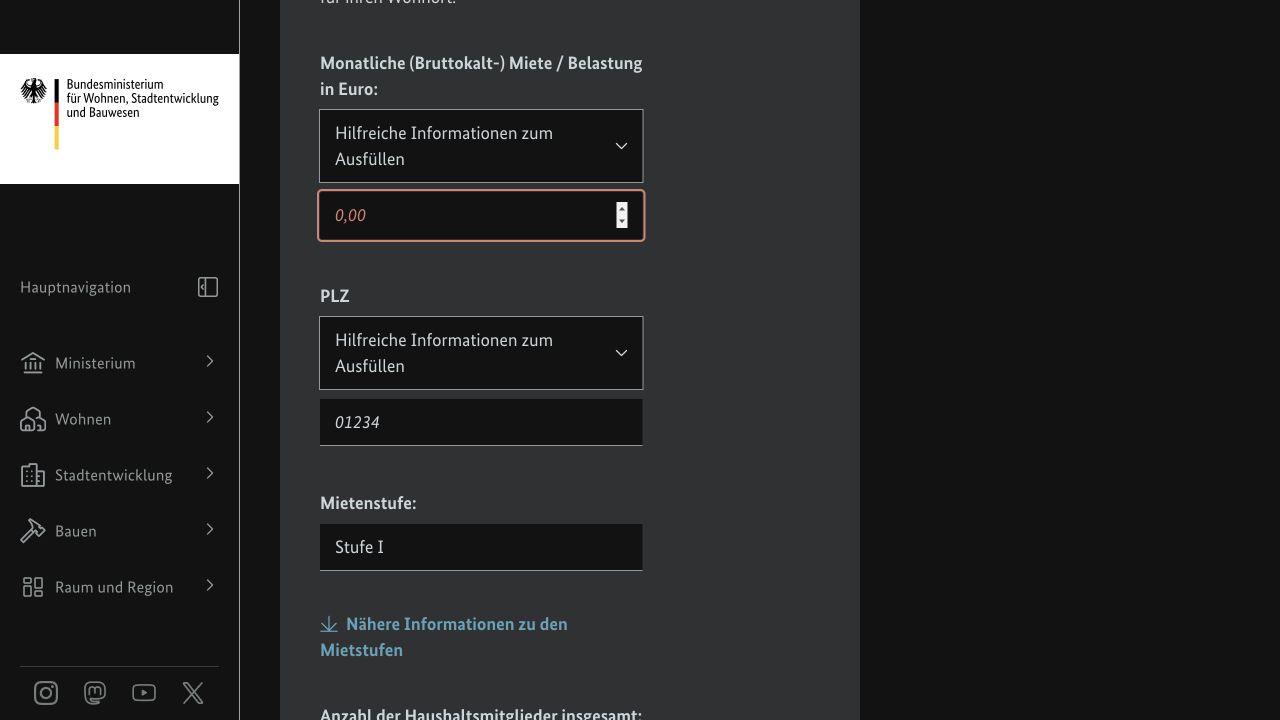
Open the BMWSB Wohngeld calculator. Its label “ab 1. Januar 2025” identifies the calculation version; it does not mean a new calculator is automatically required every year. On 3 November 2026, the ministry states that this calculator uses the current legal basis. The proposed 2027 reform is still going through parliament.
Before entering figures, prepare:
- your municipality and the correct Mietenstufe;
- the household composition, including other benefits received;
- the breakdown of rent into basic rent, non-heating charges and heating, or the relevant owner-occupier costs;
- income, relevant deductions and maintenance obligations for the people included in the calculation.
The fields for Bruttokaltmiete, postcode and Mietenstufe collect different information. A default rent level or placeholder is not confirmation of the classification for your address. Check the calculator's guidance, then complete the other household and income fields as well.
Keep a copy of the figures you entered together with the result. This makes it easier to understand any difference from the authority's calculation. Do not alter the facts to obtain a preferred amount. The result is only an estimate, not an award notice.
Where to apply in Germany's 16 federal states
Wohngeld is governed by federal legislation, but applications are handled locally. Depending on your address, the responsible office may sit within a town, municipality, district or city borough. The federal ministry does not decide individual applications. BMWSB application guidance.
| Federal state | Official starting point | How to find your application route |
|---|---|---|
| Baden-Württemberg | service-bw: apply for Wohngeld | Enter your town or postcode to find the responsible office, forms and any locally available online service. |
| Bavaria (Bayern) | BayernPortal: online Wohngeld applications | Use “Ort auswählen” to select your location. If no online process is offered, use the official form and submit it to your local Wohngeldbehörde. |
| Berlin | Service Berlin: Mietzuschuss | Apply online or through the responsible Bürgeramt/Wohnungsamt in your borough. Owner-occupiers have a separate Lastenzuschuss route. |
| Brandenburg | MIL Brandenburg: Wohngeld | Find the local offices, official forms and online-service links. Send the application to the local authority, not the ministry. |
| Bremen | City of Bremen: Wohngeld, Bremerhaven: housing benefit office | The two cities have separate authorities and procedures. Bremerhaven residents should not apply to the City of Bremen's office. |
| Hamburg | Hamburg: online Wohngeld services | Select the first-application or renewal route and Mietzuschuss or Lastenzuschuss. The page also links to paper application information. |
| Hesse (Hessen) | Hesse: Wohngeld and local offices | Select the district or city where the home is located and check that authority's details. |
| Mecklenburg-Western Pomerania | State information: Wohngeld | Follow the MV-Serviceportal link for online submission, or contact the housing benefit office in the relevant town, municipality or Amt. |
| Lower Saxony (Niedersachsen) | Lower Saxony: Wohngeld | Use the state guidance and official forms, then apply locally. You can also use the address-based search in the federal service portal. |
| North Rhine-Westphalia | Bauportal NRW: Wohngeld application | Follow the official online-service or state calculator link and select the office responsible for your home. |
| Rhineland-Palatinate | State ministry: Wohngeld | Forms and online links cover both Mietzuschuss and Lastenzuschuss. Applications go to the district administration or one of the city administrations listed. |
| Saarland | Serviceportal Saarland | Search for “Wohngeld” and enter your municipality. This is an authority finder, rather than a single application form for every locality. |
| Saxony (Sachsen) | Amt24: apply for Wohngeld | Enter your town or postcode. Since April 2026, all 30 housing benefit offices have offered online applications. |
| Saxony-Anhalt | MID Saxony-Anhalt: Wohngeld | Check the forms, online access and local responsibility. Offices operate through districts, independent cities and municipalities with more than 20,000 residents. |
| Schleswig-Holstein | State information: Wohngeld | Follow “Wohngeldbehörde im ZuFiSH”, enter the location and find your office, online process or form. |
| Thuringia (Thüringen) | Online-Verwaltung Thüringen | Search the Zuständigkeitsfinder for “Wohngeld” and add your town or postcode to find the office and available submission method. |
On a state portal, first select your town or postcode, then check the responsible office and accepted application method. A state-wide website does not mean that every municipality uses the same form. For an owner-occupied house or flat, look for Lastenzuschuss; ask the office about unusual ownership or occupancy arrangements.
When does payment start, and how can you preserve the application month?
If the conditions are already met, the award period normally starts on the first day of the month in which you apply. An application submitted in November can therefore lead to entitlement from 1 November if approved. Processing continuing into a later month does not, by itself, move that start date. If the conditions are met only later, the later month applies. Section 25(2) WoGG.
Do not postpone applying solely because one document is missing. Ask the local office how to submit a formloser Antrag, an informal application, to preserve the application month, and when to provide the full form and supporting evidence. Baden-Württemberg's service portal, for example, describes this approach. Use a submission channel accepted by the authority.
Make clear that you are applying for Wohngeld, identify the applicant, and give the housing address and contact details. Follow signature or electronic-identification requirements. Keep a copy and proof of receipt. A saved draft in a portal, a calculator result or a consultation booking is not a submitted application.
It would also be too broad to say that Wohngeld can never be awarded for an earlier period. Special start-date rules and short application deadlines can apply after certain other benefits are refused. Show such a refusal to the Wohngeldbehörde promptly and ask whether section 25(3)–(4) applies. Section 25 WoGG.
Documents to prepare
The exact requirements depend on your local office and household. Common documents include:
- the completed Mietzuschuss or Lastenzuschuss application;
- proof of identity and, where relevant, residence status;
- information about residents and household composition;
- the tenancy agreement, current rent breakdown, rent changes and evidence of payment;
- income evidence for the relevant household members, such as payslips, pension notices, self-employment records and maintenance payments;
- social benefit, BAföG or BAB decisions, including any refusal and its reason;
- evidence supporting allowances and deductions;
- bank account details.
Owner-occupiers also need documents on ownership, financing and eligible costs. The office may request further information. Berlin, for example, publishes different lists for Mietzuschuss and Lastenzuschuss. They should not be treated as exhaustive national checklists. Section 23 WoGG, section 10 WoGG.
Organise the documents into household, housing, income, benefits and correspondence. Answer requests within the stated deadline. If a document is not yet available, explain this and ask whether an extension is possible.
For help organising housing documents, discuss the task with FIRMDER. We can clarify what is available within our property support services. Reviewing a document set does not guarantee a benefit award or replace separate legal assessment of a disputed case.
After you have applied
Check the decision and award period
Review the household members, income, rent, payment amount and Bewilligungszeitraum, or award period, in the decision. The usual period is 12 months. Where circumstances are expected to remain stable, it can extend to 24 months; it can also be shortened in other cases. A further application is needed to continue receiving the benefit. Preparing it around two months before the current period ends helps avoid unnecessary gaps. Section 25 WoGG, BMWSB housing benefit FAQ.
If processing is taking a long time
Ask your office to confirm receipt, the case reference and any missing documents. If entitlement is sufficiently likely but establishing the facts will take longer, provisional payment under section 26a WoGG may be possible. This is not an automatic advance. The final calculation can differ, and overpaid amounts may have to be repaid. Section 26a WoGG.
Report changes promptly
Do not simply wait for the next renewal application if the household, income, accommodation or other benefits change. Section 27 provides for reassessment on application, among other situations, if more household members become eligible, total assessable income falls by more than 10%, or eligible rent or owner-occupier costs excluding the heating-cost component rise by more than 10%, provided this increases Wohngeld.
Certain adverse changes and notification duties use different conditions and a threshold of more than 15%. The relevant income measure must not be replaced with ordinary take-home pay. Refer to the amounts and explanatory notes in your decision. If unsure, report the actual change and ask the office to explain its effect. Moving home and the start of proceedings for a benefit that excludes Wohngeld trigger separate notification requirements. Section 27 WoGG, section 28 WoGG.
If your application is refused
First identify the reason: assessed income, household composition, another benefit, missing evidence or another exclusion. Then read the Rechtsbehelfsbelehrung, the appeal instructions at the end of the decision. It identifies the available remedy, where to lodge it and the deadline.
Depending on the applicable procedure, the route may be an administrative objection (Widerspruch) or a claim before an administrative court. A blanket instruction to submit an objection everywhere would be unsafe. Bavaria, for example, permits a choice between an objection and a direct court claim. Government of Lower Franconia: Wohngeld appeals, section 74 VwGO. Obtain timely legal advice for a specific dispute.
Frequently asked questions
Yes. Employment does not exclude housing benefit. The authority assesses household income, housing costs and the other requirements. There is no single salary ceiling for every household. Section 4 WoGG, section 19 WoGG.
This combination is possible. Kindergeld and Kinderzuschlag are not treated as income when calculating Wohngeld. Each benefit has its own eligibility rules, which must be met separately. BMWSB housing benefit FAQ.
Not necessarily. The reason for non-payment matters. An award reduced to zero because of income does not remove BAföG eligibility in principle. Other household members and whether funding is exclusively a loan also affect the assessment. Include the BAföG decision with your application. Section 20 WoGG.
No. Wohngeld is not limited to social housing. Equally, holding a WBS does not by itself establish a right to financial housing support. Baden-Württemberg Ministry of Regional Development and Housing.
Yes. Lastenzuschuss is generally available for eligible owner-occupied housing. The office calculates allowable costs and checks the remaining conditions; special ownership or occupancy arrangements may require a different classification. Section 3 WoGG, section 10 WoGG.
Processing time alone does not remove that month. If the conditions are met, the award period normally begins on the first day of the month in which a valid application was submitted. Keep proof of receipt and provide requested evidence on time. Section 25 WoGG.
Where your household can start
Collect the tenancy agreement, current income evidence and decisions on other benefits. Check household membership and each person's status, use the calculator for an initial estimate, and find the local authority through the state links above. Do not leave the application-date question until every document is perfectly organised.
If Wohngeld comes up while you are relocating, finding a flat or preparing housing documents, contact FIRMDER. Explain your location, household size and the help you need so that we can agree a possible scope of support. Entitlement, payment amount and award period are determined by the authority and cannot be promised in advance.