


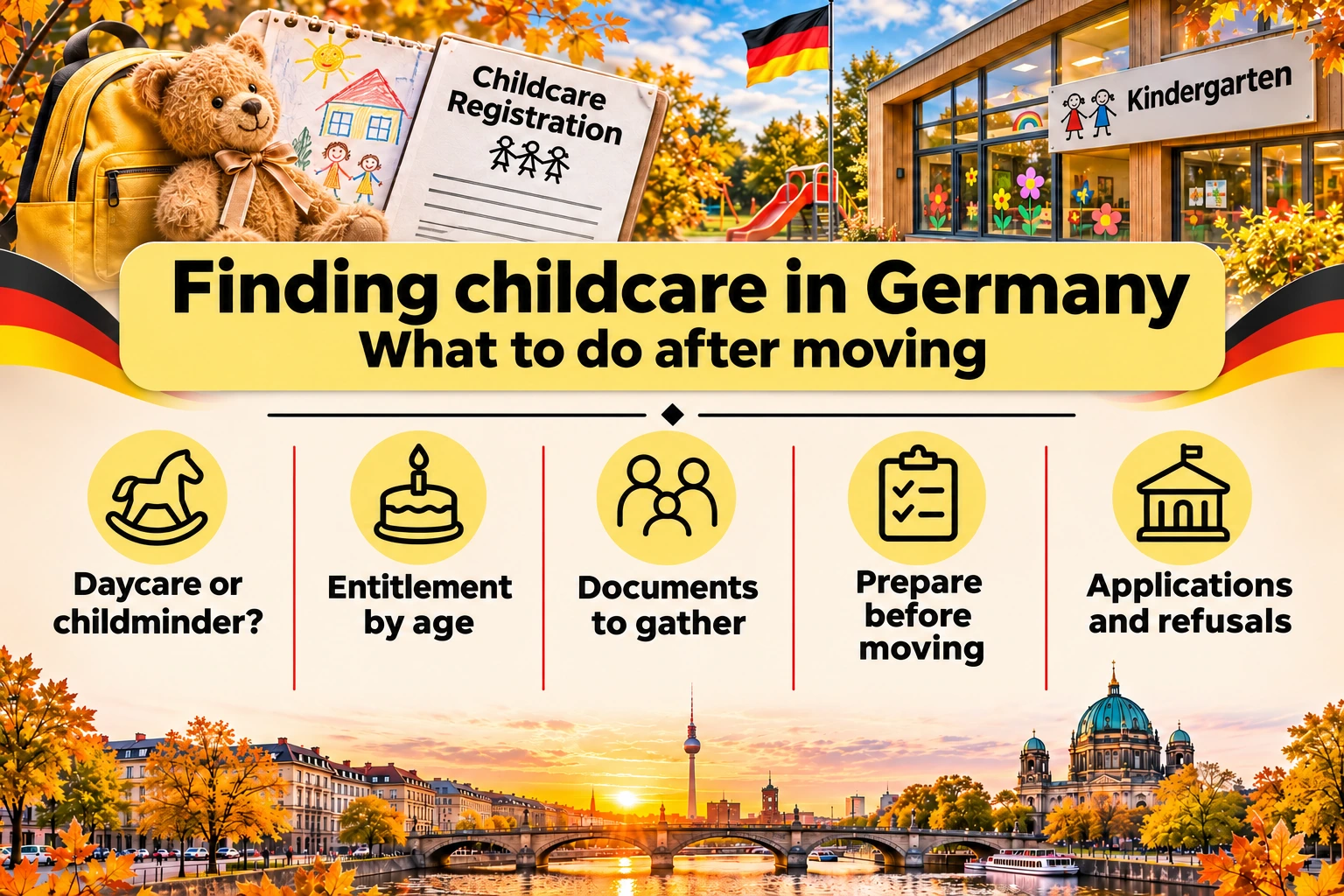
The Russian source article was checked on 7 November 2026. The main official sources cited here were checked again for this translation on 12 November 2026. This guide is for parents of preschool children who are preparing to move to Germany or have recently arrived.
Start looking for childcare once you know which town or city you will live in. First, find out how to register your child's need for care locally. Then submit the necessary applications and look for a specific place. Joining a waiting list, obtaining approval for funding and signing a contract with a nursery may be three separate stages.
Germany has neither a single waiting list covering all federal states nor a universally required set of documents. Federal law establishes the right to Betreuung: care, education and support for a child's development. The states and municipalities determine many practical arrangements, including applications, fees, funding and local portals. Instructions from friends in another city may therefore not fit your family's situation.
FIRMDER can help with the organisational preparations: finding official contacts at your future place of residence, compiling the local procedures and including the childcare search in your relocation plan. This does not guarantee a place or constitute an individual legal assessment.
Kita, Kindergarten or Tagesmutter: what to look for
Kita is a common umbrella term for a childcare centre. Krippe usually means a nursery group for children under three, while Kindergarten generally serves children from age three until they start school. Check the actual age groups and conditions with each provider: its name alone does not describe the entire service.
Kindertagespflege is another form of childcare, often provided by a Tagesmutter or Tagesvater, a childminder. It is more than simply hiring a private nanny through an advertisement. When arranged through the child and youth welfare system, it is subject to rules on authorisation and professional support. Ask the Jugendamt, the local youth welfare office, about available services, matching arrangements and funding. For a child under three, consider this option alongside nursery care from the outset, rather than only after every Kita has turned you down. Official explanation of Kindertagespflege.
Compare more than the provider's name. Consider opening hours, the journey from home, meals, the age group, languages used, the approach to settling in and cover when a carer is ill. If parents work shifts or commute a long way, standard opening hours may not be sufficient.
At what age does a child have an entitlement?
The main age-related rules are set out in section 24 of Book VIII of the Social Code (SGB VIII):
- Before the first birthday, support is available under specified conditions, for example where it is needed for the child's development or the parents work, are looking for work, are in education or receive employment integration support covered by the law. This is not an unconditional right for every infant to any chosen care arrangement.
- From the first birthday until the third birthday, a child is entitled to early childhood support in a centre or through Kindertagespflege. The age-based entitlement does not require both parents to be employed.
- From the third birthday until school starts, the entitlement is to care in a centre. Kindertagespflege may be used where there is a particular need or as supplementary care.
A childcare entitlement does not mean that a place must be available at the nursery across the street, that a particular provider must accept the child on your chosen date, or that everyone is entitled to the same full-day hours. Clarify the hours needed and how to demonstrate that need separately.
What newly arrived families should know
A German passport is not a universal condition for applying for childcare. Foreign nationals' access to support depends, among other things, on their residence status and habitual residence in Germany; special provisions and international rules may also matter. Legal basis: section 6 SGB VIII.
If you still live abroad, are staying in an initial reception facility or do not yet know your future municipality, ask the Jugendamt when it can accept an application and what information about the move is required. Do not assume that booking accommodation already proves every condition for obtaining a place.
Late resettlers (Spätaussiedler) and their family members must also follow the local application process. An Aufnahmebescheid, the admission decision under the resettlement procedure, does not replace an application for childcare. The guide to organising a family move can help with the overall relocation plan; this article focuses specifically on arranging care for a preschool child.
What to do before moving
Prepare a short summary of your childcare needs. You can use it when making enquiries to avoid missing important information:
- Your child's age on the intended starting date.
- Your future town or city, neighbourhood and address, if known.
- The expected moving date and desired start of care.
- The days and hours needed, including the parents' travel time to work or education.
- Needs relevant to care, such as accessibility or additional support.
- A working telephone number and email address for replies.
Do not send detailed medical information to many providers with your first enquiry about vacancies. Discuss what information is necessary for safe care with the chosen provider and the appropriate specialists.
You can start asking about the rules in advance. Whether you can register provisionally before completing your residential registration, Anmeldung, depends on the local system. Ask for an official answer: are applications from future residents accepted, how can you demonstrate the planned move and when must further details be supplied? Do not enter a fictitious address just to get through a form.
Start your search early. The federal Familienportal brings together regional resources. It is a starting point for research, not a single application portal for the whole of Germany: how to find a Kita place.
Finding the responsible authority and applying
Step 1: Find the official section for your town, city or district
On the municipality's or Landkreis's website, look for “Kinderbetreuung”, “Kita-Platz”, “Kindertagespflege” and “Jugendamt”. In smaller towns, the district authority may deal with some of these matters. Use the official website and the contacts it publishes, rather than a commercial service with a similar name.
Clarify four things: where to report your need for care, where to select providers, whether a separate funding application is required and how receipt of the application is confirmed. Section 24 SGB VIII requires the responsible bodies to inform parents about local childcare services and advise them on their choice.
Step 2: Register your need under the local rules
This may involve a municipal online portal, a paper form or an application to a designated local office. Sometimes selecting nurseries in a portal is a preliminary registration rather than the final allocation of a place. Do not treat an automated “data received” email as an offer.
Check whether there is a deadline for advance notification. Federal law allows states to set such rules. If the move was unexpected, explain the circumstances to the responsible authority immediately and ask what procedure applies to your situation, rather than postponing the application yourself until the next childcare year.
Step 3: Look for a specific offer in parallel
Contact providers in areas within reasonable reach. Ask whether they participate in the relevant system, have a suitable age group and how you will learn the outcome. If the portal allows several preferences, follow its rules. Submitting many identical applications does not necessarily speed up processing.
Record the provider's name, the date of your enquiry, the response and the next step. If you are told to wait for a call, ask when it would be appropriate to check the status. Update your contact details after moving: missing a message with a short response deadline could cost your family an offered place.
Step 4: Treat funding and the contract as separate matters
Hamburg is a regional example, not a nationwide rule. Hamburg uses the Kita-Gutschein, a childcare voucher. Parents apply through the responsible Bezirksamt, the district office, or the available online service, and separately find a participating nursery. The city recommends applying three to six months before the desired starting date. Kindertagespflege has a separate approval procedure. Source: Hamburg's official guidance.
Another city may have no voucher or use a different process. The document's name and the existence of an online form in Hamburg cannot be applied to the whole country.
Before signing the contract, check the starting date, hours, fees and additional charges, closure periods, termination rules, meals and settling-in arrangements. If separate funding has not yet been approved, establish what costs you would incur by signing now.
Documents to prepare
There is no single mandatory list for all of Germany. Depending on local requirements, you may need:
- details of the child and parents, a birth certificate or another document proving identity and age;
- address details and residential registration where required by the local procedure;
- documents establishing parental authority or the second legal representative's consent, if requested;
- evidence of the need for particular hours, such as a work, education or course schedule;
- income information or social benefit decisions to calculate fees and exemptions;
- the required proof of measles protection before care begins.
Do not order apostilles and certified translations of every document in advance “just in case”. Ask the actual recipient which document is needed, in what form, whether a translation is required and who may produce it. Requirements for applying and for actually starting care may differ.
Keep separate copies of submitted forms, proof of sending and a list of outstanding documents. If your address changes, ask whether the application needs to be transferred or whether you must apply again in the new municipality.
FIRMDER can help organise the list of requested documents, deadlines and communication about administrative arrangements. A doctor carries out medical assessments; individual legal questions require separate consideration by an appropriately authorised professional.
Vaccinations and proof of measles protection
Starting nursery depends on meeting the measles protection requirements, not simply having any document called a “vaccination certificate”. Under section 20 of the Infection Protection Act (IfSG), sufficient vaccination protection means at least one measles vaccination from the first birthday and at least two from the second birthday. The law also provides for medical evidence of immunity or a contraindication to vaccination, and certain confirmations that the required evidence has already been presented.
The necessary evidence must be presented before care begins. For a child who is already at least one year old, a lack of the prescribed evidence generally prevents attendance at a Kita. Promising to bring the document at some unspecified later date does not resolve this. Special rules apply to children under one and when children reach the relevant age thresholds; clarify them with the provider and a doctor.
Bring existing vaccination records from your country of origin. A doctor will assess what they demonstrate and whether further action is needed. Moving country does not, in itself, mean that your child automatically needs every vaccination repeated or a new German vaccination booklet to replace the existing documents.
Ask separately about other medical documents and local requirements. Do not equate a general vaccination recommendation with an admission condition imposed by federal law. Further information: the Federal Ministry of Health's FAQ on the Measles Protection Act.
Childcare costs and possible fee reductions
There is no uniform Kita price across Germany. Parental contributions, concessions, fee-free age groups and extra expenses depend on the state, municipality, provider and amount of care. Read a private contract carefully too: the word “private” does not tell you whether that particular nursery participates in public funding.
Ask for a written calculation separating:
- the parental contribution for care;
- meals;
- additional services and contractual charges;
- one-off expenses, if applicable.
Section 90 SGB VIII provides, on application, for a fee waiver or for the public youth welfare authority to cover a participation charge where the burden is unreasonable. The law expressly names several situations, including receipt of the relevant benefits under SGB II, benefits under Chapters Three and Four of SGB XII, benefits under sections 2 and 3 of the Asylum Seekers' Benefits Act (AsylbLG), and parents receiving Kinderzuschlag or Wohngeld.
Do not assume the concession will apply automatically as soon as another office awards a benefit. Ask where to apply, which income period is assessed and which benefit decisions to attach. Even if you do not receive any of the listed benefits, you can enquire about an assessment of the financial burden.
A waiver of the parental contribution does not automatically mean that every private childcare contract, all additional services or meals will be paid for. Ask the responsible authority whether specific support programmes apply to meals and other individual expenses. Do not choose an expensive temporary arrangement solely on the assumption that the city will reimburse everything later.
Preparing your child to start
Once a place has been offered, another stage begins: Eingewöhnung, the settling-in period. Ask the nursery to explain the process before the first day. Find out whether a parent stays, how the length of attendance increases, who decides when the child can stay longer and what happens if separation is difficult.
Do not plan to start a full work shift on the very day your child first joins the group. There is no fixed settling-in period that suits every child. Allow time to accompany your child and discuss a backup arrangement with your employer or course provider.
If your child does not yet speak German, explain which languages they understand and which words they use for basic needs. Ask how the provider helps children communicate and how parents receive important messages. Do not assume your child will definitely become fluent after a specified number of weeks.
Also agree who is authorised to collect the child, how to report illness and absence, which number to call in an emergency and how to share medically relevant information. Clarify these details before the first full day, rather than in a rush.
What to do if no place is available
Rejections from several nurseries are a reason to contact the responsible Jugendamt again, rather than simply continuing to write to providers. State the child's age, the date and hours needed, list the options already explored and ask for help finding a suitable offer.
Keep confirmation of your application and the responses. Distinguish between a telephone statement that “nothing is available yet”, an alternative offer and an official decision. Request a written explanation of the application's status, outstanding documents and possible next steps. For children under three, specifically discuss Kindertagespflege.
If an offer is unsuitable, explain why in concrete terms: for example, its hours do not cover the registered need, or the child has needs the provider cannot accommodate. Preferring another educational approach is different from being objectively unable to use the proposed service.
If a dispute continues, obtaining an individual legal assessment may be worthwhile. An entitlement to a place does not justify promising a court outcome, a processing time, reimbursement of private care or compensation for lost earnings in advance. Check the conditions for your particular situation before incurring significant costs.
Frequently asked questions
You can start searching and ask about the rules in advance. The local procedure determines whether future residents can formally register and which evidence of the move is required. You need not wait without information, but a preliminary email is not a guaranteed place.
That blanket statement is incorrect. Section 24 SGB VIII provides age-based entitlements for children aged one to under three and from three until school starts. Conditions for children under one and for determining the necessary number of hours must be checked separately.
A lack of German cannot automatically be treated as a lack of childcare entitlement. However, admission to a particular provider and the available offer need separate consideration. Discuss support for your child and how the provider will communicate with you.
Not always in the way parents expect. It may be only a preliminary list of preferences. Read the confirmation and establish whether the need has been officially registered, whether another form is required and who makes the decision.
Finding and arranging a place is part of the local childcare system. Ask your municipality or district about the procedure. Documents from the admission process under the BVFG do not replace a municipal childcare application.
For a child aged one or older, this is generally not an acceptable plan. Check the requirements in advance with the provider and a doctor. A medical contraindication must be documented in the prescribed way; a parent's explanation alone is insufficient.
For children aged one to under three, federal law provides for both forms of care. Find a suitable service through the Jugendamt and clarify funding, the contract and cover if the childminder is unavailable. From age three, the legal structure of the entitlement is different.
Contact the newly responsible authority and check what happens to the existing application, funding and contract. Do not assume that your waiting-list position or previous fee will transfer automatically.
A short plan for your family
First establish your municipality and the hours needed. Then confirm the local application procedure, submit the necessary requests and look for a specific place. Before attendance begins, check the contract, costs, medical evidence and settling-in arrangements. If no place is available, contact the responsible public authority with the record of your search.
FIRMDER helps include childcare in the overall organisational plan for relocation, coordinating the housing search, local applications and document preparation. You can discuss this assistance through the family relocation planning page. The responsible providers and authorities decide on places and funding; an outcome is not guaranteed.
Main sources
Russian original checked: 7 November 2026. Main sources checked again for this translation: 12 November 2026. Before applying, also check your municipality's official procedure.
- Section 24 SGB VIII: entitlement to care and advice.
- Section 6 SGB VIII: scope of application.
- Section 90 SGB VIII: fees and waivers.
- Section 20 IfSG: proof of measles protection.
- Familienportal: finding a Kita place.
- Familienportal: Kindertagespflege.
- Hamburg: Kita-Gutschein, a regional example only.
This is general information on organising childcare, not individual legal or medical advice.