Information current as of 22 October 2026.
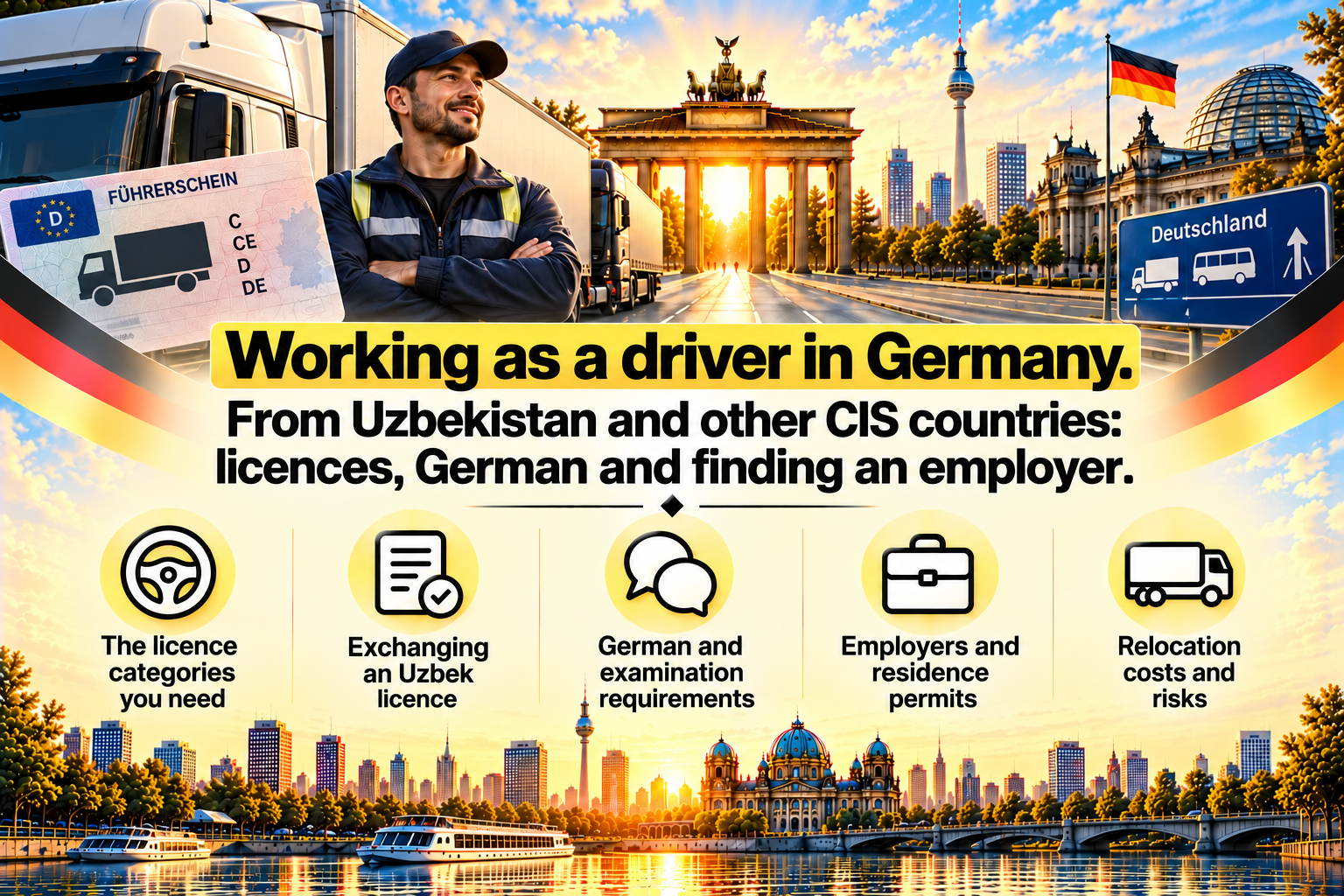
If you drive a truck or bus in Uzbekistan and want to work in Germany, what matters first: German, a European driving licence or an employer willing to support the paperwork? You need all the parts of the route to fit together. A job offer does not replace permission to drive, and a national licence does not automatically let you start driving for a German transport company.
You do not necessarily need to hold all the European documents before moving. Germany has a special route for professional drivers from third countries, including arrangements for obtaining missing qualifications in Germany. It requires a prepared applicant and a specific employer, however. It is not an offer to “arrive without the language or the right licence and learn everything afterwards”.
This guide explains when to start looking for an employer, which costs and deadlines to plan for, and why driving jobs advertised without meaningful requirements deserve careful scrutiny.
Three separate requirements for working as a driver
For ordinary truck or bus driving work at a German transport company, check three things separately:
- The right to live and work in Germany: the appropriate visa and residence permission, or an existing right to work.
- Permission to drive the vehicle: a valid, recognised driving licence for the vehicle or vehicle combination concerned.
- Professional driver qualification: the required training and evidence where the activity falls within the relevant rules.
Having one does not create the others. Permission to stay for a qualification programme does not mean that you can already carry passengers independently. Equally, a European driving licence does not itself give you permission to work in Germany.
The special immigration route is based on section 19c(1) of the Residence Act (AufenthG) together with section 24a of the Employment Ordinance (BeschV). It is distinct from other work immigration routes involving recognition of a foreign vocational qualification.
Which licence categories do trucks and buses require?
The relevant category depends on the vehicle and any trailer you will drive.
| Work | Main German categories |
|---|---|
| Truck over 3.5 tonnes | C; C1 for the restricted weight range |
| Truck with a heavy trailer or articulated vehicle | CE; C1E for the corresponding restricted combinations |
| Bus with more than eight passenger seats, excluding the driver | D; D1 where seating capacity and vehicle length are restricted |
| Bus with a trailer over 750 kg | DE, or D1E for the relevant combination |
The precise limits are in section 6 of the Driving Licence Ordinance (FeV). Category B alone does not permit you to drive a standard heavy articulated truck or large passenger bus.
When contacting an employer, do not simply say that you have a licence. Give its issuing country, categories, the date each category was obtained, expiry dates and restrictions. If you obtained C many years ago but CE only recently, show those dates separately.
Also distinguish international journeys for a foreign transport company from employment with a German company. Different residence and transport rules may apply. Having driven into Germany before does not prove that your documents are sufficient for a permanent job there.
Uzbek driving licences and the rules for other CIS countries
An Uzbek licence is an important starting qualification, but it is not a complete set of documents for a German transport employer. It can provide the basis for obtaining a German licence. Uzbekistan is not, however, in the current Annex 11 FeV list of countries whose licences benefit from test exemptions.
For an ordinary exchange of an Uzbek licence, expect both a theory test and a practical test. This does not necessarily mean completing a full driving school course from scratch. Section 31 FeV exempts the relevant holders of foreign licences from the prescribed training requirements. Preparatory lessons may still be necessary, particularly before the practical test.
There is no single rule for “all CIS licences”. The country that issued the licence matters, not just the driver's citizenship.
| Issuing country | What to expect for an ordinary exchange |
|---|---|
| Uzbekistan, Kazakhstan, Kyrgyzstan, Tajikistan, Russia and Belarus | These countries are not listed in Annex 11; both tests are normally required. |
| Moldova | For the listed categories, including C/CE and D/DE, the theory test is waived but the practical test is required. |
| Ukraine | The current Annex 11 lists categories exempt from both tests, subject to its specific notes. |
For Ukrainian truck and bus categories, medical fitness and eyesight requirements still apply. If C or D was issued without B, obtaining B needs separate examination under the relevant note. This is an overview of licence exchange, not a description of every temporary rule for people receiving protection. See the current Annex 11 FeV.
The validity of foreign licences and the circumstances in which they were issued are also checked. A “quick European licence” bought through an intermediary does not become lawful simply because a plastic card exists. An international driving permit does not replace the national licence, professional qualification or permission to work.
Unsure where to start with your particular licence? Contact FIRMDER. We can review your categories, experience and missing steps before you spend money on relocating.
Code 95 and the Fahrerqualifizierungsnachweis
Being able to operate a truck and being qualified for professional transport are separate matters. Job advertisements often refer to the latter requirement as “Code 95”.
Germany uses the Fahrerqualifizierungsnachweis, or FQN, as evidence of driver qualification. The law also recognises equivalent evidence, including an appropriate European document or a Code 95 entry issued by the authorised body. The accepted forms of evidence are set out in section 7 BKrFQG.
Check the document's validity, the type of transport it covers and the basis on which it was issued. A private training certificate with an impressive name is not necessarily recognised evidence.
One qualification route is accelerated initial qualification. The standard course consists of 140 teaching units of 60 minutes, followed by an examination. Other routes and specific shortened programmes exist, so the same course should not be prescribed for every applicant. See section 2 BKrFQV.
The date on which you first obtained the category is especially important. Certain passenger categories issued before 10 September 2008 and goods vehicle categories issued before 10 September 2009 benefit from acquired rights without a new initial qualification. Periodic training is still required. You must substantiate the equivalent category and its date; years of experience alone do not establish eligibility. See section 4 BKrFQG.
Periodic training is generally required every five years. Long experience does not remove this obligation, and training may be needed before returning to the profession after a break. See section 5 BKrFQG.
Can you move before obtaining a European licence?
Yes, there is a route for obtaining missing permissions in Germany, but an employer's invitation alone is not enough.
Under section 24a(2) BeschV, the employment contract must require participation in the necessary qualification measures. Working conditions must allow you to obtain the driving licence, qualification and required documents within 15 months. There must then be a specific driving job with the same employer. You must already hold the relevant professional driving licence from your country of origin.
Approval is granted for up to 15 months. In a justified individual case, an extension of up to six additional months is possible. Do not treat that extension as a guaranteed buffer in your plan. See section 24a BeschV.
You cannot work as a professional driver under this programme before obtaining the necessary permissions. During preparation, the contract may provide for other work, for example in a warehouse or workshop. That work must fit around qualification rather than displace it. The official Make it in Germany employer guidance describes this option.
Before signing, ask where the school is, when training starts, who organises tests, how much time is available for learning and how you will support yourself. If the answer is “we will sort it out after you arrive”, the plan is not ready.
This route is not a promise to train someone with no relevant licence from the beginning. Vocational training, or first obtaining the category and experience at home, may be worth considering. Those are separate strategies with their own requirements.

Six months and 15 months: why the rules do not contradict each other
Six months is the general period for continuing to use a third-country licence after establishing normal residence in Germany. Exceptions and special arrangements exist. The period does not itself authorise every form of commercial work. See section 29 FeV.
15 months is the period for the qualification route under employment rules. It does not automatically extend the validity of your foreign licence for driving.
You cannot therefore assume that being given 15 months to obtain documents means you can work on an Uzbek licence throughout that period. Equally, reaching the end of six months does not automatically prevent you from completing a lawful qualification programme. Each deadline governs a different issue.
Keep separate dates for the start of normal residence, expiry of driving documents, visa and permitted employment, examinations and issue of new evidence. Applying for an exchange is not the same as receiving permission to drive.
German: the law, examinations and the employer
There is no honest single answer to “Can I work without German?” that applies to every vacancy.
No blanket B1 requirement for this special immigration route
Official explanations of the reform state that proof of language proficiency is no longer a general requirement for this particular professional driver route. That does not mean every contract without German will be accepted without questions. The purpose of the stay and the qualification plan must be credible. See Make it in Germany's reform guidance.
Applicants in Uzbekistan should note a practical inconsistency: the Tashkent embassy checklist dated 9 January 2023 still mentioned B1 when checked. It is an older checklist and should not be presented without qualification as a current universal threshold. Before applying, compare the latest instructions for your specific route and ask the responsible office to clarify any conflicting document requirements.
A significant change in 2026: taking the qualification examination in Russian
The current section 2 BKrFQV permits the accelerated initial qualification examination in German and nine additional languages, including Russian and Ukrainian. Uzbek is not on the list. This concerns the professional qualification examination; it does not abolish other tests or all language challenges.
IHK Berlin already lists the additional languages for its October 2026 examinations. Invitations, administration and examination instructions remain in German. Check availability, location and registration arrangements with the responsible chamber of commerce and industry, or IHK. You should not assume any language will be available at every location on any date.
Language still matters in everyday work
Drivers receive instructions, report faults and communicate during loading, roadside inspections and emergencies. Even a Russian-speaking dispatcher cannot always be there to assist.
Bus work adds passenger questions, route changes, conflict situations and assistance for people who need help finding their way. Planning to work with passengers without any German is particularly risky.
A useful preparation goal is confident everyday communication plus the language needed in driving situations. B1 can be a sensible target, but that is not a claim that the law requires B1 for every job. Employers may assess the level their operations require and choose applicants who can work safely.
Why would an employer recruit a driver from outside the EU?
Think from the transport company's perspective. It needs someone who can start within a foreseeable period, complete the work and stay long enough for the investment in preparation to make sense.
Recruiting from Uzbekistan may involve visa waiting times, organising training, obtaining documents and helping with accommodation and adjustment. Hiring a locally available driver with all the permissions and labour market access may be easier.
This is an economic consideration, not a claim that Uzbek citizens are not hired. Nor is it a mandatory legal preference for EU citizens: official guidance says the priority check has been removed for this route. Employers still decide which applicants they are prepared to invest in.
No language, experience or relevant category? Your position is currently weak. Building a professional foundation is more sensible than paying for a promise of immediate driving work.
A valid CE category, documented experience, a clear specialism and willingness to learn? That is a profile an employer can discuss meaningfully. German, experience with the required vehicle type and well-organised documents strengthen your application, even if some German permissions still need to be obtained.
A strong application explains which vehicles you drove, what loads you carried, whether you worked internationally, when you last drove professionally, and your availability for shifts and specific regions. Verifiable descriptions of recent employers and duties are more useful than simply “15 years' experience”.
FIRMDER can help find an employer for suitably qualified applicants. Send us a description of your experience so we can identify relevant vacancies and the preparation needed. Employer matching is not a guarantee of employment or a visa.
Where to look and what to ask immediately
Start with the Federal Employment Agency's Jobsuche and transport companies' own careers pages. Useful German search terms include Berufskraftfahrer, Lkw-Fahrer, CE-Fahrer, Busfahrer and Omnibusfahrer. Add Qualifizierung or § 24a BeschV when looking for qualification programmes.
A vacancy does not establish that the company recruits from abroad. In your first message, state that you are in Uzbekistan, list your documents and ask whether the company considers applicants who need a visa and qualification programme.
- Who will employ you directly, and where is the actual workplace?
- Will you start as a driver immediately, or with training and another type of work?
- Which licence category and qualification evidence must be in place before driving starts?
- Which language is required for the interview, training and daily work?
- Who organises and pays for each stage?
“Quereinsteiger willkommen”, meaning career changers are welcome, does not mean “applicants from any country without a licence accepted”. The advertisement may target people who already live in Germany and have permission to work. Ask for a written description of the route that applies to you.
Our guide to the German work visa explains the general immigration procedure. Drivers must also check the transport-specific permissions.
Money, the contract and warning signs
Prepare two budgets: the amount needed before your first salary and the amount left each month after essential expenses. Do not compare offers only by the largest figure in the advertisement.
Ask for gross salary, guaranteed hours, overtime pay and allowances to be shown separately. Daily allowances and expense reimbursements should not automatically be treated as fixed salary. Take-home pay depends on personal circumstances; the same gross salary does not give everyone the same net amount.
For initial employment approval under this route, a salary or pension provision requirement is examined separately where employment starts after reaching age 45. For 2026, the official portal specifies at least EUR 55,770 gross per year or adequate pension provision. The law allows certain exceptions. This is a special eligibility condition, not a promise of that salary to every driver. See section 1(2) BeschV and the Make it in Germany explanation.
For a qualification programme, separately record pay during preparation and the costs of school, tests and retakes, translations, medical examinations, accommodation and travel. If the employer pays for training, read any repayment clause that applies if you leave. Have unclear obligations checked before signing rather than after moving.
Plan for difficult situations too: a failed test, a postponed course or documents taking longer to arrive. Who pays for housing? What work remains permitted? What happens to the contract? “That never happens” is not a contractual arrangement.
Be particularly cautious if you are asked to:
- pay for a “guaranteed visa” without seeing the employer and contract;
- enter as a tourist and start ordinary employment immediately;
- buy Code 95 without a lawful basis or document verification;
- hide a missing category or invent experience;
- sign documents with blank sections;
- hand your original passport to an intermediary for an indefinite period.
Insurance before employment begins is another separate issue. The policy must fit the purpose and duration of your stay. Ordinary travel insurance is not always suitable for relocation. Review insurance for the visa in advance instead of assuming any inexpensive policy will be sufficient.
What to prepare for an initial assessment
Begin with a structured description rather than sending all your personal documents to unknown intermediaries:
- citizenship and country of lawful residence;
- age and intended relocation date;
- licence issuing country, categories, issue dates and expiry dates;
- experience with trucks, trailers and buses listed separately;
- any European licence, FQN or Code 95;
- German level and other working languages;
- willingness to train, work shifts and move to a specific region;
- any job offer and budget for the preparation period.
The initial review can establish which supporting documents are actually needed and how to send them securely. Do not buy an expensive translation package based on a generic checklist before finding out who will assess the documents and what they require.
Frequently asked questions
The absence of a general language certificate requirement under the special route does not guarantee a job without German. You need an employer who accepts your level, realistic preparation and the ability to work safely. Check the embassy's older B1 checklist against current instructions.
It is important for assessing your application. It is not enough on its own for independent driving at a German transport company. Driving permission, professional qualification and permission to work must all be checked.
No. B does not replace D. The section 24a(2) qualification route assumes that you already hold the relevant licence from your country of origin. Training for the profession from scratch requires a separate plan.
Yes. Current rules permit Russian for the accelerated initial qualification examination. Check your IHK's arrangements before registering. This does not mean that the entire course, practical driving test and subsequent job will automatically be available in Russian.
There is no universal guarantee. The six-month foreign licence rule and 15-month qualification route govern different matters. Your actual schedule depends on documents, training, tests and administrative processing.
No. The employer makes the hiring decision; the competent authorities decide on the visa and permissions. Well-prepared documents help with the procedure but do not replace its requirements.
Where to start
Treat moving to Germany as a driver as a professional project. Establish your starting point: licence categories, experience, language and valid documents. Then find an employer whose needs match your profile and agree a concrete qualification plan. A promise to arrange everything after arrival is too expensive to test through experience.
If you have a driving qualification and are ready to work in Germany, contact FIRMDER. We can help find a suitable employer, review the paperwork and prepare for the visa procedure. We begin with a realistic assessment of your experience and options, without promising employment, permission to drive or a visa regardless of the requirements.