


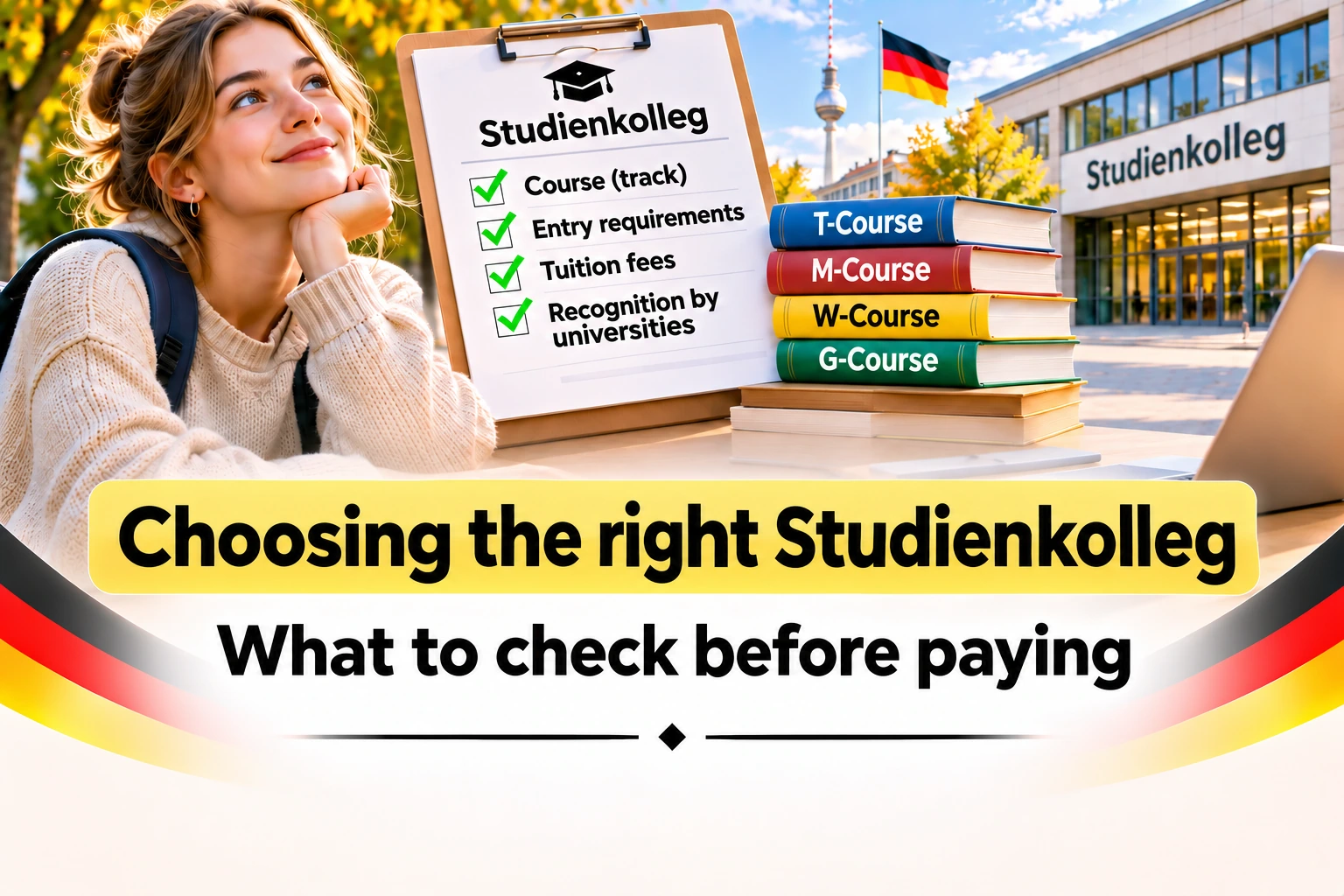
Assess a preparatory year in Germany by the degree programmes it can lead to. A convenient city, small group and clear contract matter. First, however, establish whether the programme fits your education, which examination it prepares you for and whether your chosen university accepts the result.
The mistake may not become apparent when you pay. Sometimes a student finishes a course successfully and only then discovers that the award is the training centre’s own certificate, that they must independently apply for an external Feststellungsprüfung, or that the final qualification does not suit their intended subject.
Before the first payment, obtain evidence for the entire sequence: your educational documents → the appropriate Studienkolleg subject course → admission to a specific FSP → eligibility to apply for your chosen degree. Do not replace any stage with a promise that “our graduates are accepted everywhere”.
We explain what to ask the preparatory institution and intended university, what to check in the study terms and how to compare public and private options. The Russian source was checked on 16 October 2026; confirm the requirements of the particular intake before applying.
- First check whether you need Studienkolleg
- Start with your intended degree
- Public or private Studienkolleg
- Internal and external FSP
- Choosing the subject course
- Recognition and university admission
- German and entrance selection
- Applications and calendar
- The full cost of your route
- Visa checks
- Checklist before the first payment
- Three hypothetical examples
- Frequently asked questions
- Making a decision
First check whether you need Studienkolleg
Studienkolleg prepares international applicants for German higher education. It usually applies where existing education does not give direct access to the intended degree but permits a preparatory programme followed by the Feststellungsprüfung, or FSP. Preparation typically lasts two semesters; ask the provider about its precise duration and any shortening conditions. TU Berlin overview.
The key term is Hochschulzugangsberechtigung, HZB: the educational basis for access to higher education. It depends on the issuing country, type and year of qualification and sometimes on subjects studied, entrance examinations and successfully completed university study. Assessment rules are published in anabin, with ZAB recommendations forming the recognition basis. KMK explanation of access with foreign education.
Start with three tools:
- The DAAD admission database helps with a preliminary assessment of your educational route.
- The anabin school qualification section provides country and qualification information.
- The uni-assist admission checker helps identify conditions that may apply.
A self-check is not an admission decision. uni-assist expressly describes its database as guidance. The final procedure depends on the selected institution and competent body.
Do not draw conclusions from nationality or a friend’s experience. Two graduates from one country may have different documents, subjects and prior studies. Disclose previous university attendance: it may change your eligibility. There is no universal rule that one year at any university always replaces Studienkolleg.
Start with your intended degree
Make a shortlist of specific bachelor’s or Staatsexamen programmes. For each, record the institution, subject, language, institution type and HZB requirements.
Then ask admissions whether the proposed FSP is suitable given your original education. A useful answer requires the examination organiser, subject course, FSP language and your educational documents. Where disputed, ask which official assessment procedure applies.
Hochschule means a higher education institution and does not always reveal its type. A university-type Studienkolleg generally opens the relevant subjects at both Universität and Fachhochschule. Preparation for a Fachhochschule, often called a Hochschule für angewandte Wissenschaften, generally does not provide equivalent Universität access. TI-Kurs and T-Kurs are therefore not interchangeable merely because subjects overlap. Studienkolleg association explanation.
Keep the future university’s reply with its admission rules. Recheck if you later change the subject or institution.
Public or private Studienkolleg
Ownership helps explain organisation and cost but does not answer every question about the qualification obtained.
Public Studienkollegs offer a state-recognised final qualification. Some private institutions also offer a recognised final examination. Other programmes prepare students for an external FSP at a different institution. DAAD recommends checking the qualification’s status and acceptance by the intended university beforehand. DAAD advice on choosing Studienkolleg.
Ask a private provider for:
- the contracting party’s full legal name;
- the programme name and final document;
- details of the institution conducting the FSP;
- current examination rules and evidence of the claimed status;
- an explanation of which examination-registration tasks the service includes.
Labels such as “accredited”, “university-affiliated” or “partner programme” need explanation. What exactly is recognised: the institution, programme or examination? Which body confirmed it? University cooperation alone does not define every graduate’s rights.
Do not automatically reject private options. Timing, teaching organisation and study support may suit you. Compare the documented educational route and contract, not just the advertised annual price.
Internal and external FSP
Distinguish teaching, the centre’s own final assessment and an official Feststellungsprüfung.
An internal FSP usually means an examination within a Studienkolleg authorised to conduct it. However, advertising an “internal examination” can also mean an ordinary provider test. Ask for the final document’s full title and an anonymised example.
An external FSP is taken without attending the normal course at the examining Studienkolleg. Preparation may be independent or with another provider. Admission to this examination is governed separately: paying for preparation does not replace the examination board’s approval.
For example, TU Darmstadt’s external FSP requires conditional confirmation of a place from one of the listed institutions, C1 German and planning one semester ahead. These are the specific conditions of one institution. External FSP at TU Darmstadt.
Studienkolleg Hamburg requires ordinary external candidates to have their main residence in Hamburg and provide C1 evidence, among other conditions. Separate qualifications apply to former students. Therefore, “I can always take it in another city later” must be checked in advance. Hamburg external examination conditions.
Ask what happens if you finish preparation but are not admitted to the next FSP. Who helps resolve the issue, when is the next date and what extra costs arise?
Choosing the subject course
The course determines the subject areas for which you prepare. The common university scheme uses:
- T-Kurs: technical, mathematical and natural science subjects;
- M-Kurs: medical, biological and pharmaceutical subjects;
- W-Kurs: economics and social sciences;
- G-Kurs: humanities and German studies;
- S-Kurs: language subjects.
For Fachhochschule, TI covers technical and engineering programmes, WW economics, GD creative and artistic subjects, and SW social subjects. These labels and general mappings appear on the Studienkolleg association website.
The labels help build an initial shortlist, but the selected programme’s admission rules are decisive. Check interdisciplinary subjects particularly carefully. The title “business informatics” alone cannot reliably establish which course a specific institution accepts.
Check restrictions arising from your prior education too. Being able to pay for W-Kurs does not mean that course is permitted for your educational history. TU Berlin expressly links available course selection to foreign educational documents. TU Berlin Studienkolleg applicant conditions.
Recognition and university admission
Passing the FSP allows you to apply within the relevant subject range and institution type. A place on a specific programme also depends on selection rules and other conditions. Confusing these stages is especially risky when planning medicine: Charité expressly warns that passing the FSP does not guarantee admission to the desired programme. Charité information.
Check the federal state, language and special examination conditions. For example, Saxony’s current regulations permit English-language preparation and FSP in T and W. Admission to an English-language Studienkolleg in Saxony also requires German at A2. The regulations separately address access to English-language programmes in Saxony after that FSP and additional German evidence for German-taught study. This is a reason to ask the receiving university, not to promise identical outcomes in every state. Saxony FSPVO, Sections 1–3.
If a provider offers guaranteed progression to a partner, establish the degree name, required grade, language conditions, offer validity and future tuition costs. Assess the offer only within its precise limits.
German and entrance selection
Language levels for application, entrance-test formats and final examination requirements vary. Even the same B2 label does not mean any language-school certificate will be accepted.
For example, Studienkolleg Hamburg publishes accepted B2-and-above certificates, age limits for certificates and an express exclusion of vocational language certificates. Hamburg application language documents.
Before paying, check four things: which certificate, by what date, which examination components count and whether a separate entrance test is needed. Request a sample-task link. Preparing for a language certificate and for a Studienkolleg test may require different study plans.
An eventual English-taught bachelor’s degree does not automatically waive German during preparation. Clarify “we accept complete beginners”: the initial product may be a language course followed by a separate application and selection process.
Applications and calendar
Applications may go through a university, directly to Studienkolleg or through uni-assist. A university’s use of uni-assist does not mean it handles every preparatory programme. Studienkolleg deadlines are often earlier than ordinary university deadlines. uni-assist application guidance.
Create a calendar with separate dates for the language certificate, education documents, translations, application, entrance test, visa steps, teaching start and future FSP. Include when FSP results become available for the next university application.
For example, Studienkolleg Hamburg publishes applications for its ordinary course from 1 July to 1 September for the following summer semester, whose classes begin in January. The external FSP has a different calendar. Do not transfer these dates to other institutions. Current Studienkolleg Hamburg dates.
If a VPD is required, clarify the next step: under this procedure, you normally submit the uni-assist document to the university yourself; the application is not forwarded automatically. uni-assist explanation of VPD and assessment results.
The full cost of your route
Public Studienkollegs normally charge no tuition, though semester contributions and other costs may apply. Private programmes set their own fees. Request an exact estimate for your intake. General Studienkolleg cost information.
Compare at least five expense categories:
- Preparatory language classes and the programme itself.
- Registration, entrance tests, FSP and any resit.
- Translation, certification and document delivery.
- Accommodation, deposit, insurance, transport and daily living.
- Additional living costs if there is a gap between stages.
Request the complete mandatory fee total and payment schedule. Separately ask what is refunded after visa refusal, intake postponement, a failed entrance test or refusal of FSP admission. If a refund depends on an official document and a request deadline, know this before transferring funds.
Do not equate proof of financial means with tuition payment. These are separate questions for the visa process and the training contract. A compulsory course prepayment may reduce available funds but does not remove other financial requirements.
Visa checks
A preparatory-course acceptance letter, entrance-test invitation and university admission have different content. Present the proposed document in your visa procedure and clarify which evidence your situation requires.
The government portal states that study residence under Section 16b AufenthG may include preparatory measures such as Studienkolleg. Evidence of purpose, financial means and other conditions are nevertheless assessed separately. Official study visa information.
Before buying tickets, check the responsible German mission’s requirements and whether the course start can be deferred. Translate a school’s “visa help” promise into a specific service list. The competent authority decides the visa.
Checklist before the first payment
Keep answers and documents in one folder. Each item needs a source, not merely an oral agreement.
- Do my documents and previous studies require Studienkolleg?
- Do they permit the chosen subject course?
- Which exact degrees and universities am I considering after FSP?
- Does the final qualification provide Universität or Fachhochschule access?
- Who contracts with me and receives payment?
- Who conducts the FSP and issues the final document?
- What establishes the examination’s claimed status?
- Am I studying at the examining institution or applying externally?
- Who submits the FSP application, and what admission restrictions apply?
- Which language certificate is needed at each stage?
- Does the course calendar fit the FSP and next university application?
- What is included and what do compulsory extras cost?
- What postponement, termination and refund terms are in the contract?
- What changes if I fail or am not admitted to the examination?
- Which visa document will I receive, and does it fit my intended residence purpose?
Be particularly careful about requests to pay “today” before the examination organiser is identified. Uncertainty does not prove dishonesty, but it means the decision cannot yet be properly assessed. Ask for time to read the contract and independent confirmation of material promises.
Three hypothetical examples
These examples illustrate the checks and are not real client stories.
A future engineer chooses the city before the university. An applicant finds a convenient TI-Kurs while planning a particular Universität degree. Before paying, they check the final access type and university requirements. The suitable option may be in another city or use a different course.
Preparation is paid for, but the external examination is not arranged. A provider promises teaching and FSP assistance. The contract reveals that assistance means advice only; the student submits the application. Before paying, check the examination centre’s conditions and whether the next date is realistic. Otherwise, an unplanned gap enters the budget.
M-Kurs is treated as a guaranteed medical place. A family considers only entry to preparation. A complete plan must also cover the chosen medical programmes’ requirements, subsequent selection and alternatives. Completing preparation is an important achievement, but the next stage is assessed separately.
Frequently asked questions
Educational and financial risks cannot be eliminated entirely. Check programme suitability, the FSP organiser’s authority, your own examination eligibility and contractual terms. Reviews help assess teaching organisation but do not replace these confirmations.
No. Clarify the examination name, conducting institution, admission rules and final document. If teaching and examination are at different organisations, obtain information from both.
Many recognised FSP qualifications have broader use, but the subject course, institution type and specific document conditions matter. To preserve choice, check several future programmes before starting preparation.
Some cases allow an Ergänzungsprüfung, a supplementary examination expanding accessible subjects. Ask the receiving institution about conditions. Do not assume this is an automatically available backup. Charité explanation of supplementary examinations.
Assess the actual contracted tasks: document checks, option selection, calendar and application support. The service cannot replace institutions’ decisions. uni-assist expressly warns that it does not cooperate with commercial student placement agencies; its official website is uni-assist.de. uni-assist warning.
Making a decision
A suitable Studienkolleg connects your existing education with a specific study objective. Once the course, examination, subsequent eligibility, timing and costs are confirmed, compare the remaining options by teaching quality and living conditions.
If you need help checking the educational route, you can discuss admission preparation with FIRMDER. Bring education documents, German-language details, desired programmes and the Studienkolleg offer. The support scope is agreed separately; the relevant institutions and authorities decide examination eligibility, university admission and the visa.